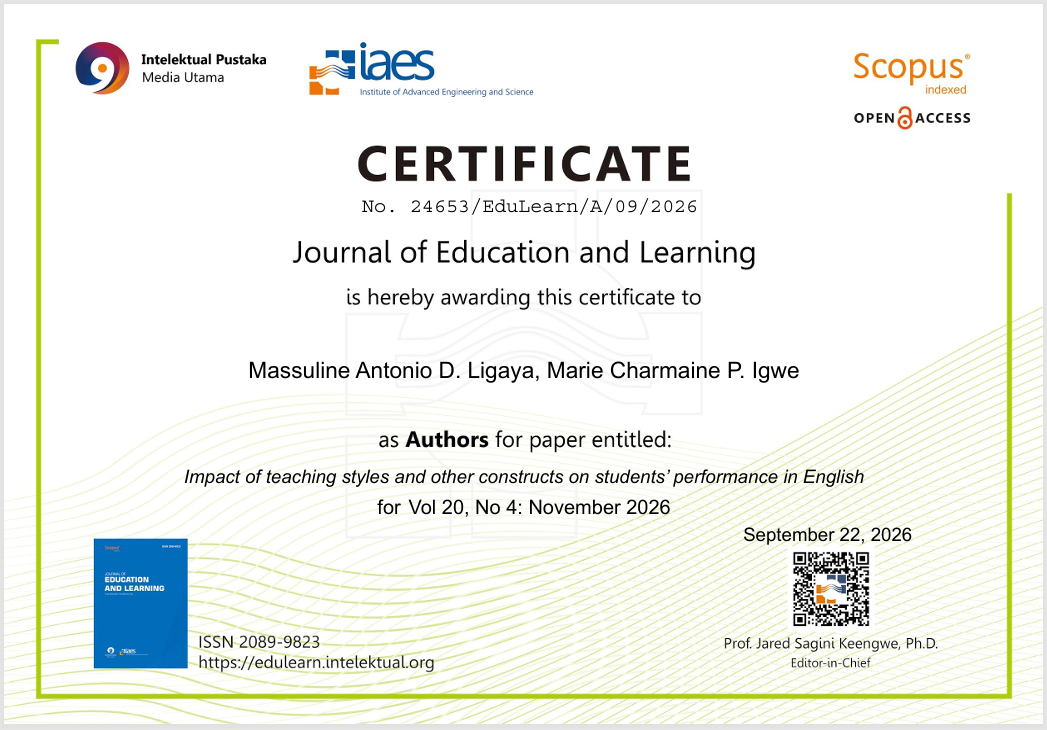
Impact of Teaching Styles and Other Constructs on Students’ Performance in English
A research paper published in a Scopus-indexed journal

Massuline Antonio D. Ligaya and Marie Charmaine P. Igwe
Journal of Education and Learning (EduLearn)
Vol. 20, No. 4, November 2026, pp. 2321~2335
ISSN: 2089-9823, DOI: 10.11591/edulearn.v20i4.24653
Research Summary
This study examined how teaching styles and selected teacher- and student-related factors are associated with university students’ performance in English. Specifically, it investigated the relationship between teachers’ teaching styles and students’ English performance, the moderating role of teachers’ leadership behavior, and the mediating roles of students’ motivation to learn English and grit.
The participants were 385 students and 22 foreign English teachers from a university in South Korea. The students assessed their teachers’ teaching styles and leadership behaviors and reported their own motivation and grit. Their English proficiency was measured using a 25-item test covering vocabulary, correct grammar form, answering questions, sentence combination, and word sequencing. The data were analyzed through descriptive statistics, correlation, regression, moderation, and mediation analyses.
The students were found to be moderately proficient in English. They demonstrated high motivation to learn the language, with integrative motivation exceeding instrumental motivation, while their level of grit was moderate. Teachers frequently exhibited all four dimensions of teaching style and demonstrated consideration leadership behavior slightly more strongly than initiating structure.
Teaching style and its dimensions were positively but weakly associated with English performance. Among the teaching-style dimensions, decision-making negotiation emerged as the most consistent predictor, although it explained only a small proportion of the variation in students’ performance. Teachers’ leadership behaviors also showed weak positive relationships with English performance but did not significantly moderate the relationship between teaching style and student performance.
The mediation analysis revealed that instrumental and integrative motivation produced significant but opposing indirect effects. Integrative motivation showed a positive mediating effect, whereas instrumental motivation showed a negative one. Grit did not significantly mediate the relationship. When all three mediators were considered collectively, the total indirect effect was not statistically significant.
Overall, the findings indicate that teaching practices contribute to English performance, but their effects are modest. Interactive approaches that give students a voice in classroom decisions may support engagement and learning. The results also highlight the importance of integrative motivation, meaningful engagement with English-speaking cultures, and attention to students’ psychological well-being. Language achievement depends not only on what teachers do but also on the motivational, personal, and contextual conditions under which students learn.
Research Contribution
The study contributes to English-language education by integrating teaching styles, teachers’ leadership behavior, motivation to learn English, grit, and English performance within a single analytical framework. It extends previous research by examining leadership behavior as a moderator and motivation and grit as parallel mediators among South Korean university EFL learners. Its findings also emphasize that statistically significant instructional factors may have limited practical influence when considered apart from broader learner-related and contextual conditions.
Keywords
Grit; leadership behavior; motivation; students’ performance in English; teaching style
Full Text
The complete published article is available through the DOI link above.
To God Be The Glory!

Posted on September 23, 2026, in Grit, Instrumental Motivation, Integrative Motivation, Leadership Behavior, Leadership Behavior - Consideration, Leadership Behavior - Initiating Structure, Motivation, Students' Performance in English, Teaching Style and tagged Consideration, Grit, Initiating Structure, Instrumental Motitvation, Integrative Motivation, Leadrship Behavior, Movitation, Performance in English. Bookmark the permalink. Leave a comment.



 M.A.D. L I G A Y A
Leave a comment
Comments 0