Author Archives: M.A.D. LIGAYA
The Sense of Fulfillment

Fulfillment isn’t a trophy waiting at the end of self-improvement. It grows from
becoming more fully the person you are capable of being.

Achievement asks, “What did I accomplish?” Fulfillment asks a deeper question: “Who did I become while accomplishing it?”
Fittingly, fulfillment stands at the far end of the self-improvement process presented in this book. But it should not be mistaken for a final destination where all striving stops. Fulfillment goes deeper than accomplishment. It is not merely reaching a goal; it is experiencing the meaning that comes from growing into the person capable of reaching it.
This is why external achievement alone can feel strangely incomplete. A promotion, publication, degree, business, award, or financial milestone can be deeply satisfying, but none automatically creates a fulfilling life. What matters is how those achievements relate to our values, health, relationships, purpose, and continuing development.
The Why–How–What structure helps clarify the relationship. The Why is the person you are trying to become and the potential you want to realize. The How is the self-improvement process—the attitudes, skills, habits, choices, and discipline through which growth occurs. The What is the life that emerges from that process: the concrete expressions of success, health, happiness, contribution, and meaning.
In my framework, fulfillment is strengthened when success, health, and happiness support rather than destroy one another. Success without health can become fragile. Health without purpose can feel incomplete. Happiness that depends entirely on circumstances can disappear as quickly as those circumstances change. Fulfillment becomes richer when these dimensions reinforce one another rather than compete for survival.
And because we continue changing, fulfillment must remain dynamic. Today’s best self is not necessarily tomorrow’s. New responsibilities, losses, discoveries, relationships, and possibilities reshape what a meaningful life requires from us. Fulfillment, then, is not the end of growth. It is one of the experiences that tells us our growth is moving in a direction that matters.
Pause and Reflect
If you stopped chasing fulfillment as an outcome and focused instead on becoming your best self, what would you do differently today?
One Step Forward
Write one sentence describing the person you are becoming—not what you hope to possess or achieve, but who you want to be in the process.
Explored in full in Part 3, Section II — Fulfillment of A Holistic Approach to Self-Improvement.
Self-Discipline

Self-discipline isn’t one more skill on the list—it’s the force that helps hold your beliefs, skills, goals,
and habits together when motivation fades.

Goals may tell you where to go. Self-discipline keeps you moving when the road stops being comfortable.
Self-discipline occupies a special place in self-improvement because it reaches across almost everything else. Strong beliefs are of little use if we do not act on them. Skills remain underdeveloped if we do not practice them. Goals remain plans on paper if we repeatedly abandon the work required to reach them. Self-discipline is what helps convert intention into sustained action.
Three words often accompany it: sacrifice, hard work, and focus. None is particularly comfortable. Sacrifice means saying no to something attractive now for something more important later. Hard work asks us to continue when ease is available. Focus requires us to protect our attention in a world designed to compete for it. Self-discipline does not eliminate discomfort; it teaches us that discomfort does not always deserve the final vote.
This is also why discipline should not be confused with punishment. Healthy self-discipline is not about treating yourself harshly. It is about governing yourself deliberately. Rest can be disciplined. Saying no can be disciplined. Stopping work when continued effort would damage your health can also be disciplined. The question is whether your choices serve your deeper values rather than your immediate impulses.
I learned this most tangibly after pursuing university teaching in South Korea. Opportunities for research, writing, conferences, and professional growth were available—but opportunity by itself produces nothing. Papers still had to be written. Revisions had to be completed. Books required page after page of work. The conditions helped, but conditions do not write books. Discipline does.
Over time, self-discipline strengthens the entire self-improvement process. It turns attitudes into behavior, competence into performance, and repeated practices into habits. Motivation may open the door. Discipline is what helps us keep walking through it.
Pause and Reflect
How disciplined are you when no one is watching, the excitement is gone, and the work has become ordinary?
One Step Forward
Identify one comfort or distraction you are willing to limit this week in service of a goal that genuinely matters to you. Write down what you are protecting—and why it is worth the sacrifice.
Explored in full in Part 3, Section I — Self-Discipline of A Holistic Approach to Self-Improvement.
THE DAY “FART” BECAME A TEACHING AID
When Grammar, Chemistry, and Childhood Mischief Met in My Classroom
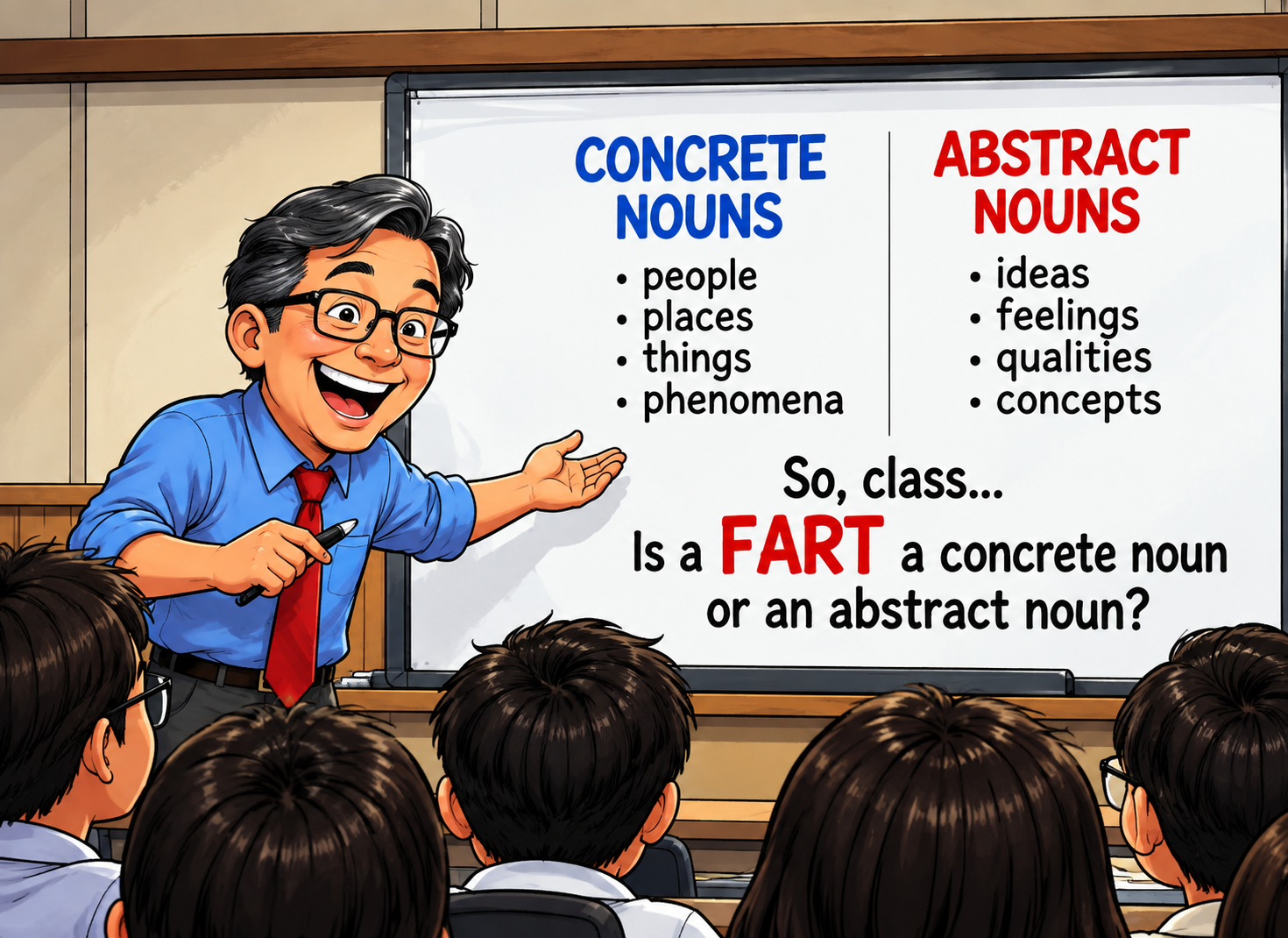
Nouns can be a very boring topic in grammar. After all, how much excitement can students possibly find in learning about the names of people, places, things, and ideas?
But the challenge for teachers like me is how to make even the simplest and seemingly most boring topics interesting, engaging, and, whenever possible, fun.
I once came across a saying suggesting that good teaching is one-fourth preparation and three-fourths pure theatre. I cannot remember its exact wording or who originally said it, but I have always appreciated the sentiment behind it.
Preparation provides the substance of a lesson. Theatre gives it life.
Of course, I do not enter my classroom intending to perform a comedy show. I prepare my lessons, identify my objectives, and think about how best to explain the concepts. Whatever theatrical elements emerge usually happen spontaneously.
Sometimes, even I am surprised by what comes out of my mouth.
And speaking of things coming out…
One day, while discussing nouns, I introduced the distinction between concrete and abstract nouns.
I explained that concrete nouns refer to physical things or occurrences you can perceive through the senses, whereas abstract nouns refer to concepts, qualities, feelings, and ideas.
After giving several conventional examples, I decided to test my students with a less conventional one.
“Class,” I asked, “is a FART a concrete noun or an abstract noun?”
There was a moment of hesitation.
“Yes class you heard it right… FART.”
The students looked at each other, some smiled, some laughed.
They I warned those who laughed, “Oops not too much… you might fart.”
More laughter came after that.
Then came the answers.
“Abstract, sir!”
Practically everyone agreed.
I could understand their reasoning. A fart is generally invisible. You cannot put it on a table, examine its shape, or display it like a book or a chair.
But I had other ideas.
“No!” I declared. “A fart is a concrete noun!”
The students looked puzzled.
And so, our grammar lesson unexpectedly became a chemistry lesson.
I explained that a fart involves releasing intestinal gases. These gases have physical existence. They occupy space, consist of matter, and can be detected through our senses.
“Just because you cannot see something,” I explained, “does not mean it does not exist!”
I thought that would settle the matter.
But then I decided to go further.
“Besides,” I told them, “who says you cannot hold a fart?”
That was when I remembered something from my childhood.
When I was a little boy, I was playing with my younger sister. At some point, I passed gas. Being the mischievous little creature that I was, I quickly cupped my hand near my behind, pretending to catch what had just escaped.
Before the gas could completely disperse, I brought my cupped hand close to my sister’s nose.
Then I opened it.
My poor sister!
She cried and immediately ran to our mother to report the terrible injustice she had suffered.
Mama, apparently finding the whole incident amusing despite my sister’s distress, gave me a light smack with her slipper, partly to reprimand me and partly to appease the offended little girl.
I had received my punishment.
My sister had received her justice.
And neither of us could have imagined that decades later, the incident would become part of a university grammar lesson in South Korea.
By the time I finished telling the story, my students were in stitches.
What began as an ordinary discussion of concrete and abstract nouns wandered through chemistry, human biology, childhood mischief, and a mother’s slipper.
And somehow, we were still discussing grammar!
But the laughter wasn’t over
Having established that a fart was a concrete noun, I decided to challenge my students further.
“Now, class,” I asked, “is fart a count noun or a non-count noun?”
Immediately, two students began debating.
“It’s non-count, sir!” one insisted.
“No, it’s count!” the other argued.
One student tried to defend his position by referring to our earlier discussion.
“Sir just said it’s concrete! Like a smartphone is concrete. You can say, ‘I have one smartphone!'”
His classmate was unconvinced.
“Come on!” he protested. “You can’t say, ‘I have one fart!'”
The classroom erupted in laughter again.
I could hardly have asked for a more entertaining grammatical disagreement.
When the laughter subsided, I explained that fart is indeed a countable noun. We can say a fart, two farts, or several farts. The issue wasn’t its countability but the choice of expression. In ordinary conversation, we generally say someone lets out a fart rather than has one fart.
I also clarified that concrete and countable describe two different noun characteristics. A noun can be concrete and countable, like chair, or concrete and uncountable, like water.
By then, we had explored two grammatical classifications using one rather unconventional example.
But something else had happened.
My students were no longer merely listening to an explanation. They were arguing, reasoning, challenging one another, and defending their answers.
One student had attempted to apply an earlier grammatical concept to a new question. Although the reasoning wasn’t entirely correct, it gave us another chance to clarify the distinction between the two classifications.
And all of this happened because of a fart!
When Preparation Meets Theatre…
Looking back, I find the experience amusing not merely because of the laughter it produced, but because the lesson unfolded so naturally.
I had not planned to tell that childhood story. It wasn’t in my lesson plan. There was certainly no instruction in my teaching materials that said, “At this point, introduce a childhood fart incident.”
The story simply emerged from our discussion.
But beneath the humor was a genuine learning opportunity.
My students had initially associated concrete with things they could see or hold. The unusual example challenged that assumption and encouraged them to reconsider what physical existence means.
The chemistry explanation supplied the conceptual clarification. The childhood anecdote made the discussion memorable.
The subsequent debate about countability created another learning opportunity. It required students to examine their assumptions, explain their reasoning, and distinguish between two different grammatical concepts.
Did the laughter guarantee that every student understood the lesson? Of course not. Understanding still needs to be checked through questions, examples, and opportunities to apply what has been learned.
But the laughter helped turn an otherwise ordinary lesson into an experience we could share.
I have always believed that teaching should be a serious undertaking without necessarily becoming a solemn activity.
A teacher can be academically rigorous without being intimidating. A lesson can be intellectually demanding without being joyless. And sometimes, a little spontaneity can encourage students to participate in ways a carefully prepared explanation alone might not.
Perhaps that is what the expression about preparation and theatre really means to me.
Preparation ensures that I know what I am teaching, why I am teaching it, and what I want my students to learn.
Theatre, whether intentional or spontaneous, helps me bring the lesson to life.
And when the two come together, the classroom becomes more than a place where information is delivered. It becomes a place where ideas are explored, mistakes are examined, questions are encouraged, and learning can be accompanied by laughter.
I have often described my philosophy of teaching this way:
“The classroom is my playground, the students are my playmates, and the subject is our toy.”
That particular day, our toy happened to be a fart.
And somewhere in the Philippines, my younger sister probably has no idea that her childhood suffering has contributed to the grammatical education of university students in South Korea.
Sorry, little sister.
But thank you for your contribution to science—and English grammar!
Consistent Daily Routine
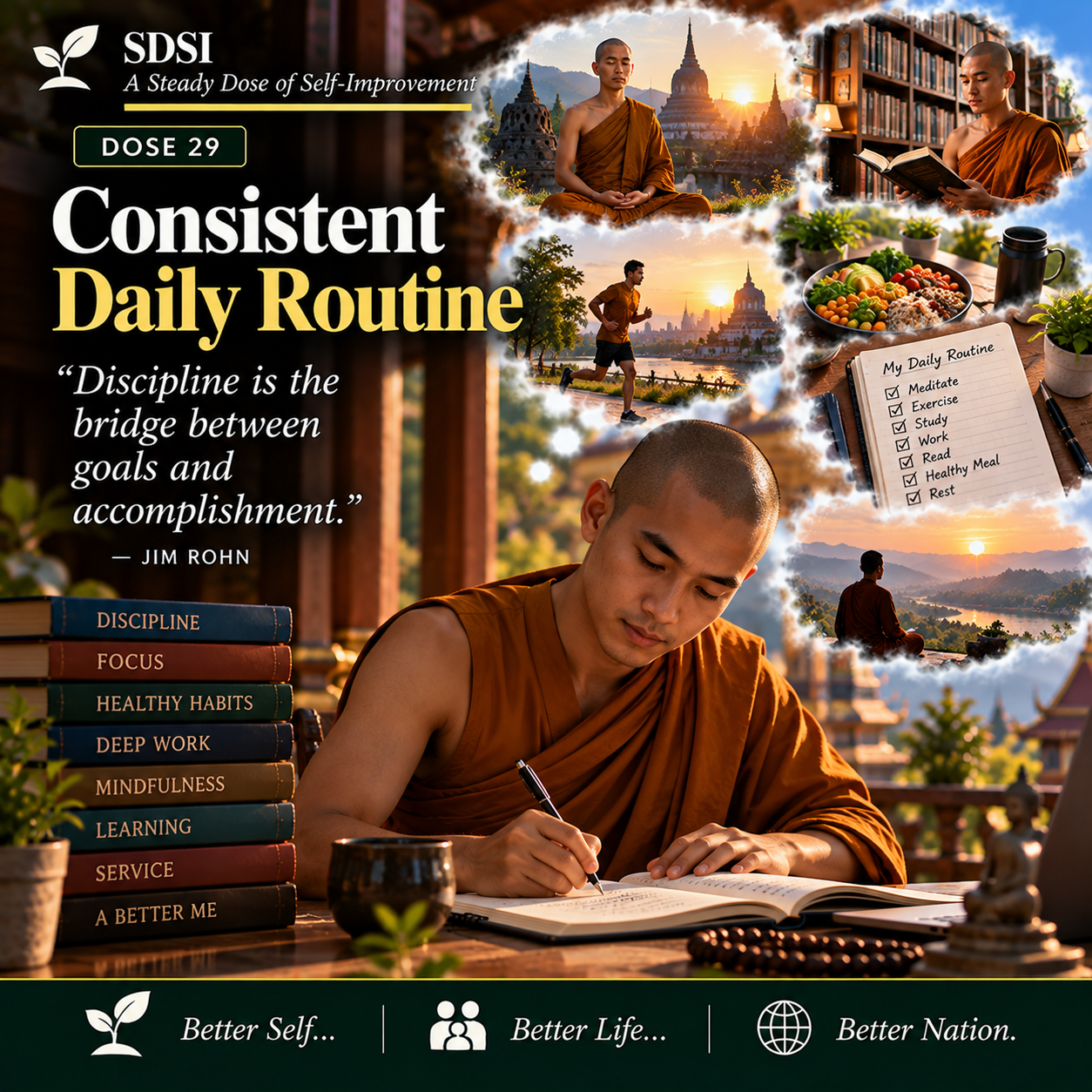
A well-designed routine isn’t a cage — it’s daily proof that you’re authoring
your life instead of drifting through it.

Are you more like a homing pigeon, or driftwood?
Are you more like a homing pigeon—or driftwood?
Whether we notice it or not, much of life is built from repetition. What we habitually do—or repeatedly fail to do—shapes our health, competence, relationships, and progress. Significant results rarely come from one dramatic burst of effort. More often, they emerge from small actions performed often enough to become part of who we are.
A daily routine gives those actions a place to live. It is a deliberate pattern of activities that supports the things we say matter to us. Without some structure, we can become like driftwood—moved by whatever demand, distraction, mood, or circumstance happens to arrive. With direction, we become more like a homing pigeon: still affected by wind and distance, but oriented toward home.
Benjamin Franklin famously organized his day around work, reading, meals, reflection, and rest. He began the morning by asking what good he would do that day and ended by examining what good he had done. Maya Angelou also created a remarkably consistent writing practice, regularly leaving home to work in a plain hotel room for hours. Neither routine was glamorous. Both reduced the need to renegotiate important work every day.
I have experienced the same principle in my own life. The routines I have developed in South Korea—morning preparation, teaching, writing and research during available periods, reading and reflection, and attention to physical well-being—have contributed enormously to what I have been able to produce. The individual actions often feel ordinary. Their accumulated effect is not.
A useful routine should serve your life, not imprison it. It must leave room for rest, relationships, emergencies, spontaneity, and change. But when the essentials are given a dependable place in the day, progress no longer depends entirely on whether motivation happens to show up.
Pause and Reflect
How intentional is your daily routine? Do the things you repeatedly do actually support the person you say you want to become?
One Step Forward
Choose one deliberate morning ritual and one evening wind-down activity. Try both tomorrow, then decide whether they deserve a permanent place in your routine.
Explored in full in Chapter 20 — Consistent Daily Routine of A Holistic Approach to Self-Improvement.
Pursuing Longevity

Longevity isn’t just physical survival — true longevity harmonizes the physical, mental, emotional, social,
and spiritual dimensions of who you are.

“I have signed up for what I call the Race to 100.”
I have signed up for what I call the Race to 100. I want to celebrate my 100th birthday on my feet—still able to move, think, laugh, create, and perhaps dance while surrounded by people I love. Reaching a number is not the entire goal. I want the years themselves to remain worth living.
That is why longevity should not be understood as physical survival alone. A long life becomes more meaningful when physical health is accompanied by mental engagement, emotional resilience, social connection, spiritual depth, and a continuing sense of purpose. The aim is not simply to stay alive longer, but to preserve as much capacity for living as circumstances allow.
Studies of long-lived populations repeatedly point toward familiar patterns: regular movement, nourishing food, strong relationships, purpose, and social engagement. None offers a guarantee. Genetics, environment, healthcare, chance, and many other factors also matter. Longevity is not something we can completely control—but we can influence some of the conditions under which we age.
Our beliefs about aging may matter too. In a well-known longitudinal study, older adults with more positive self-perceptions of aging lived, on average, several years longer than those with more negative perceptions, even after researchers accounted for several other factors. That does not mean positive thinking can defeat biology. It does suggest that the way we approach aging may influence the behaviors, motivation, and resilience with which we live it.
So I choose to treat aging not as a countdown but as a continuing project. I can strengthen my body. I can keep learning. I can protect relationships. I can pursue purpose. I can make choices today that my older self may one day be grateful for. The finish line is uncertain for all of us. But the way we run the race is still partly ours to shape.
Pause and Reflect
What does longevity mean to you: simply living longer, or remaining capable of living well for as long as possible? Is your present lifestyle moving you toward that picture?
One Step Forward
Imagine yourself 30 years from now. Write down one specific change that future version of you would thank you for beginning this week.
Explored in full in Chapter 19 — Pursuing Longevity of A Holistic Approach to Self-Improvement.
Pursuing Well-Being
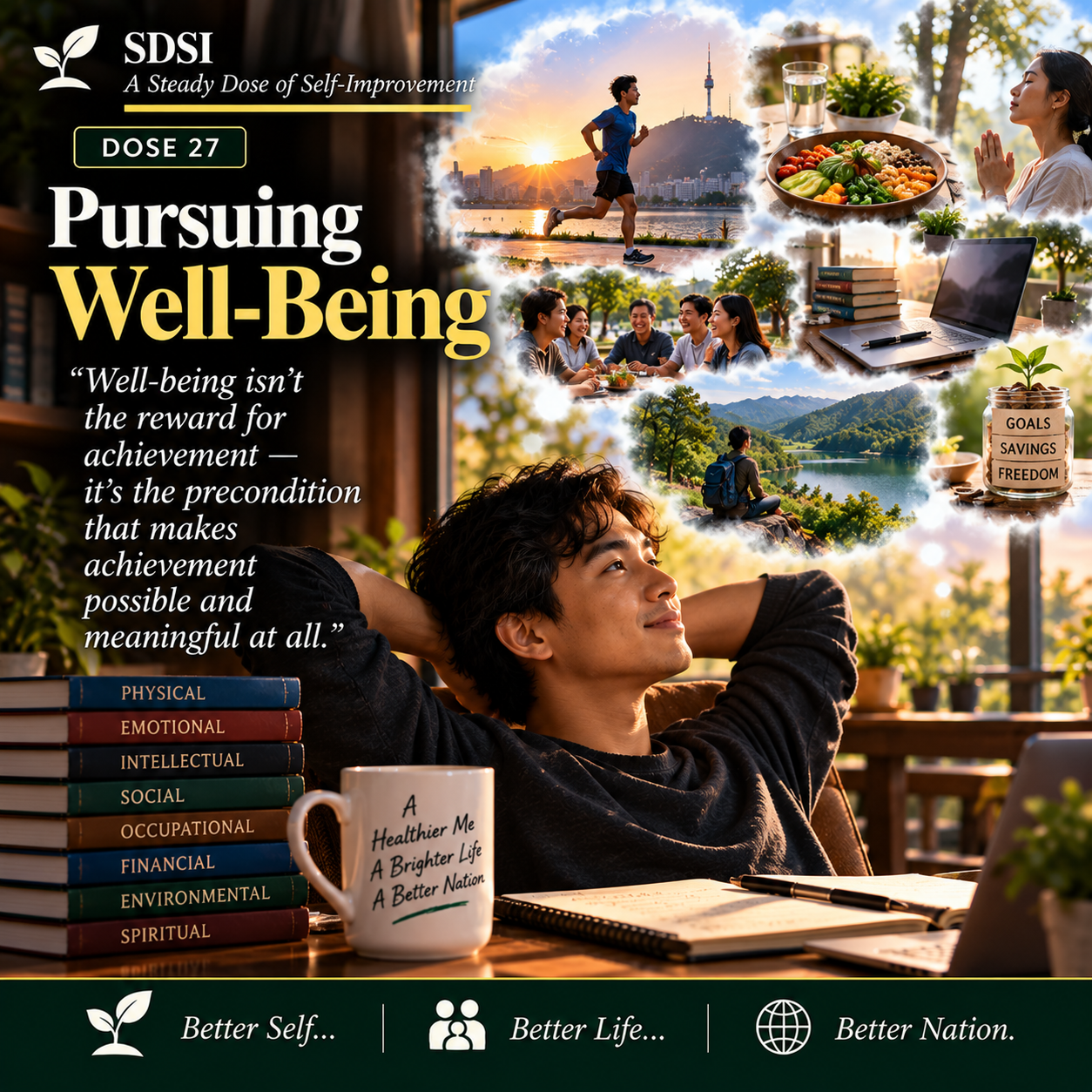
Well-being isn’t the reward for achievement — it’s the precondition that makes
achievement possible and meaningful at all.

Most people think of well-being as the absence of illness. It is far more than that.
Well-being is often reduced to physical health: no illness, no pain, a reasonably fit body. But genuine well-being reaches much further. It involves how we feel, how we function, how we relate to others, how secure and purposeful our lives feel, and whether the different parts of our lives support rather than constantly undermine one another.
One useful way of viewing well-being is through several interconnected dimensions: physical, emotional, intellectual, social, occupational, financial, environmental, and spiritual. The categories may overlap, but that is precisely the point. Human life is not divided into sealed compartments. Neglect one area long enough and the effects often spill into the others.
Research on exceptionally long-lived populations offers an interesting illustration. Communities studied for unusual longevity have often been associated with patterns such as regular movement, plant-rich diets, meaningful social connections, and a sense of purpose. Researchers continue to debate how broadly the popular “Blue Zones” framework should be applied, but the larger lesson remains useful: well-being is rarely the product of one habit. It is usually built from a pattern of living.
My own experience in South Korea has made that lesson personal. A manageable teaching schedule has given me room not only to work, but also to write, read, exercise, reflect, spend time with family, and pursue projects that matter to me. I have learned that having time outside work does not necessarily reduce productivity. Used deliberately, it can make productive work more creative, focused, and sustainable.
The goal, then, is not perfect balance every day. Life will sometimes demand more from one dimension than another. The goal is awareness: knowing when one part of yourself has been neglected for too long and having the courage to restore it before the deficit becomes a crisis.
Pause and Reflect
Which dimension of your well-being—physical, emotional, intellectual, social, occupational, financial, environmental, or spiritual—needs the most attention right now?
One Step Forward
Rate the eight dimensions from 1 to 10. Choose your lowest score and identify one small action you can take this week to strengthen it.
Explored in full in Chapter 18 — Pursuing Well-Being of A Holistic Approach to Self-Improvement.
WORK-LIFE SYNERGY: When Work Becomes Play
(A PERSONAL ESSAY)

People often talk about work-life balance. In fact, striking that balance is something I advocate in my book: A Holistic Approach to Self-Improvement. As we pursue professional growth, success, and financial security, we should not allow work to consume the other parts of life that make it worth living—our family, relationships, health, and time for ourselves. But lately, I have found myself wondering about another possibility. What happens when the line between work and life becomes blurred, not because work has invaded life, but because the work itself has become part of a life one genuinely enjoys? What happens when the two no longer seem to compete for time and attention, but instead become integrated—each enriching the other, with neither necessarily being sacrificed? Perhaps, in such a life, the challenge is no longer simply to maintain work-life balance, but to discover something beyond it: work-life synergy.