Ragnarok: When Gods Become Human – 3
A REVIEW – Part 3
Nobody Really Wins a War
By the final episodes, gods and giants prepare for the confrontation the title has promised us from the beginning.
Ragnarök.
Here it comes.
The gods assemble. The giants assemble. Weapons appear.
Although, to be fair, only Magne seems to have received an actual god-level weapon. Some of the others look as though they were given five minutes to grab whatever they could find in the garage.
For all its mythology, the confrontation begins to resemble a neighborhood gang fight.
And then something unexpected happens.
They stop.
“Put your weapons down.”
There is another way.
I had mixed feelings.
For three seasons, the series had been preparing me for Ragnarök, only to arrive at the battlefield and essentially say, “Perhaps violence is not the answer.”
Part of me wanted to protest:
Then why have I been waiting for Ragnarök?
Episode 5 initially felt anti-climactic.
Yet the more I thought about it, the more appropriate the decision became.
For three seasons, we waited for Thor to become powerful enough to fight the giants. Perhaps his real transformation was becoming wise enough not to.
And as I watched gods and giants—sworn enemies who had every reason to distrust one another—slowly lay down their weapons, my thoughts wandered beyond Edda.
I thought about the conflicts raging in different parts of our world. Different histories, different grievances, different interests, and different ideas of who is right and who is wrong. Yet beneath all of them are ordinary human beings who eventually pay the price.
If gods and giants could look across the divide and decide that destroying one another was not the only way forward, I found myself asking:
When can humans do the same?
Perhaps that is an overly hopeful question. Real conflicts are infinitely more complicated than a television confrontation between gods and giants. Weapons cannot simply be put down because somebody delivers a good speech.
But sooner or later, people who cannot destroy one another without also destroying much of what they value have to find some way to coexist.
The series makes the same point closer to home. The people of Edda oppose the pollution created by Jutul Industries, but many of those same people depend on the company for their livelihoods. Eventually, Saxa brings environmental activists and industry representatives to the same table.
Nobody gets everything.
Nobody completely disappears.
They talk.
Perhaps balance does not require enemies to become friends. Sometimes it simply requires them to find a way not to destroy one another.
Maybe that is the real alternative to Ragnarök.
And perhaps sometimes the best way to redefine mythology is simply to tell mythology:
“Screw you. We are not doing it your way.”
And Then Episode Six Happened
Just when I thought I understood what Ragnarok was trying to say, the final episode pulled the rug from under me.
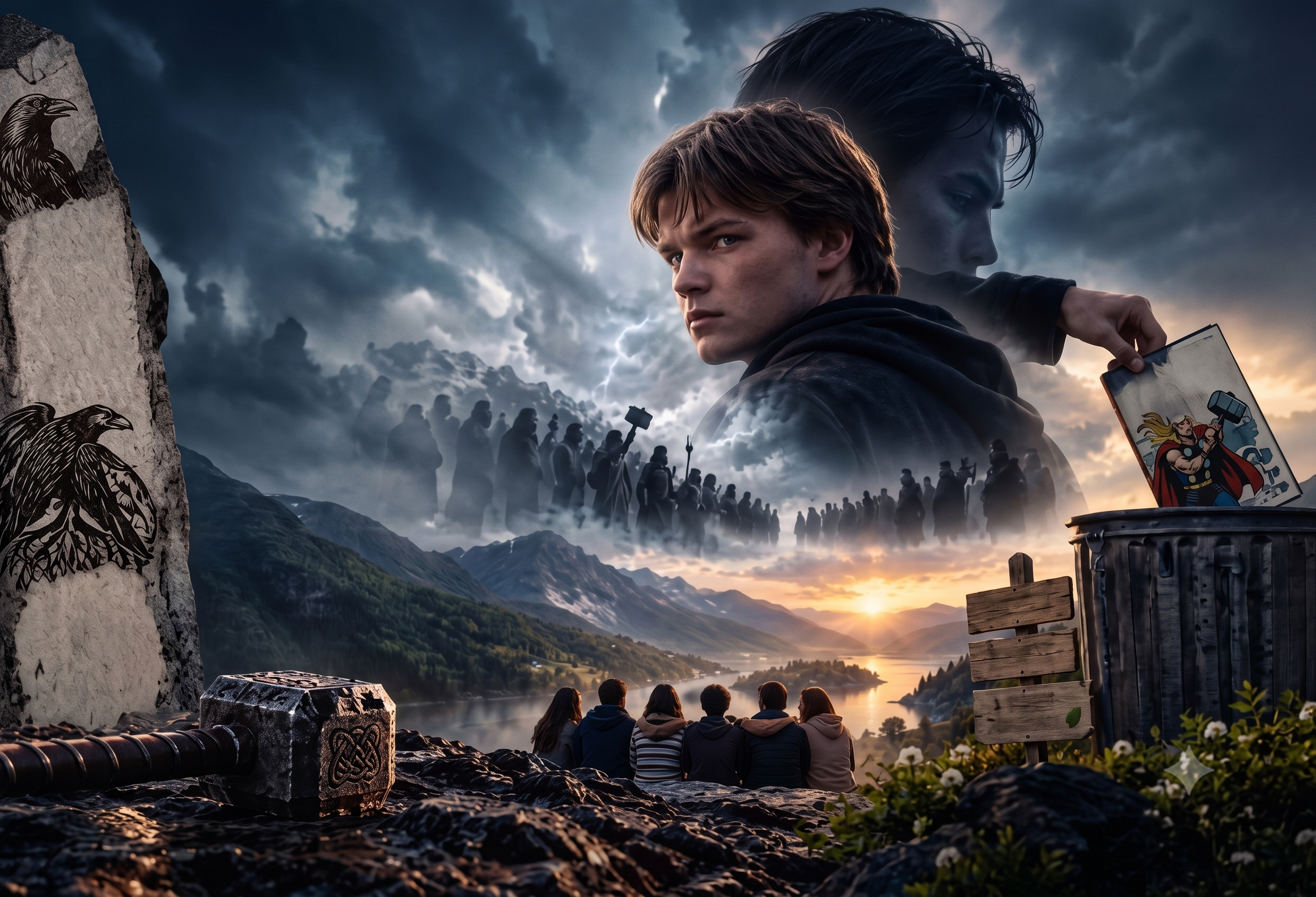
Old Thor comic books appear.
Magne looks through them.
Images from the comics begin echoing the mythology we have been watching for three seasons.
And suddenly I found myself asking:
Wait. Was all of this happening only in Magne’s mind?
Then the Ragnarök we had expected finally occurs—but in a very different way.
And when it is over, Magne throws the Thor comics into the trash.
For me, that image unlocks the ending.
Thor goes into the garbage.
Magne walks away.
The mythology that had consumed his understanding of himself and the people around him is something he no longer needs.
At first, an ending like that risks provoking the dreaded response:
“You mean it was all imaginary?”
But strangely, it did not destroy the series for me.
Because whether Thor, Loki, Odin, Mjölnir, the giants and the serpent existed literally within Magne’s world does not erase what the writers accomplished with them.
If anything, it makes their approach to mythology even more unusual.
Marvel essentially asks what would happen if Norse gods existed in our modern world.
Ragnarok asks something quite different:
What if a modern young man used Norse mythology to understand his world?
Pollution becomes the work of giants. Corporate domination becomes supernatural power. His complicated brother becomes Loki. His own growing strength becomes Thor. His struggle with power becomes a battle over Mjölnir.
And eventually, his greatest battle becomes Ragnarök itself.
Not gods against giants.
Magne against the world he had created inside himself.
That realization did not make me feel that the previous three seasons had been wasted.
Quite the opposite.
The mythology may have existed in Magne’s imagination, but it existed beautifully in mine while I watched it.
Throwing Thor Away
That final image stayed with me.
Three seasons of gods, giants, hammers, serpents and prophecies end with some old comic books being thrown into a trash bin.
Yet I did not feel that the writers were throwing away the mythology.
Magne was.
There is a difference.
Perhaps growing up sometimes requires us to discard stories we once needed—not because those stories were worthless, but because they have already served their purpose.
And perhaps that is why Ragnarok managed to hold my attention when I had never intended to give it so much.
It gave me a Thor who could become a bully.
A Loki I could pity.
An Odin on a mobility scooter.
Giants who worried about corporate management.
A Midgard Serpent I kept calling “the worm.”
A mother whose love often expressed itself through compromise.
People whose strengths could become their weaknesses.
Powerful beings who discovered that love could make them vulnerable.
And a Ragnarök in which perhaps the greatest act of strength was deciding not to fight.
For three days, I tried to keep Ragnarok in the background while I worked, ate, exercised and went about my life.
It refused to stay there.
The story ambushed my attention.
And when Magne finally threw Thor into the trash, I realized that somewhere along the way, this strange little Norwegian series had done exactly the opposite to me.
It had pulled mythology out of the trash, dusted it off, and made me think about it all over again.



 M.A.D. L I G A Y A