Category Archives: Integrative Motivation
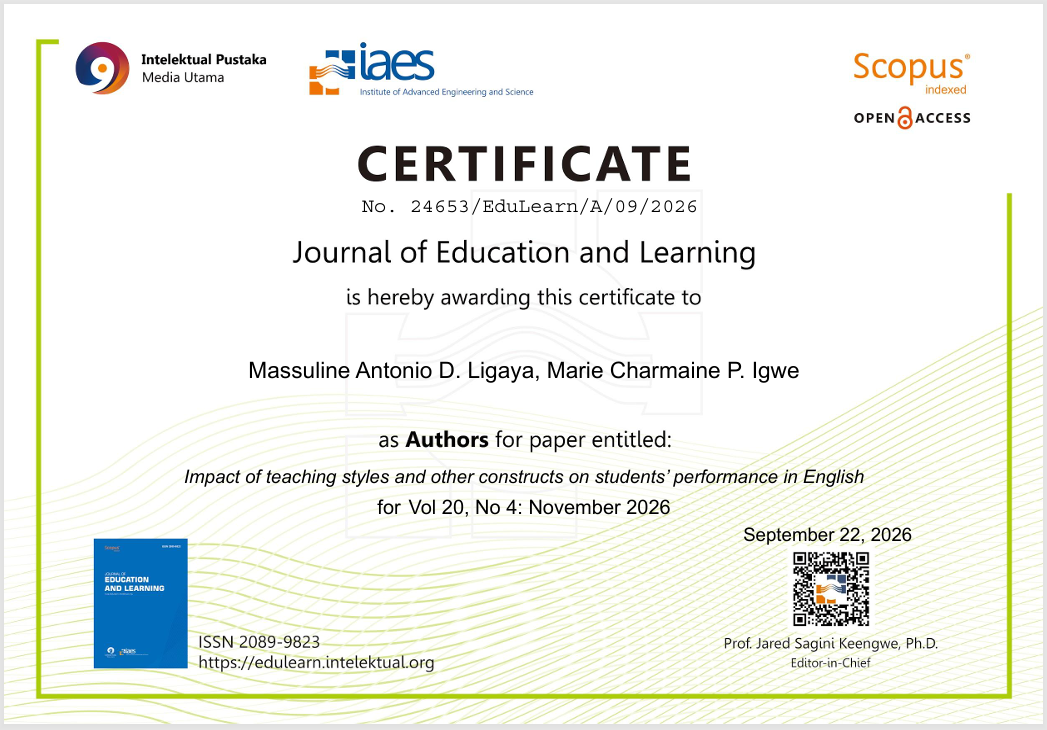
Impact of Teaching Styles and Other Constructs on Students’ Performance in English
A research paper published in a Scopus-indexed journal

Massuline Antonio D. Ligaya and Marie Charmaine P. Igwe
Journal of Education and Learning (EduLearn)
Vol. 20, No. 4, November 2026, pp. 2321~2335
ISSN: 2089-9823, DOI: 10.11591/edulearn.v20i4.24653
Research Summary
This study examined how teaching styles and selected teacher- and student-related factors are associated with university students’ performance in English. Specifically, it investigated the relationship between teachers’ teaching styles and students’ English performance, the moderating role of teachers’ leadership behavior, and the mediating roles of students’ motivation to learn English and grit.
The participants were 385 students and 22 foreign English teachers from a university in South Korea. The students assessed their teachers’ teaching styles and leadership behaviors and reported their own motivation and grit. Their English proficiency was measured using a 25-item test covering vocabulary, correct grammar form, answering questions, sentence combination, and word sequencing. The data were analyzed through descriptive statistics, correlation, regression, moderation, and mediation analyses.
The students were found to be moderately proficient in English. They demonstrated high motivation to learn the language, with integrative motivation exceeding instrumental motivation, while their level of grit was moderate. Teachers frequently exhibited all four dimensions of teaching style and demonstrated consideration leadership behavior slightly more strongly than initiating structure.
Teaching style and its dimensions were positively but weakly associated with English performance. Among the teaching-style dimensions, decision-making negotiation emerged as the most consistent predictor, although it explained only a small proportion of the variation in students’ performance. Teachers’ leadership behaviors also showed weak positive relationships with English performance but did not significantly moderate the relationship between teaching style and student performance.
The mediation analysis revealed that instrumental and integrative motivation produced significant but opposing indirect effects. Integrative motivation showed a positive mediating effect, whereas instrumental motivation showed a negative one. Grit did not significantly mediate the relationship. When all three mediators were considered collectively, the total indirect effect was not statistically significant.
Overall, the findings indicate that teaching practices contribute to English performance, but their effects are modest. Interactive approaches that give students a voice in classroom decisions may support engagement and learning. The results also highlight the importance of integrative motivation, meaningful engagement with English-speaking cultures, and attention to students’ psychological well-being. Language achievement depends not only on what teachers do but also on the motivational, personal, and contextual conditions under which students learn.
Research Contribution
The study contributes to English-language education by integrating teaching styles, teachers’ leadership behavior, motivation to learn English, grit, and English performance within a single analytical framework. It extends previous research by examining leadership behavior as a moderator and motivation and grit as parallel mediators among South Korean university EFL learners. Its findings also emphasize that statistically significant instructional factors may have limited practical influence when considered apart from broader learner-related and contextual conditions.
Keywords
Grit; leadership behavior; motivation; students’ performance in English; teaching style
Full Text
The complete published article is available through the DOI link above.
To God Be The Glory!
Students’ Performance in English: Effects of Teachers’ Leadership Behavior and Students’ Motivation
A research paper published in a Scopus-indexed journal

Massuline Antonio D. Ligaya and Marie Charmaine P. Igwe
Journal of Education and Learning (EduLearn), Vol. 19, No. 1, February 2025, pp. 91–102
DOI: 10.11591/edulearn.v19i1.21680
Research Summary
Teachers do more than deliver instruction; they also exercise leadership in guiding, motivating, and managing students throughout the learning process. In foreign-language education, this leadership role may be particularly important because successful language learning requires active student participation and sustained motivation. This study investigated how English teachers’ leadership behavior relates to students’ performance in English and examined whether students’ instrumental and integrative motivation mediate that relationship.
Teacher leadership was examined through two dimensions derived from the Leadership Behavior Description Questionnaire (LBDQ): initiating structure, which emphasizes task organization and goal attainment, and consideration, which emphasizes interpersonal relationships, respect, trust, and concern for students. Motivation toward learning English was examined through instrumental motivation, in which the language is learned for practical or external benefits, and integrative motivation, associated with interest in communicating with and understanding people from other linguistic and cultural backgrounds.
The study employed a descriptive survey design involving 911 university students in South Korea who were enrolled in mandatory English courses across different academic departments. Students evaluated their teachers’ leadership behavior and their own motivation toward learning English. Leadership items were drawn from the LBDQ, while motivation measures were adapted from Gardner’s Attitude/Motivation Test Battery (AMTB). Students’ English performance was assessed using a 25-item grammar proficiency test covering vocabulary, correct grammatical form, answering questions, combining sentences, and word sequencing. Data were analyzed using descriptive statistics, correlation and regression analyses, and parallel mediation analysis using Hayes’ PROCESS procedure.
Students perceived their English teachers as demonstrating high levels of both leadership behaviors, although consideration was more strongly manifested than initiating structure. The mean for initiating structure was 4.06, while the pattern of responses for consideration showed that nearly 88% of students rated their teachers high or very high on this dimension. Students also reported high levels of both forms of motivation, with integrative motivation (M = 3.96) exceeding instrumental motivation (M = 3.55).
Performance on the English test was generally satisfactory. Of the 911 students, 542 obtained scores of 12 or higher, while 369 scored 11 or below. Analysis of specific areas showed that students were proficient in vocabulary, correct grammatical form, and answering questions but only moderately proficient in combining sentences and word sequencing.
Correlation analyses showed that both initiating structure and consideration were positively related to students’ instrumental and integrative motivation and to English performance. Integrative motivation was also positively and significantly correlated with English performance, whereas instrumental motivation was not significantly correlated with performance at the bivariate level.
The regression and mediation analyses revealed a more differentiated pattern. When the two leadership dimensions were considered simultaneously, consideration—but not initiating structure—significantly predicted students’ English performance. Consideration also significantly predicted both instrumental and integrative motivation. When leadership behavior and both forms of motivation were entered together, consideration and integrative motivation had positive significant coefficients, whereas instrumental motivation had a significant negative coefficient.
Most importantly, the mediation analysis showed that neither instrumental nor integrative motivation significantly mediated the relationship between initiating structure and English performance. In contrast, both forms of motivation significantly mediated the relationship between consideration and students’ English performance. The direct effect of consideration remained significant after the mediators were included, indicating partial rather than complete mediation.
Overall, the findings emphasize the potential importance of the relational dimension of teacher leadership in language learning. Students may benefit when English teachers combine pedagogical competence with leadership behaviors characterized by rapport, respect, accessibility, and concern for students. The findings further suggest that students’ reasons for learning English form part of the pathway through which this people-oriented leadership behavior relates to their academic performance.
Research Contribution
The study contributes to research on teacher leadership and second/foreign-language learning by integrating teacher leadership behavior, student motivation, and measured English performance within a mediation framework. Rather than examining teacher and learner variables independently, it investigates a possible mechanism linking them: teacher leadership → student motivation → English performance. Its finding that consideration, rather than initiating structure, was associated with performance through both instrumental and integrative motivational pathways highlights the potential importance of relationship-oriented teacher leadership in the foreign-language classroom. The study also provides a foundation for further research examining how teacher behavior and different forms of learner motivation jointly contribute to English-language achievement.
Keywords: teacher leadership, consideration, initiating structure, instrumental motivation, integrative motivation, English performance, mediation, South Korea
Full Text
The full text of this publication is available upon request. Researchers, educators, students, and other interested readers who wish to obtain a copy may contact the author through this website or by email at madligaya@gmail.com.