Blog Archives
Visualization

Visualization isn’t wishful thinking — it’s mental rehearsal. By vividly rehearsing an action or experience
in the mind, we can prepare ourselves for performing it in the real world.

At the 2008 Beijing Olympics, Michael Phelps’s goggles filled with water mid-race, leaving him unable to see clearly.
Visualization is one of the most powerful—and perhaps most underestimated—tools in the self-imprOvement toolkit. Like positive thinking, it is sometimes dismissed as little more than imagining success instead of working for it. But effective visualization is not a substitute for action. It is preparation for action.
Visualization involves creating vivid and detailed mental representations of an action, process, or desired outcome. Rather than merely seeing an image in the mind, effective visualization can engage multiple senses: what you see, hear, feel, and even how your body moves. Research on mental imagery suggests that imagined and actual actions can engage overlapping neural processes, helping explain why mental rehearsal has long been used in sports and other performance settings.
At the 2008 Beijing Olympics, Michael Phelps faced exactly the kind of situation he had mentally prepared for. During the 200-meter butterfly final, his goggles filled with water, severely limiting his vision. Yet he continued swimming, relying partly on his practiced stroke count and preparation, and won the race in world-record time. His longtime coach, Bob Bowman, had taught him to mentally rehearse races—to “watch the videotape” in his mind, including situations in which things did not go perfectly.
That detail matters.
Effective visualization is not simply seeing yourself standing triumphantly at the finish line. It is rehearsing how you will get there—and how you will respond when something goes wrong.
Research by Pham and Taylor similarly highlighted an important distinction between visualizing an outcome and visualizing the process required to achieve it. Imagining yourself receiving the diploma, losing the weight, publishing the book, or crossing the finish line may inspire you. But mentally rehearsing the studying, training, writing, decision-making, and persistence required to get there can better connect the vision with action.
Before deciding to pursue ESL teaching in South Korea, I spent considerable time imagining what that life might look like: the classroom, the students, the research opportunities, and the life I hoped to build. That mental picture did not magically bring me to South Korea.
Visualization did not get me here. But it helped make the destination real enough for me to move toward it.
And perhaps that is visualization’s greatest value. It allows us to visit a possible future before we arrive there—not so that we can escape into it, but so that we can return to the present knowing more clearly what we need to do next.
Pause and Reflect
What future have you repeatedly imagined for yourself—and what would you need to start doing today to move closer to it?
One Step Forward
Set aside 10 minutes today. Close your eyes and visualize not only achieving one of your important goals, but taking the next concrete steps toward it. See the environment. Hear the sounds. Feel yourself doing the work. Then open your eyes—and take one of those steps.
Explored in full in Chapter 16 — Visualization of A Holistic Approach to Self-Improvement.
Conquering Self-Doubt
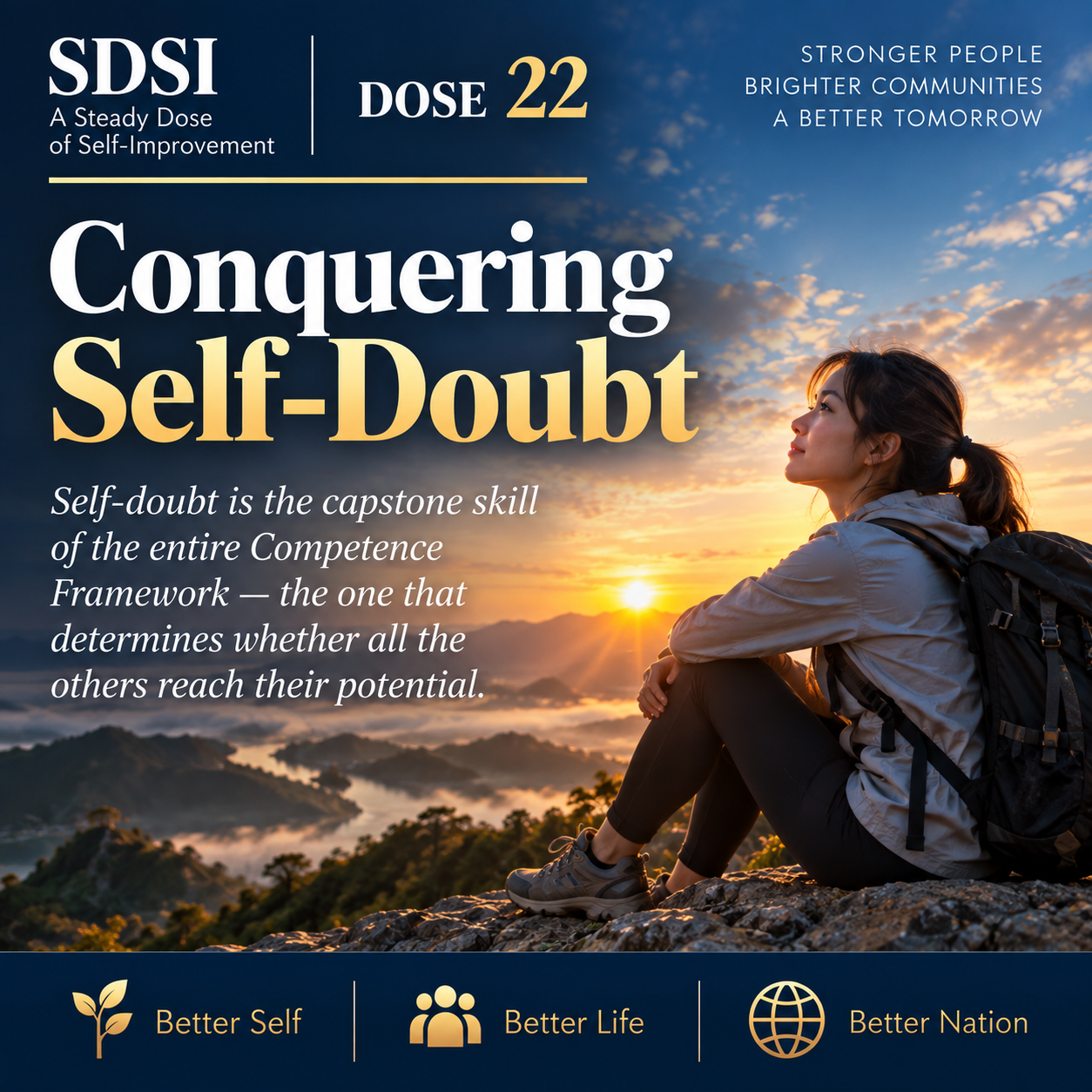
Self-doubt is the capstone challenge of the Competence Framework—the one that determines whether
all our other abilities are ever fully used.

What if self-doubt belongs on the list of deadly sins?
Perhaps that question goes too far. Ordinary self-doubt is neither evil nor necessarily harmful. Sometimes it protects us from arrogance. It makes us examine our preparation, recognize our limitations, and seek the help or training we genuinely need.
But self-doubt becomes destructive when it continues speaking even after the evidence has answered it.
It whispers that you are not intelligent enough, capable enough, or worthy enough to succeed. It dismisses every accomplishment as luck, every compliment as politeness, and every opportunity as something intended for somebody better. Given enough authority, it does more than make you uncomfortable—it prevents you from using the abilities you already possess.
I know that voice.
It has asked me who I thought I was to teach abroad, present research, write books, and advocate self-improvement. It did not disappear when I earned another degree, accumulated years of teaching experience, published my work, or stood before international students. Whenever I attempted something larger, the same question returned in a different form:
Who do you think you are?
Eventually, I learned to answer it with evidence.
I am someone who has faced unfamiliar situations and learned. I am someone who has been rejected and continued. I am someone who has completed difficult work before. None of this guarantees that everything I attempt will succeed. It simply proves that self-doubt is not qualified to declare what I cannot do.
Conquering self-doubt does not mean silencing it forever. Even accomplished people occasionally question themselves. The goal is not to become so confident that we ignore our weaknesses or assume that we cannot fail. That is not confidence; it is carelessness.
The goal is to place self-doubt in its proper position. Let it ask questions, but do not let it deliver the final judgment. Examine what it says. If it identifies a real deficiency, improve. If it merely repeats an old fear that contradicts the evidence, proceed despite it.
This is why conquering self-doubt completes the Competence Framework. You may manage your time efficiently, remain focused, think before acting, make purposeful decisions, communicate effectively, and maintain balance. But if you continually doubt your right or ability to use those skills, much of your potential will remain untouched.
You do not need absolute certainty before taking the next step. You need sufficient preparation, honest evidence, and the courage to act while a little uncertainty remains.
Self-doubt may accompany you.
It simply must not lead you.
Pause and Reflect
What opportunity have you avoided because you doubted yourself?
What evidence from your own life challenges that doubt?
One Step Forward
Write one sentence naming a capability you genuinely possess. Beneath it, list three experiences or accomplishments that provide concrete evidence for it.
Explored more fully in Chapter 14 — “Conquering Self-Doubt” of A Holistic Approach to Self-Improvement.
Better Self… Better Life… Better Nation.
Efficient Time Management
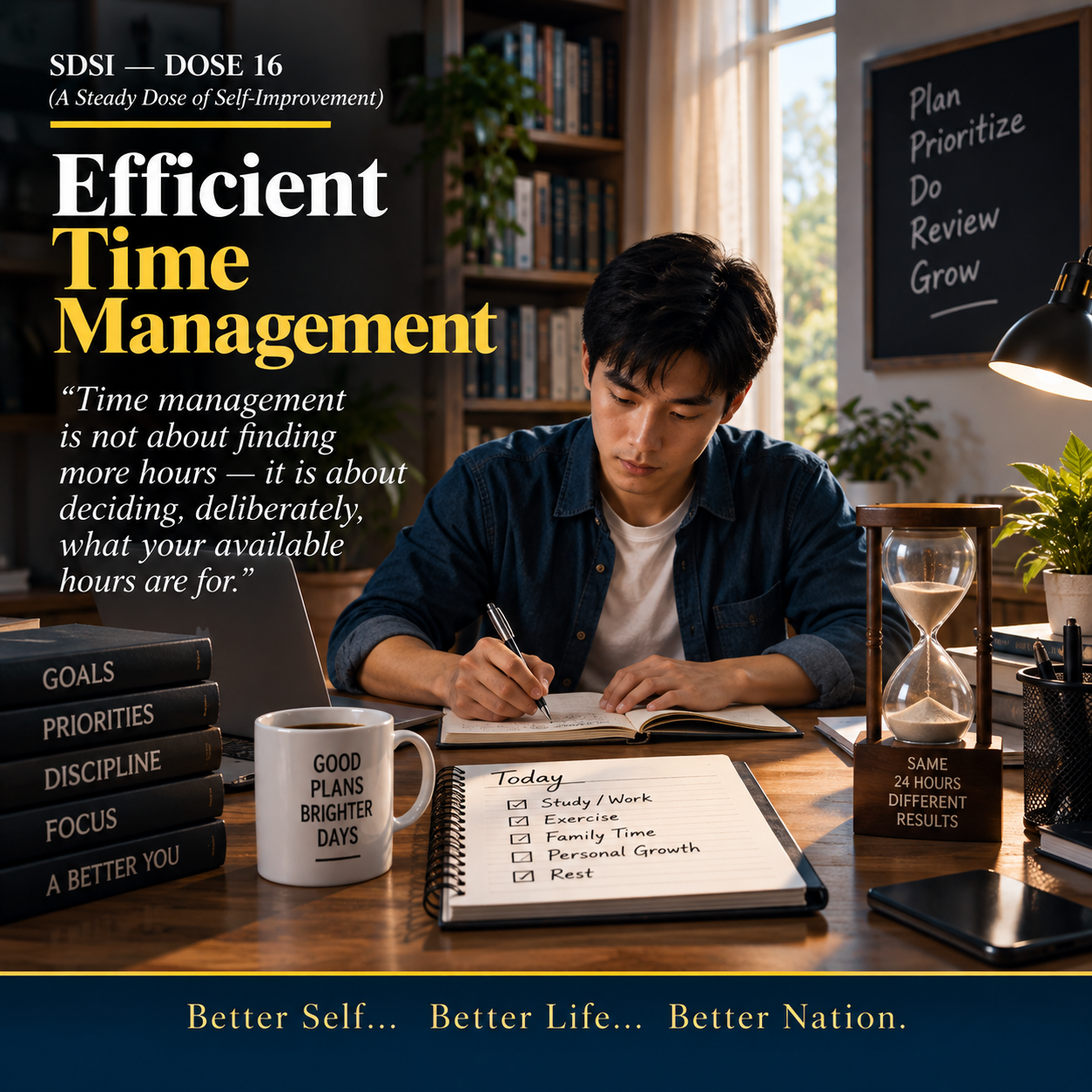
Time management is not about finding more hours—it is about deciding,
deliberately, what your available hours are for.
“If I had some extra time, I could make some extra money.” Jim Rohn’s answer: Forget it. There is no extra time.
Every person receives the same number of chronological hours: 24 each day and 168 each week. However, not everyone has equal freedom over those hours. Work demands, caregiving responsibilities, health conditions, financial circumstances, and long commutes can consume much of a person’s time before any personal choice is made.
Efficient time management does not deny those realities. It asks a more practical question: Within the time I can influence, am I using it for what matters most?
Jim Rohn once recalled a man telling him, “If I had some extra time, I could make some extra money.” Rohn replied that there was no extra time. When midnight arrives, the day is over. Whatever we hope to accomplish must be attempted within the time already available to us.
Laura Vanderkam’s 168-hour framework makes this easier to see. A person who works 40 hours a week and sleeps eight hours each night uses 96 hours, leaving 72. Those remaining hours are not automatically “free”—meals, commuting, household tasks, caregiving, exercise, and rest must come from them. Still, looking at an entire week often reveals possibilities that are hard to notice when we focus on one crowded day at a time.
Benjamin Franklin designed his daily schedule around purposeful blocks of activity. At the beginning of the day, he asked, “What good shall I do this day?” At night, he reflected, “What good have I done today?” His schedule was not merely about filling every hour with work. It connected time use with intention.
Franklin also admitted that maintaining perfect order was difficult. That matters because efficient time management does not mean rigidly controlling every minute. A schedule must guide us without becoming a prison.
Researchers Brad Aeon and colleagues describe time management through three related practices: structuring, protecting, and adapting time. We structure time by creating routines and assigning activities to appropriate periods. We protect it by setting boundaries and declining demands that interfere with important priorities. We adapt it when circumstances change and our original plans are no longer realistic.
Before improving how you use time, however, you must first discover how you are using it now. Memory is unreliable; a written record is much harder to argue with.
A time audit may reveal obvious waste, but it may also reveal something kinder: perhaps you are not lazy or undisciplined at all—perhaps you are carrying more responsibilities than you realized. Either discovery is useful because effective time management begins with truth, not guilt.
You cannot create extra time. But you can become more deliberate with the time that is genuinely yours to direct.
Pause and Reflect
If you recorded every hour for three days, what do you think you would discover about where your time actually goes?
Which activity deserves more of your available time—and which one deserves less?
One Step Forward
For the next three days, record how you use each hour. Mark every entry as essential, useful, restorative, or wasteful. At the end, identify one hour you can use more deliberately.
Explored more fully in Chapter 8 — “Efficient Time Management” of A Holistic Approach to Self-Improvement.
Better Self… Better Life… Better Nation.
Proper Perspective
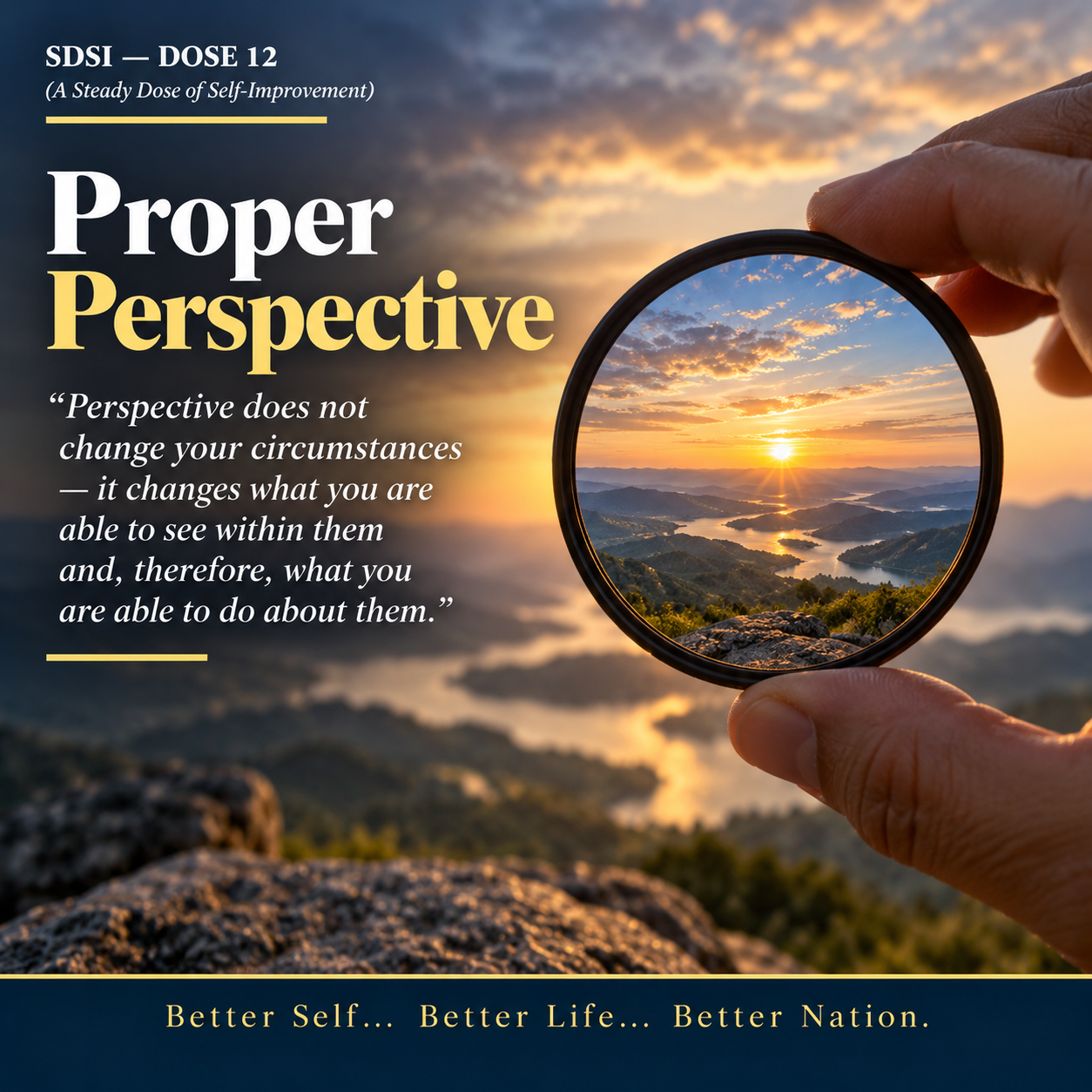
Perspective does not change your circumstances—it changes what you are able to see within
them and, therefore, what you are able to do about them.

A friend of mine is often mistaken for me. When he asked, half-offended, “Do I look as old as you?” I told him, “No—I look as young and handsome as you.”
My friend and I teach at the same university. We have similar builds and similarly rounded faces, so people occasionally mistake him for me.
One day, visibly bemused, he asked, “Why would they think I am you? Do I look as old as you?”
I paused, smiled, and replied, “No. I look as young and handsome as you.”
As he laughed, I realized that our contrasting reactions to the same situation illustrated perspective in miniature. He initially viewed the comparison as an unfavorable comment about his age. I treated it as a flattering comment about mine. Nothing about the situation changed—only the position from which we viewed it.
Proper perspective, however, does not mean forcing every unpleasant experience into a cheerful interpretation. It means looking at something truthfully, completely, and proportionately. A negative interpretation can be as incomplete as an unrealistically positive one. Sometimes we stand too close to a problem and allow one unpleasant detail to fill our entire field of vision.
I once spoke with a colleague who was frustrated about his salary as an expatriate university teacher. He compared his annual income with that of a truck driver back home and concluded that the driver was better compensated.
His dissatisfaction may have been legitimate, but the comparison was incomplete. I asked him to consider the driver’s actual working hours, physical demands, time spent away from home, and working conditions. We then considered the teacher’s lighter schedule and extended periods away from the classroom while continuing to receive a regular salary. Once those factors were included, the comparison became far less straightforward.
The purpose was not to tell him that he had no right to want better compensation. It was to help him evaluate his situation using the whole picture rather than one number.
Viktor Frankl wrote about preserving an inner freedom even amid circumstances of unimaginable cruelty. His reflections did not deny suffering or pretend that pain was good. They recognized that when a situation could no longer be changed, a person could still decide how to respond to it. As he wrote, “When we are no longer able to change a situation, we are challenged to change ourselves.”
Sometimes proper perspective reveals a hidden advantage. Sometimes it exposes a genuine injustice that must be addressed. In either case, it helps us respond more wisely because we are no longer reacting to only one fragment of reality.
Perspective does not erase the problem. It brings the rest of the picture into view.
Pause and Reflect
What frustration in your life might look different if you stepped back and examined the fuller picture?
Are you overlooking facts that challenge your present interpretation?
One Step Forward
Choose one situation bothering you today. Write down your current interpretation, then list two relevant facts you may have overlooked. Revise your interpretation only if the fuller evidence justifies it.
Explored more fully in Part 2 — Section I — Chapter 5, “Proper Perspective,” of A Holistic Approach to Self-Improvement.
Better Self… Better Life… Better Nation.
Dreams and Ambitions

“What we say we want and what we actually pursue often diverge — and closing that gap
starts with being honest about our own list.“

What did you want to be when you grew up?
That question takes me back to second grade, when my teacher asked everY child in the room, “What do you want to be when you grow up?” When my turn came, I searched for an answer that hadn’t already been given. Then I saw it—the photograph of our head of state mounted above the blackboard. “I want to be the president of our country,” I said. My classmates laughed out loud, and I felt the heat of embarrassment rise to my face.
That memory taught me something about the question itself. Childhood is far too early to know what we actually want — most people don’t begin gravitating toward their real interests until adolescence, and even then, the question keeps changing shape as we age.
Ask adults the same question today, in different words, and the pattern repeats. Most people answer: rich. Famous. Influential. Almost nobody says healthy. Happy. Successful. It’s not that these simpler wishes matter less — it’s that they’re often the hardest to actually win, so we quietly stop naming them as goals at all.
John Lennon once wrote “happy” for a school assignment asking what he wanted to be when he grew up. His teacher told him he didn’t understand the assignment. He told her she didn’t understand life.
None of this makes wanting wealth, fame, or influence wrong. The real question worth asking isn’t whether you want more — it’s why.
Pause and Reflect
What’s actually on your list — and is it the list you’d give a child, or the one you’ve quietly settled for?
One Step Forward
Write your real list, unedited for how it sounds to others. Circle the one item you’ve most neglected pursuing.
Explored in full in Part 1, Section I — Dreams and Ambitions of A Holistic Approach to Self-Improvement.
Better Self… Better Life…Better nation.