H’wag Nang Itanong

(Inspired by John Farnham’s “Please Don’t Ask Me”)
Tatanungin mo pa ba laman ng isip
Batid mong ‘ngalan mo dito’y nakaukit
Batid mong masidhi ang aking pananabik
Na makita ka’t mayakap nang mahigpit
Tanong mo ay bakit ‘di kita lapitan
Kung sabik ako’y bakit ‘di kita hagkan
Sa halip yumakap kita’y nilayuan
Takot na pagtangi ko’y iyong malaman
Sa gabi ang diwa ko’y gising na gising
Ngiti mo’y ilaw sa silid kong madilim
Pagpikit ng mata’y kita na’y kapiling
Nagkukunwari na pwede kang angkinin
Sa pagkukunwari’y lalo lang nasasaktan
Ngunit hindi pwede na iyong malaman
Kaya’t mahal man kita’t pinananabikan
Sapat nang sa malayo kita’y pagmasdan
Kung bakit sana ay h’wag akong tanungin
Kung mahal kita’y bakit ayaw kong sabihin
Kung malaya lang akong kita’y ibigin
Pagmamahal sa ‘yo di ibubulong sa hangin
Muling Mahalin

(Inspired by Air Supply’s “Here I Am”)
Kahit anong gawi’y ‘di mapigilan
Na ang nakalipas muli kong balikan
Ala-ala mo’y naging aking kulungan
Ako’y sawing aliping sunud-sunuran
Tamis ng halik mo sa labi’y tumatak
Heto’t ramdam ko pa mahigpit mong yakap
Bakit ganito kahit saan sumulyap
Mata ko’y ikaw ang tanging hinahanap
Pinilit na kita’y sa limot ilibing
Ang mawala ka’y pinilit na kayanin
Ngunit nang ika’y malayo na sa akin
Mundo ko’y tumigil biglaang dumilim
Mabuhay nang wala ka’y aking sinubukan
Sinikap kong tanggapin ang iyong paglisan
Ngunit ala-ala mo’y ayaw akong iwan
Tinik itong bumaon sa aking isipan
Pangungulilang paigting nang paigting
Pinipilit man ay di ‘na kakayanin
Mahirap mabuhay nang di ka kapiling
Naninikluhod akong muli mong mahalin
Ika’y Talinghaga

(Inspired by Elvis Costello’s “She”)
Ika’y pintig na sa puso ko’y tumibok
Lakas na sa mundo ko’y nagpapaikot
Ngunit ang ngiti mo sa akin ang dulot
Isang laksang saya’t labis-labis na lungkot
Ikaw ay kaligayahang dapat damhin
At pagsisising lumunod sa damdamin
Ika’y kayamanan kung aking ituring
At kabayarang dapat na balikatin
Amihan ka ngang ginhawa sa tag-init
Ngunit hanging sa gabi dulot ay lamig
Kandungan mo’y itinuturing kong langit
At bilangguan nang inaliping pag-ibig
Talinghaga kang mahirap na arukin
Palaisipang di ko kayang sagutin
Magkaganun man ikaw ay mamahalin
Magpakaylan man ‘di kita lilimutin
Pangako mo ma’y mahirap panghawakan
Madali mang sa iyo na ako’y iwanan
Ang mahalin mo kahit panandalian
Dulot ay ligayang walang katapusan
2016 Elections: Postscripts

During the campaign period leading to the May 9 presidential derby in the Philippines, Duterte’s opponents were quick to point out that he had no well-defined economic policies in the platform of government he was presenting. His political opponents pounced on this for they perceived the absence of a solid plan for the country’s economy as a weakness of the then candidate for the most powerful seat in the government.
Even the members of the Makati Business Club, an organization of the richest and most influential businessmen in the Philippines, lamented Duterte’s vague economic agenda. They dismissed as lacking in substance, at least in their point of view as businessmen, the speech he delivered when they invited him in to speak in a forum. They expected him to give definitive statements about the conduct of business in the country should he he win (which he did.)
But notwithstanding the absence of clear economic programs (and an assortment of issues hurled against him) the mayor of Davao City garnered almost 16 million of votes to secure a clear mandate from the Filipino electorate. Surprisingly, he has more votes than Aquino, the outgoing president who also tried to dissuade the voters from choosing Duterte by emphasizing that should he win all the economic gains the country had in the past 6 years will be wasted.
In an interview conducted a few hours after the May 9 elections, when the results were unequivocally showing that he would be the 16th President of the Philippine Republic, he unabashedly admitted that economics is not his strong suit. Thus, he intends to hire the best economic minds. To Aquino’s credit, the presumptive president even hinted at continuing the incumbent government’s economic programs.
But why then that the voters did not mind the absence of clear-cut economic policies in Duterte’s to-do lists as a candidate then. The answer is simple…the problem is not the economy. If it is, the people should have voted for Roxas, the economist.
The truth is the problem of the Philippines is not the economy. The economic woes of the country are just the results of deep-seated social problems and failures of existing systems that cannot be solved by an economist. Such problems can only be uprooted by a strong leader, a leader who cannot be manipulated by scheming politicians and businessmen. The Philippines needs a leader who has a strong political will, a political will that cannot be bent by influential lobbyists. Thus, the Filipino voters cast their lot on Duterte.
The programs Duterte are putting in his presidential pipeline are not economic policies per se but they have profound economic implications. For many times that he mentioned in his campaign sorties that it is the job of the government to create an environment that is not only conducive to economic development but where the citizens and foreigners also feel safe and secured.
By eradicating corruption and red tape in all the branches of government he will be creating an atmosphere favorable for the conduct of business and would eventually make the country a haven for both domestic and foreign investments. Specifically, he wants to shorten the processing of papers when transacting business with any agency of the government.
By obliterating criminality and drugs, he will make the citizens focus on improving the quality of their life without fear of getting victimized by petty criminals. Parents can rest assured that their children will not become a victim of drugs.
By increasing the salaries of policemen and soldiers he will strengthen law enforcement which is sorely needed in the maintenance of peace and order. He will boost the morale of policemen and soldiers and make them feel more dignified.
By increasing the salaries of teachers he will make them more effective in the delivery of education which, undoubtedly, is a key component in national development.
By promoting Federalism, he will bring a final solution to the country’s century-old Muslim separatist problem. There will finally be equitable allocation of government resources where people in their respective regions will finally have a chance for self-determination.
It is hard to dispute that all these acts will bring tremendous economic benefits, indirect it may be.
He clearly pointed out that the days of unscrupulous elements in society are numbered, that people should avoid committing acts inimical to the interest of the Filipino, that people can do anything that makes the Filipino comfortable, and that nobody will be allowed to do things that will make his countrymen uncomfortable.
In the interview on May 9th, he proclaimed that he has nothing in mind but the interest of the Filipino people, and nothing follows.
Defining Happiness
What may be considered as the most encompassing definition of happiness was provided by the great Greek philosopher Aristotle. He said, “Happiness is the meaning and the purpose of life, the whole aim and end of human existence.” The Dalai Lama seemed to have concurred when he said that the very purpose of life is to seek happiness.
Life indeed is an endless quest for happiness. People always seek for things that gives them pleasure and enjoyment. They do whatever it takes for them to attain contentment and satisfaction. They enjoy the moments when they feel untroubled, delighted and satisfied.
Happiness may come from different sources. It can be put this way also…that happiness is an effect resulting from different causes. It depends on a person’s beliefs and perspectives. People define happiness in different ways thus they tread different directions when pursuing it. They differ in opinion as to what brings joy and meaning to one’s existence.
Since time immemorial people have been debating whether or not money can buy happiness. The question commonly asked is “Are wealthy people really happy and those who are not unhappy?”
Democritus articulated,“Happiness resides not in possession, and not in gold, happiness dwells in the soul.” In disagreement Albert Camus had this to say, “It’s a kind of spiritual snobbery that makes people think they can be happy without money.”
Which of the two contentions would hold water in a world driven by materialism, Democritus’ or that of Camus? Can people be happy without money? Does happiness reside on the things that a person’s wealth would allow him to buy and to own…clothes, jewelry, gadgets, cars?
However a person responds to the questions aforementioned is grounded on his perspectives about life. Whatever a person does to his life is his own prerogative. Believing that money dictates happiness would not make a person bad. And if believing so would make him focus on amassing wealth then fine. People do whatever makes them happy. As Aristotle said, “Happiness depends on ourselves.” How a person gets the money is another question.
Oscar Wilde once said, “When I was young I thought that money was the most important thing in life; now that I am old I know that it is.” Believe that or would you rather take it from Benjamin Franklin who said, “Money has never made man happy, nor will it, there is nothing in its nature to produce happiness.” He also added that the more of it (money) one has the more one wants.
Here’s another one from Henry David Thoreau… “Wealth is the ability to fully experience life.” In response, Dennis Waitley explained, “Happiness cannot be traveled to, owned, earned, work or consumed.” In addition, he argued that “happiness is the spiritual experience of living every minute with love, grace and gratitude.”
The downside of embracing Thoreau’s thoughts can be summed up in the following question: What happens if you don’t have wealth? Would it mean that those who do not have money cannot fully experience life?
Not everybody can be rich so much so that they can buy beyond what is necessary. Many are content with having just enough. Many live modest lives and they do not complain.
There are people who earn just enough to buy the basic things they need yet they are happy. They live in modest houses, not big mansions and not all of them have cars yet they are satisfied and contended. Why? They don’t have lots of money but perhaps they have love. They chime to George Sand’s idea that there is only one happiness in this life, to love and be loved or sing along with The Beatles who, in one of their songs said, “For I don’t care too much for money, for money can’t buy me love.”
There are people whose happiness lies not in the material things the world offers. Some people find happiness by helping others. They believe that there is more happiness in giving than in receiving (Acts 20:35). They embrace the idea “Happiness never decreases by being shared (Buddha).”
Some feel ultimate joy when they bask in the glory of their achievements, when they finally get what they have worked so hard to achieve. As Franklin D. Roosevelt puts it, “Happiness lies in the joy of achievement, in the thrill of creative effort.”
However a person wants to achieve happiness is entirely up to him. But as Zig Ziglar pointed out, “Until your are happy with who you are, you will never be happy with what you have.”
We don’t only chart our own destiny but we also define our own happiness. It starts from within. It should not be contingent on anything nor dictated by terms set by other people.
Happiness is a decision we make. “Most folks,” according to Abrham Lincoln, “are as happy as they make up their minds to be.”
So, heed Leo Tolstoy’s advise, “If you want to be happy, be.” Remember what Buddha said, “Happiness does not depend on what you have or who you are; it solely relies on what you think.”
I’d Rather

My President is foul-mouthed
In his speech he lacks tact
But he is not corrupt
I’d rather have a foul-mouthed leader
Than somebody who will foul-up my nation’s coffer
He is foul-mouthed
But he’s not an oligarch
We are not a democracy
But an oligarchy
Governed by the few mighty and wealthy
The nation remains in poverty
I’d rather have a Duterte… careless in his speech
Than be led again by a member of the elite
I’d rather have a leader whose language is nasty
Than a somebody with a flip-flopping nationality
Would you rather have a ventriloquist dummy
Controlled by the TRAPOS pushing her candidacy?
Would you rather have a thief, a weak oligarch or a dummy?
I’d rather have a Duterte, foul-mouthed he may be
My President?
Who got my nod in the Philippine presidential derby when I cast my vote at the Philippine embassy in Seoul yesterday (April 16th)?
I don’t know… nobody knows (only the Man above), if I made the wrong choice. I would have a glimpse of the wrongness or rightness of my decision after 3 years. However, let me reserve my judgment on the performance of the President I chose in 2022.
My choice hinged on several premises.

I love my country and I am proud to be a Filipino. But my nationalism doesn’t make me blind not to accept the fact that majority of my countrymen lack discipline. They are abusive of the liberties that democracy bestowed them forgetting that with freedom comes responsibility.
That being said, my conscience dictated that I vote for a President capable of reminding the citizenry to exercise their freedom without disregarding the rule of law and to protect their dignity without trampling on somebody else’s.
I am aware of the accusations hurled against him as regards the Davao Death Squad. The problem with human rights activists is they cry a howl when those involved in drugs get killed. But did they say anything about the victims of drug dealers and drug pushers? What about those who were raped by drug addicts, those whose family members were robbed and killed by them. What about those families that were destroyed because of the drug menace?
The utter disregard for law by many in the Philippines has come to a point that sometimes there’s a need to resort to extra-judicial means to restore order and to promote justice. It sounds radical and it can be argued that that in itself is a “disregard of law.” But when democratic processes are failing and society is about to crumble somebody has to take the lead, put the law in his hands and restore order for the benefit of the majority.
We’ve got to choose between “honorable” thieves who, with money and influence, can play around the so-called “rule of law” and continue to ransack the national treasury and a leader who may disregard the rule of law when the situation calls for it so justice will be served and order in society be restored.
We’ve got to decide which kind of leader we want. Do you wish to have somebody who is afraid to restore death penalty because it is contrary to the teachings of the Catholic Church who, with a majority of the voters being Catholics, may campaign against him or her? Or would you rather have a Chief Executive who is not willing to give criminals a safe haven where they could freely ply their deadly and dangerous trades.
I decided to tick the box in the ballot opposite the name of the presidential candidate who will not babysit corrupt officials and criminals. I don’t care how that candidate would do it. For me, the only way to succeed against corruption and criminality is to use “iron hands.”
We need a President who can’t be manipulated by scheming politicians. He (yes… it’s a he I chose) must be a strong leader who will not bend to the whims and fancies of anybody and can’t be swayed by opinions when performing his duties.
That is the reason I voted for this President.
He has the capability to instill discipline in the different branches of government. The country needs a President whose strong presence would make public officials perform their constitutional duties to the best of their ability and avoid any wrongdoings… a leader who will bring back the essence of accountability in public service.
We need a leader not afraid to crack the whip against corrupt officials and send them to rut in jail, a leader who is not afraid to lock horns with the members of the House of Representatives and the Senate and admonish them when they are deemed to be just spewing their saliva in endless debates and not taking actions on important legislation…a leader who will not have second thoughts to “interpret” the laws in manner he sees fit if he detects incompetence and complacency among his colleagues in the Judiciary.
The President I chose is unafraid to make unpopular decisions and try new things.
I want him to be President because he said he’ll try Federalism.
The Philippines has a unitary government where national and local affairs are controlled by the central or national leadership. Considering the socio-economic performance of the Philippines as a nation for the past decades, it is safe to say that the current form of government has failed.
For a geographically fragmented country inhabited by people belonging to different ethnolinguistic groups, Federalism may be a better form of government. It is said “If it ain’t broke, don’t fix it.” But it is! The system in place is defective therefore it must be replaced.
The one who earned my nod in the presidential derby said that Federalism will eliminate the problem of unfair distribution of funds between the local government and the national government and the decades-long Muslim insurgency in the South. And I believe him.
I want him to be the next President because it’s about time the Philippines experienced meaningful change.
Change is coming!
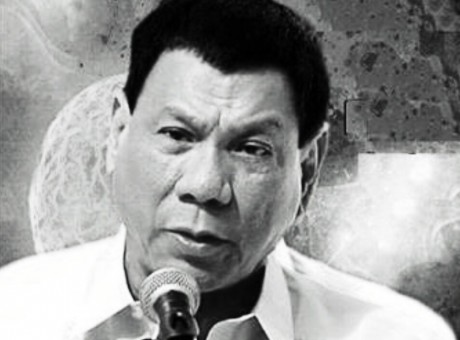
Yes, my president is DUTERTE.
 M.A.D. LIGAYA


 M.A.D. L I G A Y A