Of Stories and Storytelling

I was once asked to be one of the judges in a “short film” competition. When the board of judges convened to discuss the results, one member was surprised by my choice of winners. To my chagrin, he asked me this question – “Do you really know what a story is? I was unsure if he was kidding then, especially since his list of winners is completely different from mine.

That question made me reflect. Do I really know what a story is?

Of course, I do.

That surprising comment inspired me to write something about stories and storytelling.

It gave me chills when I got to this part of this article. I imagined Montressor knocking off the neck of a bottle of wine and offering it to Fortunato as they descend to the catacombs of the Montressors with the intention of inebriating the latter so he could consummate a fatal revenge on him because of past insults.

Let me begin by saying that I love stories… like Edgar Allan Poe’s “The Cask of Amontillado,” a part of which I described in the previous paragraph. I am so fascinated by them. Very likely that my having earned the degree Bachelor of Arts in English and my having completed the academic requirements for the degree Master of Arts in English contributed to that. The two main fields of study (major) in both degrees are English language and literature, but more on literature. We studied, among other things, the different forms of literature – prose and poetry, the body of literature of selected countries, literary criticism, philosophy of literature, and creative writing. Just imagine how many stories I had to read when I was enrolled in subjects like Short Stories, Novels, Drama, and Shakespeare. To enhance my understanding of the stories I was reading then, I had to watch their screen adaptation (especially of Shakespeare’s famous plays) if they happened to be available. In short, I became interested in stories, not as a hobby. I studied them. I taught Literature and Literary Criticism when I was teaching in the Philippines. By the way, I also worked so hard to become a writer. I write dramatic monologues, short stories, novels, and plays. Check my website for some of my works – madligaya.com.

I am so fascinated by the art of knitting together the elements of fiction within the frame of a plot – of how to make sure that the most important element of fiction – conflict – is laid down clearly and passes through exposition, complication, crisis (commonly known as climax), falling action, and resolution. Gustav Freitag, a nineteenth-century German critic, laid this down in what came to be known as the Freitag Pyramid. Crisis – or climax – is at the top of the pyramid. The exposition and complication constitute the rising action that ultimately leads to the crisis. Thereafter is the falling action, which leads ultimately to the resolution or the denouement. Some stories (movies) abruptly end when the climax is reached. In cases like this, the crisis implies a resolution. The resolution is left for the readers to deduce.

When a series of events is not laid down in the conflict-crisis-resolution arc, they are but just that – series of events, not a story. Conflict, crisis, and resolution (call them together as a plot) are the necessary features of a story. To be classified as a story, a narrative requires more than setting, character, theme, point-of-view, tone, and style. No matter how short or long a story is, there should be a conflict, conflict that progresses from the time it is revealed (exposition), becomes complicated, reaches a climax (referred to as crisis earlier), slows down to a falling action, and makes a full stop at the juncture called resolution. Am I right? As I articulated earlier, a writer may stop raising the action right after reaching the climax to let readers imagine how it ends or create the kind of ending they desire.

In movies (or films), cliffhanger endings have become so popular. In cliffhangers, it can be argued that the story does not immediately end after the climax but somewhere between the falling action and the resolution. There was no clear resolution. It can be argued also that cliffhanger endings are applicable only in the case of standalone movies, not serialized ones like Star Wars, Avengers, and the like. When for example, Thanos (in Avengers: Infinity War)  snapped his fingers, and some of the Avengers were reduced to dust,  we were left hanging and wondering why all those heroes we used to see alive and victorious in previous Marvel movies died or disappeared. But it’s not a cliffhanger ending per se because we know that that movie is the 3rd part of the main 4-part Avengers series. We know that the last part of the series is forthcoming. All the Avengers movies and the other standalone Marvel hero movies in previous years are part of one whole story.

You might ask, “Where are the events in Avengers 3 located in the Freitag (plot) Pyramid?” It’s in the complication (or rising action part), far away yet from the climax. Your next question might be – “Which part of Avengers 4 is the climax?” It started when Tony Starks snapped his fingers and said, “I am Iron Man,” culminating at the moment Thanos slowly turned to dust. All the events that followed are parts of a very clear falling action and resolution.

What do you think? Am I right not to consider the endings of serialized stories as cliffhanger endings (because of the imaginary “To be continued”)? 

An example of a movie with a climax and a falling action but the resolution was unclear, and the audience needed to decide what to think about it is how the movie “Don’t Breathe” ends. (I hope you have watched that movie, too… and in case you haven’t, I am sorry if this part of my article will now serve as a spoiler. Just skip reading the rest of this paragraph and proceed to the next one, in case you plan to watch the movie.) The climax of that movie came at exactly the 1:20:43 mark. The blind man, after Rocky, hits him repeatedly in the head with a crowbar, falls from the 1st floor of the house to the basement. Part of the falling action shows Rocky coming out of the house alive with the blind man’s money. Later she could be seen with her sister leaving Detroit for California. The movie ends showing that the blind man is alive. He survived. And I was left formulating my own resolution… or is a sequel (or a prequel)  being planned?

I used to teach Literature, Creative Writing, and Literary Criticism in the Philippines. One of my students asked this question: Should all stories conflict?

If you were me then, how would you answer?

Can a series of events stitched up together in any form be considered a story without a central conflict?

From Janet Burroway’s “Writing Fiction: A Guide To Narrative Craft”:

“And the story is a form of literature. Like a face, it has necessary features in a necessary harmony… Every face has two eyes, a nose between them, a mouth below; a forehead, two cheeks, two ears, and a jaw. If a face is missing one of these features, you may say, ‘I love this face in spite of its lacking nose,’ but you must acknowledge that in spite. You can’t simply say, ‘This is a wonderful face.’

The same is true of a story. You might say, ‘I love this piece even though there’s no crisis action in it.’ You can’t say, ‘This is a wonderful story.’

Fortunately, the story form’s necessary features are fewer than a face’s. They are conflict, crisis, and resolution.

Conflict is the first encountered and the fundamental element of fiction, necessary because, in literature, only trouble is interesting.”

Let the foregoing paragraphs be my answer to the question, “Should all stories have conflict?”

If a narrative has no conflict, don’t call it a story. Call it a face without any part that should be there – eyes, nose, mouth, cheeks, or forehead.

Part 2

Kapag Tumibok Ang Puso

REMEMBERING MY DAD

I sorely miss the best dad in the world. My pop.

My dad was a clever, good-looking Batangueño with great humor. That’s the best way to describe him.
He was a merchant. He would buy different products (clothes, kitchen utensils, blankets, mosquito nets, etc.) from Divisoria and sell them in far-flung barrios (villages) in the provinces of Central and Northern Luzon. He would bring me along occasionally, especially during summertime. His capability to interact with people, make them laugh, and convince them to buy fascinated me. There were times when my father challenged me to initiate and close deals. I tried so hard to copy his excellent business acumen.

Aside from teaching me how to communicate with customers, my dad also impressed upon me when I accompanied him in his business sorties the values of hard work and patience. We sweated, huffed, and puffed as we carried the products he was selling and walked together through muddy rice paddies to reach the homes of potential customers in places that the vehicle he hired could not reach. This was how I realized that whatever we want in life will not be served on a silver platter.


My dad was the reason why I developed a fondness for reading. He was a voracious reader. He would read three newspapers daily – Bulletin Today (now Manila Bulletin), Tempo, and Balita. He did not spend a day in high school but was so good at English. He was my first English teacher.

He was also why I included “teaching overseas” among my career options. In the late 1990s, when I informed my dad that I was about to complete my Master’s, he asked, “How much would your additional degree add to your monthly salary?” I gave him a rough estimate of my monthly pay should I get that graduate degree. He shook his head and told me that my cousins (and the husband of a cousin) who have no Master’s but are working as seamen are receiving salaries three (3) to five (5) times higher than mine.

My dad, due to circumstances beyond his control when he was young, could not get a college diploma. But he valued education. He was the one who pushed (and helped) me to get a college diploma.

He was also why I included “teaching overseas” among my career options. One night in the late 1990s, when my dad visited me in my flat, I informed him that I was about to complete my Master’s; he asked, “How much would your additional degree add to your monthly salary?” I gave him a rough estimate of my monthly pay should I get that graduate degree. He shook his head and told me that my cousins (and the husband of a cousin) who have no Master’s but are working as seamen are receiving salaries three (3) to five (5) times higher than mine.

My dad did not underestimate the degree I was about to earn. He merely challenged me to maximize the returns of whatever degrees I earned. That night, I revisited my career path and included ESL teaching abroad as an option.

My coming here to South Korea to teach was not an overnight decision; it was part of a plan that my dad influenced.

I love you, Dad!

My “Reconfigured” YouTube Channel

My primary goal with this channel is to appeal to viewers to embrace self-improvement to reach their full potential. I believe people will succeed, have good overall health, and find happiness only when they become their best version. To strive to be the best is a perfect duty toward oneself.

This channel also features my creative and academic works in English and Filipino. It is also one of the platforms I am using to share my expertise as a teacher and my experiences as an expat working and living here in South Korea. I have three passions – teaching, writing, and learning.

I am a Filipino currently residing and teaching in South Korea. I blog and vlog the things I write. I have three websites and two YouTube channels where I publish my works in my areas of interest. I also use Wattpad and Pinterest to publish my creative works. I am into research as well. Some of my articles were presented at conferences and published in indexed journals.

TO GOD BE THE GLORY!

__________

Please check my websites also:

https://madligaya.com/

https://chingligaya.wordpress.com/

http://www.tonyligaya.com/

You can read some of my stories here:

https://wattpad.com/user/madligaya

You can see the PINS of the poems I have written here:

https://www.pinterest.co.kr/madligaya

I Write, Therefore I am

People write for countless reasons, and I have my own reasons.

Let me answer the question – “Why do I write?

Is it to impress?

I don’t write to impress, and my writing skills are nowhere near excellent. It seems to me that I am not even halfway through my journey to excellence in writing. But I am sure I’ll get there before I breathe my last. The road that leads to the door of excellence has always been “long and winding.” It stretches up into the hills of challenges and down to the valleys covered with trees and undergrowth of uncertainties. Robert Frost best describes it as “the road not taken.” But I decided to travel on it.

Let me go back to the question – Why do I write?

Do I write in the hope that I earn money and become famous?

Maybe.

Becoming famous and earning money are not my primary reasons for writing. Of course, I need money, and it’s hypocritical to say that I don’t like to have other numbers to the farthest north of the first digit in my bank account.

But can writing earn you money?

Writing is very financially rewarding, especially if you are a scriptwriter of one of the popular TV networks or movie outfits in your own country or a novelist who belongs in the league of the likes of J.K. Rowling, Dan Brown, and Stephen King.

Yes, I am also earning from writing. It’s actually my secondary source of income. I got paid for some of the articles or papers I have written. When I began writing when I was young, I did not expect that someday it would be an additional source of income for me. Like the skeptics, I used to think that “there’s no money in writing.” Of course, that’s not true.

The university where I am employed gives additional evaluation points and offers cash incentives to professors for research works published in international (indexed) journals. Professors can also opt to apply for research grants, and we can get research funds and ensure the paper is published within 2 to 3 years. The money they offer is quite handsome, making writing the research more than worth it. They also give an honorarium for articles contributed to the school’s publication in English.

I wouldn’t pass up the opportunity to hone my skills as a writer and researcher, to possibly add to the sum of existing knowledge, to have my works read, and to even get paid in the process. So, I have been publishing papers in international journals and contributing articles to our university publication. In addition, I have been doing it (the publication of research papers) because university professors are supposed to publish. Our university does not require us to do so, but I consider publishing a “professional obligation.”

Once in a while, some individuals would also commission me for writing jobs. Sometimes I did it for free if the ones asking for help were loved ones and friends dear to me. There were also times that I was promised remunerations for what I wrote but didn’t get any. I was also duped once by an online news organization that did not pay me a single cent for the articles I wrote for them.

I consider the cash incentives as my reward for doing what I love doing – writing. But it’s not all about money, which is not why I write.

The rewards that writing gives, for me, are hard to quantify. Such rewards are transcendental. That’s not me trying to sound spiritual or philosophical, and that’s just the way I feel about it.
What about fame? What about the accolades? Are those the things that inspire me to write?
No!

As a matter of fact, when I write and allow people to read my works, I am unnecessarily putting myself under the microscope. I am putting myself in the line of fire if among my readers, there are unforgiving members of the grammar police who wouldn’t hesitate to shoot on sight anyone whose spoken and written English are perforated with grammar errors. When they start firing, you can not hide. My missing the comma between the words “if” and “among” in the previous sentence is something they could not miss. What about you? Did you notice it?

So, instead of accolades, I may get negative comments.  This is why a friend said he would never write for any publication or post any of his writings on social networking sites. He is afraid he may not be able to take negative comments. He added he fears committing grammar errors, and he considers it embarrassing to be corrected for such mistakes.

In my case, criticisms and corrections are welcome. I won’t die if I commit grammatical errors and be criticized and corrected. As a matter of fact, I have already received a lot of those, and here I am – still alive and kicking. I don’t mind if somebody calls my attention for mistakes I committed. Just break it to me gently and constructively… please. But it’s okay if you do so otherwise. I just have to put it down to experience and continue writing.

The reason erasers were invented and computer keyboards have backspace and delete keys is… nobody’s perfect.
I keep rereading my stuff, mainly those published on my website and social media accounts, to correct and improve possible errors.

People may read or disregard what I write. If they do read, a million thanks. If not – no hard feelings. And for reaching this far into my essay, I want to thank you. Please continue reading.
I received some excellent comments from my friends for some of my writings in the past. But, of course, those comments may have been either meritorious or simply generous. Sometimes some people give positive and encouraging compliments and thanks to them.

But aside from good comments, some of my works have also angered some offended individuals, thinking that what I wrote pertained to them. Writing sometimes is a magnet for trouble, and the journalists who are either killed or missing until now are proof.

I remember pretty well when I wrote a satirical poem in Filipino (about a wolf in sheep’s clothing) when I was working at a college run by a religious congregation. The parish priest who felt alluded to (and I was really alluding to him) reportedly asked my superior, a nun, to summon me to the latter’s office so he could talk to me about what I wrote. However, he was dissuaded from pursuing his request. But I wouldn’t agree to see him even if he could convince my superior. Why? That poem I wrote, and my act of writing it had nothing to do with my employment. My being a writer has no personality and office that could be connected to any of the lines that run vertically and horizontally in our organizational chart. In short, the priest had no authority over me. The priest never bugged me again, but I wrote another poem for him (Habit and Habit).

My quatrains (in Filipino) are the ones that brought me some colorful moments. I have lost a friend or two (Or is it three?… perhaps more) for the quatrains I have posted on a social networking site. I once wrote a quatrain, and a friend “liked” it. Almost a year later, I re-posted the same quatrain, and surprisingly, the same person who previously liked it was angered and gave me a mouthful. His wife joined the fray. The two of them ganged up on me. We’re friends, so we talked about it. He understood, apologized, and we both forgot about it since then.

Also, my writings where my political beliefs are on full display had me losing very dear friends.

So, why do I write then?

Is it for the “likes,” “reactions,” and compliments I get when I post those poems, stories, and essays on my social networking accounts or this website?

Not also.

Of course, those things make me happy, and I am so thankful for those friends who take the time to read my works and then even react and comment on them.

Then, why? Why do I write?

It’s tough to explain. It combines the answers to the following questions: Why do people need to eat when hungry? Why do they need to drink when they are thirsty? Why do they need to take medicine when they are sick? Why do they laugh? Why do they cry?

There is a kind of hunger within me that only writing can satisfy. There’s an insatiable thirst in my soul that would go away only when I read what I write. I suffer from a very mysterious illness that goes away only when I write in sentences or verses the equivalent words of the thoughts and feelings that drown me during quiet moments in my life.

Writing is my endorphin.

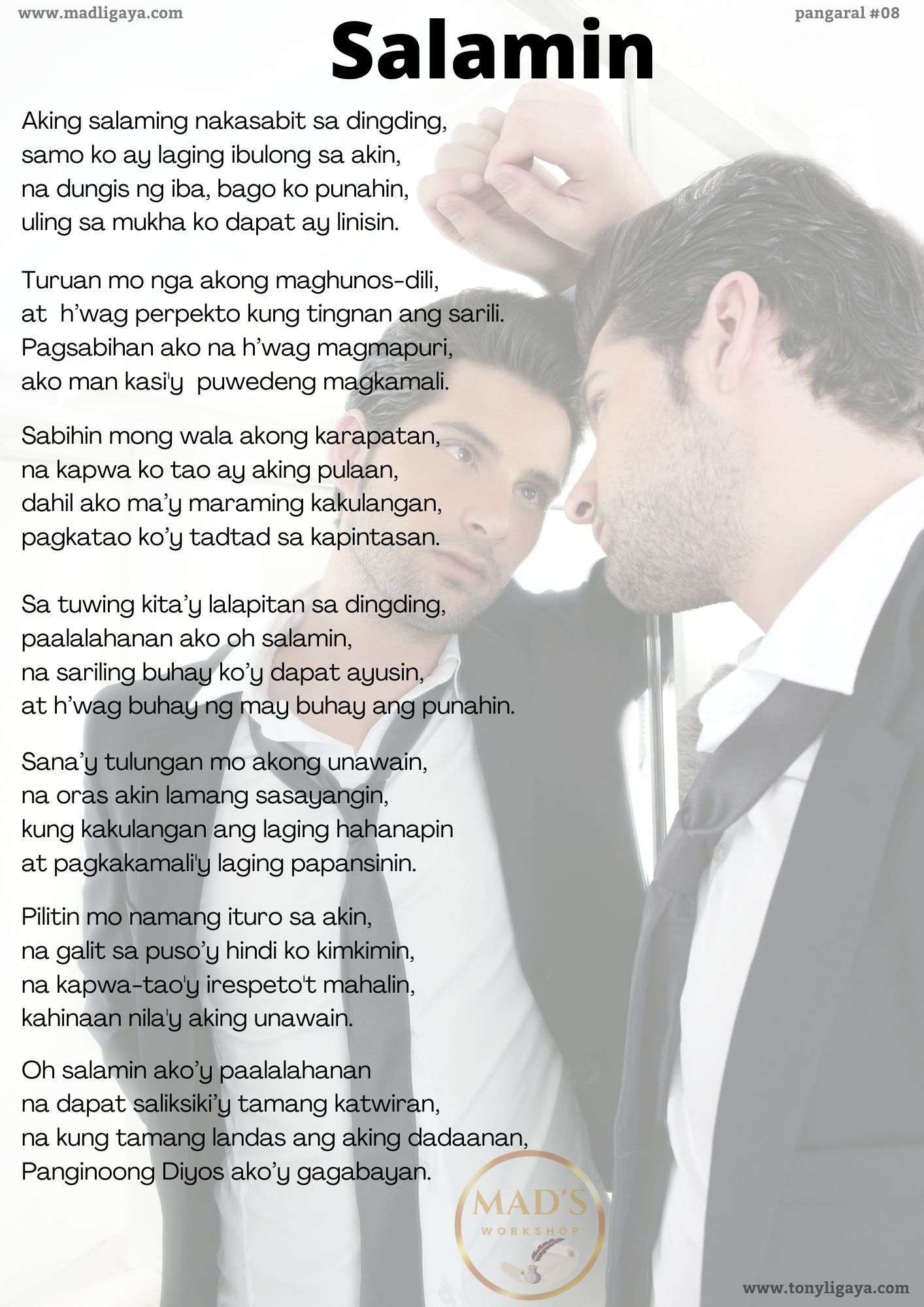
I must release my pain, anger, and disagreement by writing about them, or they will endlessly haunt me. When I feel wronged, I have to respond, not by violent means. I respond creatively – through poems – sometimes satirical. I usually do it using anthropomorphism.

If the spirits of William Shakespeare and Elizabeth Browning, I could not summon through the glass to inspire me to express in poetry whatever I wish to say, then I turn to Francis Bacon and Michel de Montaigne’s way of capturing into words – essays – whatever it is that I want to convey. If I don’t wish to be so direct with my points and would like to hide my feelings and thoughts between lines and behind symbolism, then I walked the path that Edgar Allan Poe and Guy de Maupassant paved. I write stories.
I just don’t keep quiet when I notice human follies displayed by my loved ones, friends, and other people around me. Again, I resort to anthropomorphism and use animals to represent their irrationality. It may hurt and make them angry, but the truth may be bitter but sweeter than the sweetest lie. VERO NIHIL VERIUS. Nothing is truer than the truth.
This is not to say that I am a perfect human being, and I am as imperfect as anyone else and may have, perhaps, done more terrible things. Thus, the satires I wrote are like boomerangs and sometimes hit me.

Pain is like a prison cell. It is by writing that I break free from that hell. As my heart churns out the words, I go through the pain, feel it,  not escape it. And the pain vanishes as I write the final sentence or verse and put the final punctuation mark.

Even my happiness and satisfaction wouldn’t be complete if I did not write about them. I need to capture those moments in either prose or poetry to feel the joy they bring more deeply. I write about them so I can relive those moments whenever I wish.

I need neither material rewards nor accolades for what I have written (and will be writing.) The rewards are the essays, plays, poems, research works, and stories I created. I love and treasure them.

I write not to impress but to express my thoughts, feelings, and ideals. Writing is my freedom, my happiness.  In the dictum “I think, therefore I am,” Descartes argued that whenever he thinks, he exists.” In like manner, when I write, I become more aware of my existence. No matter how simple, what I write gives me a sense of fulfillment.

SCRIBO, ERGO SUM. I write; therefore, I am.

Mirage

Sounds of the Trail