“Please Teach Me English!” (2)
(Second of Three Parts)

I’ve realized that getting into K-pop and K-drama has been beneficial for me. It has provided me with valuable insights into the nature and culture of my Korean students even before I taught my first class in their country. Watching the movie “Please Teach Me English” has also been helpful.
The Young-jus and Jang-hyuks
The students in the movie are not regular enrollees in basic education institutions or universities. They are professionals enrolled in what looks like a hagwon (or it could be an adult education center of a university). In reality, classes in hagwons could be a mixture of students and working people.
Through the characters in the romantic-comedy film, I learned in advance about the different types of Korean students and their reasons for learning the language. The students in the movie had to choose English names, like Candy for Young-ju and Elvis for Jang-hyuk. Other students in Catherine’s class had English names like Betty, Julie, Tyson, and Richard, but their real Korean names were not revealed in the movie. I followed Catherine’s example in my classes. I also had my students adopt English names. Most embraced the idea, but some, like Young-ju, were hesitant. When I asked them to adopt an English name in one of my classes, a student suggested I should also have a Korean name. That student named me Hyeong. When I asked why he chose that name for me, he said the word means “big brother” in English, and that’s how he considered me.
The film emphasizes the reasons why Korean students take English classes. Young-ju was chosen to take the class because the head of the government office where she works made it mandatory. Someone in their office must learn English to effectively deal with foreigners.
Around the time the movie was released, the Korean government began to acknowledge the growing interconnectedness of global economies and cultures. South Koreans are actively engaged in international trade, exporting products as well as pop culture, entertainment, music, TV dramas, and movies. They recognize that success in business and international relations relies on establishing connections with the outside world, which necessitates the ability to communicate in English.
Language experts have identified two types of motivation for learning a language: instrumental and integrative. As contextualized in the movie, instrumental motivation is learning for practical reasons, while integrative motivation is learning to connect with others.
Those who are instrumentally motivated to learn a language, like Young-ju, do so to obtain essential qualifications and to improve career prospects. On the other hand, Jang-hyuk is integratively motivated to learn English. He wants to learn the language because his long-lost English-speaking sister, who cannot speak Korean, is visiting South Korea to meet him and their mother. His intention is to be able to “socialize” with somebody who does not speak his native tongue.
Many of my Korean students, like Young-ju, are instrumentally motivated. They aim to obtain the required scores for their English course or to meet specific academic or job requirements rather than to effectively communicate and engage with people from different cultures who speak a different language.
Like Young-ju, Richard is instrumentally motivated. His new boss is a foreigner who conducts his meetings in English. Thus, he must learn the language, even if it’s difficult given his old age. Julie’s reason is akin to Jang-hyuk’s. She is going to migrate to the US soon. The film does not have enough information to help determine Betty and Tyson’s motivation for taking the language course. But Betty seems to enjoy attending English classes, for where Catherine teaches is already her nineteenth school.
The movie also reveals specific characteristics of Korean learners when it comes to language learning. There was one instance when Julie and Betty disagreed with Catherine’s teaching style. They demanded that their teacher do away with preliminary activities or introductions and focus on the primary language skills they wanted to acquire. It is hard to determine if this indicates their impatience or desire to learn only the primary language skills they signed up for. This incident may be unfortunate, as it goes against a trait Koreans are known for – respect for elders and persons in authority. However, it reminds me of what every teacher must bear in mind – that students have expectations that must be met.
What The Students Expect
Before embarking on my journey as an English teacher in South Korea, I read a lot about the country’s culture and people. As an English teacher who would soon teach Korean students, I felt it incumbent upon me to study their culture because of some cultural nuances that may affect or influence my communication with them.
I have watched several K-dramas such as Jewel in the Palace, Stairway to Heaven, Lovers in Paris, Winter Sonata, and Baker King. These shows have taught me a great deal about the people of South Korea. The movie “Please Teach Me English” also gave me insights into Korean students. Furthermore, our TESOL supervisor shared tips on effectively working with ESL/EFL students.
It’s not enough to be guided by the apparent truth that students want to learn and expect their teachers to guide them in their learning journey. Yes, I had been a teacher in the Philippines for over two decades before I came to South Korea. However, students in those countries are of a different breed of learners.
The information the film provided about the characteristics of Korean learners is obviously not enough. So, as I taught during the first weeks of my classes, I took the opportunity to observe my students and determine their tendencies and habits, strengths, and weaknesses.
Korean students have a strong foundation in grammar. They pay more attention to the discussion of grammar points than other topics. They expect their teachers to give them grammatical rules, structures, and many grammar exercises. They tend to understand what they are being taught when presented to them in structural form. This group of learners pays close attention to details and can quickly determine grammar and spelling mistakes. However, they struggle with spoken fluency. As much as they prioritize grammatical accuracy, their speaking proficiency was paid less attention. This makes them feel less confident (or unconfident) in speaking English. My students are aware of this and want me to help them develop confidence in speaking.
Considering that they are from a technologically advanced country, Korean students are highly skilled in using digital tools and accessing online resources for learning. Being so, they expect their teachers to incorporate technology in the classroom; without it, they tend to lose interest. Therefore, I have had to adapt and stay current with the latest educational technologies. For instance, I have transitioned to using Google Forms for assessments instead of traditional paper-based exams. Additionally, I have set up individual Google folders for each student to submit their assignments and other requirements. My presentations need to be visually stimulating as well.
Many of them are highly motivated to excel in English because, as mentioned earlier, they understand its significance in business and international relations. As a result, they persist in their efforts to learn the language and expect to succeed at any cost. Their desire to learn the language sometimes borders on desperation. This is illustrated in a scene in the movie where Young-ju (and another character on a bus) is seen chewing and swallowing pages of a dictionary. It is hard to determine whether that is just a symbolic illustration of their fervent desire to learn the language or if it happened.
I found out that it is true that Korean students, like the rest of their compatriots, demonstrate politeness and respect. In the movie, it may have seemed that Betty and Julie were not polite when arguing with their English teacher. However, Catherine was at fault for repeatedly committing a faux pas by forgetting to include politeness when she talked to her students in Korean. Yes, Catherine is the teacher, but most of her students are adults, and some are even older than she is. This part of the movie may remind foreign teachers that cultural norms regarding social etiquette and English-speaking cultures’ formality levels are different from theirs. Tyson, the most sensible among Catherine’s students, tried to find a way to point this out to their teacher nicely. He advised Catherine to include honorifics if she insists on using Korean when talking to them.
Catherine followed Tyson’s advice. She started including honorifics whenever she used the Korean language, much to the delight of her students. What she did improved communication between her and the students. Their rapport resulted in Catherine enjoying teaching and the students having fun learning.
Establishing A Good Rapport
The film “Please Teach Me English” underscored the importance of rapport. Establishing a harmonious relationship with students is essential in Korean ESL/EFL classrooms. Creating a good rapport between me and my students is something I learned as a teacher a long time ago. I have also read many studies that found that students tend to perform better academically when their teachers establish a good rapport with them. It is one of the foundations of effective learning in any subject area, including English.
I always prioritize building a positive relationship with my students regardless of where I teach. As a foreigner in South Korea, this can be more challenging, so I make a conscious effort to earn the trust of my Korean students. I take special care in planning the class orientation to establish a strong partnership with my students. It’s not just a simple introduction to the course but a foundation for a constructive relationship.
In addition to introducing myself and going over the course content and requirements, I need to establish a good rapport with my students, clarify any misconceptions about the classroom and the teacher, debunk any myths about ESL/EFL teaching, and deliver an encouraging speech to motivate them for the upcoming semester. Together, these elements constitute the script I use religiously when meeting my classes for the first time in a semester.
During the initial meeting, my goal would be to achieve one of the most challenging educational tasks: to change the students’ perception of the classroom as a prison cell, with them as inmates and the teachers as harsh prison guards. Traditionally, Korean students hold a high level of respect for teachers, often seeing them as authoritative figures in the classroom. While this is good for maintaining order and discipline in the class, it can have adverse effects as it affects the development of critical thinking and creativity. My students are reluctant to ask questions, thinking that doing so is disrespectful. Rarely did they participate in discussions, even if they knew the answer to my questions. They would not volunteer to answer, so I had to call on them.
Students deferring too much to their teachers kills their creativity and makes instruction teacher-centered instead of student-centered, which reduces their engagement and motivation. They become overly dependent on their teachers.
I ensured the students felt comfortable in my presence at our first meeting. I emphasized that I am not a “sage on the stage” but rather a “guide on the side,” always ready to assist them. I encouraged them to ask questions, seek clarification, and actively participate in discussions.
Like Catherine, the teacher in the movie, I consciously try to build a positive connection with my Korean students. The first day of class is the perfect opportunity to establish this connection, especially as an expat teacher working with students for whom English is a second or foreign language. Through my research, I discovered that students’ speaking ability is influenced by their attitude towards foreign English teachers. This reinforced my belief that students are more motivated to learn when they perceive their teachers as approachable, friendly, and caring. It solidified my determination to deliver course content and prioritize building a rapport with my students. Just like a farmer must prepare the soil before planting seeds, I understand that gaining the trust and confidence of my students is crucial. Teaching students without establishing a positive relationship with them is akin to sowing seeds on unprepared soil.
Like Catherine, ESL/EFL teachers need to be adaptable and open-minded. When she followed Tyson’s advice to behave and speak in a way acceptable to Koreans, her students began to enjoy her class and became more engaged and interactive. This illustrates that foreign teachers, like myself, must consider cultural nuances when interacting with Korean students. We must learn quickly and try to understand their specific communication styles and social norms.
The whole semester is a marathon, and I believe that by first winning my students’ hearts, our journey together in language learning will be as enjoyable and productive as possible. Gaining their trust means that half of the battle is already won.
Establishing rapport with my students is more complicated due to our cultural barrier. Before I can start teaching, I need to put in more effort than my local counterparts. The cultural barrier immediately arose when I entered the classroom during our first meeting. This barrier makes the students anxious, as they don’t know what to expect from me as their English teacher from a foreign land. The student’s level of English proficiency could add to their anxiety. The lower their language ability, the more uncomfortable they would feel dealing with me. Therefore, I must set the right tone during my class orientation, ensuring my students feel comfortable and confident when interacting with me. Achieving this depends on how I present myself to them the first time we meet. Thus, I must make a good account of myself.
I always strive to make the first day of class memorable wherever I teach, and that’s no different here in South Korea. But here, I have added a new task to my routine during class orientations – to destroy a fallacy, which I will explain in the next section. The rest of my introduction is the same as usual; I present the course contents and requirements. The only difference is that I incorporate humor into my presentation. Those who know me say I have a strong sense of humor and a knack for making people laugh. I use humor as a tool in my teaching because I know it effectively captures students’ attention and makes the learning experience more enjoyable.
I create a relaxed and enjoyable atmosphere when introducing myself to my students during our first meeting. As I previously mentioned, one of my immediate objectives as a teacher is to help the students not feel that the classroom is a prison cell and I am a jail guard. Thus, I would never miss presenting and explaining my educational philosophy to them – “The classroom is my playground. The students are my playmates, and the subject I teach is our toy.” I know it’s unconventional, but I find it to be practical. My students here in South Korea seem to enjoy this approach to teaching as much as my students in the Philippines do.
My self-introduction would always include telling my students the nickname I adopted to elicit laughter whenever I deliver a talk. It’s Tony-Tony-Bo-Bony- Banana-Fanna-Fo-Fony-Fee-Fi-Mo-Mony-Tony. Yes, that’s taken from the song “Name Game” by Laura Branigan. I say that with the exact tune from the song – twice, sometimes thrice. Some students would smile. A few would laugh. I am not sure if that is because of the way I introduce myself or the way I sing.
It is incredible how when I tell my students my long nickname and jokingly threaten them to memorize it, or they will fail in my subject, they try very hard to repeat it after me. If they can’t say it, they laugh at themselves. I always add, “Whoever can say my nickname correctly will get an A+.” Of course, I don’t mean it. Luckily, no one has succeeded in saying it correctly so far. It’s always me who succeeds – in getting their attention.
When I have their attention, that’s the time I would try to debunk a myth.
“Please Teach Me English!” (1)
(First of Three Parts)

“I don’t speak English well… please teach me.” One or two of my Korean students would tell me this (or a similar statement) in broken English at the end of our first meeting or any class as the semester progressed. Their voice and how they said it straddled between surrender and supplication. I cannot recall a semester where I did not hear something similar to that sentence. It reminds me of the first Korean movie I watched, “Please Teach Me English,” a romantic comedy film. It was recommended by the instructor who supervised the Teaching English to Speakers of Other Languages (TESOL) short course that I took when I decided to include teaching English overseas as one of my career options. Each enrollee in that program was given a VCD copy of the movie. Well, I watched the film not because of TESOL-related intentions but because of the increasing popularity of K-Drama and K-Pop, with which I got hooked. Little did I know that watching that movie would later influence my career path.
There is no shame in admitting that I am one of the millions who became obsessed with Korean cultural content. In short, I got drowned by the Korean Wave (Hallyu) that reached the shores of the Philippines at the turn of the 21st century. Like many of my compatriots (and people from other parts of the world), I became enamored with K-pop and K-drama. Therefore, even if our TESOL supervisor did not mention that the movie provides plenty of tips for foreign English teachers, I would watch the movie. I even revisited the film before completing the program. However, the movie only came back to my mind during my first semester of teaching here in South Korea when my students started approaching me and saying sentences similar to the movie’s title. It prompted me to vividly recall the scenes between the English teacher and her students and made me rewatch the film.
Since then, when students confide in me about their difficulties in learning English, I am reminded of the main characters, Young-ju and Jang-hyuk, in the movie. These characters embody the excitement and struggles many Koreans face while learning English. One scene that particularly stands out is when Young-ju is seen eating pages from a dictionary in hopes of improving her vocabulary. This desperation is a testament to the lengths that some Koreans will go to master the English language.
The English teacher in the story is named Catherine, a native speaker of English from Australia. After watching the movie again, her interactions with students came to mind when I held my classes. Catherine tried to speak Korean to communicate better with her students, which is something I struggle with.
The movie provides insight into the English education system in South Korea. It sheds light on how Koreans perceive English learning and interact with English-speaking foreigners. The film also reveals the differing opinions on the necessity of learning the language. Despite being released in 2003, it still accurately portrays the current realities of English education in South Korea and their belief that English is essential for upward social and economic mobility. It also gave me a deeper understanding of life in Korea and the Korean psyche. The movie succeeded in reconfiguring my “Korean Dream.”
My “Korean Dream”
The constant influx of Korean content in my country’s print and broadcast media sparked a deep interest in the history and culture of South Korea within me. In addition to watching K-dramas on TV, I actively sought out Korean-related materials on the internet and read encyclopedia entries about the country south of the 38th parallel line. Gradually, I found myself becoming more and more immersed in Korean culture. Instead of using traditional greetings like “hello” and “thank you,” I began using “annyeonghaseyo” and “gamsahamnida.” When expressing deep affection, I started saying “saranghaeyo” instead of “I love you.” I even began singing Korean songs and desired to try their food, particularly the legendary Kimchi. Over time, my interest in everything related to Korea grew.
The cultural influences of South Korea on my homeland have ignited a strong desire within me to visit the country and explore the locations featured in TV shows and movies. I have always wanted to come here to fulfill that desire. I had many plans for my trip, such as riding the subway system in Seoul, strolling through Myeongdong at night and trying street food, spending my summer vacation on the beautiful island of Jeju, tasting soju and maekju, and trying the unique combination of the two, known as somaek. I also looked forward to savoring Korean dishes prepared by local chefs, wearing traditional hanbok outfits, and immersing myself in the culture by interacting with native Korean people. This is how my dream of experiencing Korea began and has become deeply rooted in my mind.
After watching the movie “Please Teach Me English,” I dreamt of teaching English in South Korea. Initially, I wanted to teach English at a university in the Middle East, but then I started thinking, why not teach in the country I have been fascinated with for so long? My dream of visiting South Korea as a tourist turned into a desire to live and work here.
When I was training for TESOL, I was then experiencing severe burnout from years of work as a school administrator. It did not help that I was confronted by personal demons at the same time. That personal circumstance required that I make not only a change in my career but also in my environment. That’s when I decided to apply for a position as an English teacher here in South Korea. This country is a popular destination for English teachers due to the attractive salaries and excellent benefits. However, there is intense competition among native English speakers for teaching positions in schools and hagwons (private academies). Non-native English speakers encounter even more tremendous obstacles in securing these positions, and their prospects of landing a teaching role in the language department of a South Korean university are slim. It’s like trying to find a needle in a haystack. If you’re not a citizen of a country that belongs to the inner circle of the concentric circles model of the English language, it’s nearly impossible to get hired.
I couldn’t believe it when, for the first time, I read in an advertisement for ESL/EFL teachers the lines “Only native speakers of English may apply!”. I thought it was a prank. But it wasn’t. Why native speakers of English are accorded that preference or almost an exclusive right to teach Korean students is unfathomable. Fortunate and privileged are the “Catherines” of the world.
Blessed “Catherines”
When I began searching for teaching positions abroad, I noticed numerous job openings for English teachers in South Korea. However, I was disappointed to find very few opportunities for non-native English speakers like myself, while there were many for native speakers like the character named Catherine in the movie. I couldn’t help but grudgingly think that being a “Catherine” in this world is a privilege. I was surprised to learn that many universities in Asian countries such as South Korea, China, Japan, Vietnam, and the Middle East only preferred to hire native English speakers to teach the language. I realized this policy existed when I started looking for teaching positions abroad. I never thought that native-speakerism was a real thing. In a world as diverse as ours, it seems unfair that only native English speakers can teach the language.
Is the “only native speakers of English may apply” policy fair, just, and acceptable? If I get to respond to the question, the answer is already apparent. So, I decided to seek the opinion not of a non-native English speaker or a native speaker of the language but of a neutral entity – ChatGPT.
ChatGPT explains that “being a native speaker does not necessarily equate to being a skilled language teacher. Teaching requires specific training and expertise in pedagogy and language instruction, which native speakers may not possess. Additionally, non-native speakers who have learned English as a second language often have firsthand experience with the challenges that learners face, making them empathetic and effective teachers.” It added that “the effectiveness of language teaching depends on various factors, including the qualifications, experience, and teaching approach of the instructor, rather than solely on their native speaker status. Therefore, a more inclusive approach that values expertise and diversity in language education may be a wiser policy in promoting effective language learning for all students.”
I have worked with English teachers from specific countries over the years and observed their personalities and levels of professionalism. Additionally, as a member of the hiring team at the university where I currently teach, I have gained insight into job applicants’ educational qualifications and training. As shown in their CVs, some who tried to apply for a teaching position in our university are legitimate and qualified ESL/EFL teachers, but some were hired mainly because of their country of origin. They have been teaching in South Korea for a long time but are not English majors and have not graduated from courses aligned with education and language teaching. If only I could take the liberty to spill (all of) the beans.
It’s puzzling why most universities in South Korea and other Asian countries prefer to hire only native English speakers to teach the language. This practice is a form of discrimination, and, ironically, Asians themselves deny their fellow Asians equal job opportunities. However, I didn’t give up my dream of living and working as an English teacher in South Korea. Some universities here understand that accent and country of origin should not be the criteria for hiring ESL/EFL teachers. I hoped that some universities would prioritize qualifications, training, language proficiency, and pedagogical skills over accent and country of origin when hiring English teachers.
I was right! Although few and far between, some universities in South Korea do not discriminate against non-native English speakers. I sent an application to all of them. After a challenging application process, a university offered me a teaching contract, even though I am not a “Catherine.” My dream of living and working in this country became a reality. I have been plying my trade here as an English teacher for over ten years.
If there is something else significant that the movie “Please Teach Me English” taught me, it is understanding more about the Young-jus and Jang-hyuks and how to deal with them.
My Continuing Journey In South Korea
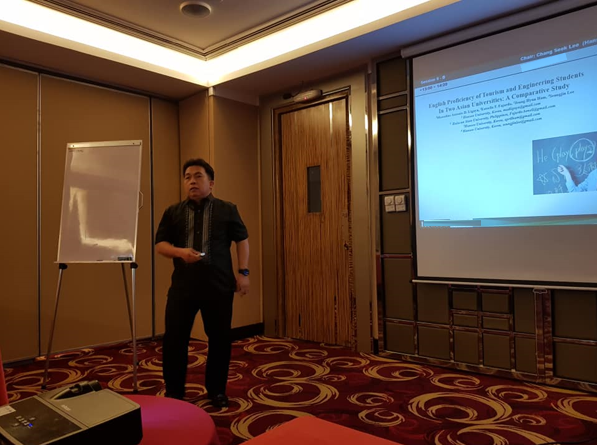
When I quit my job as a school administrator in Bulacan to pursue ESL teaching in South Korea, my loved ones and friends strongly advised me to reconsider. They reminded me that I already had a solid career in the academe in the Philippines, and the pay was decent. But as Jake Sully says in the movie Avatar, “Sometimes your whole life boils down to one insane move.”
So, in 2013, I flew to South Korea. But it wasn’t an insane move, rather a calculated risk. I have no regrets, as coming here was one of the best decisions I’ve made in my life. Working here has been an enormous blessing. This country is a beautiful place to live. When I arrived, I could confirm the impressions created by the Korean dramas and movies I had watched. Indeed, South Korea is progressive and beautiful, and its citizens are competitive, hard-working, and health-conscious.
Beyond providing financial stability for me and my family, my time in South Korea has fostered tremendous personal and professional growth. The working conditions at the university where I am currently employed are excellent. At first, I could hardly believe that I only needed to work less than 20 hours over four days. We must work only seven months but are paid for the entire year. This arrangement has given me ample time to connect virtually with my family and pursue my other passion—writing. Additionally, our university offers performance points and cash incentives for research projects, further enhancing my love for writing.
I mainly teach English subjects. There have been semesters when I was asked to teach at the graduate school and serve as an adviser to graduate students working on their dissertations. When I’m not engaged in academic work, I dedicate time to writing stories, poems, plays, and scholarly studies, many of which are published on my personal website. Several of my research studies have been presented at international conferences and published in internationally indexed journals. I have genuinely found fulfillment as a writer in this country.
I can’t imagine having any other “job cum hobby” besides teaching and writing. You may ask why. As Seth Godin said, “Do what you love and love what you do.” What I do and love is teaching, and what I love and do is writing. I use the expression “job cum hobby” because, when I engage in these activities, I don’t feel like I’m working; it feels more like pursuing hobbies.
My greatest challenge as a teacher is overcoming the cultural barrier between myself and my Korean students. I address this by building a good rapport with them and diligently fulfilling my responsibilities. Being a Filipino in ESL/EFL teaching places me and my fellow countrymen at a disadvantage. There is a common misconception that only native English speakers can teach the language, and even some of our Korean students believe this. It is something that Filipino English teachers like me must work to dispel. If I were to identify my most significant contribution as a Filipino in my profession, it would be demonstrating to the academic community in South Korea that one doesn’t need to be a native English speaker to be an effective ESL/EFL teacher.
I can’t think of anything negative about my current job; I have nothing but gratitude. I enjoy a harmonious relationship with my coworkers, both Korean and foreign. Although I occasionally clash with fellow foreigners over policy matters and work attitudes, we adhere to the principle of disagreeing without being disagreeable, which helps us maintain mutual respect.
My best advice for my fellow Filipinos working in South Korea is to work hard and respect everyone. Hard work leads to success as expat workers, while respect for others, regardless of citizenship, helps them stay out of trouble. It’s also important to abide by the laws of our host country.
Reflecting on my 12 years here, I see that what began as a leap into the unknown has become the most fulfilling chapter of my life. Teaching and writing—my two greatest passions—have flourished in this country. Embracing new challenges reminds me why I took that “calculated risk” in 2013. South Korea has provided me with opportunities to improve my overall well-being and has reaffirmed my belief that staying true to what you love leads to rewarding outcomes.

The Pursuit of Well-Being (Part 2)

A holistic approach to well-being also requires embracing lifelong learning. The primary component of intellectual well-being is the desire to continuously learn and perpetually crave new ideas. Those strong in this dimension possess a sense of curiosity and the desire to develop their critical thinking and creative abilities.
On its website, dedicated to promoting well-being, the University of Virginia refers to intellectual well-being as the ability to open one’s mind to new ideas and experiences that can be applied to personal decisions, group interaction, and community betterment. It added that it also involves using one’s mental abilities meaningfully and feeling satisfied and proud of one’s educational and intellectual journey.
Awareness about how you learn and study best is vital to enhancing your intellectual well-being. You can foster this by challenging yourself and not allowing self-limiting beliefs. You will encounter setbacks and failures along the way, but treat them as opportunities for growth and development.
People with enhanced intellectual well-being are lifelong learners. Talerico (n.d.) states that they are interested in pursuing personal and professional development, such as picking up a hobby, studying a subject, learning a language, taking a vocational course, playing a sport, and joining a club. She also enumerated the benefits of lifelong learning: job security, career options, renewed motivation, stronger soft skills, better cognitive health, confidence, and networking opportunities.
__________
In addition to physical and mental well-being, the World Health Organization (WHO) considers social well-being an important dimension of overall health (Salehi et al., 2017). They identified five key domains of this dimension: social integration, social acceptance, social contribution, social actualization, and social coherence. Social wellness, or the lack of it, can significantly impact overall well-being.
Enhancing your social well-being requires building strong relationships and participating in community activities. You must cultivate positive and healthy relationships with family, friends, and colleagues. Volunteering in activities organized by your community is also an excellent way to establish new connections. Staying connected with the people in your life will help you enhance your health’s social and emotional aspects. Keep in mind that effective communication is essential in the process of establishing connections.
STRIDE (n.d.) explained that social wellness is achieved when one can create and maintain healthy, reciprocal relationships with the people around one. Positive social relationships can provide comfort and support in difficult times, increasing one’s resilience and ability to cope with life’s challenges.
It is not difficult to set a goal for social well-being. You can begin by regularly contacting friends, joining a group of people with whom you share common interests, or volunteering at community organizations that promote your advocacy.
__________
The quest for holistic well-being also involves engaging in activities that provide a feeling of purpose or productivity. At a certain point in your life, you will want a job or work where you can apply the knowledge and skills you acquired or developed. You may either apply for a job or be self-employed (or run an enterprise of your own) in your chosen field. When you finally settle into any kind of work, another dimension of your well-being is activated: your occupational well-being.
Occupational well-being is about pursuing a career that gives you a sense of purpose and fulfillment. It involves recognizing your talents and skills while seeking opportunities for personal satisfaction and growth through your work and pursuing a hobby or interest.
Sometimes, instead of contributing to overall health, having work becomes a source of stress. Instead of finding joy through it, work becomes a source of depression. Oakland University (n.d.) stressed that occupational well-being also involves achieving a healthy work-life balance, managing workplace stress, and building relationships with bosses and coworkers while integrating the commitment to your occupation into a satisfying and rewarding lifestyle. It may not be easy, but the only way to achieve occupational well-being is to learn the art of juggling your personal life and career.
__________
The occupational facet is directly tied to another dimension of well-being–financial well-being. Finding a job or pursuing a hobby or interest is done for self-fulfillment and financial stability. It can serve both purposes. The occupation that awaits you there will provide you the economic resources you must have for your basic needs and those beyond basic (healthcare, self-care, education, recreation, and what-have-you).
The CFPB (2015) defined financial well-being as a state of being wherein a person can fully meet current and ongoing financial problems, feel secure in their financial features, and make choices that allow enjoyment of life. The report added that the concept of financial well-being has four central elements: Having control over day-to-day and month-to-month finances, having the capacity to absorb a financial shock, being on track to meet your financial goals, and having the financial freedom to make the choices that allow you to enjoy life. For Kempson & Poppe (2017), this dimension of well-being refers to how individuals can comfortably meet their current commitments and needs and have financial resilience to maintain this ability.
Individual differences also affect how people determine the financial resources needed to cover necessities, settle obligations, handle emergency expenses, and fund recreational activities. A person’s level of materialism and practicality will influence the amount of money they require to achieve financial well-being.
__________
In the pursuit of overall well-being, we establish and nurture relationships with our fellow human beings, the social institutions we belong to, and our surroundings. You must preserve not only your personal relationships but also the environment. Your awareness of environmental issues, attitudes toward climate change, and willingness to adopt sustainable practices indicate your level of environmental well-being.
BU (n.d.) explains that environmental well-being involves valuing the relationship between ourselves, the spaces we live and work in, and the planet. It requires noticing and understanding how our surroundings impact our thoughts and feelings and how our actions affect the environment. This awareness enables us to make decisions promoting sustainability and respecting our community. According to STRIDE (n.d.), your sense of safety, comfort, and connection with your physical surroundings is called environmental well-being. It entails considering how your surroundings, community, and self interact.
While we may be at the top of the food chain due to our superior intelligence and the technology we have created, we must respect all of nature and the animals that inhabit it. This respect is the foundation of environmental well-being and fosters our environmental consciousness and conscientiousness. Such conscientiousness leads us to take on the role of a good steward of God’s creation rather than its destroyer.
__________
As previously articulated, Swarbrick maintains that all the dimensions of well-being are equally relevant and interdependent. However, if there’s one aspect that strongly affects all the others, it’s the spiritual dimension. While the journey toward overall wellness often begins with physical health, spiritual well-being provides a deeper sense of purpose and meaning, helping to sustain and balance the other dimensions.
The spiritual dimension is the foundation in your quest to achieve overall well-being. It will guide you through challenges and contribute to your emotional, mental, and social stability. Your spiritual inclinations will serve as the guiding force shaping your thoughts, behaviors, and attitudes in every dimension of well-being.
Najarkolaei et al. (2019) explained that spiritual well-being is a unique source that coordinates physical, mental, and social dimensions, and it is characterized by stability in life, peace, adjustment, and harmony, a sense of close relationship with oneself, God, society, and the environment.
Spirituality has a strong positive influence on the way people live. Those whose spiritual well-being is robust are better equipped to deal with difficulties and challenges in life. Faith in the existence of God gives hope when the chips are down, and assurance that helps is on the way. Puchalski (2001) mentioned that some studies indicate that spiritual people tend to have a more positive outlook and a better quality of life. This assertion was supported by the findings of the analysis performed by Casanova et al. (2023). They found a significant correlation between spiritual beliefs and hope/optimism, indicating the positive influence of spirituality on emotional well-being. Additionally, spirituality is positively associated with autonomy, highlighting its role in fostering independence in later life. They also explained that spirituality is both a coping mechanism and a source of purpose and meaning in life.
__________
With all the dimensions of well-being—physical, emotional, social, intellectual, occupational, financial, environmental, and spiritual—collectively contributing to holistic well-being, neglecting any one of them will adversely affect your journey toward living a balanced

The Pursuit of Well-Being (Part 1)

“Wellness is the complete integration of body, mind, and spirit – the realization
that everything we do, think, feel, and believe has an effect
on our state of well-being.”
~ Greg Anderson ~
To most people, being healthy is seemingly inconsequential–not a big deal. It’s not considered an achievement worthy of praise and deserving of a spot on social media. As someone once quipped, “Being healthy is a success that many people forget to celebrate.” They don’t consider not being stricken by any kind of disease or burdened by stress and anxiety a victory–a huge blessing that they should thank God for (if they believe He exists).
Virgil’s assertion that the greatest wealth is health is often disregarded. Only when we get sick and bedridden do we start to pay attention to our health or well-being. In some instances, we only do so when it’s too late, and the condition is already either difficult to reverse or not reversible at all.
Let’s not forget that pursuing your personal and professional endeavors is difficult if you’re not healthy—mind, body, and soul. Nurture your well-being before you can embark on a journey towards achieving your dreams and ambitions.
The Oxford Dictionary defines well-being as the “state of being comfortable, healthy, or happy (Oxford, n.d.). Merriam-Webster defines the construct in almost the same way except that instead of “comfortable,” it uses “prosperous” as an adjective used to explain the construct further. As Purcell (2018) explained, this concept embraces more than just physical health. It considers the entire person, both body and mind [and more]. It indicates not just the absence of illness but also the presence of positive mental states, emotions, and moods.”
Ruggeri et al. (2020) gave a more comprehensive definition of well-being. They explained that well-being is the combination of feeling good and functioning well, experiencing positive emotions such as happiness and contentment, developing one’s potential, having some control of everyone’s life, having a sense of purpose, and experiencing positive relationships. This shows that well-being goes beyond the pursuit of a healthy body. It encompasses various aspects of a person’s life, including physical, mental, emotional, spiritual, and social. A person is a physical, emotional, mental, and a spiritual being.
Engaging in activities that promote wellness can nurture well-being. Good wellness habits can contribute to a sense of well-being. This article will delve into the various wellness activities that can lead to well-being.
Wellness is the active pursuit of activities, choices, and lifestyles that lead to holistic health (Wellness Defined, n.d.). The enhancement of one’s overall well-being is the ultimate goal of engaging in activities that promote wellness.
Swarbrick (2012) explained that wellness is a conscious, deliberate process that requires a person to become aware of and make choices for a more satisfying lifestyle. She proposed a model that has been used to craft a practical framework for the pursuit of overall health. Her ‘wellness model’ (see Figure 1) is considered the gold standard for a comprehensive well-being program. Well-being programs found on the Internet have adopted this program in one way or another, wholly or in part.
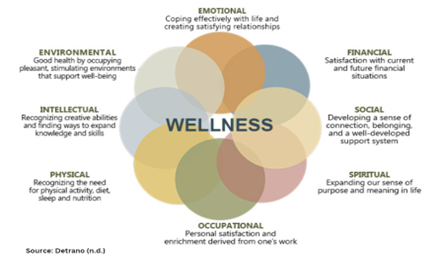
Figure 1 – Eight Dimensions of Well-Being
The model illustrates the different dimensions interlocked in circles to demonstrate their connection and interdependence. Swarbrick proposed that wellness should be approached holistically. You should not focus solely on specific dimensions while neglecting others. A meaningful wellness program aimed at maximizing your overall well-being requires that each dimension be given due consideration. You need to become familiar with each dimension and give them proper attention.
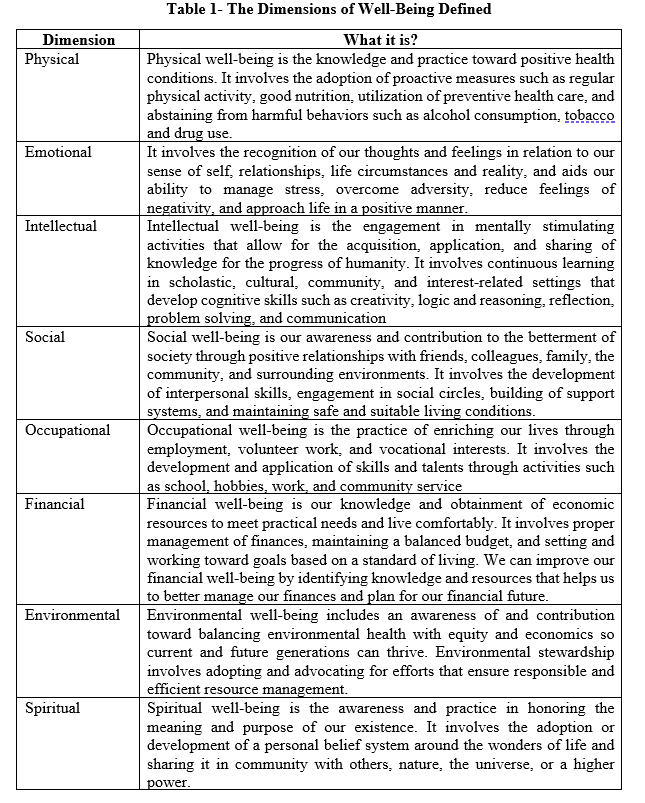
The definitions/explanations of each dimension shown in Table 1 were compiled by the University of Pittsburg on its website, which caters to well-being.
While all eight dimensions are equally important and should receive proper attention, overall well-being should begin with the physical aspect—by taking good care of your body. You must be strong and healthy before pursuing your dreams and ambitions. Regular exercise, a balanced diet, and adequate sleep are the usual advice to achieve physical well-being. It would behoove you to also take regular check-ups and preventive care.
Mahindru et al. (2023) asserted that physical activity also positively affects mental health in addition to the apparent physical health benefits. They mentioned specifically that consistent physical activity may also significantly improve sleep quality. The researchers cautioned that physically inactive individuals have been reported to have higher rates of morbidity and healthcare expenditures. Taking good care of your physical well-being also requires avoiding alcohol, cigarettes, or cigars and using prohibited drugs. Government and health authorities issue warnings against these substances, but surprisingly, there are no high-profile precautions against sugar, another substance that, when abused, will cause illnesses. Just like smoking, excessive sugar consumption leads to debilitating diseases like diabetes, obesity, and heart disease. So, if you genuinely care about the physical aspect of your well-being, be sure to include sugar in the list of substances to avoid.
__________
Emotional wellness has been proven to be directly tied to physical health. When you experience tremendous stress and negative emotions and fail to overcome them, you are bound to develop health problems. You need to develop techniques to manage stress. You probably have often heard how mindfulness practices and meditation help reduce stress and enhance focus.
Mental health professionals suggest staying connected with people in our lives to safeguard our emotional and mental well-being. They also recommend striking a balance between life and work. Thus, you must leave your work in the office so you will have fun and enjoy yourself when you’re with your family and friends. Additionally, cultivating a positive mindset and practicing gratitude are essential. Most importantly, do not hesitate to seek professional help when necessary.
The activities or things you can do to nurture your emotional well-being include exercising, eating well, and getting good sleep. In addition, the CDC (n.d.) offered tips to improve the emotional aspects of your well-being. You get outside to take a nature walk or a city hike. Be active, too. Take a dance break. You can also go to the gym to lift weights or do push-ups or sit-ups. You can also channel your energy into quick cleaning or spending an hour at home. You may also practice relaxation techniques. You can close your eyes, take deep breaths, stretch, do yoga, or meditate. In addition, they suggested that you embrace self-care, check it with yourself, practice gratitude, laugh, consider a new hobby, find an inspiring song or quote, maintain or build your social network, and connect with your faith through prayer or reach out to a member of your faith community.
The Pursuit Of Lifelong/Lifewide Learning

““The key to success is dedication to lifelong learning.”
~ S.R. Covey ~
Jim Rohn had a very unique perspective on success. He said it is not to be pursued but instead attracted by the person you become. He probably meant that success is like a fruit and you are a fruit-bearing tree. How long does it take before a tree bears fruit from the day its seed is planted? Not overnight, not a week or two, not even months, but years. A tree has to grow and mature before it can bear fruit. You must grow, mature, and attain your full potential like a tree. Focus on becoming a sturdy, full-grown tree; the fruits naturally come out of your branches when the proper time comes.
When you become the best you, success comes knocking at your door. However, reaching your full potential or becoming the best you is a long and arduous process. It requires continuous striving, an unending quest for learning. Succeeding requires becoming better every day. As S.R. Covey asserts, “The key to success is dedication to lifelong learning.”
Lifelong learning kicks off when a person starts breathing until their last breath. This means that learning is a continuous process that begins as a newborn infant and progresses throughout your life. Learning doesn’t stop when you’re done schooling. A graduation ceremony is called a commencement exercise because it marks the beginning of a new chapter in a person’s life. The graduate can decide to work or pursue further education. They may do both – work and study again. The world is changing rapidly, with industries improving fast due to technology continuously evolving. That evolution even became faster with the rise of Artificial Intelligence. To keep pace and stay relevant, it is necessary that you constantly learn and embrace changes. You need to adapt and go with the flow of innovation lest you risk becoming obsolete with outdated knowledge, skills, and values.
Lifelong learning is often misconstrued as “lifelong schooling.” It draws a negative subjective feeling to some. Perhaps it conjures up in their minds the image of an inmate serving a lifelong sentence in jail. However, the term should not be misunderstood to mean going to school until all your hair is gray and all your bones are brittle, although I believe there is nothing wrong if one wants to be a perennial student. It is perhaps the negative connotations that the term “lifelong learning” draws that lead to the birth of a similar concept, “lifewide learning.”
Lifewide learning refers to learning in various settings, including formal, informal, and non-formal, and occurs in spaces the learner simultaneously inhabits – work, school, home, etc. Barnett (2010) clarifies that if lifelong learning occupies different spaces through the lifespan – ‘from the cradle to the grave’ – lifewide learning is learning in different spacers simultaneously. The former runs vertically, while the latter runs horizontally.
Introducing “lifewide learning” doesn’t imply that “lifelong learning” is erroneous. Skolverket (2000) explained that the “lifelong” dimension is non-problematic. What is essential is that the individual learns throughout life. He clarified that the “lifewide” dimension refers to learning in various environments and situations and is not only confined to the formal education system. Ates & Alsal (2012) explained that lifelong learning is lifewide, voluntary, and self-motivated pursuit for personal and professional reasons. They argued that it enhances social inclusion, active citizenship, and individual development and increases competitiveness and employability.
Whichever is used to describe learning, lifelong or lifewide, it is an activity that contributes to your personal growth and development. Even if lifelong learning and lifewide learning are to be viewed separately in the context of how they are technically defined, their objectives are the same – to help you achieve your full potential and become the best you.
Schuller et al. (2007) argue that learning does not occur just in school – it is both lifewide (occurring in multiple contexts, such as work, at home and in our social lives) and lifelong (starting from the cradle to the grave). These different types of learning affect each other in various ways. Their impact in terms of the outcomes of learning is equally complex – whether it is in the economic and social spheres, the individual and collective, the monetary and the non-monetary.
Embarking into lifelong/lifewide learning (or continuous learning) is obviously a worthwhile endeavor. The benefits you get from it are aplenty.
Continuous learning leads to acquiring new (or additional) knowledge and skills needed to become a productive person and a competent professional. Not stopping to learn will prevent you from becoming irrelevant in your chosen field. Remember that changes are inevitable. Those who refuse to innovate and update their competencies will find themselves jobless or bankrupt. Conversely, those who actively engage in continuous learning, as Mascle (2007) reiterated, will have a better chance of getting a fatter paycheck. He added that job promotions go to smart people who keep up with the latest innovations in information and technology. Tamborini et al. (2015) revealed that men and women can expect to earn 655,000 US$ and 455,000 US$ more during their careers with a bachelor’s degree than with a high school degree, and graduate degrees yield further gains.
If you keep learning, it will also broaden your perspectives leading you to make well-informed decisions. You will gain a better understanding of how things work and how things are done. The new skills you acquire through continuous learning will boost your problem-solving abilities and critical thinking. It will allow you to look at issues more judiciously and prevent you from saying or doing anything mindlessly. Nordstrom (2006) even contend that it increases wisdom. Continuous learning will allow you to put your life in perspective, increase your understanding of previous successes and failures, and help you understand yourself better. He added that learning continuously will help you fully develop your natural abilities.
Continuous learning is also beneficial to your well-being. The mere reading you do while pursuing lifelong/lifewide learning will keep your brain active. Brain experts ascertained that continuous learning helps improve cognitive functions and prevent brain diseases like dementia and cognitive decline. The more frequently the brain is used, the better, especially when you grow older. Additionally, acquiring new knowledge and skills will give you a sense of self-worth and boost your self-esteem and confidence. You can also read a lot of health-related materials that will inspire you to live a healthy and stress-free life. If you learn about the importance of meditation, a nutritious diet, and regular exercise, you could be motivated to try them. Cutler & Lleras-Muney (2006) even explored the relationship between longevity and education. They revealed that the better educated have healthier behaviors along virtually every margin, although some may also reflect differential access to care.
There are many reasons to continue learning and the collective weight of the evidence presented in many studies on the subject indicate that lifelong/lifewide learning is essential in an individual’s quest to attain full potential. The only way to becoming the best you is through lifelong/lifewide learning.
However, the journey to continuous learning can be challenging and troublesome. Different kinds of barriers, whether imposed by circumstances or self-imposed, can hinder your path.
Topping the list of reasons for the inability of some people to continue learning is their busy schedule. They reason that juggling work (or business), family, and other responsibilities is tricky and consumes a lot of their time. More is needed for personal growth and development activities. But if you embrace the idea that a better self leads to a better life, you must prioritize self-improvement. It would help if you allocated time to pursue lifelong/lifeward learning and consider it not an extra burden but rather an investment.
Aside from time constraint, financial limitations can be a significant barrier also in the pursuit of continuous learning. Enrolling to degree or certificate courses or attending seminars for further studies and career advancement come with a cost. But as I said previously, self-improvement is an investment. If you want to attain your full potential, you must be willing to pay the price. Success will not be served to you in a silver platter.
There are other kinds of constraints like unavailability of learning materials. There are still some parts of the world that are undeveloped. Attaining personal growth and development is more challenging to people who live in those areas where internet connectivity and resources in libraries are limited (or worse – no libraries at all).
The foregoing are only few of the circumstances that can hinder continuous learning. But take it from George Herbert who said: “To him that will , ways are not wanting.” If you are strongly motivated and committed to succeed, you will do whatever it takes for that to happen.
—–
Ates, Haydar & Alsal, Kadir. (2012). The Importance of Lifelong Learning has been Increasing. Procedia – Social and Behavioral Sciences. 46. 4092-4096. 10.1016/j.sbspro.2012.06.205.
Barnett, Ronald. (2011). Lifewide education: a new and transformative concept for higher education? http://lifewideeducation.co.uk/.
Cutler, David & Lleras-Muney, Adriana. (2006). Education and Health: Evaluating Theories and Evidence. Making Americans Healthier: Social and Economic Policy as Health Policy. 12352. 10.3386/w12352.
Mascle, D. (2007, Mar. 27). No Adult Left Behind: 5 Big Benefits of Lifelong Learning. Article Alley, UK. http://deannamascle.articlealley.com/no-adult-left-behind-5-big-benefits-of-lifelong-learning-139607.htm
Nordstrom, N. M. & Merz, J. F. (2006). Learning later, living greater; the secret for making the most of your after-50 years. Colorado; USA, Sentient Boulder CO Publishing.
Schuller, Tom; Desjardins, Richard (2007). Understanding the Social Outcomes of Learning (PDF) (Report). OECD. http://ul.fcpe.rueil.free.fr/IMG/pdf/9607061E.pdf.
Skolverket. 2000. “Lifelong Learning and Lifewide Learning.” Stockholm:The National Agency for Education.
Tamborini CR, Kim C, Sakamoto A. Education and Lifetime Earnings in the United States. Demography. 2015 Aug;52(4):1383-407. doi: 10.1007/s13524-015-0407-0. PMID: 26100983; PMCID: PMC4534330.