Category Archives: Voters Education
When Do We Wake Up?
(LAST OF 4 PARTS)
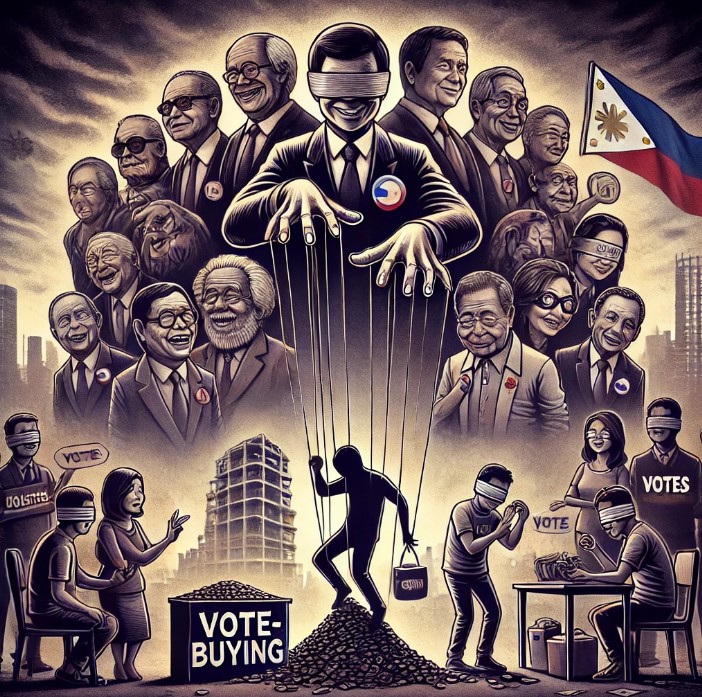
FILIPINOS’ HAMARTIA
The first three parts of this series of articles identified our serious faults as Filipinos—we sell our votes, we use questionable standards when choosing leaders, we treat elections as if they are popularity contests, allowing immensely popular but inexperienced and incompetent celebrities to win, and we either keep restoring the same traditional politicians from the “recycle bin” or replace them with family members. It is a “hamartia” (or tragic flaw) in our character as a nation.
Our inability to choose the right leaders clearly prevents us from reaching our full socio-political and economic potential as a nation.
We know the government is essential in leading all efforts to make our country progressive. We need the best leaders if we really want to become a “developed nation.” We as citizens are responsible for selecting the best ones to hold the reins of government. Unfortunately, we keep failing to do so.
The funny thing is that after we put them into power—the politicians who won because they had the money to buy votes, celebrities-turned-politicians who are inexperienced and incompetent, “recycled politicians” and the members of their political dynasties—we expect them to perform well. After every election, we expect a better-performing government.
And why would we expect a different government – a more effective one – when we know that we keep electing the same politicians or use the same old rotten standards when choosing new leaders?
Let us revisit Albert Einstein’s definition of insanity: “Doing the same thing repeatedly and expecting a different result.”
But assuming that one day we restore our sanity and finally refuse to sell our votes—finally, we learn to elect the most deserving and qualified candidates into office—would the wheels of national development start rolling?
Not quite yet!
There’s one more problem, a problem more serious than our failure to vote wisely and conscientiously. The more serious problem of Filipinos, as mentioned in the first part of this series, is the mindset that the leaders we elect are solely responsible for solving all of our society’s ills and the nation’s problems.
We view our relationship with the state from the vantage point of “self-entitlement.” We think that our leaders must give us “this and that.” We say the government should do “this and that” for us. We expect too much from leaders whom we don’t even choose using the best and most appropriate standards.
Is it the duty of the government to provide each citizen with food, clothes, and shelter?
There goes another problem among us Filipinos. We answer “yes” to the foregoing question, and we seem to have embraced another dangerous tendency—the “ayuda mentality.”
The government’s general functions are to formulate, implement, and enforce the laws of the land, build infrastructure, ensure peace and order, and create economic and other opportunities that help its citizens enjoy the conveniences of life, have the best chance to get a good education, and find or create means of livelihood.
It is also not the duty of the government to provide everybody with a job.
One of the functions of the government is to create an environment that promotes economic growth. They have to ensure that businessmen would be encouraged to invest and initiate business activities, thus creating job opportunities. But jobs are not given on a silver platter. We have to search for job openings, apply, and ensure that we have the required qualifications for the jobs we want. Getting ourselves ready for employment is a personal responsibility. The government will not deliver to our doorsteps the jobs that we want.
The government is also an employer but cannot possibly provide each citizen with a job. It is also impossible for the private sector to employ everybody. That’s just the reality—harsh as it may be. Those who don’t get employed or do not want to work for others because they have better plans for themselves could perhaps succeed as entrepreneurs.
Not everybody would get a college degree. Not everybody is trained and destined to be in a workplace – either in the corporate world or the academe. Some of us will be factory workers, sales clerks, farmers, fishermen, plumbers, drivers, gardeners, or what-have-you. It doesn’t matter what jobs we have, as long as they are decent and they allow us to earn a living honestly.
Don’t reason out that you came from a poor family and your parents could not send you to school to get a good education and have a better chance for a better life.
Unfortunately, this is how we are wired. When we encounter failure, when things don’t turn the way we expect them to, when we are not doing well in the different areas of our personal lives, we are always ready to check our “blame list” to find somebody or something to put the blame on. And our favorite whipping boy – the government. When we are done accusing our leaders for not doing their job well, causing us to become losers, we next vent our ire on our parents, saying that they did not work hard enough to ensure that we live a good life when we become adults.
We need to throw away that “blame list” because, whether we like it or not, we are personally responsible and accountable for our successes and failures. There comes a time in our lives when we should become self-sufficient, when we, not the government nor our parents, decide for ourselves and take complete control of our destiny.
We Filipinos must realize that without recognizing our faults and changing, this country will never become progressive and “developed.” We will never gain the respect of the community of nations if we remain the way we are now.

John F. Kennedy said something we should reflect upon: “Ask not what your country can do for you—ask what you can do for your country.”
We Filipinos need to realize that there are two requirements for a country to become progressive and developed: good government and responsible citizens. Remove one, and a nation is doomed. The citizens and their leaders need to work harmoniously towards achieving national goals. There’s no other way. Both of them need to work hard. They have to work hand in hand. And in case you did not notice, we as citizens control both requirements – we can decide to become responsible as citizens and also choose in whose hands we should put the reins of government.
When Do We Wake Up?
(THIRD OF 4 PARTS)
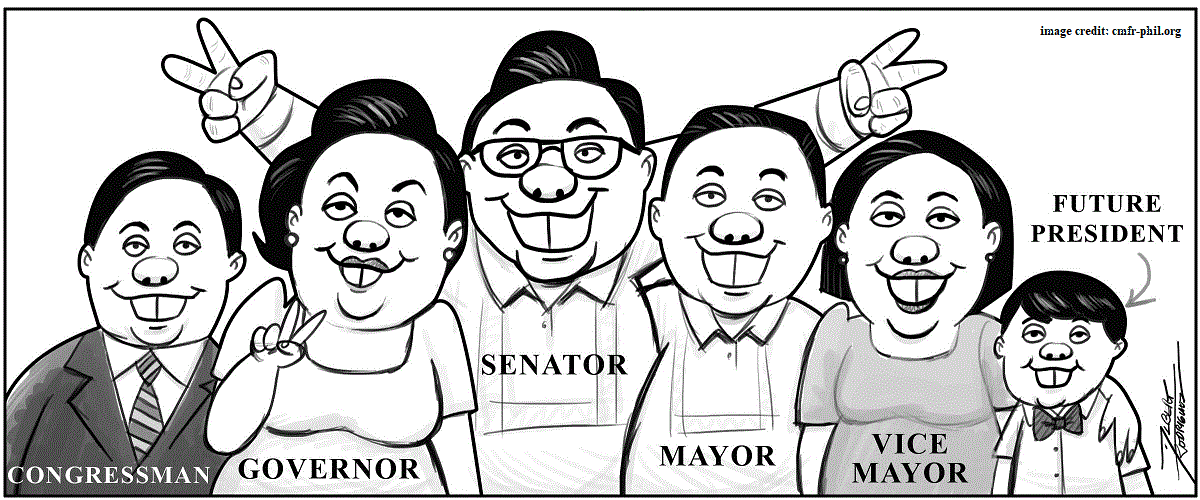
SAME POLITICIANS… SAME RESULTS
We’re complaining about political dynasties, right? But haven’t we realized we are guilty of creating the political dynasties in the Philippines? Yes, we have to admit it. We allowed the same politicians and their family members to lord it over in the Philippine political landscape.
When a politician, let’s say a mayor, could no longer run for re-election due to term limits, what would the honorable gentleman do? Turn his back on politics? Of course not! Power is so addicting. So many of those who experienced being at the helm of either local or national politics (and enjoyed the benefits, including those “passed under the table”) would not just quit politics or pass the torch to another person.
So, what would happen?
His wife would run for the position he previously held. Then that politician would run for another post – as governor, perhaps. Most of the time, Filipino voters would allow them to win, and usually, they would be able to mesmerize (or buy) the voters to luckily get re-elected until they reach their term limits. Would it be the end? Would their thirst for power (and the so-called “benefits”) be finally satiated?
You know the answer… a resounding NO.
The couple would ask their son or daughter (a grandson, a granddaughter, or an in-law) to run for the positions they would vacate. The shocking thing (and you might not believe it) is that there are times when siblings, or even husbands and wives, do not give way to the other, and so members of the same family slug it out in the political arena.
Anyway, this is not about family members squabbling in the political arena but about the political dynasties their families created.
Let’s continue, then.
Let’s return to the mother who just reached her term limit as mayor. Would she go back to being a full-time mother and wife? You were born only yesterday if you don’t know the answer to that question. Yes – she would run for the post vacated by the husband-politician. The husband would then aim for a higher position – run as congressman or senator. If all family members win, then for years, the power will change hands within the same family. The son (or daughter) is a mayor, the mother a governor, and the father either a congressman or senator. When term limits are reached, they will just run for the position a family member would vacate. Some siblings, and even in-laws, in the family also occupy minor positions in their geographical units.
Did that family create their political dynasty? No! We did it. We Filipinos created the political dynasties in the Philippines.
Now, answer these questions – “How (did they perform) are they performing as leaders?” “What is the country’s current economic, social, and political condition?” “Is the Philippines marching towards progress with them holding the reins of government for God knows how long?”
Of course, you know the answers to the foregoing questions.
How many of the available positions in the Philippine government, local and national, are held by the same families who have been the gods and goddesses of Philippine politics since time immemorial? Most of them are offspring of the peninsular who survived “America’s power grab” at the turn of the 20th century. Eventually, they stayed in the country and reaped the dividends. And it’s not only the politics that they dominate. With the enormous fortune they inherited from their Spanish parents/grandparents, they also control the country’s economy. That’s why Filipinos sometimes jokingly ask – “Did the Spanish rule really end?”
Only a few pure-blooded Filipinos and foreign expatriates of Chinese origin who became wealthy when the Americans took their turn to colonize the Philippines had the financial resources to challenge the Spanish mestizos for political supremacy in the Philippines, especially after the Americans granted the Filipinos their independence after the World War II. Some of them succeeded, and when they experienced how intoxicating power is, they (and their offsprings) kept running, and we kept electing them as if nobody else were qualified.
It is no longer surprising that politicians holding national positions have one or two family members and in-laws holding seats in the local government.
Filipinos might ask, “When would the same people from the same families pass the reins of leadership to each other in national and local governments after elections end?”
That’s up to the Filipino voters.
So, we should not wonder why the World Bank still classifies the Philippines as a “developing country.”
According to Albert Einstein, “insanity” is doing the same thing repeatedly and expecting a different result.
Why do we expect a better-performing government when we keep electing the same politicians?
ELECTIONS: Cyclic and Vicious

That’s how this writer considers elections in the Philippines… CYCLIC and VICIOUS!. Say viciously cyclic if you may.
Why CYCLIC?
Elections are repeated every 6 years for the Presidential derby and every 3 years for the so-called “mid-term elections” where 12 of the incumbent 24 senators finish their term and the people get to vote for their replacements. It is also during this time that members of the House of Representatives and local officials on the regional (for autonomous regions), provincial, city, municipal and “barangay” are elected. More often than not that the regional and the barangay elections are held irregularly, much to the delight of the incumbents in those geographic units.
Election is CYCLIC not because of the foregoing though. It is CYCLIC because of some conspicuous patterns of behaviors and events that would take place a few months before elections.
The incumbents, after hibernating in their air-conditioned offices and luxurious homes for a couple of years would suddenly come out in the open and initiate projects like road repairs and widening, construction of additional classrooms in public schools, medical and dental missions and other socio-civic projects. Then they will run for re-election, if lady luck laughs on them and they get re-elected, then they will again go into hibernation and just re-appear when the next campaign period comes. CYCLIC! Isn’t it?
Nowadays you would see maneuverings being done by politicians through their political leaders in the locales where they are seeking election (or re-election). They are mustering support and building alliances. They are putting forth organizations under the pretext that they would be helping the members have better lives.
Politicians would dangle as baits a few hundred of pesos and/or a bag of goodies for those who will register as members of the organization. They would indirectly buy the support of unsuspecting voters who because of poverty would bite. But immediately after elections, the organizations, whether or not their politician-benefactors win, will die a natural death then again resurrect on the next election period. Isn’t that CYCLIC?
Whenever you see in the roadsides billboards and streamer where written are words like PROJECT OF HON. WHO E. VER you are almost certain that elections are forthcoming
What are the other signs of the time (time for elections)?
Promises! Promises! Promises!
Suddenly, politicians who would dare not get out of their luxury cars during ordinary days would be walking, even in the muddiest rice paddies, greeting and shaking the hands of just about anybody. Smiling to just about anybody. Posing for pictures even with the lowliest of people.
You would see the politicians everywhere… in sports events, in the market, in schools, in terminals…everywhere! Even in wakes! Yeah, also on TV… there you would see them suddenly embracing an advocacy… championing a certain cause. But where are they between the period after the election and before they become visible again… Where? Boracay? Dakak? Or in a cruise ship either in the Mediterranean or Carribean? Perhaps in Las Vegas.
Cyclic! So cyclic…
Consider this… A politician, let’s say a Mayor, can no longer run due to term limits. So, his wife will run for the position he previously held. Then that politician will run for another post…as Governor perhaps. Assuming both the politician and his wife win and luckily get re-elected until they reach their term limits, is it the end?
Hell no! The couple will ask their son or daughter to run for Mayor. What about the mother? She will run for the post vacated by the husband-politician. She will run as Governor. What about the husband? He will perhaps run either as Congressman or even Senator. In case all family members win then for years that the power will run circles within the same family. The son (or daughter) is a mayor, the mother a governor and the father either as Congressman or Senator. When term limits are reached then they will just run for the position that a family member would vacate. Some siblings in the family are also occupying minor positions in the geographical unit where they reside..
Then of course they will tell the people that they do not belong to a political dynasty…but a family of public servants. Oh common…that’s a lot b&((@^%! Please define “political dynasty.” Please explain what a “public servant” is.
It seems that the only competent leaders in the different regions of the country are only those belonging to the same political clan lording it over in those areas since time immemorial. If so, then PHILIPPINES please evaluate the performance of these leaders who came from the same political clans who held the reins of power since VIVA ESPANA and HAIL AMERICA left the archipelago.
The same family names…same genes…in the seats of power in the country for decades now…same economic and socio-political performance for the country… round and round we’re going circles…cyclic…dizzying.
VICIOUSLY CYCLIC!
Why VICIOUS?
For the adjective VICIOUS, Merriam-Webster online dictionary gives the following definitions: “malicious,” “having the nature or quality of vice or immorality” and “dangerously aggressive.”
Even the simplest of minds can explain why the elections are VICIOUS?
Election is an important democratic exercise. It gives the electorate a chance to put into office the best and the most qualified among candidates. However, both the politicians and the electorate desecrated the electoral process.
The exercise of suffrage has become tainted and impure with the politicians doing just about anything just to win. Even to the point of killing. Remember the Maguindanao massacre? Remember the death tolls during the elections and the corresponding campaign periods. VICIOUS maybe an understatement!
So malicious and impure have elections become. It has become so VICIOUS. You would witness a lot of mudslinging during this period. Politicians have developed the propensity of opening their opponents’ “cans of worms” in order to cast doubts on their integrity and lessen their chances of winning. Indeed, anyone who wishes to run for any elective position must develop the art of exposing the chinks in his opponent’s armor while at the same time ensuring that the dirty tricks department of the other party would not be able to see the skeletons he is keeping in his closet.
What has become a dictum for politicians is the worse the publicity on their opponents are the better are their chances of winning. Well, that dictum is a lesser evil as compared to the idea that “the higher is their possibility of winning if their opponents would be dead.”
Politicians are by nature Machiavellian. Hasty generalization or truth?
Then surprise of all surprises, politicians throwing mud at one another during the past elections would become allies in the next election. This is the politics of the new era.
More surprising is the fact that in some areas there are politicians who would be virtually unopposed. It is either they are too good as incumbents that running against them in the next elections is both a political and a financial suicide. Or negotiations and backdoor dealilngs may have taken place.
The vote that is supposed to be sacred has become like a commodity in the market, it now has a tag price.
Vote buying is VICIOUSLY rampant. This is public knowledge.
The question nowadays is “Can a politician come forward and claim that he has never attempted to buy votes?”
What is sad is that the voters have become more than willing to cast their votes on the candidates who would put the highest bid. For them, the ability and qualifications of the candidates are not important. What counts is how much is a candidate willing to pay for their votes.
For P500 or P1000 (okay make it bigger, P2000), the voters are unwittingly selling their votes… their dignity… their future.
Thus, elections have become a business of sort. Candidates would be investing by buying votes and then they will have a chance to recoup their investments, with corresponding interests, when they are elected into office. And how? Through numerous commissions from government projects? By directly dipping into the coffers of the government?
Another question is: Can a politician come forward and declare that he is willing to spend millions of pesos during elections just to get elected for the sake of “public service” and expect nothing in return?
On the issue of vote buying, the politicians are not the only ones to be blamed. Equally guilty are the voters who put a tag price on their votes. “It takes two to tango,” so goes the saying.
But hope springs eternal. The vicious cycle will eventually come to an end.
When?
The viciousness of the cycle ends when finally the voters remove the tag price from their votes.
The viciousness of the cycle ends when the voters put into office the new generation of politicians… those who will be consistent with their commitment of serving the public… those unwilling to buy a single vote… those who will not suddenly come out on national TV and camouflage their political ambitions by suddenly embracing an advocacy only when an election is forthcoming… those who will run not for the sake of keeping alive a political dynasty… those who are visible not only during election periods… and those who will seek public office for the sake of public service and not because of the cravings for power and more money.
It is in the hands… in the conscience of the voters. Lest we forget, WE DESERVE THE LEADERS WE ELECT!


 M.A.D. L I G A Y A