Higit Pa Sa Kaibigan (Part 1)
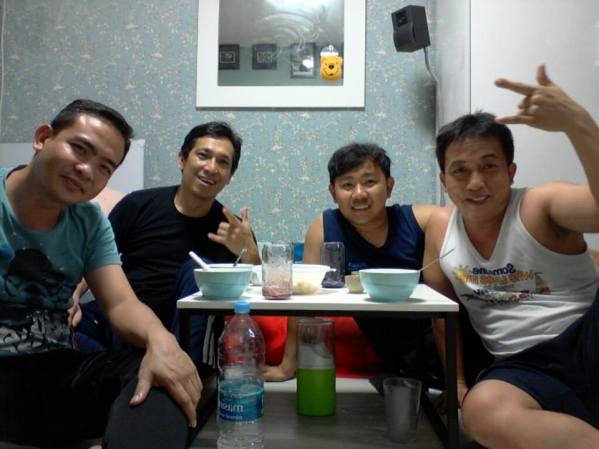
Madaling araw ng March 2 noong 2013 ako umalis ng Pilipinas sakay ng Asiana Airlines at bandang alas-otso ng umaga kami lumapag sa Pusan International Airport. Kasabay ko noon si sir Ken, kapwa ko guro sa Gyeoungju University, ang unang unibersidad na pinagturuan ko dito.
Aaminin kong sabog ako noong panahong iyon, hindi sa droga, kundi sa napakadaming agam-agam at isipin. Labag sa kalooban kong lisanin ang mga mahal ko sa buhay. Ayaw ko ring talikuran ang paraaalang pinanglikuran ko ng ilang buwan bilang isang principal. Subalit ayaw na ayaw kong nagpapadaig sa aking emoyson. Napakalinaw na kaylangan ko ng isang napakalaking pagbabago sa aking buhay dahil nga sa mga dahilang nabanggit ko sa “Sa Aking Pagtungo sa South Korea.” Sabi nga ni Jake Sully, ang main character sa pelikulang “Avatar,” “Sometimes your whole life boils down to one insane move.” At katulad din ni Jake, may pangamba man ay sigurado ako sa aking gagawin bago ako tumalon upang makipagbuno at mapaamo ang sariling kong “Toruk.”
May dalawang bagay akong baon ko nang pumunta ako sa South Korea… tiwala sa sarili at pananalig sa Diyos. Laging ito ang kumbinasyong ginagamit kong panangga sa lahat ng pagsubok at panungkit sa ano mang inaasam kong makamit.
Hindi swerte ang hanap ko sa bansang pinuntahan, hindi ako naniniwala sa swerte. Naniniwala ako na “Nasa Diyos ang awa, nasa tao ang gawa.” Ang pakay ko ay sumulat dito ng bagong kabanata sa aking buhay… bagong yugto sa tadhanang naniniwala akong tayo ang gumuguhit.
Unang byahe ko iyon palabas ng bansa at mabuti na lamang na nakasabay ko si sir Ken, na bukod na sa matulungin ay sanay na sa “overseas travel.” Sa Gyeoungju University din s’ya pupunta kaya nakakatiyak na akong hindi ako maliligaw.
Nang makarating kami sa Pusan International Airport ay nagulantang ako sa lamig. Nanuot ito sa suot kong jacket. Buong akala ko ay dahil tapos na ang winter at noo’y papasok na ang spring ay parang sa Baguio lamang ang lamig. Mabuti na lamang at ang nasakyan naming bus papuntang Gyeoungju-si ay nakaandar ang heater. Antok na antok ma’y hindi ako makatulog sa biyahe dahil tinitignan ko bawat lugar na madaaanan. Wika ko sa sarili’y, “Heto na ako sa South Korea.”
Matapos ang halos dalawang oras na biyahe ay nakarating kami sa Gyeoungju-si. Ang sumalubong sa amin ay sir Mark. S’ya ang naghatid sa amin sa apartment na aming titirhan, si sir Ken sa “white house,” ako nama’y sa “blue house.”
Bago umalis si sir Mark ay tiniyak n’yang maayos ang unit na magsisilbi kong tirahan at ipinakilala din n’ya sa akin ang isa pang Pinoy na professor din sa Gyeongju University…si sir Randy.
Pumasok na ako sa aking kwarto at doon ko unang naramdaman ang pakiramdam ng literal na nag-iisa, malayo sa mga mahal sa buhay at nasa isang lugar na hindi ko kabisado. Nakatayo lamang ako, hindi ko malaman kung ano ang una kong gagawin. Binuksan ko ang aking maleta at unti-unti inayos ang mga dala kong gamit.
Tahimik ang paligid, wala akong nadidinig kundi ang mga sarili kong yabag at buntong-hininga. Matapos kong ayusin ang mga damit at gamit ko’y bigla nanamang naramdaman ko ang sobrang lamig at nagsimula na rin akong makaramadam ng gutom. Walang laman ang refrigerator na nandoon, may gas stove kaya lang wala naman akong lulutuin. Pinagtyagaan ko ang baon kong biscuits (Skyflakes) mula sa Pilipinas.
Naalala ko na kaylangan ko nga palang tawagan ang aking mga mahal sa buhay sa Pilipinas upang ibalitang nakarating ako ng ligtas sa South Korea. Nang kuhanin ko ang aking cellphone ay noon ko pa lamang napagtanto na hindi ko nga pala na-activate ang aking sim na roaming. Pakiramdam ko’y napakatanga ko, napamura ako ng hindi oras. Hindi ako makakatawag, ang cellphone ko’y magagamit ko lamang na parang music player.
Aaminin kong sa pagkakataong iyon ay inatake ako ng matinding kalungkutan… gutom pa rin ako kahit naubos ko halos ang baon kong biscuit… giniginaw… tahimik… walang makausap… at nagiisip na baka nagaalala nang masyado ang mga mahal ko sa buhay, lalong-lalo na ang aking kabiyak, na naghihintay ng balita mula sa akin. Sa pagkakataoong iyon ay naramdaman ko ang totoong kahulugan ng HOMESICK, iyon eh matapos lamang ang ilang oras pagkalapag ko sa South Korea.
Pero sa kalagitnaan ng kalungkutang iyon ay napatingala ako sa langit at naala-ala kong ang pagtungo ko sa bansang ito’y naidulog ko na sa panalangin ng maraming beses. Hindi ko alam kung bakit pero sa pagkakaalam ko’y wala akong panalanging hindi n’ya dininig… kaya nga ang paborito ko sa mga tulang nagawa ko sa English na may pitong syllables lang ay…
HE answers.
Just wait.
Have faith!
Hihiga na sana ako upang lunurin na lang sa tulog ang gutom ko’t kalungkutan nang makarinig ako ng mga katok sa aking pintuan. Si sir Randy iyon. Pumasok s’ya at nakipagkwnentuhan sa akin. Hayun, at least may kausap na ako. Habang kami’y nag-uusap ay tinignan n’ya ang lutuan ko’t itinuro kung paano iyon i-operate. Maaring napansin n’yang giniginaw ako kaya’t itinuro din n’ya kung paano gamitin ang floor heater. Medyo na-relax ako sa pagtulong na ginagawa n’ya noon. Binuklat n’ya ang mga drawer at doo’y nakakita s’ya ng ilang de-lata na hindi pa naman expired. Maya-maya pa’y panandalian s’yang umalis at pagbalik ay may bitbit na ilang balot ng noodles at mga 3-in-1 coffee. Nagulat ako sa generosity na ipinakita ni sir Randy. Animo’y matagal na n’ya akong kakilala. Umalis ulit s’ya sandali at nang pagbalik niya’y sinabing, “Halika na brod, nakaluto na girlfriend ko, kain tayo. Sunod ka sa 401.” Nagulat ako pero hindi na ako nagpakipot pa, hindi dahil sa talagang ako’y gutom sa pagkakataong iyon kundi dama ko ang sinseridad ng imbitasyon n’ya at nakakahiyang tanggihan.
Mainit ang mga inihaing pagkain, ngunit mas higit ang init ng pagaasikasong ipinakita sa akin nina sir Randy at nang kasintahan n’yang si Nikki na taga-China. (Mag-asawa na sila ngayong). Susubo na sana ako nang biglang nagdasal muna sir Randy bilang pasasalamat, lumalalim at tumataas ang pagtingin ko sa kanya sa nakita kong iyon. Sa unang subo ko ay nangilid ang luha ko sa kabutihang loob na nasaksihan ko sa kanila at sa kung gaano sumagot ng panalangin ang Panginoon. Nang napatingin sa akin ang magkasintahan ay pasimple kong sinabi na sinisipon yata ako kaya ako naluluha.
Pagkakain ay inihatid ako ni sir Randy sa aking unit, may bitbit pa s’yang ilang lutong pagkain. Sabi ko’y, “Sobra-sobra na ito bro!” Ngumiti siya’t sinabing aalis silang magkasintahan papuntang Daejon at gusto lang n’yang matiyak na may kakainin ako hanggang kinabukasan. Tapos bumalik s’ya sa kanyang unit at kumuha ng kasirola, kawali ang pakuluan ng tubig, at karagdagang 3-in-1 coffee. Hindi ko alam kung ano ang sasabihin ko sa kanya noon, gusto ko s’yang yakapin sa sobrang pagtulong na ginagawa n’ya.
Hindi doon natapos ang pagtulong sa akin ni sir Randy. Nang malaman n’yang hindi ko magamit ang SIM kong roaming ay ipinahiram nya sa akin ang isa n’yang smart phone at ang kanyang i-pod bago sila umalis at iniwang bukas ang kanyang wifi sa kwarto upang makagamit ako ng internet.
Wala na akong masabi sa pagkakataong iyon. Gasgas na paulit-ulit na “thank you” na sinasabi ko. Gusto ko na talaga sanang s’ya ay yakapin pero nagmamadali s’yang umalis. Napapikit na lamang ako at nagpasalamat sa NASA ITAAS.
Sobrang swerte ko. Hindi naman ako mabait na tao. Taimtim lang talaga akong magdasal at matibay ang pananalig ko sa KANYA.
SIDE DISH-ney Land
Welcome to SIDE DISH-ney land!
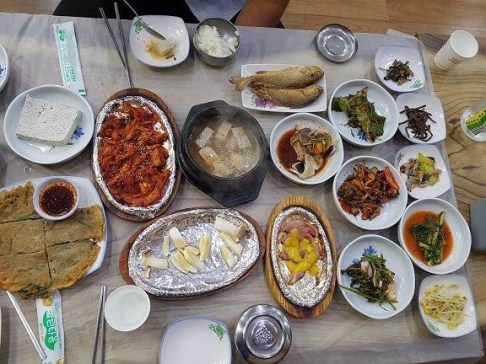
As I mentioned in my article entitled “Kimchied,” I was surprised (and delighted) to see lots of side dishes (반찬 – banchan) which restaurants serve with the main dish ordered. The only side dish I was expecting to see when I first ate in a restaurant here was what Korea is famous for – kimchi. I was wrong. I never thought also that there are different varieties of kimchi and it is not always made with cabbage.
I would probably write a separate article about kimchi in the future but for the meantime… let’s go back to SIDE DISH-ney land.
Side dishes are put in small plates and are served either in advance of (or along with) the main dish. If restaurant owners are afraid that customers might be too hungry that all the side dishes will disappear like magic before the main dish is served, they will have the two (side and main dishes) served together. Some restaurants are generous, they allow their customers to ask for additional side dishes.
There’s no extra charge for the side dishes. It’s “service” (When Koreans in restaurant and other business establishments say “service” it means free). As to how many kinds of side dishes restaurants offer, it’s not the same. If I remember right, the least is 3 and the most is 10. Of course, I, I guess others as well, prefer to dine in restaurants where there are more side dishes. Most of the time that just with the side dishes I would already be full and how I wish I could just bring home the main dish and have it for my next meal at home.
It is really the “side-dish culture” that makes it so difficult to lose weight here in South Korea especially if one does not cook and has to depend on restaurants mainly for meals. One has got to have strong self-discipline in order to succeed in not picking the side dishes. It is so hard not to taste palatable foods just chopsticks away from you.
There are different kinds of side dishes. I have already tried a lot of them. It is safe to say that majority are made with vegetables. People who love vegetables would love it here. But aside from vegetable side dishes, there are some made with meat, fish, tofu and egg as well.
Some restaurants also offer fermented squid or octopus sides dishes and crunchy squid threads. There’s one restaurant where I dine at least once a week mainly because of their stirfried dried anchovy side dish.
Shown in the picture below were the side dishes served when I had lunch with some Filipino teachers after the seminar I conducted at Namwon in North Jeolla Province sometime in June , 2017. The main dish we ordered was fried mackerel. Aside from the side dishes we were also given soups. I’m sorry that I can’t name the side dishes in Korean.
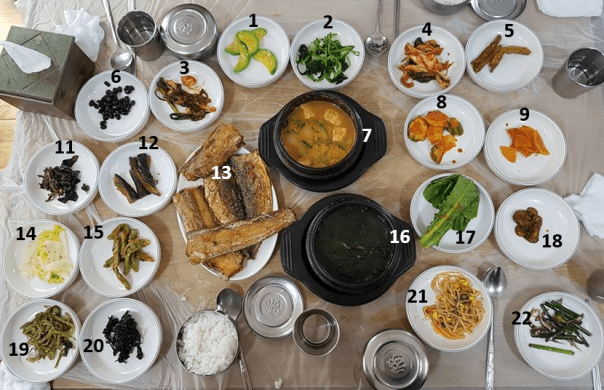
The side dishes and the soup, with their corresponding numbers in the picture are stir-fried zucchri (1); seasoned spinach (2); kimchi (4); steamed pepper (5); soy-braised black soybeans (6); spicy cucumber salad; (7) seasoned radish (9); bean paste stew (10); fried mackerel (13); fermented pepper (15); seaweed soup (16); fermented squid (18); seasoned seaweed (19); stir-fried seaweed (20); and seasoned soybean sprouts (21). There are some items that I can’t identify.
— 0 —
Source: SIDE DISH-ney Land
Technology and the 21st Century Teacher
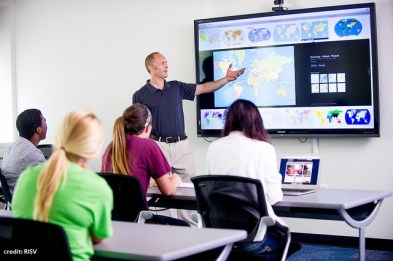
The central argument upon which I anchored my previous research work entitled “Factors Affecting The Use of Computers for Classroom Instruction in South Korean Universities”1 is “information technology has significantly altered the landscape of teaching and learning.” Indeed, it drastically changed the ways teachers taught and students learn thus school administrators and teachers need to respond accordingly and effectively.
At the turn of the 21st century education leaders have been reconfiguring educational paradigms that became almost obsolete because of the rapid changes in technology. Nowadays, emerging models of educational frameworks have included technology in both the expected outcomes and support mechanisms of the new paradigms.
The P21, a national non-profit organization that advocates for 21st century readiness for every student, developed the “Framework for 21st Century Learning” (F21CL) to define and illustrate the skills, knowledge students need to succeed in work, life and citizenship.2 The two parts of the framework (see figure below) are student outcomes (as represented by the arches of rainbow) and the support system (as represented by the pools at the bottom. One of the 4 clusters of student outcomes, is “Information, Media, and Technology Skills.” The article explains that to be effective in the 21st century, citizens and worker must be able to create, evaluate and effectively utilize information, media and technology.
And to be effective 21st century teachers, it has become A MUST that the teachers themselves should have those skills just mentioned. We cannot have “the blind leading the blind” scenario.

The 21st Century Student Outcomes and Support Systems
Schools need to respond by making the needed investment. They have to upgrade their existing facilities and purchase the necessary equipment in order to cope up with the demands of the new educational paradigms they have drawn up in order to keep abreast with the demands of the 21st century.
Not only in terms of equipment and facilities that the schools should focus on. They need to pay attention also to their manpower – particularly the teachers who plays the key role to ensure that success of the endeavor.
I made an assertion (in the previous work aforementioned) that integration of technology in instruction and assessment is inevitable and the teachers, being at the center of the delivery of learning need to accept it. The F21CL clearly defines the responsibilities of teachers (Standards and Assessment, Curriculum and Instruction, Professional Development and Leaning Environment.) Much of the responsibilities will be shouldered by the teachers. The said framework even specified clearly what is the role of teachers in the attainment of cluster 4 of students outcome – that is to “Enable innovative learning methods that integrate the use of supportive technologies, inquiry-and-problem-based approaches and higher order thinking skills.
But the application of technology in instruction is a contentious area that caused (or is causing) a lot of arguments and controversies in the academe. Despite the immense benefits that technology brings to education, some teachers are still either unwilling or hesitant to embrace the application of technology to the teaching-learning process.
I specifically identified also (in that same work) the pedagogical benefits that computers and internet provide. For example, the internet has become the teachers and students’ virtual library. Projectors and media players make the interaction between the students and their mentors more efficient. For the teachers in particular, the educational and organizational softwares and web browsers give them more resources and enable them to create better presentations.
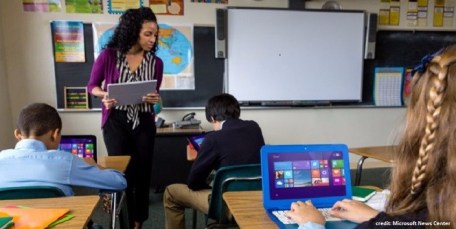
But apparently, not all teachers are convinced. They do not believe that computers benefit teaching and learning. They are the ones who do not use presentation softwares preferring to either just dictate or write on the board everything they wish to convey to their students. They are ones who refuse to use available course softwares opting to just open the prescribed textbook and read from it while teaching.
But why?
There are two possible reasons.
First – these teachers were exposed to educational philosophies different from those of the ones to whom embracing technology is a welcome development . This could be the reason they have different attitudes and views about the value of computers in teaching and learning. Their educational beliefs just don’t jibe with using computers in the classrooms.
Second and last – they simply (heaven forbid) do not know how to use any office software suites (word processing, spreadsheet, database and presentations applications) and specific educational software provided for them. They have difficulty navigating around any computer-generated environment. They are so helplessly not computer-literate that no amount of tutoring would help them learn.
Presumably, the reason they could not use the prescribed course software packages (that make things easier for them and their students) is that they don’t have the ability to do so. Even if assuming a course software, at a particular time, suddenly doesn’t work, its contents can be copied and pasted to any presentation software. But that again could be another problem… they probably don’t know how to create presentations.
Worst, they could simply be just aversive to technology.
Or maybe, they are simply lazy. They are computer literate but are not willing to try new systems being introduced.
The question that begs for answer is, “How can a teacher without the required 21st century skills teach such things to students?”
Professional competence for teachers is continuously evolving as technology keeps creeping into the foundations of education. Alongside pedagogical skills, another skill through which competence of 21st century teachers should be gauged is how extensive and effective do they apply technology (computer) to teaching and learning.
Perhaps it’s about time that computer literacy be strictly considered when hiring teachers.
On the part of school administrators and owners, they have a responsibility of ensuring that when they introduce a new computer application of learning the teachers are given enough time and sufficient training to become familiar with it.

The following is one of the recommendations I made in a previous study I have been referring to.
“It should be noted also that among noted also that among the variables that are significant statistically teachers’ perception on the value of computers has the positive influence on their extent of use of computers for instruction in Korean classrooms. Thus, it is important for school administrators to keep that perception positive. The study also found out that a key factor in this positive perception is the teachers’ level of preparedness in using computers to facilitate learning. Being proficient in using computers is different from being familiar in using a new computer application for learning. Even the most proficient among computer users need time to learn an application introduced to them for the first time. Teachers tend to perceive the value of computers for classroom instruction negatively if they were not given enough time to acclimatize themselves with a new system being introduced.”
According to Edwin Creely3, “I was challenged by the ideas from Don Idle that we are textured for technology and that technology has always been and will ever be part of the deepest learning that we do. Learning to move technology and the digital technology of the 21st century into the heart of the learning process is an ongoing challenge for educators. So, the practice of being a literacy educator in the 21st Century must be, has to be, inclusive of digital literacies, including, most importantly, the use of social media.”
As Janelle Cox puts it, “A modern teacher is willing to try new things, from new educational apps to teaching skills and electronic devices. Being innovative means not only trying new things, but questioning your students, making real-world connections and cultivating a creative mindset. It’s getting your students to take risks and having students learn to collaborate.”4
References:
Factors Affecting the Use of Computer Technology for Instruction in South Korean Universities
http://www.p21.org/our-work/p21-framework
(E.Creely)(https://www.researchgate.net/post/What_are_the_qualities_required_of_ teachers_to_teach_21 st_century_learners.
(J.Cox)http://www.teachhub.com/15-professional-development-skills-modern-teachers
“Till We MEAT Again”
Some of the meat dishes I tried here in South Korea are somewhat similar to the meat dishes in the Philippines.
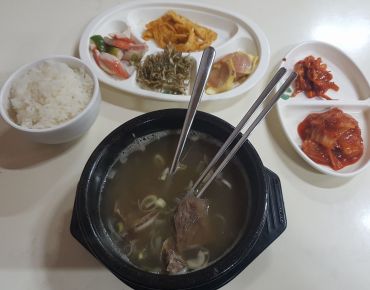
갈비탕 – Galbitang/Kalbitang
One Korean beef dish that reminds me so much of our own “nilagang baka” (Filipino beef stew with clear broth) is 갈비탕 (galbitang/kalbitang). (I had to tell my Filipino friends in the Filipino version of this article that G and K in Hanguel are used interchangeably thus kimchi when written in Romanized form could also be gimchi.)
Kalbi, in English, is short ribs. When Filipinos cook beef stew, it’s also the ribs of the cow they choose. But while in the Philippines we add Chinese chard, potato, cabbage and saba (a banana variety used primarily for cooking), with kalbitang, mixed are radish, dangmyeon (starch noodles) and onions. In a restaurant, I was once served kalbitang with egg. I was also told that it can also be cooked with kimchi. That I have not tried yet.
Tang means soup. Synonymous to tang is another Korean word – guk. Thus, if at the end of the name of a certain Korean dish there’s either tang or guk, expect that the meat is cooked with soup. 삼계탕 (samgyetang) for example is soupy chicken dish. It is comparable to the Filipinos’ tinolang manok (chicken stew) which is cooked with either green papaya or chayote and ginger. What primarily goes with samgyetang when prepared are red dates, ginseng, onion, and garlic.
Another Korean meat dish that has striking similarities with another famous Filipino food is 설렁탕 (seolleongtang). For kalbitang, the part of the cow used are the ribs but for this dish called ox-bone soup in English it’s the leg bones. Usually prepared with spring onions only but one time I have tried one with radish and thin wheat flour noodles. It’s similar to Philippines’ bulalo (beef marrow stew.)
What about pork dishes?
I’m familiar with two… one of which is actually my favorite. These two Korean pork dishes is not like any of the pork dishes I got accustomed to in the Philippines. They are uniquely Korean.

감자탕 – Gamjatang
The first one is 감자탕 (gamjatang). It’s pork neck bones that are used to make this Korean meat dish and usually cooked with potatoes (primarily) and other vegetables. There seems to be a disagreement among Korean food experts as to what gamja in gamjatang refers to – is it the potato or meat around the pork spines bones? So, it’s not settled yet as to how should it be called in English – spicy pork bone stew or potato stew. For the meantime, forget about the name. Just enjoy the taste.
The second and last pork dish… and the last among the Korean meat dishes I wish to feature in this article but not the least because it’s actually my favorite meat dish here… is 뼈해장국 (ppyeo haejangguk).

뼈해장국 – Ppyeo Haejangguk
Others would simply call it haejangguk, which means, according to existing literature, hang-over soup. I’m more used to calling it ppyeo haejangguk for that’s how it’s written in the menus of restaurant where I ate them. One thing that I have noticed is that it is somewhat similar to gamjatang minus the potatoes. Both are spicy but when you order you can request that it be made less spicy or not spicy at all. I was told that there is a variety of haejangguk where instead of pork spine it’s ox-bone that is used.
Of all the meat dishes I tried here in South Korea, ppyeo haejangguk is my favorite. It doesn’t mean though that I need to eat it often because of hang-over. I just love the taste and the spiciness of this meat dish. The price ranges from 5,000 KRW to 7,000 KRW.
Two other meat dishes I came to like here are the following:
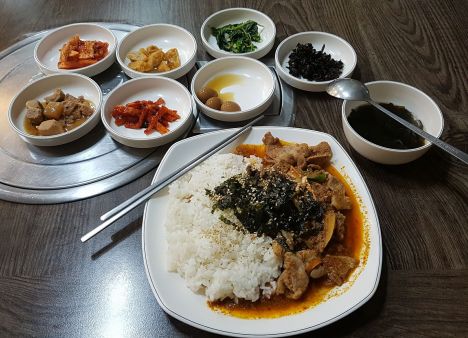
제육덮밥- jeyuk deopbap
There are more meat dishes here in South Korea but the five I presented here are the top 5 in my list. It is very possible that after my 5 years being here I may how not tried some them yet.

족발 (jok-bal)
I wrote an article in Filipino about Korean meat dishes in order for my friends in the Philippines to know the different ways Koreans cook meat. This is the English version of the said article. The beef, pork and chicken dishes I mentioned in that write-up were limited to the ones that I already tried. I focused mainly on what I literally saw on the bowls and plates when I ate them… like what kind of meat were they, which parts of the cow, chicken or pig were used, and what vegetables and other ingredients were mixed. I added some personal observations.
— o —
“Pork-bellied”
 This is about my first 삼겹살 (samgyeobsal) experience… why the pork belly should be faulted for my becoming “pork-bellied.”
As I said in the article “Love at First Bite,” I fell in love with kimchi. But I have to admit that with all the luscious Korean… DISHES, I wasn’t faithful to kimchi. I would later fall in love with other Korean foods. I also completely abandoned my plan to loose weight. It’s a “mission impossible.”
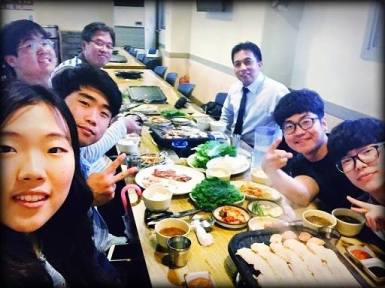
Before my first week in South Korea ended, we were given a treat by sir Randy. He brought me and two other foreign professors (Deborah and Kenn) to a restaurant serving 삼겹살 (Samgyeobsal). That was after we claimed our Alien Registration Card (ARC) from the immigration office in Pusan to legitimize our stay our .
It isn’t enough to just say that I have tasted samgyeobsal that night. For me it was more than just eating a pork belly. I don’t intend to sound dramatic nor philosophic but I guess it would be more appropriate for me to say that night “I experienced samgyeopsal” instead of “I ate it.”
I consider the experience very special.
Why?
It’s a culture thing.
As we entered the restaurant, I saw sir Randy and the other professors remove their shoes. I did the same. We were escorted by an ahjussi (a middle-aged man) to a table and immediately left us after getting our order. There were no chairs, not like the set-up in that restaurant in the hotel where we had the orientation for our students. We sat on the floor. So, for the first time that I experienced eating while seated on the floor. I wasn’t comfortable sitting cross-legged but as soon as the ahjussi returned and put on our table what sir Randy ordered I forgot about my discomfort and started salivating.
Along with the slices of pork belly, we were given plenty of lettuce and perilla leaves. There were also raw onions, garlic and green chili peppers. We were also served with, of course, kimchi and other vegetable side dishes and spicy tofu. In short there were lots of food.
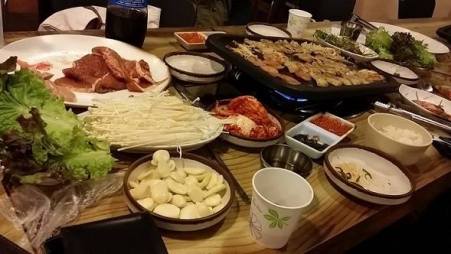
The ahjussi turned the portable gas griller on and the grilling began. As sir Randy held with a tong a slice of pork belly, like a teacher, he explained what samgyeopsal literally means: 삼- sam (three), 겹 – gyeop (layered), 살 – sal (flesh). His impromptu lecture did not end there. When the meat was cooked, he explained how to eat samgyeopsal the Korean way, that was after I excitedly picked up a piece of the cooked meat and had my first bite. He took a piece of meat, dipped it into a sauce then placed it on a leaf. Not done yet, he also added garlic and a bit of rice too. Then he rolled it up and stuffed it into his mouth.
“That’s the way the Koreans do it,” he said.
He made another roll and asked me to open my mouth. I hesitated at first because it was a little awkward. He explained that when dining Korean males usually do that and nobody would suspect them of “bromance.” So, I allowed him to stuff it in and returned the favor shortly after.
We learned quickly how to enjoy samgyeopsal. It was either sir Rhandy’s a good teacher or it was just our hunger. Soon enough, we had to order another round of pork belly.
There were two varieties of dipping sauces given to us by the ahjussi. Sir Randy told us that one is 쌈장 (ssamjang) and the other one 소금과 후추 기름 장 (sogeumgwa huchu gileum jang).
The kimchi served tasted differently from the one I first tried. No traces of sweetness. It was plain spicy.
While we were enjoying the “feast,” sir Randy who has been here in South Korea for a long time, recommended other kinds of Korean foods that he said he was sure I would come to like.
The other customers in the restaurant were enjoying their samgyeobsal with 맥주 (maegju) and 소주 (soju). We wanted to also but we had class the following day.
We were one in saying that it was a sumptuous dinner.
For me, it was not a simple dinner. It was a wonderful cultural experience.
— o —
Source: “Pork-bellied”
Do NOT Expect

If you think this is a perfect world then prepare to face a perfect disappointment. This world is not a perfect one and will never be. Things are not the way you wish them to be. People don’t behave, talk and think the way you thought (or wished) they would. Your co-workers, your boss, your friends…even the people you love… might treat you in a way quite the opposite of what you expect.
Nothing is perfect in this world. Nobody is perfect in this world. So, do not expect too much or do not expect anything at all from anyone.
Do not expect that the politicians will deliver on their promises. Do not believe them when they say that should you vote for them they would bring about utopia. Be thankful if they could but do not bet on it. The truth is no earthly being is capable of making the social, political and economic conditions of the world perfect.
Expect nothing from your leaders. If you think you could do better than them…that your country is better off with you at the helm… then run for public office. Oppose them. Or go to the street…. protest. Convince people to champion your cause. Otherwise it would be best if you just keep quiet and perform your civic duties and be a responsible person and citizen.
Do not also expect that the workplace is a perfect environment. That’s the worst assumption to make. You will never find a heavenly workplace. You will end up disappointed if you expect that the people in your organization, from the rank and file to the people upstairs, are angels. They are not. They are just like you and me…humans.
Expect nothing from anyone in your workplace. Just work and perform your duties and responsibilities as stipulated in your job description. That’s the way to do it. Love the job and enjoy the pay.
If you’re not happy with the job and the pay… LEAVE. If you love your work and the compensation is good but you feel that the organizational climate is so terrible that it suffocates you then LEAVE. If you feel like you’re being taken advantage of…LEAVE. It is as simple as that. Find employment somewhere else. Find the perfect workplace you dream of. If you think you are too good to be just an employee then start a business. Make it grow. Employ people and see for yourself if you would be a better employer than the employers you hate.
You should not expect other people to solve your problem (or solve a problem for you)…not even if those people are mandated by their job description to solve those problems. Even if it is the moral obligation of a person to help you get out of a difficult situation, don’t expect that you’ll get help from that person. Be thankful if you’ll get it but one thing you OUGHT to learn is to solve your own problems. Find a solution to whatever difficulty you are encountering.
Do not expect people to think and behave the way you do and embrace your principles and advocacies. Always remember that people look at things from their own perspectives and are driven by a set of motivations that maybe entirely different from yours. Never assume that your perspectives are correct and theirs are wrong.
Remember that people think and behave in different ways. The biggest disappointment you’ll ever encounter is when you expect that all people (or even half of them) are reasonable and conscientious.
You will be gravely disappointed if you expect that the love, generosity and kindness you show will be reciprocated by your friends, loved ones or anyone around you. Do not expect any of them to praise the good things you’re doing and express gratitude for the favors you do for them. Lucky you if they would.
Lucky you, indeed, if the people you deal with , the leaders you elect, the ones you work with and work for, and your family and friends have conscience and conduct themselves within the bounds of reason.
If not, does it mean you are unlucky? Not necessarily. Things just didn’t turn out the way you wanted. At least, don’t be like them.
You have two options. You need to decide. Move away from them or embrace them for the way that they are.
Your choice.
As Mother Theresa said, “People are often unreasonable and self-centered, forgive them anyway.”
She added, “ You give the world the best you have and it may never be enough, give your best anyway.”
You might not get the fair treatment and respect you think you deserve but you do not have to retaliate. As Martin Luther King Jr. puts it, “Hate cannot drive out hate; only love can do that.”
So, when your expectations are not met, move on and say, “Life goes on.”
Hold on to your dreams. Hold on to the values you hold dear.
Finally, there are two questions you need to answer. Are you a better person than those who you think disappoint you? That’s the first question. Here’s the second. Do they not consider you a disappointment also?
Reflect!
Source: Do NOT Expect
 M.A.D. LIGAYA


 M.A.D. L I G A Y A