Category Archives: Educational Management
Teachers, Leadership Styles, and McGregor’s Theories X and Y Assumptions

Managing people, either in academia or industry, is difficult and complicated. It requires not only mental and emotional competence but also toughness. It is an enterprise not meant for the fainthearted and weak-kneed.
Managers need both smarts and grit. They need to be astute and their patience boundless. Perhaps the trickiest part of the job of those in supervisory positions is as leaders, they have to determine which leadership style is most applicable given the kind of people they are leading and the nature of the business they have.
Leadership theories abound, and before managers, supervisors, or administrators are catapulted into the position of head of the organization, they might already have a style that is inherent in them and framed by their education and personal experiences.
As leaders, they could be any of what Koontz and Weilhrich in “Behavioral Theories” describe as autocratic, democratic, or free-rein leaders (laissez-faire). Those in the position of leadership (according to the said authors) have the following options: maintain strong control over their subordinates and lead using their ability to withhold or give rewards and punishment; consult with the people they are leading on proposed actions and decisions and encourage participation from them; or use their power very little, if at all, giving subordinates a high degree of independence in their operations.
Which of the aforementioned styles is most effective is hard to determine. Those espousing the “Contingency Theory” claim that there is no best way to organize a corporation, to lead a company, or to make decisions. They add that the optimal course of action depends on the internal and external situation. This principle guided me when I was given the opportunity to lead.
In my experience as a school administrator (1994-2012), I figured there was no one-size-fits-all kind of leadership. I realized that the way to supervise people is a decision that designated leaders could arrive at only when they assume office. They may have a blueprint for leading when they take the reins of leadership in their organization, but such is not set in stone. Whether as leaders they become autocratic, democratic, or free rein depends largely on the kind of people being led.
Douglas McGregor, in his Theory X and Theory Y, presented two opposing perceptions about employees. Theory X assumes that employees inherently dislike work, avoid responsibilities, and seek formal direction and should be coerced, controlled, or threatened with punishment. Conversely, in theory, Y, they (employees) are viewed quite the opposite. They need not be controlled and closely supervised because they love work, exercise self-direction and self-control, accept and even seek responsibility, and make innovative decisions.
When leaders have already determined under which set of perceptions the people they are supervising belong, they begin to devise what they think is the best way to lead them.
Experts in human behavior say that people working in organizations are not necessarily either one type or the other. They said that between the two extremes, there could be a combination of behaviors. Thus, leaders need to be careful not to implement policies and operate in response only to either (or both) of those two assumptions about employees. They need to be flexible.
The best leaders are those who can devise a way to have a complete inventory of the different personalities of people in the organization they are running and calibrate their approaches to leadership to the categories of personalities that would emerge from the inventory. That, of course, is easier said than done, especially if they are overseeing a big group, company, or association.
What about teachers? Generally speaking, where should teachers be classified – under theory X or theory Y?
It is hard to imagine teachers disliking their work and avoiding responsibilities. To be in charge of the teaching-learning process is not a walk in the park. It demands the highest form of professional competence, which means doing a lot of work and accepting a lot of responsibilities as well. The list of the things that teachers are expected to perform is long – prepare lessons; construct exams, mark tests, quizzes, and assignments; prepare reports; attend seminars and trainings; and keep abreast with the current innovations, including using technology in instruction. The teachers’ primary function, of course, is instruction. If they are in universities, they are also expected to research and get involved in community extension programs.
That’s a lot of things to do for teachers, and with their plates that full, the teachers cannot possibly be theory X type. When they embrace the profession, they know the kind of work they are doing. They know that they don’t stop working after class hours. Teachers always walk an extra mile or two.
The prevailing perception about teachers is that they are consummate professionals – embodying the theory Y assumptions.
Teachers are responsible and independent. They don’t need to be micromanaged because they are happy to work on their own initiative, and their strong sense of professionalism and self-motivation always lead to the successful completion of their tasks and responsibilities and strict adherence to policies and guidelines. They also need not be told what to do because they have a strong sense of self-direction and self-control.
Are these assumptions about teachers true?
I have been in academia for more than 30 years as a teacher. I worked with different kinds of teachers across demographics – age, gender, race, education, religion, and philosophical persuasion – as a colleague and administrator (for 18 of those years). Based on my experiences (particularly here in South Korea, where I have been teaching since 2013 and was briefly a head professor for 3 semesters), I can say that the prevailing perception about teachers is untrue.
Some teachers are theory X type, some theory Y, and some are in-between.
Most of the teachers I worked with (as a teacher) and supervised (as a school administrator before) were committed to professionalism. Yes, that’s MOST at the beginning of the previous sentence. I would be lying if, instead of MOST, I used ALL. The worst assumption that school owners and administrators could make is that “all teachers conduct themselves within the bounds of professionalism.” Teachers are very much similar to other individuals in any profession. They vary in their behavior and adherence to professional standards. Even in the academe, there is always a possibility of unprofessional behavior and misconduct occurring. It is naive to think otherwise. Thus, the code of ethics for teachers exists to serve as a reminder to me and my fellow teachers that there professional standards we ought to adhere to.
It is imperative on the part of school administrators to see to it that they strictly monitor the performance of the teachers and ensure they are following school policies and guidelines. This should not be construed as a lack of trust but rather as enforcing excellence and ensuring that the students get what they deserve, what they pay for.
The ones leading schools need to make sure that their teachers are not engaged in what I call “mercenary teaching” – interested only in the money and disregarding professional ethics.
Professionalism Among Teachers

The complexities involving the teaching profession and the importance of the role of teachers in the holistic development of learners require strict adherence to the tenets of professionalism. There are expectations that teachers need to meet, and there are qualities that they are expected to possess.
All the qualities teachers ought to have and what is expected of them can be summed up in one concept – “teacher professionalism.”
“Teacher professionalism” is an idea that can be defined differently based on multiple perspectives, and its merits are scrutinized according to various arguments. It is considered a broad concept consisting of several dimensions. However, for delimitation purposes, this article’s discussion on the subject is anchored only on the definitions of “professionalism” given in the next two (2) paragraphs.
Evans pointed out that “professionalism means different things to different people.”1 The Oxford dictionary defines the term as “the competence or skills expected of a professional.”2 It is the level of excellence or competence that professionals should manifest in their chosen fields of specialization.
Tichenor3 explains that professionalism is the expected behavior of individuals in a specific occupation. Professionals need to conduct themselves in accordance with set standards.
Boyt, Lusch, and Naylor4 combined the views about professionalism when they describe it as a multi-dimensional structure consisting of one’s attitudes and behaviors towards his/her job and achieving high standards. Similarly, Hargreaves5 defines professionalism as the conduct, demeanor, and standards that guide the work of professionals.
The terms associated with professionalism, as seen from the definitions and explanations given, are as follows: competence, skills, behaviors, conduct, demeanor, and standards. Competence and skills are synonymous with behaviors, conduct, and demeanor. Standards refer to the quality or accepted norms for competence and behaviors.
Skills are not the only components that make up a teacher’s competence. Knowledge is, of course, an integral part of it.
However, skills and knowledge are very broad attributions to a teacher’s competence. What specifically are the skills and knowledge that would make a teacher competent?
As Baggini puts it, “To be a professional or a professor was to profess in some skill or field of knowledge.”6 It’s a given that teachers should have knowledge of the subject matter or expertise in a particular skill. Teachers are expected to know not a little but much about what they are teaching.
What adds challenge to being a teacher is the ability to dig (whenever applicable) into the scientific, philosophical, legal, sociological, and psychological foundations of what is being taught. It is important that teachers can relate whatever they are discussing to other fields. Such an ability would enable teachers to enrich the discussion.
But teaching and learning are complex processes that involve a lot more… not just knowing what to teach and being able to connect a topic to other disciplines. The corresponding skills that enable teachers to effectively teach what they know and make the students learn would make them truly competent. Such skills are acquired through training in pedagogy.
Pedagogy is commonly defined as “the art, science, or profession of teaching.” Pedagogy informs teaching strategies, teacher actions, and teacher judgments and decisions by considering theories of learning, understandings of students and their needs, and the backgrounds and interests of individual students.7
Pedagogy, in a nutshell, tells how best to teach and how best the students learn.
Knowledge and expertise in a field would not make one a teacher. Pedagogical skills are needed. Competent teachers SHOULD know the subject matter and how to set learning objectives, motivate students, design learning activities, facilitate learning, construct assessment, and assess learning.’
In addition, another skill through which the competence of 21st-century teachers is gauged is how extensively and effectively they apply technology (computer) to teaching and learning.
Aside from competence, the other dimension of a teacher’s professionalism this article explores is behavior.
Teachers are aware that they should behave according to the ethical standards set for the teaching profession. They are expected to speak, act, and dress accordingly. Barber8 pointed this out when he identifies as one of the main characteristics of professional behavior a “high degree of self-control of behavior through codes of ethics.”
However, the behavior dimension of professionalism among teachers goes beyond proper manners and decorum.
Another characteristic of professional behavior identified by Barber is “orientation primarily to community interest rather than to individual self-interest.” It is no secret that teachers sacrifice a lot to help their students. Teachers work long hours and practice a lot of patience. As Orlin puts it, “ I see it (teaching) as an act of self-sacrifice, as a hard path undertaken for the greater good.”9
Teachers also know that they need to keep learning. They need a continuing professional development plan to better deal with the profession’s challenges. They need to keep abreast with the current trends and innovations in the field of education.
There are also general teaching behaviors that, according to a study, are the most important for effective teaching (as perceived by students). Hativa identified five (5) of them: making the lessons clear, organized, engaging /interesting, and maintaining interactions and rapport with students.10
Two (2) of the said general teaching behaviors (making the lessons clear and organized) are related to the first dimension of teacher professionalism (competence and skills). The rest are more indicative of the second dimension (behavior).
Teacher professionalism strongly implies the demands and complexities of teaching, making it harder to understand why the profession doesn’t get due recognition. Teaching is not just any profession. Not just anybody can be a teacher. Helping young people achieve holistic development and preparing them to become responsible individuals and productive members of society is a ginormous responsibility. If those young people are your children, you will not entrust that responsibility to any Tom, Dick, or Harry but to a “professional” teacher.
References:
- Evans, Linda (2008) Professionalism, professionality and the development of education professionals. British Journal of Educational Studies, 56 (1). pp. 20-38.
- Definition of “professionalism” – Oxford English Dictionary
- Tichenor, M. S., Tichenor, J. M. (2005). Understanding teachers’ perspectives on professionalism. ERIC.
- Boyt, T., Lusch, R. F. ve Naylor, G. (2001). The role of professionalism in determining job satisfaction in professional services: a study of marketing researchers, Journal of Service Research, 3(4), 321-330
- Hargreaves, A. (2000). Four ages of professionalism and professional learning. Teachers and Teaching: History and Practice, 6 (2),151-182.
- Baggini, J. (2005). What does professionalism mean for teachers today? Education Review, 18 (2), 5-11.
- Shulman, Lee (1987). “Knowledge and Teaching: Foundations of the New Reform”(PDF). Harvard Educational Review. 15(2): 4–14. Retrieved 12 June 2017.
- Barber, B. (1965). Some Problems in the Sociology of the Professions. In K. S. Lynn (Edt.), The Professions in America (pp. 669-688). Boston: Houghton Mifflin.
- Orlin, Ben “Teaching As Self Sacrifice.” Match With Bad Drawing. WordPress, March 10, 2014. Web. 19 July, 2017.
- Hativa, N. (2014). A practical approach to designing, operating, and reporting, 2nd, Tel Aviv: Oron Publications.
On The First Day of Class

Each meeting with my students is important but it’s the first day that I consider very special – the most strategically important. It’s the day that I would attempt to accomplish one of the hardest things to do in education – to shatter the students’ image of the classroom as a prison cell, with them as prisoners and the teachers as nasty prison guards. It’s the day when I begin to lay the foundations of what every teacher should endeavor to forge between them and their students – a good rapport.
The entire semester is a long haul and I know that winning their hearts would make our journey together as enjoyable and productive as it could be. If I succeed in making them trust me, half-of-the battle is already won. Earning the trust of my Korean students is very important to me as an expat teacher teaching English. What makes that task of earning their trust not only necessary but also (doubly) challenging is the fact that I maybe an ESL teacher with the proper qualifications and training but I am not from any of their preferred native English-speaking countries.
There’s nothing very special about the way I conduct my first meeting with my new students here in South Korea. It’s just a bit unconventional.
My introduction would always include telling my students the nickname which I adopted with the intention of eliciting laughter whenever I deliver a talk – Tonitonipoponibananananapoponinomimayfofoni. (That’s inspired by the song “Name Game.”) Amazingly, when I tell my students that and jokingly threaten them to memorize it if not they would fail in my subject, they would try very hard to repeat it after me and laugh at themselves if they wouldn’t be able to say it.
Then I would add, “Whoever could say my nickname correctly will get an A+.” I don’t mean it of course. Luckily, up until this time, no one among those who tried succeeded. It was I who would always succeed – in getting their attention.
From there, I would give them the necessary information about me as their teacher. The most significant of which (as far as I am concerned) is the number of years I have been teaching. It’s 34 years. The point I wish to drive home for highlighting to my students how long I have been teaching is – I wouldn’t stay this long in the academe if I don’t love my job.
The next part of my first-day-of-class script would touch on the boundaries of philosophy.
I would be delivering something like an“eve-of-battle” speech. The way they do it in movies.
I would ask my first question: “Why am I a teacher?”
Puzzled, the students would grope for an answer.
I would give follow-up questions after that – Would you call a woman a mother without a son or a daughter? Are your mothers and fathers mothers and fathers without you as their children?
Amid their “aahs” and nods I would then say, “I am a teacher because of the students. My reason for being a teacher is each of you. Without you, I am just a person – not a teacher.”
That’s my way of telling my students that the most important stakeholder in a school are them. Schools exist because of them. School administrators and teachers have work because of them.
That’s my way of telling them that I exist (as a teacher) to serve their interests.
I would end that part with the following statement: “Thank you for having me as your teacher.”
After that, I would show them a video clip from the movie “Collateral Beauty” – that part where Howard Inlet, the character played by Will Smith, delivered a speech in a gathering of his employees at the beginning of the movie.
- “What is your why? Why did you even get out of bed this morning? Why did you eat what you ate? Why did you wear what you wore? Why did you come here?”
I would pause the video clip after each question and would ask them to give an answer.
Then I would ask them follow-up questions. (These were the only questions I asked when I was not yet using that movie clip.)
Why are you here in school?
Why do you want to finish your studies?
The last question I would ask is– Why did you enroll in this class?
I never failed to ask the said questions because I want my students to understand that for them to succeed not only in their studies but in all their present and future endeavors, they need to set goals. They ought to know their whys. They must know the reasons why they do what they do, say what they say, and think what they think.
I would tell them also that the worst “why” to have for studying is to get A+ – that grades are not the be-all and end-all of schooling.
All of the foregoing would be finished in twenty to thirty minutes.
I would then ask the student to introduce themselves.
After all of the foregoing, I would proceed to the presentation of the course syllabus – explain the course objectives, give the topics to be discussed weekly, and tell them what activities will be done in the class and how are they going to be graded.
In explaining discipline in the class, I would simply ask this question – “Are you small children?” They would of course say “NO.” Then I would tell them this – “I, therefore, expect you not to speak and behave like small children.”
Then we proceed to the finale – the presentation of course requirements.
It’s not surprising to see the students frown when they see the course requirements on the last page of the syllabus. That’s the time that I would deliver the last part of my “eve-of-battle” speech.
I would ask – “Is learning fun?”
As expected, majority would say “no.”
My next question would be – “Is work fun?”
Of course the students would say “no” again. And every time I would ask that, one or two would say “There were many times I heard my father complained about his job.”
Then I would go on and tell them the following:
“Nothing is to be given to you in a silver platter. You need to work hard to achieve your dreams. Studying and working would require effort – you have to exert mentally, emotionally and physically. But something could make studying and working fun – your attitude. Your attitude towards studying will be dictated by your whys. Your whys put together is your philosophy.”
I told my students that I would be lying should I tell them that studying is easy. Then I added the following…
“Going to the gym to exercise is not also easy. Doing all forms of exercises… lifting barbells and dumbbells is stressful. You stress your muscles. But what would be the result? Your body will look better and you will be healthier. That kind of stress is good. But you have not only a body but a mind as well. You need to develop both. Now, imagine the books as barbells and dumbbells. You read them to exercise, not your body, but your brain. Reading… studying… that’s the way you develop your mind.”
I would spend another minute or two to explain something about “personal philosophy.” At the end I would tell them that each teacher has a personal teaching philosophy and mine is as follows:
“The classroom is my playground. The students are my playmates. The subject is our toy.”
How surprised they would be whenever I say that when I come to class I don’t work, I play. Work is hard. Play is fun.
As we end the first meeting I would tell them, “Come back next week and let’s play.”
Can Anyone Teach? (The Extra Mile Teachers Walk)
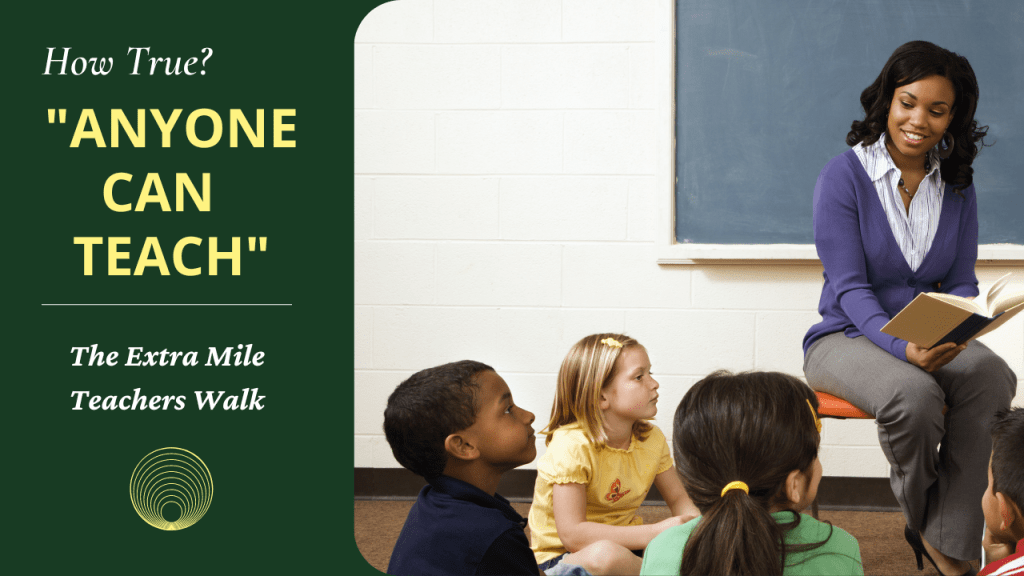
Search any site on the internet for the highest-paid professions in the world and you will not find “teachers” in the top 30. Expand your search and look for the list of professions in different countries where the practitioners receive the best compensation packages and you will find out that teaching is not among them. You will not find a country where teachers are ranked among the highest money earners.
Teaching not classified among the highest paying jobs, of course, is not surprising. That has been the case since time immemorial and it is most likely not to change anytime soon. One possible reason teaching as a profession is not getting the recognition it should get is because of the pervading notion that “anyone can teach.” You cannot say the same for law and medicine… not just anyone can practice those professions. But how true is it that just anyone can be a teacher?
But even if teachers do not get the recognition and sufficient remuneration they deserve, they wholeheartedly perform the role they have embraced. Indifference and poor salary are included among the thorny steps in the extra mile that teachers need to walk when they have accepted that teaching is not merely a profession but a vocation. It is not merely a job to perform but an obligation to carry out.
Acknowledging that teaching is not merely a job but a duty to fulfill is what makes teachers go the extra mile, to do what is more than required in the performance of their tasks, including sacrificing personal resources and sometimes even happiness. Teachers understand and fully grasp the nature of the responsibility that they agreed to fulfill when they signed up for the job. They know it’s not easy. How in the world would one consider it easy to be responsible for the education of other people, especially the young ones? When did it become easy to facilitate the acquisition of knowledge and values and the development of skills of your fellow human beings?
Teachers would be one of the highest-paid professionals if only pay would be commensurate to how significant is one’s job in the enlightenment of the soul, the preservation and enhancement of the fabric of society, and the socio-economic development of a nation. Teaching would certainly be at top of the list of the highest-paid professions in the world.
But it is what it is. Teaching is not a profitable profession. If it is material wealth one would like to accumulate, teaching is not the profession to have. The realities confronting the teachers in the academe could really make them say a lot of things in the “present unreal conditional” form. There are times that they couldn’t also help but make a “wish statement” like “I wish that I were a health care professional.”
And why?
Healthcare professionals like physicians, surgeons, and dentists, consistently round out the top 10 in the lists of highest-paid professionals.
What they (the medical practitioners and their fellow health workers) do, maintenance and restoration of good health are very important. For that, they deserve the pay they get, most especially during the time that the coronavirus pandemic was raging. But nurturing the human spirit…helping a person achieve holistic development is as equally important, if not more important. What professional endeavor could be more meaningful than helping your fellow men achieve their full potential for them to become responsible human beings and productive members of society?
And not only are the teachers not getting the pay commensurate to the importance of the work they do and the effort they need to exert when doing their job, but they also don’t get the recognition they deserve.
A study concluded that American society does not generally view teachers in the same way, as they view other professionals; the belief that “anyone can teach” is not found in other professions. For example, not just anyone can play professional baseball, be an accountant or engineer, or practice law or medicine.
Such is the indifference teachers, as professionals are getting.
But how true is the contention that “anyone can teach?” Those who know what it takes to become a teacher would say that it is a fallacy. That “anyone can teach” is an erroneous assumption.
Education is not just a matter of whether you can teach or not but also whether or not you can make the students learn. Even if a person is an expert in a particular field, it is not a guarantee that they can teach what they know. Knowing something is different from knowing how to teach it.
Hiring just anyone to become a teacher is doing a disservice to the teaching profession. Hiring somebody to teach a language just because they could speak that language is a mistake. Not because somebody is good at math that they should be allowed to teach math. It takes a lot to become a teacher. Teachers undergo rigid training for them to hone their pedagogical skills. They read a lot knowing that teaching and learning are both grounded in Philosophy, Psychology, Sociology, and other related fields. They understand that they need to be familiar not only with their field of expertise or chosen subject area but with different principles and strategies to effectively deliver learning and teaching. They know that when they are done teaching in the classroom, their work is not done yet. There are other things to be done – checking graded activities and preparing a new lesson plan. The preparation of a lesson plan, in itself, is a tedious process.
The list of the things that teachers need to know and do is long. At the end of that long list are two characteristics that teachers need to develop if they wish to succeed in the profession. Those are PASSION for their work and COMPASSION for their students.
With all the aforementioned, what would anybody assume that just “anyone can teach?”
Be that as it may, teaching will forever be a NOBLE PROFESSION! Nothing can diminish its intrinsic value.
One thing is for sure, all successful professionals in the world – business executives, lawyers, architects, engineers, surgeons, physicians, dentists, nurses, brokers, and what-have-you – know that their teachers, who did not mind walking the extra mile contributed a thing or two or more into whatever they have become.
The Keys to Effective Teaching
This is the talk I delivered when I was invited as a resource person in a webinar for Education students in the Philippines on February 16, 2022.
Part 1
Part 2:
On Finding A Better School

Each time teachers or school administrators resign but expressed intentions to continue with their career in the academia, their colleagues would tell them this – “I hope that you find a better school.” I heard that several times because I also moved from one school to another – 6 times in the Philippines and twice here in South Korea – in the past 31 years.
Hiring committees in the academe consider “school-hopping” as a red flag. Some (if not most) people in charge of recruiting teachers or school officials think that when an applicant for an academic position has moved from one school to another several times, hiring them is a risky proposition. To this, I disagree.
You may disagree with my disagreement but I think that depriving applicants of the opportunity to get hired because they “hopped” from one school to another is b—s–t! Recruiters who subscribe to the notion that transferring from one academic institution to another is an indication of an attitude problem on the part of the applicant think that they are morally better than anyone else – holier-than-thou. They should not forget that there are justifiable reasons teachers and school officials may do so. Of course it’s a different story if the hopping is due to an applicant getting fired from their position for whatever reasons and there are ways of determining if that’s the case.
At the very least, the applicants described must be given a chance to be interviewed and afforded the dignity to explain themselves. In my case, I tell you, if you would know my reasons why I left the last two schools where I served as a school administrator (where I stayed only for a year each), before I came here to South Korea, I could almost hear you saying “that’s the best decision to make” and that you would not have second thoughts doing the same if you were me.
There are a thousand and one reasons why teachers and school administrators resign. Some of them are justifiable, some are not. Reasons could also vary from professional to personal, sometimes both. But for those whose reason, specifically, is to find a better school, there is one question whose answer you should carefully contemplate on– “Does a school better than where you are presently working (or where you were previously employed) exist?”
For those who like me “hopped” from one school to another – Did you find a better school? What about me? Did I find a school better than the previous ones that employed me as a teacher and as head of a department or of the school as a whole?
Before I, or any of you who, like me, moved from one school to another, at least once, answer the questions aforementioned (and before those who might also be considering leaving their current academic positions to find a “better school” make their final decision) there is another question that should be answered also:
“What, FOR YOU, would make one school better than the others?”
Yes, I emphasized the phrase FOR YOU because when you look for a better school you will definitely be using your own standards to guide your choice. Only you know whether the personal norms you will be using agree with the existing (and research-based) measures used in judging whether a school is good or bad. Only you know what philosophy, if any, informs those benchmarks that you will be using.
For you, probably, a school is better when it is paying higher and giving more benefits. Nobody would fault you if that’s one of the bases, or it could be the primary basis, you’re using to judge the worthiness of a school. As I said, I don’t blame you. Who would not want to graze where the pasture is greener? Who would not want a pasture where there are waterholes bursting with fresh water?
But there are other things that should be taken into consideration. In that school, you may be satisfied with the compensation package but what about the organizational climate and working conditions? Will you not consider those things? Would you not check first if behind the bushes in the pasture lions or tigers are not lying waiting to devour you? Would you not check first if in the waterholes submerged are crocodiles and snakes ready to bite you?
Will you not try to find out if it is a school wherein people, from top to bottom, treat each other professionally and humanely?
Is it a school that has benevolent administrators and ideal teachers?
Is it a school where while you are enjoying the pay, you would also be happy and peaceful?
Is it a school where you could grow personally and professionally?
Is it a school where you don’t disagree with the policies because they are perfect?
If the answer to each of the foregoing questions is a yes, then it means you have found a better school. Congratulations! And I think you found not just a school better than your previous one but THE PERFECT SCHOOL.
But do you honestly think you can really find a school that would answer yes to all of the questions above?
I hate to disappoint you but the answers is — NO!
Believe me.
And why you should believe me?
I have more than 3 decades of experience in the academe as a teacher and as a school administrator at the same time – transferred to different schools several times in the Philippines and here in South Korea and worked with teachers from different parts of the world. I have seen the best and the worst in the academe from both sides of the fence – the employers (school officials) and the employees (teachers). I can tell you with all honesty that there are demons and angels in both sides of aisle.
Believe me that no matter how good the compensation a school will give you, you will not be contented. You will always wish that they give you more… you will always want more. Humans are hard to satisfy. If you say I am mistaken, that you are satisfied with what you’re receiving now then you are not like most of us. You are probably not human. You are a sentient being… an angel.
Believe me also that no matter how good the school administrators (or owners) are, some people in the organization will always find something wrong with them. That’s just how people are naturally wired. They are programmed to find faults and trained to see what’s wrong. I am not saying all have that kind of attitude and tendencies. And I sincerely hope that you are the exception.
But what about you? Are you nor really like that? Don’t you have the mindset that those people holding offices are born to make things difficult for their subordinates – that the policies they implement are making your life difficult? If yes, I tell you this, you will never find a better school. In your next school, with that kind of mindset, you will see the same problems and you will hurriedly pack your things again and leave after a year or less.
The employers and employees, like the administration and opposition parties in the political spectrum, are seemingly locked in an ancient struggle we call the battle of good and evil. As to who’s who – good or evil – nobody knows What I know is that employees are naturally positioned to think that they are always at the receiving end of the bargain. That policies are inimical to their interest, that they are given too much work but are paid less, and — they think that they can do better than their school administrators. Come on girl! I dare you put up your own school and let’s find out if you would not become the school owner/administrator you hate.
Educators – you teachers and administrators – will definitely find a new forest but one thing for sure you will be the same animal there and don’t be surprised if you’ll find the animals in that forest as very much like the ones you left in your former forest. I will bet my house and savings that the problems and issues you experienced and had in your former school will be the same you will encounter in your next school. You know why? Human beings are the same where ever you go. And you? Believe me, you will be the same person where ever you go. Unless you decide to change. And that is the prerequisite to finding a better school or a better workplace. You will find out why if you read on.
Oh… so you decided to read on. Thanks!
So, what happened to my quest for a better school?
First, here’s what I found out.
You searching for a better school – one better than your former school – is like Vladimir and Estragon waiting for Godot… who never came. I used this analogy hoping that you are familiar with Samuel Beckett’s existentialist play entitled, “Waiting for Godot”. For all of you thinking that you can find that school somewhere – that one better than your previous – imagine me as the boy telling Vladimir and Estragon that Godot will not be coming tonight and I will return again tomorrow to tell you the same thing – that Godot is not coming… that you will never find a better school.
Why?
Because that better school we are searching is an abstraction – an ideal. That school exists nowhere but in our minds and in our hearts. We don’t search for the better school but we make the school where we are better by becoming a better educator.
We create the better school when the pursuit of our pedagogical functions as educators is not predicated on the material gains we get in return for the efforts we exert. The efforts you exert, from the creation of your lesson plans (setting your objectives, designing your learning activities, constructing your tests, and what have you) to their execution in the classroom is a priceless endeavor that can not be valued monetarily. Its significance is intangible.
When at the end of the month you exclaim that your pay is not commensurate to all the efforts and sacrifices you put up in the classroom (and at home because most of the time you have to bring home work you could not finish in school), it is an indication that you may might have embraced the wrong profession. The solution is not to find a better school that gives higher compensation and less work but to search for another job that would give you what you value more – MONEY. And hey, I’m not saying that’s bad. Me too likes money… lots of it. But if earning as much money as you could, the academe is not the right place for you. You should stay as far away as possible from the academe. I advise you to try becoming an entrepreneur. Who knows you might be the next Jeff Bezos or Warren Baffet.
Those who fully embraced teaching and acknowledging that it is not purely a profession done to earn a living but a vocation at the same time that has to be pursued for a higher purpose – that of preparing young people for life and to become the best they could be – find their pay envelopes bursting with both money and sense of fulfillment. They receive intangible benefits – happiness and contentment. They are the teachers and school administrators who found a better school – it’s in their hearts and minds. They found joy in what they do.
We make the school where are better when we begin to acknowledge that we are in the academic institutions where we are not for ourselves, not for our colleagues, and not for our school administrators.
For whom then that we are in a school and why are we teachers?
It’s sad if you don’t know the answer.
STUDENTS.
Yes, the students are the reason why you’re in school. The students are the reasons why you are a teacher. The students are the ones that gives essence to your being an educator.
Just like a woman that could not be called a mother if she has no son or daughter, adopted or biological.
Right? She’s just a woman (and a wife), but not a mother, if she has no child or children.
And would you call yourself a teacher without a student. I think not. Those buildings in campuses of schools would be referred to only as structures, collectively they could not be called a school, if there are no students.
You can make a school better when you acknowledge that you are there for the students. It is important that you nurture your relationships with your colleagues and administrators but the more important relationship that you must nurture is that with your students.
The school becomes better when you realize that you are there to perform your functions as a teacher and not as a critic waiting for the slightest mistakes from your colleagues and the leaders of the institution so that you will have a topic to discuss (or shall I say gossip about) with your friends or an issue to hurl against the people concerned.
When you realize that changes being implemented would redound to the interest of the students being the most important stakeholders of the institution – the institution whose very reason for existing is to serve them – then you just made the school all the more better. When you realize that such changes, and the corresponding adjustment you have to make are necessary, for the good of the student then you become a pillar of the better school where you wish to be.
Good riddance if the reason you leave the school is because you view necessary changes as too much, not too much per se, but too much as far as you and your standards are concerned. I hope that you are not so entrenched in your comfort zone that you construe the demand of existing and evolving circumstances for you to change and to learn something new as being unreasonable and disrespectful of your rights as an individual. That’s why you are at the verge of leaving your current academic position to look for a better school – and your idea of a better school is probably one that will not mind you not wanting changes to happen, one that will pretend not to see the badge of mediocrity displayed proudly in your chest.
The school where you are becomes the better school you are searching when you decide that even if nobody is watching, you conduct yourself within the bounds of professionalism and excellence that all educators are duty-bound to uphold. Your school becomes better when you make it a policy to never short-change your students.
Now, have I found a better school?
Eventually I did.
I found a better a school. It is where I am now. You cannot see it, because it is in my heart and in my mind.
I found it when I started to focus on the main reason I am a teacher – the students.
I found it when I decided to trust my colleagues and administrators that they know what they are doing. I trust that my administrators have got to do what they need to. I trust that my colleagues will do no less. My job is not to mind what they are doing because I have no control over those. My job is to guide my own students into becoming the best they could be and into getting themselves ready to live life when they finally leave school.
In that school, I found joy.
That joy make me not work, but play. Since then, school has ceased to be a workplace, but a playground. Yes, I play with my students. And for playing with them, I am given a reward everyday and every payday. Every payday – a well-deserved paycheck. Everyday – happiness.
Teachers, Leadership Styles and McGregor’s Theories X and Y Assumptions
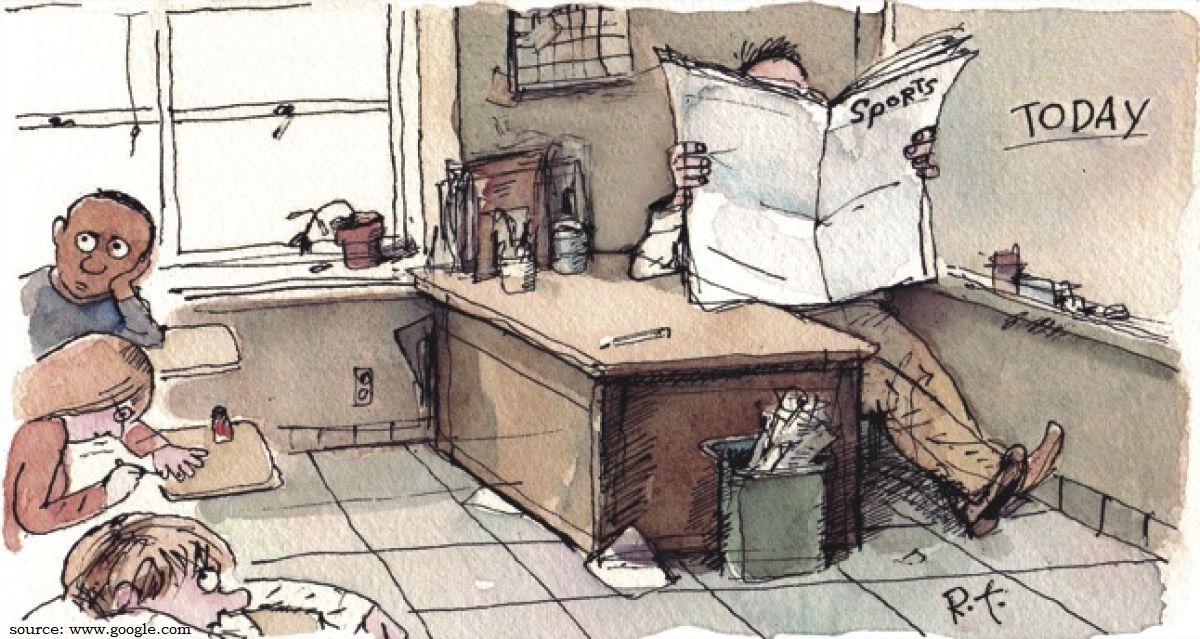
Managing people in both the corporate world and the academia industry is difficult and complicated. It requires not only mental and emotional competence but also toughness. It is an enterprise not meant for the fainthearted and weak-kneed.
Managers need both smarts and grit. They need to be astute and their patience boundless. Perhaps the trickiest part of the job of those in supervisory positions is as leaders they have to determine which leadership style is most applicable given the kind of people they are leading and the nature of the business they have.
Leadership theories abound and before managers, supervisors, or administrators are catapulted into the position as head of the organization they might already have a style which is inherent in them and framed by their education and personal experiences.
As leaders, they could be any of what Koontz and Weilhrich in “Behavioral Theories” describe as autocratic, democratic, or free-rein leader (laissez-faire). Those in the position of leadership (according to the said authors) have the following options: maintain strong control over their subordinates and lead using their ability to withhold or give rewards and punishment; consult with the people they are leading on proposed actions and decisions and encourage participation from them; or use their power very little, if at all, giving subordinates a high degree of independence in their operations.
As to which of the aforementioned styles is most effective is hard to determine. Those espousing the “Contingency Theory” claim that there is no best way to organize a corporation, to lead a company, or to make decisions. They add that the optimal course of action is contingent upon the internal and external situation. This is the principle that guided me when I was given the opportunity to lead.
In my experience as school administrator (1994-2012), I figured that there is no one-size-fits-all kind of leadership. I realized that the way to supervise people is a decision that designated leaders could arrive at only when they assume office. They may have a blueprint on how to lead when they take the reins of leadership in their organization but such is not set in stone. Whether as leaders they become autocratic, democratic, or free-rein depends largely on the kind of people being led.
Douglas McGregor, in his Theory X and Theory Y, presented two opposing perceptions about employees. Theory X assumes that employees inherently dislike work, avoid responsibilities and seek formal direction and should therefore be coerced, controlled, or threatened with punishment. Conversely, in theory Y, they (employees) are viewed quite the opposite. They need not be controlled and closely supervised because they love work, exercise self-direction and self-control, accept and even seek responsibility, and make innovative decisions.
When leaders have already determined under which set of those perception the people they are supervising belong, they begin to devise what they think is the best way to lead them.
Experts in human behavior are saying though that people working in organizations are not necessarily either one type or the other. They said that between the two extremes, there could be a combination of behaviors. Thus, leaders need to be careful not to implement policies and operate in response only to either (or both) of those two assumptions about employees. They need to be flexible.
The best leaders are those who could devise a way to have a complete inventory of the different personalities of people in the organization they are running and calibrate their approaches to leadership to the categories of personalities that would emerge from the inventory. That of course is easier said than done especially if they are overseeing a big group, company or association.
What about teachers? Generally speaking, where should teachers be classified – under theory X or theory Y?
It is hard to imagine teachers disliking their work and avoiding responsibilities. To be in-charge of the teaching-learning process is not a walk in the park. It demands the highest form of professional competence which means doing a lot of work and accepting a lot of responsibilities as well. The list of the things that teachers are expected to perform is long – prepare lessons; construct exams, mark tests, quizzes and assignments; prepare reports; attend seminars and trainings; and keep abreast with the current innovations including using technology in instruction. The teachers’ primary function, of course, is instruction. If they are in universities, they are also expected to do research and get involved in community extension programs.
That’s a lot of things to do for teachers and with their plates that full the teachers cannot possibly be theory X type. When they embraced the profession, they know the kind of work they are doing. They know that they don’t stop working after class hours. Teachers always walk an extra mile or two.
The prevailing perception about teachers is that they are consummate professionals – the embodiment of the theory Y assumptions.
Teachers are responsible and independent. They don’t need to be micromanaged because they are happy to work on their own initiative and their strong sense of professionalism and self-motivation always lead to the successful completion of their tasks and responsibilities and strict adherence to policies and guidelines. They also need not be told as to what to do because they have strong sense of self-direction and self-control.
Are these assumptions about teachers true?
I have been in the academia for almost 31 years as a teacher. I worked with different kinds of teachers across demographics – age, gender, race, education, religion, and philosophical persuasion – as a colleague and as administrator (for 18 of those 31 years). Based on my experiences (most particularly here in South Korea where I have been teaching since 2013 and was briefly a head professor for 3 semesters), I can say that that prevailing perception about teachers is not true.
Some teachers are theory X type, some theory Y, and some are in-between.
The worst assumption that school owners and administrators could make is “all teachers conduct themselves within the bounds of professionalism.” They ought to check carefully the background of the teachers they hire. They need to strictly monitor the performance of the teachers and ensure they are following school policies and guidelines. This should not be construed as lack of trust but rather enforcing excellence and ensuring that the students get what they deserve, what they pay for.
The ones leading schools ought to make sure that their teachers are not engaged in what I call “mercenary teaching” – interested only in the money and disregards professional ethics.



 M.A.D. L I G A Y A