Category Archives: Flooding in the Philippines
Quezon’s Curse
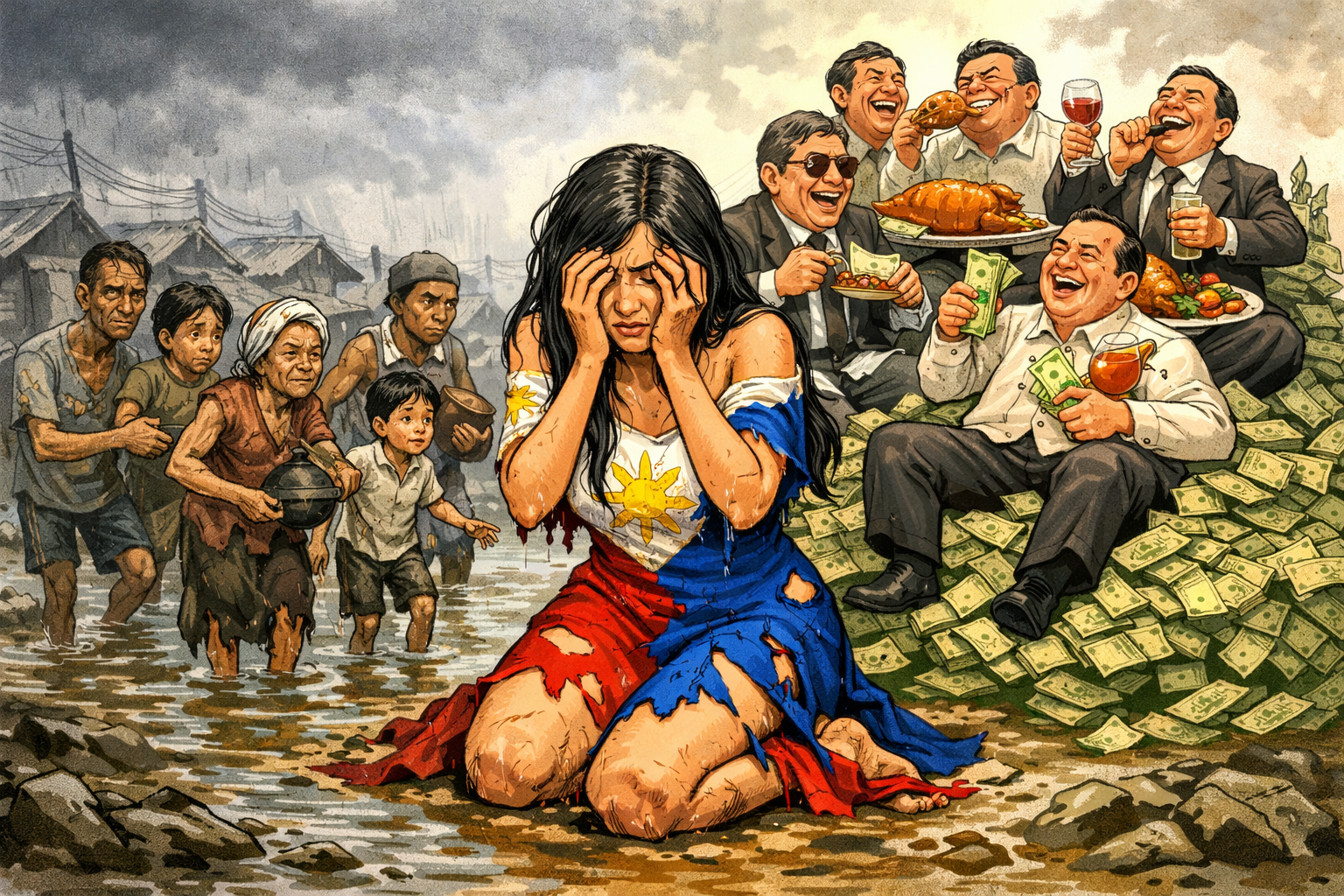
Did Manuel L. Quezon, the second president of the Philippines who served from 1935 to 1944, unknowingly curse the nation when he declared, “I would rather have a government run like hell by Filipinos than a government run like heaven by Americans”?
The Americans eventually ceased governing the Philippines by force after the Second World War. It was not independence that the Filipinos were granted on July 4, 1946, but freedom. The Americans did not save the Philippines from Spain, as some uninformed Filipinos and the rest of the world wrongly thought. The US coerced Spain into selling the island to them. So, the Philippines was passed by a colonial tyrant to another… to a more powerful and ruthless tyrant.
Let this be clear… The US did not save the Philippines from Spain. The former forcibly grabbed our nation from the latter.
When the Americans finally turned over the reins of government to Filipinos, Quezon could have been the happiest man alive had he lived to witness it. At last, the Philippines had a government run by its own people.
But as the saying goes, “Be careful what you wish for.”
Our country has since been governed by Filipino politicians. Given the Philippines’ governance over the decades, how would we assess the performance of those who have served in the different branches of government since the Americans passed the baton of leadership?
Only the blind — and those who benefit from the system — would deny how badly the nation has deteriorated. Only the naïve would refuse to see that the Filipino spirit seems lost. Like a dried leaf in autumn, it drifts wherever the wind blows. The Filipino identity has become like a shattered mirror. Each broken piece reflects a different truth, yet none shows the whole picture of who we once were or what we should be as a people.
As a nation, we are as fragmented as the islands that form our archipelago. The colonial strategy of “divide and conquer,” once used to weaken and subjugate us, continues to linger in our society. Even today, it keeps us deeply divided.
And all this appears to trace back to what now feels like Quezon’s curse — “a government run like HELL by Filipinos.”
For how long have we been led by politicians who seem to have descended from hell itself? Would it be unfair to describe members of the executive and legislative branches as soulless demons who take turns plunging their hands into the nation’s coffers, depriving the people of the services and opportunities they deserve? And what of those in the judiciary and the military who appear to look the other way?
One cannot help but recall the countless anomalous “flood control projects” — billions poured into programs meant to protect communities, yet every year, towns and cities continue to drown while only a select few grow richer. What was supposed to shield the people from disaster has instead become another avenue for plunder.
The sad reality is that the Filipino people cannot simply play the victim. It was Filipinos themselves who summoned these demons from the depths of hell and enthroned them in Malacañang and in Congress. In short, they voted for them. And the sadder part is that even now, when it is clear as day that the devils they have chosen are guilty of corruption, many still continue to support them.
Thus, Quezon’s pronouncement refers not only to Filipino politicians but also to the Filipinos who placed them in power.
“Kawawang Inang Bayan.”
Would we not, at times, be tempted to think that perhaps we would have been better off had the Americans continued to run our government?
Would we not be tempted to accept their old justification for staying on Philippine soil — that Filipinos were not ready for self-governance?
Yet perhaps Quezon did not curse us at all.
Perhaps what he offered was not a prophecy of doom but a challenge — a declaration of faith in the Filipino people’s capacity to govern themselves, to learn from their mistakes, and to shape their own destiny. The tragedy is not that Filipinos were given the reins of government. The tragedy is that, over time, many surrendered vigilance, traded principles for convenience, and allowed power to fall into the hands of the few.
A government “run like hell by Filipinos” was never meant to be permanent. It was meant to be corrected by an awakened citizenry. Democracy was supposed to be a system in which bad leaders could be removed, corruption punished, and the people remain the true sovereign.
But when a nation grows tired, when poverty silences voices, and when hope is repeatedly betrayed, tyranny does not need foreigners to thrive. It is cultivated from within.
Quezon’s words were not a curse. They were a warning wrapped in hope.
What turned that hope into hell was not Filipino governance itself, but Filipino complacency. We allowed demons to rise not because we were incapable of self-rule, but because we stopped guarding it fiercely.
In the end, the real question is not whether Quezon cursed us.
The real question is whether we, as a people, abandoned the responsibility that freedom demanded.
The Floodgates of Command Responsibility

The Secretary of Public Works and Highways (DPWH) appears to be taking all the blame as the scandal surrounding the flood control projects unfolds. The question is this: Whose conscience will get inundated with guilt if we open the floodgates of command responsibility?
Suppose we adhere to every aspect of the command responsibility framework. Shouldn’t someone be uttering the well-known phrase, popularized by U.S. President Harry Truman, “The buck stops here”?
Who should be saying, “The final responsibility rests with me”?
Who is conscientious enough to say, “I take full responsibility”?
Nobody is doing so. Instead of doing a Harry Truman, the mayors, governors, congressmen, and senators are all doing a “Pontius Pilate.” I will not be surprised if, in the days to come, these Honorable Gentlemen and Ladies will also do a “Judas Iscariot.”
I don’t know if President Bongbong Marcos was correct in using the pronoun “kayo” when he said “Mahiya naman kayo” in his latest State of the Nation address. I think it should have been “Mahiya naman tayo.” He would have gained more admiration had he used “tayo” instead of “kayo.” While the DPWH is directly responsible for implementing flood control projects, the President, as the head of the executive branch, bears ultimate accountability for ensuring proper oversight. At least, His Excellency is now correcting the acts of omission and commission (and yes, the “commission,” if you get what I mean). He should be given credit for that, although “prevention” would have been preferable to “correction.”
Did you see how some local executives, congressmen, and senators crucified the DPWH officials and contractors? Did they not know about the substandard and ghost flood control projects in their respective localities? Did they not really know about the corrupt practices happening right under their noses? Come on, we were not born yesterday.
Nobody will believe you, even if you deny to death that you know nothing about the substandard and ghost flood control projects. It is improbable that nobody informed you that these mega projects are being undertaken in your jurisdiction. As a VIP (being an elected official), nobody in their right mind would construct anything in your backyard without notifying you. Furthermore, it is impossible that nobody whispered to you about “for the boys.” Whether you accepted or rejected it, only you and God know.
Don’t be a “Pontius Pilate.” You may not be guilty of accepting anything passed under the table, but why are you not brave enough to say that you actually turned a blind eye? Don’t act now as if you are the champions of your constituents and during TV interviews hurl all those invectives against those who are now tagged as suspects in the “flood control project scams.” Your act of washing your hands on national television didn’t go unnoticed. It’s not funny at all. If only we had an intelligent electorate, I doubt you would get reelected because of it.
We need to answer the following two questions:
“Is it proper for the House of Representatives to conduct an inquiry into the flood control project scam?”
“Is it proper for the 12 remaining senators from the 19th Congress to join the ongoing investigation of the Senate’s Blue Ribbon committee on the same issue?”
Just asking!
There is another web whose strands we need to trace aside from command responsibility. It’s the web of corruption. The webs of command responsibility and corruption are connected.
Who is responsible for the Congressional appropriations for the 2025 National Budget’s subpar and ghost flood control projects?
Who is brave enough to say, “I bear ultimate responsibility”?
Who, after a deep reflection, would say, “The final decision and its consequences are mine to bear”?
And please don’t mind me asking a last question:
Whose bank accounts fattened through the scam involving the flood control project?
Puwede po bang makabalato?



 M.A.D. L I G A Y A