Category Archives: Education
On Philosophy and Teachers
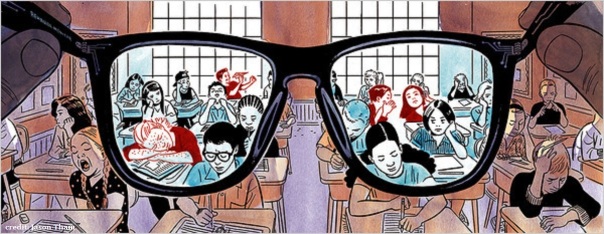
No two teachers are alike. Even if they are from the same race and culture and graduated from the same university, don’t expect them to embrace the same educational philosophies and to develop the same set of beliefs and values. You won’t see them apply the same methods and strategies in the classroom, approach teaching and learning with the same degree of passion, and treat the learners in the same manner.
Teachers are different in many ways.
Teachers decide which perspectives they would use in looking at their role as mentors and in treating their students. Such perspective depends on either the philosophical foundations upon which they are grounded or their personal set of beliefs… or may be both.
Teachers may have read too much of Hegel, Kant and Plato that they may have developed idealistic tendencies indoctrinating their students into believing that they do not exist for themselves but for others and for a higher purpose. Or like Aristotle, Locke or Rousseau, who all tried to debunk the ideas established by Plato and company, the teachers maybe slowly training their students to subscribe to rational thinking, that the latter need to think critically and scientifically. They could be pragmatists like Dewey and Kilpatrick, guiding students to keep themselves in touch with reality for they believe that there is no other world aside from what can be perceived by the senses.
Their educational philosophies determine the way they talk, think, and behave as professionals.
Whatever values and beliefs teachers bring to the class don’t really matter for as long as nothing they say and do in the while teaching is inimical to the interests of the lerners. What is important is that everything that transpires in the classroom is intended to make the students the best persons they could be and make them prepared to live life.
So be it if the teachers are like Satre, leaning towards Existentialism in guiding the students to take responsibility… in deciding who they are in order to make themselves authentic individuals.
Nobody can claim that this or that philosophical perspective in education is superior over the other. It’s fine if the teachers wish to embrace all the philosophies and combine their best features to serve and guide them in shaping their set of values and in choosing their methods and strategies.
Combining the philosophies, by the way, is not a novel idea. In Scholasticism, St. Thomas Aquinas, harmonized Idealism and Realism.
What about coming out with a philosophical perspective combining the four major philosophies in Education?
The philosophies aforementioned have shaped the teachers into the kind of educators that they are today. Whatever they knowingly and unknowingly say and do in the classrooms are offshoots of their set of values and beliefs. And this set of values and beliefs constitute their philosophy of education.
Teachers may have also accumulated through the years a personal system of values that govern every decision they make in the classrooms. Thus we see them approach their teaching (and deal with their students) in different ways. We see them display different degrees of enthusiasm in teaching. Some display no enthusiasm at all.
There are teachers who are “sages on the stage” who believe, the way the realists and idealists do, that knowledge emanates from them being the authorities. So, the students should be spoonfed. Conversely, there are teachers, who, like the existentialists and pragmatists, act like “guides on the side” painstakingly guiding the students to self-discovery.
There are teachers who would choose specific methods and strategies without considering the specific needs of their students. But there are also those who would be conscientious enough to take into consideration the heterogeneity in the class before deciding what learning system they would put into effect.
There are teachers whose mere mention of their names would send shivers down the spine of students. Conversely, there are teachers who try to make learning fun making the students enjoy, and not fear, the classroom.
There are teachers who consider the classroom a workplace, while others consider it a playground. They work playfully or playfully work happy doing what they are doing in the classroom thereby rubbing off to the students their joyful spirit.
There are teachers who have seemingly forgotten that the students are not just empty sheets waiting to be filled-out as in Locke’s Tabula Rasa. The kids in the classrooms are not wax figures with empty minds which the teachers need to stuff with all the knowledge that the curriculum requires. These students are not just intellectual beings, they have emotions. They need more that education. They also need love and understanding. They should be treated the way parents treat their children.
Whatever the teachers decide to be… whatever system they implement… whatever method and strategies they apply… however they view learning… however they treat their students… would depend on their perspectives as dictated by their educational philosophy and their set of values and beliefs.
At the end, the way teachers conduct themselves as professionals and the way they treat their students depend on whether they consider teaching a means of livelihood or a way of life.
Measuring School Effectiveness

The main subject of the dissertation I wrote for my doctorate was “school effectiveness.” Choosing this subject was driven by a personal belief that the school contributes most to an individual’s development. It is in school where a person formally acquires and develops most of the knowledge, skills, attitudes, and values they need and ought to have.
I placed emphasis on the word “formally” in the preceding paragraph, for it could be argued that the home and the church also contribute to an individual’s formation.
It is true, but not all parents are trained educators. Teachers (presumably) are. And not all families are functional. The dysfunctional ones may fail to help in the proper development of an individual. A school is, presumably, always functional. This is not to say that the home does not contribute to an individual’s development — it does, but not as comprehensively as the school could.
What about the Church?
An individual cannot be forced to embrace religion. Many people have none. And even those who profess a religion cannot be obliged to go to church or attend services during days of spiritual obligation. Thus, religious institutions may contribute little, if at all, to an individual’s development. A young person, on the other hand, cannot avoid going to school. No parent in their right mind would want their children to go without an education. For as long as the family can afford it, children will be sent to school from basic to tertiary education. And even when a family lacks the resources for private schooling, government-run or government-subsidized schools serve as an alternative.
The school carries on its broad shoulders the task of ensuring that the students entrusted to it acquire and develop the knowledge, skills, attitudes, and values they ought to possess. The school, already acknowledged as an extension of the home, should even be ready to serve as a vehicle of the church in spreading the gospel — except, of course, in societies where religion is not part of the culture.
The school, then, cannot afford to be mediocre. Schools, as a matter of course, should always be a paragon of excellence.
But how do we measure excellence in schools?
Excellence is an abstract concept, but it can be tested empirically. The excellence of schools can be quantified through existing measures of school effectiveness.
Existing literature suggests that measuring school effectiveness requires accounting for student performance or achievement. Scheerens1 refers to school effectiveness as “the performance of the organizational unit called school. The performance of the school can be expressed as the output of the school, which in turn is measured in terms of the average achievement of the pupil at the end of the period of formal schooling.”
Student achievement in basic skills is undoubtedly the most widely used criterion for defining an effective school. Sergiovanni2 explains that an effective school is one in which students perform well in basic skills as measured by standardized tests. Schools, therefore, take pride whenever their students top government examinations — proficiency exams for basic education students and board exams for college graduates.
But are grades and scores on standardized tests and government examinations a valid measure of school effectiveness?
Sergiovanni’s model, and similar approaches to quantifying school effectiveness, have been criticized as unidimensional and insufficient. Critics argue that focusing exclusively on academic achievement ignores the relationship between effectiveness in academic outcomes and effectiveness in other dimensions — citizenship training, the development of self-esteem, independence training, and the development of self-discipline.
This overemphasis on academic outcomes has made society too obsessed with grades.
Schools are believed to have purposes beyond teaching basic skills. School effectiveness, therefore, should not be measured only by whether graduates can read, write, and compute, or by how well they perform on government examinations.
Effectiveness should be measured along other dimensions as well. To measure school effectiveness through Sergiovanni’s model alone is to take a myopic view of the purposes of education — it considers only the intellectual purpose of schooling, which, according to McNergney and Herbert3, includes the teaching of basic cognitive skills such as reading, writing, and mathematics, and the transmission of specific knowledge. McNergney and Herbert identify other purposes of education as well — political, social, and economic.
A comprehensive measurement of school effectiveness should attempt to quantify how schools perform across all of these dimensions.
It is beyond dispute that schools play a vital role in the development of the individual and in nation-building. They cannot, therefore, disregard their political and social purposes.
Measuring the effectiveness of schools should not stop the moment their students graduate. How those students perform in the workplace and in society as they grow older should also be considered.
The school is the vehicle for the delivery of education, and the quality of education that a citizenry and its leaders receive through the educational system determines whether a nation is destined for greatness or condemned to socio-economic stagnation.
A nation, it is said, is only as good as its citizens. One measure of school effectiveness, then, is the kind of citizens — the kind of members of society — that schools produce.
Whatever a country’s condition at the moment, whether progressive and peaceful or not, is what its citizens have made it to be. And how the citizens have made their nation reflects the kind of education they received from their schools.
Measuring school effectiveness this way, admittedly, is difficult. But even the simplest of minds can easily answer the following:
Which school is more effective — the one that produced graduates who topped board examinations, or the one that produced responsible, productive, and conscientious citizens and leaders?
Which schools are effective — those that produced topnotchers in standardized and board examinations, or those that produced citizens and leaders who contribute positively to the betterment of society, the nation, and the world?
The answer, I think, is self-evident — yet our systems of accreditation, our league tables, and even our own instincts as parents keep reaching for the test score anyway, because it is easier to count than character. Perhaps that, in the end, is the truer measure of a school’s effectiveness: not merely what its graduates score, but what they become, and what they choose to build with what their education gave them.
References:
1. Scheerens, Jaap. Effective Schooling: Research, Theory and Practice.
2. Sergiovanni, Thomas. The Principalship: A Reflective Practice Perspective.
3. McNergney, Robert & Herbert, Joanne. Foundations of Education: The Challenge of Professional Practice.
Technology and the 21st Century Teacher
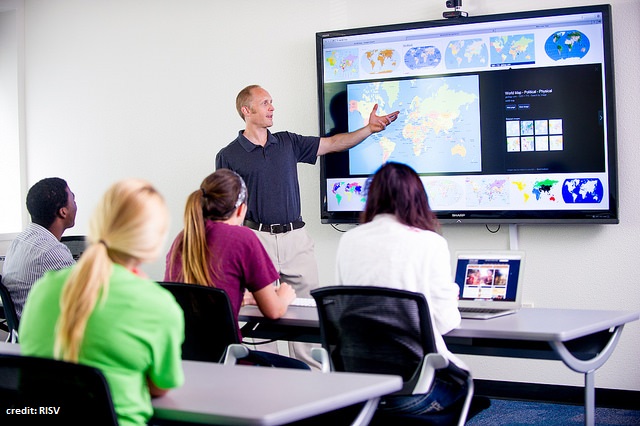
The central argument upon which I anchored my previous research work entitled “Factors Affecting The Use of Computers for Classroom Instruction in South Korean Universities”1 is “information technology has significantly altered the landscape of teaching and learning.” Indeed, it drastically changed the ways teachers taught and students learn thus school administrators and teachers need to respond accordingly and effectively.
At the turn of the 21st century education leaders have been reconfiguring educational paradigms that became almost obsolete because of the rapid changes in technology. Nowadays, emerging models of educational frameworks have included technology in both the expected outcomes and support mechanisms of the new paradigms.
The P21, a national non-profit organization that advocates for 21st century readiness for every student, developed the “Framework for 21st Century Learning” (F21CL) to define and illustrate the skills, knowledge students need to succeed in work, life and citizenship.2 The two parts of the framework (see figure below) are student outcomes (as represented by the arches of rainbow) and the support system (as represented by the pools at the bottom. One of the 4 clusters of student outcomes, is “Information, Media, and Technology Skills.” The article explains that to be effective in the 21st century, citizens and worker must be able to create, evaluate and effectively utilize information, media and technology.
And to be effective 21st century teachers, it has become A MUST that the teachers themselves should have those skills just mentioned. We cannot have “the blind leading the blind” scenario.
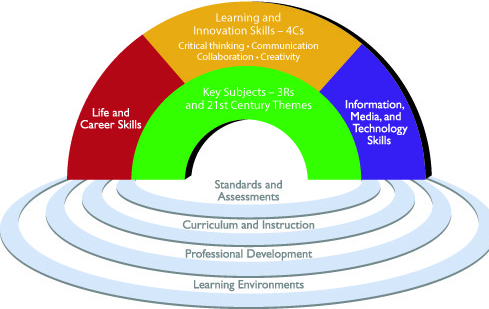
The 21st Century Student Outcomes and Support Systems
Schools need to respond by making the needed investment. They have to upgrade their existing facilities and purchase the necessary equipment in order to cope up with the demands of the new educational paradigms they have drawn up in order to keep abreast with the demands of the 21st century.
Not only in terms of equipment and facilities that the schools should focus on. They need to pay attention also to their manpower – particularly the teachers who plays the key role to ensure that success of the endeavor.
I made an assertion (in the previous work aforementioned) that integration of technology in instruction and assessment is inevitable and the teachers, being at the center of the delivery of learning need to accept it. The F21CL clearly defines the responsibilities of teachers (Standards and Assessment, Curriculum and Instruction, Professional Development and Leaning Environment.) Much of the responsibilities will be shouldered by the teachers. The said framework even specified clearly what is the role of teachers in the attainment of cluster 4 of students outcome – that is to “Enable innovative learning methods that integrate the use of supportive technologies, inquiry-and-problem-based approaches and higher order thinking skills.
But the application of technology in instruction is a contentious area that caused (or is causing) a lot of arguments and controversies in the academe. Despite the immense benefits that technology brings to education, some teachers are still either unwilling or hesitant to embrace the application of technology to the teaching-learning process.
I specifically identified also (in that same work) the pedagogical benefits that computers and internet provide. For example, the internet has become the teachers and students’ virtual library. Projectors and media players make the interaction between the students and their mentors more efficient. For the teachers in particular, the educational and organizational softwares and web browsers give them more resources and enable them to create better presentations.
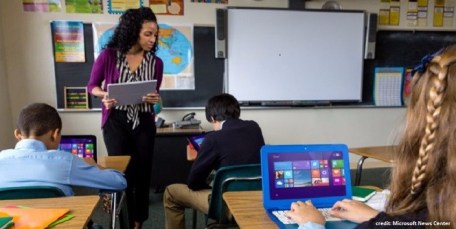
But apparently, not all teachers are convinced. They do not believe that computers benefit teaching and learning. They are the ones who do not use presentation softwares preferring to either just dictate or write on the board everything they wish to convey to their students. They are ones who refuse to use available course softwares opting to just open the prescribed textbook and read from it while teaching.
But why?
There are two possible reasons.
First – these teachers were exposed to educational philosophies different from those of the ones to whom embracing technology is a welcome development . This could be the reason they have different attitudes and views about the value of computers in teaching and learning. Their educational beliefs just don’t jibe with using computers in the classrooms.
Second and last – they simply (heaven forbid) do not know how to use any office software suites (word processing, spreadsheet, database and presentations applications) and specific educational software provided for them. They have difficulty navigating around any computer-generated environment. They are so helplessly not computer-literate that no amount of tutoring would help them learn.
Presumably, the reason they could not use the prescribed course software packages (that make things easier for them and their students) is that they don’t have the ability to do so. Even if assuming a course software, at a particular time, suddenly doesn’t work, its contents can be copied and pasted to any presentation software. But that again could be another problem… they probably don’t know how to create presentations.
Worst, they could simply be just aversive to technology.
Or maybe, they are simply lazy. They are computer literate but are not willing to try new systems being introduced.
The question that begs for answer is, “How can a teacher without the required 21st century skills teach such things to students?”
Professional competence for teachers is continuously evolving as technology keeps creeping into the foundations of education. Alongside pedagogical skills, another skill through which competence of 21st century teachers should be gauged is how extensive and effective do they apply technology (computer) to teaching and learning.
Perhaps it’s about time that computer literacy be strictly considered when hiring teachers.
On the part of school administrators and owners, they have a responsibility of ensuring that when they introduce a new computer application of learning the teachers are given enough time and sufficient training to become familiar with it.
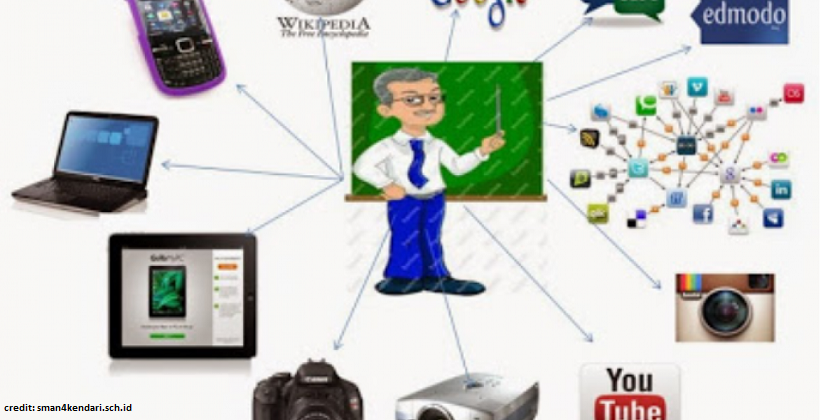
The following is one of the recommendations I made in a previous study I have been referring to.
“It should be noted also that among noted also that among the variables that are significant statistically teachers’ perception on the value of computers has the positive influence on their extent of use of computers for instruction in Korean classrooms. Thus, it is important for school administrators to keep that perception positive. The study also found out that a key factor in this positive perception is the teachers’ level of preparedness in using computers to facilitate learning. Being proficient in using computers is different from being familiar in using a new computer application for learning. Even the most proficient among computer users need time to learn an application introduced to them for the first time. Teachers tend to perceive the value of computers for classroom instruction negatively if they were not given enough time to acclimatize themselves with a new system being introduced.”
According to Edwin Creely3, “I was challenged by the ideas from Don Idle that we are textured for technology and that technology has always been and will ever be part of the deepest learning that we do. Learning to move technology and the digital technology of the 21st century into the heart of the learning process is an ongoing challenge for educators. So, the practice of being a literacy educator in the 21st Century must be, has to be, inclusive of digital literacies, including, most importantly, the use of social media.”
As Janelle Cox puts it, “A modern teacher is willing to try new things, from new educational apps to teaching skills and electronic devices. Being innovative means not only trying new things, but questioning your students, making real-world connections and cultivating a creative mindset. It’s getting your students to take risks and having students learn to collaborate.”4
References:
Factors Affecting the Use of Computer Technology for Instruction in South Korean Universities
http://www.p21.org/our-work/p21-framework
(E.Creely)(https://www.researchgate.net/post/What_are_the_qualities_required_of_ teachers_to_teach_21 st_century_learners.
(J.Cox)http://www.teachhub.com/15-professional-development-skills-modern-teachers
On Teaching English In South Korea
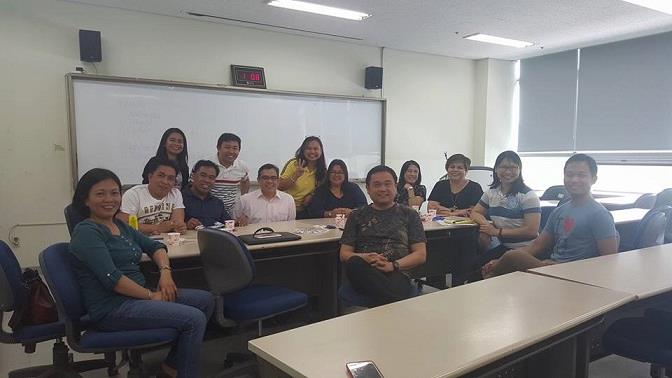
Filipino professors attending a meeting of the AFEK
Most universities here in South Korea (and other Asian countries) prefer to hire English teachers from countries where English is the native language. That is a matter of policy but it does not follow that the best English teachers are the ones coming from those countries… they could be somewhere else just waiting to be given an opportunity to prove their mettle in ESL teaching.
There are only a few tertiary institutions in this country who employ Filipino teachers to teach English. These are the universities who believe that teaching English is not a monopoly of the teachers labeled as “native speakers” coming from the following countries: USA, UK, Canada, Australia, New Zealand, South Africa, Ireland.
If the statistics gathered in 2013 by the AFEK, Association of Filipino Professors in Korea, is accurate then there are more or less 100 teachers from the Philippines in this part of the Korean peninsula. Reportedly, there are more in elementary and secondary schools and academies (hagwon). This, the organization (AFEK) came to know when they launched in May, 2017 the program “Skills Enhancement for Filipino Teachers Teaching English in Korea.” Several of the attendees were Filipino women married to South Koreans and are employed as English teachers. The Philippine Embassy in Seoul, however, doesn’t have an official record as to how many Filipinos are teaching in the basic education schools and academies here.
Filipino professors are not limited to teaching English subjects only. They are E-1 visa holders and are allowed to teach content subjects depending on their fields of specialization.
E-2 visa holders are allowed by the Ministry of Education here to teach strictly English subjects only. One advantage of hiring Filipino professors, because theirs is E-1 visa, is they can be asked to teach content subjects related to their fields especially if the curriculum requires that the content subjects are should be taught in English. Currently, in the university where this writer is teaching, three teachers from the Philippines, are also teaching, aside from English subjects, content subjects in the university’s Graduate School.
I wouldn’t say that Filipino professors in universities in South Korea are lucky to have been hired. Why? They have to go through the proverbial eye of the needle to have a chance of getting hired. They applied alongside teachers who are native speakers of English who have the upper hand because of their geographical roots.
Most of the Filipino professors here are PhD degree holders. The minimum requirement FOR THEM is Master’s.
To the universities who opened the opportunity for Filipino professors, the applicants needed to prove that they are as equally capable as their counterparts from the native English-speaking regions of the world. When they got hired, it was because they are qualified and had proven that they have what it takes to be English teachers. It wasn’t luck.
Filipino teachers are trained in the Philippines to both know what to teach and know how to teach what they know.

Modesty aside, the Philippines have a very good education curriculum implemented through the Commission on Higher Education which closely monitors TEIs (Teacher Education Institutions) to ensure strict compliance. Thus, Education graduates from the Philippines can be relied upon not only in terms of the knowledge, skills, attitude and values in their field of specialization but also in pedagogy and in research. Filipino teachers are good in both instruction and research.
One of the best features of Teacher training in the Philippines is teachers are made to understand that the most important stakeholder in a school is the STUDENT, not the TEACHER. Filipino teachers adhere to the philosophy that the teaching-learning process should be student-centered.
One reason, if not the main and only reason, most universities in Asian countries (like South Korea, Japan and China) prefer to hire teachers from those seven countries is ACCENT.
Filipinos are good at English. It (English) is the medium of instruction in the Philippines from kindergarten to college – even in the graduate school. Filipinos, at an early age, write and speak English. They hear and read it everywhere. It is also the the official language of communication in the Philippines. All business and government transactions are done in English. The country also has the 3rd largest group of English speakers in the world. Their accent is not bad. Philippines wouldn’t be the BPO/Call Center capital of the world if so. But notwithstanding all the aforementioned, still the said universities prefer native English speakers and not include Filipino teachers in their lists of preference.
But there are two things that would make hiring a Filipino teacher a wise investment – two things far more important than ACCENT… their PASSION for teaching and COMPASSION for the learners.
It is not difficult for a teacher to improve his accent. It is easy to train the tongue to mimic somebody’s way of producing vowel and consonant sounds and diphthongs. What is hard is to convince a teacher to be passionate about the job and to be compassionate to the students…. especially if he/she is not really trained to be one and was only forced to accept the teaching job for lack of better options.
Remembering My Teachers

“What is done in the classroom today becomes the indelible memories of tomorrow.” – Robert Brooks
What do we remember most about our teachers? Is it their intelligence or their wit and humor?
Why do we say that we’ll never forget some of our teachers? What made it hard to erase them from our memory – the positive influences they exerted on us or the emotional wounds they may have directly or indirectly inflicted? Do they remain in our memory because of the words of encouragement they said that motivated us to excel or the mouthful they delivered with the meanest of intentions that destroyed (or almost destroyed) our self-esteem?
Do we recall the lessons our teachers taught in the class or is it the jokes they shared that we cannot forget to the point that to date those same jokes we also share with others?
Think about this – Is it our teachers’ impeccable display of mastery of the subject matter we remember about them or is it their compassion and gentleness that made us feel so comfortable in the classroom?
Being a teacher myself I often wonder what my students remember about me, or do they remember me at all. Imagine how many students I already had having been a teacher since 1988. Has anyone of them proudly announced my name when asked “Who’s your most favorite teacher?” or “Who among your teachers influenced you most positively?”
Constantly asking myself such questions makes me conscious about my performance in the class. Not that I wish to be popular among my students. Teaching is not a popularity contest. But if I get to be remembered by my former students, I wish that it is for the right reasons and not the wrong ones.
As part of my planning, each time a school term begins I make a conscious effort of remembering my former teachers. Why? My teachers in the past, aside from the subjects they taught, they directly and indirectly showed me “what to do” and “what not to do” as an educator. They contributed the pieces in the teaching-learning model that guides me as I practice pedagogy.
There are several teachers whose names were etched in my memory (although I wish to keep their identities under wraps except for some clues). There are a variety of reasons why after all these years I have not forgotten them.
During my PhD days at Bulacan State University I always looked forward to attending the classes of two professors. One of them taught me that “Whatever we don’t use will die of disuse.” and “In onion there is strength.” Yes, that’s onion… not “union.” The other one bragged that “His PEN IS six inches long.”
I didn’t consider their brand of humor offensive although I know some of the ladies in those classes felt uncomfortable whenever those professors deliver those double-meaning sentences. I am not sure what made the students pay attention to those professors – the ideas they were expounding or the jokes they interspersed in their discussions.
Even without those double-meaning sentences those two professors were really committed to bringing humor into the classroom. A lot of times that they shared hilarious personal stories. Three classes in one day, with each class 3-hour long, in the graduate school are stressful and the best known antidote to stress is laughter.
That’s what they did…gave entertainment on the side while we go through the rigors of graduate school.
But when it comes to sense of humor, no one beats my Psychology and Political Science teacher during my first year in college. Aside from his contagious smile, he had the knack for injecting humor during discussions. I remember him making exaggerated facial expressions and movements.
As Maurice Elias suggests, “Let’s add some more enjoyment to school. We don’t need guffaws — a smile and a little levity can go a long way.”
Let me just clarify that the said professors are not just humorous – they are very intelligent educators.
I was also blessed to have three teachers (one each in High School, College and Master’s) who modeled academic excellence. Each meeting with them was always an opportunity to learn something new. Of course I learned from all of my teachers and they all contributed to my development but these three are simply a cut above the rest.
Their common denominator is they never came to class unprepared and demanded nothing less from the students. They were demanding but were very supportive. I don’t know but there was something different in the way that they taught and the way they carried out their duties as mentors.
Because of this dedication to excellence, one of them (the professor in the Master’s program who influenced me the most), became “the avoided one.” Students, as much as possible, would avoid enrolling in her classes. They were students who wanted their grades to be given to them in a silver platter. They were the ones who consider a weekly reaction paper and several book reviews too much for a graduate student. For me, that was the challenge that I wanted to undergo to test my mettle, to hone my skills. I wanted to be deserving of any degree I would be conferred with.
That was the kind of attitude inculcated upon me by my High School Biology and English 2 (and 4) teacher. She gave us assignments and projects that I considered at that time as requirements done by college students. It was difficult but it prepared me to the rigors of college life.
Then in College I had this teacher who taught Shakespeare (and his plays) rarely bringing instructional materials to the class from beginning up to the end of the semester. She did not use audio-visual materials when teaching. She would just stay seated the whole period. But when she talked it was like listening to an audio book. There was never a question from us (the students) she did not satisfactorily answer.
However, I don’t remember the said teachers only because of their brilliance. I had a lot of equally intelligent teachers but whose names I could no longer recall. But these mesdames are different. They displayed enthusiasm while teaching. I witnessed how much they loved what they were doing.
I would also not forget my Grade VI adviser. I felt so sleepy in her class one day but I was trying very hard not to fall asleep. The reason was during my Elementary days, almost every morning I needed to wake up around 4:00 AM in order to sell “pandesal” (bread) before going to school so I would have extra allowance.
One day, while she was discussing I closed my eyes but I was awake. Then one of my classmates said, “Look ma’am! Ching (that’s my nick name when I was a kid) is sleeping.” My eyelids were a bit heavy so I couldn’t open my eyes immediately when I heard a classmate say that. Then my adviser responded, “It’s okay. Let him sleep for a few minutes. I saw him selling “pandesal” this morning.”
That for me was a display of compassion. My teacher did not get angry. She was aware of my situation and she tried to understand. Her simple act of kindness made me feel I am important. It started to develop my self-esteem.
Then I had these experiences with two of my High School teachers that reinforced my self-esteem. My English 1 teacher told me one day, “You’re performing well in the subject. Keep it up!” That was the first time I received a positive comment about my academic performance. Then my Biology and English 2 (and 4) teacher, the same one I previously mentioned, told me also that I can be a good student if I study harder. In addition, she told me that I can be a writer.
The words they said nurtured my self-esteem. The things they told me awakened a self-confidence that until now is alive and strong in me. The words they said encouraged me to excel.
Those teachers believed in me and I promised myself not to disappoint them.
In his book entitled “Self-Esteem Teacher,” Robert Brooks explained that “Teachers have a very significant, lifelong impact on all of their students. This impact involves not only the teaching of particular academic skills, but as importantly, the fostering of student self-esteem.”
What do I remember most about my teachers? What qualities did they have that made their memories persisted in my mind and continued to influence my practices as an educator?
It is their sense of humor, enthusiasm, dedication to the craft, compassion for the students, and the practice of praising students – of telling them what they are capable of.
The foregoing are the building blocks of the educational philosophy that I have embraced.
“Most children will not remember what a teacher taught as much as how he or she made them feel. Children who perceive themselves as accepted and valued will work harder and have positive feelings about their school experience.”
~ Leah Davies
Source: Remembering My Teachers
Realities in the Workplace

The experience of Isaiah Thomas in the NBA, getting traded by his former team, the Boston Celtics, despite giving his all when he plays, despite playing for them in the playoffs a day after his beloved sister died tragically in a car accident, mirrors some of the painful realities in the workplace.
Isaiah Thomas learned the hard way that no one’s indispensable in an organization.
How valuable is Isaiah Thomas as a Celtic player? He led the team to the best record in the East during the 2016-2017 NBA season and brought the franchise all the way to the Eastern Conference finals. He was the team’s scoring and spiritual leader. But that did not prevent the Boston Celtics from letting go of him through the Kyrie Irving trade.
Should the Boston Celtics be faulted for doing what they did? Thomas should know that it’s nothing personal. It’s all business. The executives of the Celtic organization merely exercised their prerogatives. They did nothing illegal. They simply acted in what they think is in the best interest of the team.
That is one thing employees should bear in mind. There are times that employers have to do what they need to do in order for their business to prosper or simply survive. They need to implement changes and tweak policies at a certain point, sometimes at times when the employees least expected them. Notwithstanding disagreements coming from “downstairs,” changes “people upstairs” want to make, will be implemented.
When changes are implemented and policies tweaked, the employees should not take it personally. Changes in the workplace happen when they are due. It is something inevitable. They need to get used to it. Employees need to be ready to make decisions when they happen. There are available options that they are free to exercise.
Employees may simply embrace the changes and move on. They may decide to just accept organizational shake-ups, policy modifications, and what-have-you then continue working. It’s either they view the changes as necessary or accept the fact that they could simply do nothing to prevent them from happening.
Those who would consider that such changes are unacceptable… those who think that they are being taken out of their comfort zones… those who feel being taken advantage of… do have two possible courses of action. They can either resign and continue their quest to find a perfect workplace or they will stay put and contest the legality of the changes that the employers made.
But locking horns with the bosses is a difficult struggle. Employers are always careful with decisions they make. Only the ignorant ones would risk getting hauled to court by effecting changes or making moves contrary to established laws and ordinances. Just like the Boston Celtics who certainly made sure that they have all legal loopholes covered before they finalized their agreement with the Cavs.
Most employers are wise. One of the things an employer or businessman worth his salt does is study the laws and regulations that govern his business endeavors. It’s hard to catch them off-guard in legal matters. They simply know what buttons to push whenever “push comes to shove.” In addition, they also consult lawyers to make sure that they face no legal impediments with anything that they do.
Employees who disagree with changes that those who employ them implement often fight a lonely battle which they are more likely to lose than win. They risk getting ostracized. If they decide to settle the matter of disagreement in the court of law, the employers are ready. With all their financial resources they are ready to fight a long-drawn legal battle until the employee’s pocket and resolve run dry. There’s also a question of whether or not the majority (or even a few) of their co-workers share their sentiments. They cannot force anybody to join their cause, especially those who consider the changes made necessary and inevitable. They should not force anybody not willing to listen to their complaints about policies and personalities in their organization to give them time for their whinges and whines.
You simply cannot expect your colleagues to look at things and issues in the organization in the same way you do. You don’t share the same perspectives. Even your circumstances are different. People are also driven by sets of motivations that might be entirely different from yours. Learn to respect that.
Another thing that employees should always remember is that while they need to ensure that their rights as workers are protected, conversely, the employers will do everything to protect their own investments…to improve their business…or to keep their business afloat… even if it means firing their best employees. It’s nothing personal. It’s simply business.
And the lesson everybody should learn from the Isaiah Thomas’s experience in the NBA is that in an “employer-employee relationship,” business interests outweigh loyalty. Expect nothing from your employers beyond what is stipulated in your contract. They do the same. The employees just need to work as best as they can. There are employers who know how to reward those who work hard. Employers also know how to deal with the perennial whingers and whiners.
Just love the work and enjoy the pay. Find a motivation that will keep you going in the workplace. If there’s none, not even the pay, then it’s time to pack up and find another workplace.
Here is the thing, if you think you can find a perfect workplace, you’ve got to be kidding.
The workplace is a jungle….and only the fittest survive. The workplace is not for the faint-hearted. Remember that!
Professionalism Among Teachers
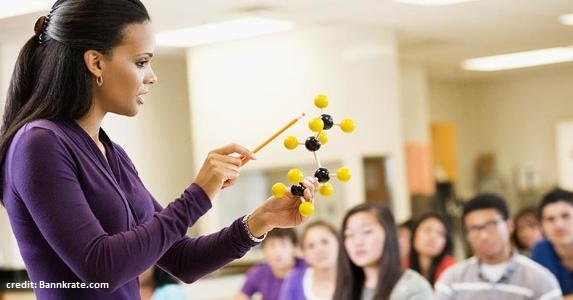 The complexities involving the teaching profession and the importance of the role of teachers in the holistic development of learners require strict adherence to the tenets of professionalism. There are expectations that teachers need to meet and there are qualities that they are expected to possess.
All the qualities teachers ought to have and what are expected of them can be summed up in one concept – “teacher professionalism.”
“Teacher professionalism” is an idea that can be defined differently based on multiple perspectives and its merits scrutinized according to various arguments. It is considered a broad concept consisting of several dimensions. However, for delimitation purposes, the discussion on the subject in this article is anchored only on the definitions of the term “professionalism” given in the next two (2) paragraphs.
Evans pointed out that “professionalism means different things to different people.”1 The Oxford dictionary simply defines the term as “the competence or skills expected of a professional.”2 It is the level of excellence or competence that professionals should manifest in their chosen fields of specialization.
Tichenor3 explains that professionalism are the expected behaviors of individuals in a specific occupation. Professionals need to conduct themselves in accordance to set standards.
Boyt, Lusch and Naylor4 combined the said views about professionalism when they describe it as a multi-dimensional structure consisting of one’s attitudes and behaviors towards his/her job and the achievement of high level of standards. Similarly, Hargreaves5 defines professionalism as the conduct, demeanor and standards which guide the work of professionals.
The terms associated to professionalism as seen from the definitions and explanations given are as follows: competence, skills, behaviors, conduct, demeanor and standards. Competence and skills are synonymous and so are behaviors, conduct and demeanor. Standards refer to the quality or accepted norms for competence and behaviors.
Skills are not the only components that make up teacher’s competence. Knowledge is, of course, an integral part of it.
Skills and knowledge are very broad attributions to teacher’s competence however. What specifically are the skills and knowledge that would make a teacher competent?
As Baggini puts it, “To be a professional or a professor was to profess in some skill or field of knowledge.”6 It’s a given that teachers should have knowledge of the subject matter or expertise in a particular skill. Teachers are expected to know not a little but much about what they are teaching.
What adds challenge to being a teacher is the ability to dig (whenever applicable) into the scientific, philosophical, legal, sociological and psychological foundations of what is being taught. It is important that teachers are able to relate whatever they are discussing to other fields. Such an ability would enable teachers to enrich the discussion.
But teaching and learning are complex processes that involve a lot more… not just knowing what to teach and being able to connect a topic to other disciplines. What would make teachers truly competent are the corresponding skills that enable them to effectively teach what they know and make the students learn. Such skills are acquired through training in pedagogy.
Pedagogy is commonly defined as “the art, science, or profession of teaching.” Pedagogy informs teaching strategies, teacher actions, and teacher judgments and decisions by taking into consideration theories of learning, understandings of students and their needs, and the backgrounds and interests of individual students.7
Pedagogy, in a nutshell, tells how best to teach and how best the students learn.
Knowledge and expertise in a field would not make one a teacher. Pedagogical skills are needed. Competent teachers SHOULD know, not just the subject matter, but how to set learning objectives, motivate students, design learning activities, facilitate learning, construct assessment, and assess learning.
In addition, another skill through which competence of 21st century teachers is gauged, is how extensive and effective do they apply technology (computer) to teaching and learning.
Aside from competence, the other dimension of teacher’s professionalism this article is exploring is behavior.
Teachers are aware that they should behave in accordance to the ethical standards set for the teaching profession. They are expected to speak, act and dress accordingly. Barber8 pointed this out when he identifies as one of the main characteristics of professional behavior a “high degree of self-control of behavior through codes of ethics.”
But the behavior dimension of professionalism among teachers goes beyond proper manner and decorum.
Another characteristic of professional behavior identified by Barber is “orientation primarily to community interest rather than to individual self-interest.” It is no secret that teachers sacrifice a lot to help their students. Teachers work long hours and the practice a lot of patience. As Orlin puts it, “ I see it (teaching) as an act of self-sacrifice, as a hard path undertaken for the greater good.”9
Teachers also know that they need to keep learning. They need to have a continuing professional development plan for them to be better-equipped in dealing with the challenges of the profession. They need to keep abreast with the current trends and innovations in the field of education.
There are also general teaching behaviors which, according to a study, are the most important for effective teaching (as perceived by students). Hativa identified five (5) of them, namely, making the lessons clear, organized, engaging/interesting, maintaining interactions, and rapport with students.10
Two (2) of the said general teaching behaviors (making the lessons clear and organized) are related to the first dimension of teacher professionalism (competence and skills). The rest are more indicative of the second dimension (behavior).
Teacher professionalism strongly implies the demands and complexities of teaching making it harder to understand why the profession doesn’t get due recognition. Teaching is not just any profession. Not just anybody can be a teacher. Not just anybody can be entrusted the responsibility of developing the mind and body.
– SDG –
References:
- Evans, Linda (2008) Professionalism, professionality and the development of education professionals. British Journal of Educational Studies, 56 (1). pp. 20-38.
- Definition of “professionalism” – Oxford English Dictionary
- Tichenor, M. S., Tichenor, J. M. (2005). Understanding teachers’ perspectives on professionalism. ERIC.
- Boyt, T., Lusch, R. F. ve Naylor, G. (2001). The role of professionalism in determining job satisfaction in professional services: a study of marketing researchers, Journal of Service Research, 3(4), 321-330
- Hargreaves, A. (2000). Four ages of professionalism and professional learning. Teachers and Teaching: History and Practice, 6 (2),151-182.
- Baggini, J. (2005). What professionalism means for teachers today? Education Review, 18 (2), 5-11.
- Shulman, Lee (1987). “Knowledge and Teaching: Foundations of the New Reform”(PDF). Harvard Educational Review. 15(2): 4–14. Retrieved 12 June 2017.
- Barber, B. (1965). Some Problems in the Sociology of the Professions. In K. S. Lynn (Edt.), The Professions in America (pp. 669-688). Boston: Houghton Mifflin.
- Orlin, Ben “Teaching As Self Sacrifice.” Match With Bad Drawing. WordPress, March 10, 2014. Web. 19 July, 2017.
- Hativa, N. (2014). A pratical approach to designing, operating, and reporting, 2nd, Tel Aviv: Oron Publications.
Source: Professionalism Among Teachers



 M.A.D. L I G A Y A