Category Archives: Better Self… Better Life…Better Nation
Personal Accountability

Personal accountability begins when you stop asking only who caused the problem
and start asking what part of the response belongs to you.

Put Yourself on the List
Jim Rohn had a blame list. His mentor pointed out the one name missing from it.
Jim Rohn often told a story about his mentor, Earl Shoaff, who once asked him, “Jim, just out of curiosity, tell me, how come you haven’t done well up until now?”
Rohn had an impressive list of explanations ready: the government, taxes, rising prices, the weather, traffic, company policies, inadequate training, negative relatives, cynical neighbors, the economy, and the community.
Shoaff listened patiently. When Rohn finished, his mentor identified the problem: Jim’s own name was missing from the list.
That realization changed him. Rohn discarded his collection of excuses, took a fresh sheet of paper, and wrote one word on it:
Me.
But personal accountability does not mean blaming yourself for everything that happens. Some hardships are imposed upon us. We do not cause every injustice, illness, rejection, betrayal, accident, or disadvantage we experience. Holding yourself responsible for what was never within your control is not accountability—it is misplaced guilt.
Accountability means looking honestly at what was yours: your decision, your effort, your preparation, your conduct, your promise, your mistake, or your response.
It allows you to say, This situation may not be entirely my fault, but what I do next is still my responsibility.
One of my favorite poems is William Ernest Henley’s Invictus. Its closing declaration has remained with me: “I am the master of my fate: I am the captain of my soul.” To be the captain does not mean controlling the sea. A captain cannot command the wind, silence the storm, or remove every obstacle beneath the water. But the captain remains responsible for reading the conditions, adjusting the course, protecting the vessel, and deciding what to do next.
This is where personal accountability follows seizing control. Seizing control means recognizing that you still possess agency. Personal accountability means answering honestly for how you use it.
When something goes wrong, blame asks, Whose fault is this? Accountability asks more useful questions: What part of this belongs to me? What could I have done better? What must I repair? What will I do differently next time?
Accountability is not humiliation. It does not require endless punishment for past mistakes. Its purpose is growth. Once you acknowledge your part, you recover the power to learn, apologize, make amends, improve, and choose differently.
Other people may belong on the list. Circumstances may belong there too. But before you finish writing, make sure your own name has not been conveniently left out.
Pause and Reflect
In one unresolved problem in your life, what part genuinely belongs to you?
Have you been protecting yourself with an explanation that prevents you from changing?
One Step Forward
Divide a page into two parts: Not Mine to Control and Mine to Own. Write one present difficulty under both headings, identify your responsibility, and take one corresponding action today.
Explored more fully in Part 2 — Section I — Chapter 3, “Personal Accountability,” of A Holistic Approach to Self-Improvement.
Better Self… Better Life… Better Nation.
Seizing Control

You may not control every circumstance written into your life,
but you still hold the pen that writes what comes next.
Who Is Writing Your Story?
Your life is not a blank page—but neither is it a finished book.
You did not choose where you were born, the family into which you arrived, or many of the circumstances that shaped your early life. Even now, illness, injustice, economic hardship, other people’s decisions, and unexpected events can alter your plans without your permission.
Seizing control does not mean pretending that these forces do not exist. It means refusing to give them authorship over the rest of your story.
Fate and destiny are often used interchangeably to suggest that the future has already been decided. What makes this belief dangerous is not the vocabulary but the helplessness it can produce. When people become convinced that nothing they do matters, they stop making deliberate decisions. They wait for fortune to improve, for someone to rescue them, or for the right moment to arrive.
Waiting then becomes a decision in itself.
Nelson Mandela spent 27 years in prison under South Africa’s apartheid regime. He could not simply choose to unlock his cell or erase the injustice that placed him there. His control was severely restricted, but not completely destroyed. He could still decide what kind of person he would become within those restrictions and what he would do if freedom came.
Mandela emerged from prison without allowing bitterness to dictate his entire future. He helped negotiate an end to white minority rule and, in 1994, became South Africa’s first democratically elected president. He did not control every event that shaped his life or his country. But within the choices available to him, he exercised courage, discipline, patience, and purpose.
That is what seizing control truly means.
You cannot command every outcome. You cannot guarantee that effort will always be rewarded, that people will treat you fairly, or that every plan will succeed. But you can examine your options, choose your response, develop your abilities, seek help, change direction, and take the next meaningful step.
Your circumstances may influence the story. They may limit some choices and make others painfully difficult. But influence is not always authorship. As long as you retain the capacity to choose your next response, part of the pen remains in your hand.
Do not waste your strength trying to control what is beyond you. Use it to take responsibility for what is still yours.
You may not be able to rewrite the opening chapters. But today, you can write the next sentence.
Pause and Reflect
Who or what has been making too many of your recent decisions?
What part of your present situation remains genuinely within your control?
One Step Forward
Identify one area in which you have been waiting for circumstances to decide for you. Take one concrete action today that places the pen back in your hand.
Explored more fully in Part 2 — Section I — Chapter 2, “Seizing Control,” of A Holistic Approach to Self-Improvement.
Better Self… Better Life… Better Nation.
Strong Self-Belief
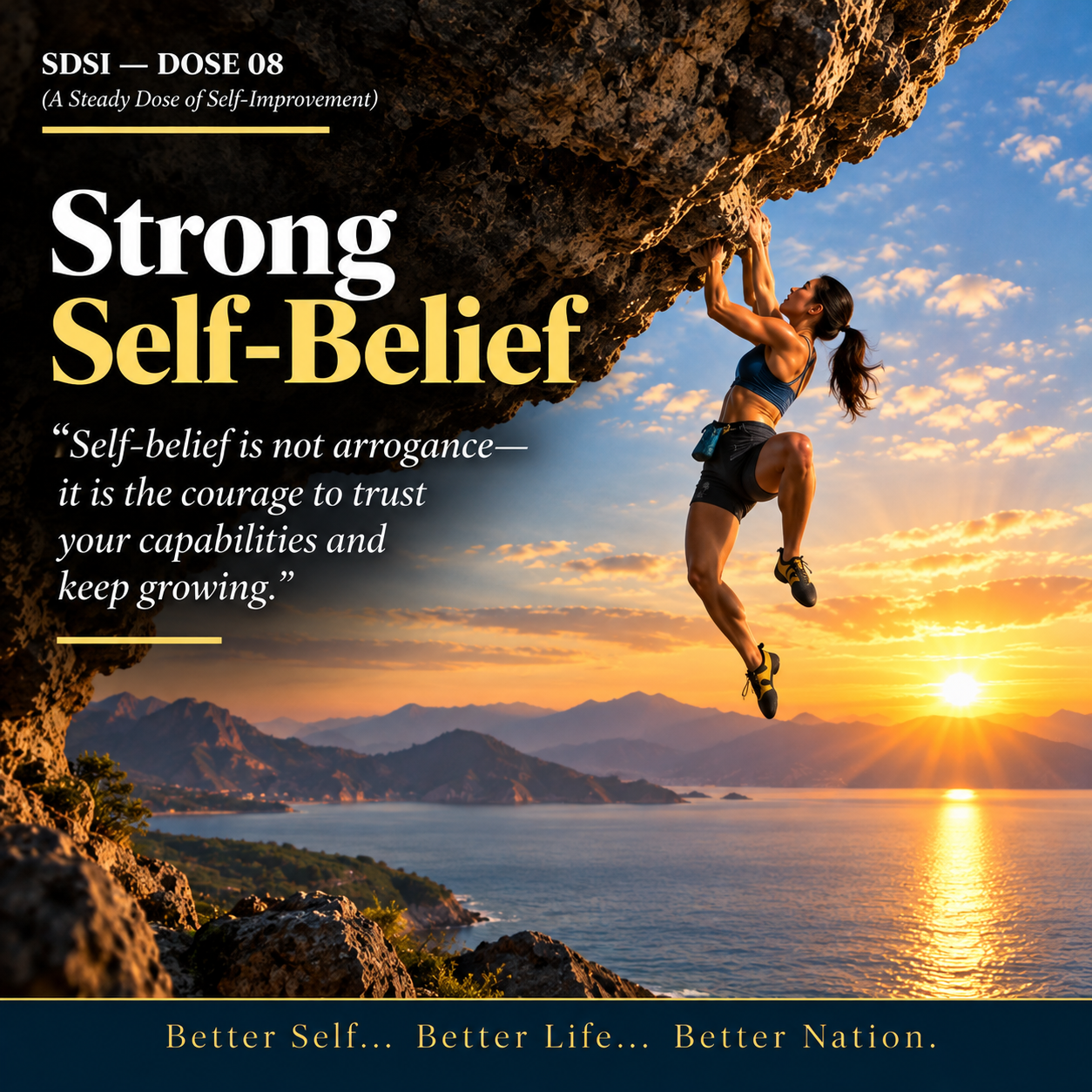
Self-belief is not arrogance—it is an honest recognition of your capabilities and the courage
to move forward while continuing to improve.

Other people’s disbelief does not kill a dream. It is the self-doubt that follows it home.
One image from the Gospel of Mark has stayed with me: “No one pours new wine into old wineskins, or the wine will burst the skins.” In its biblical context, the passage speaks of the incompatibility between the new and the old. But it also offers a powerful metaphor for personal growth.
The knowledge, skills, and habits we acquire through self-improvement are like new wine. Yet when we try to contain them within an old identity built on fear, inadequacy, and self-doubt, our growth becomes difficult to sustain. We may receive opportunities but feel unworthy of them. We may develop new abilities but remain afraid to use them. We may know what must be done but still believe we are incapable of doing it.
Strong self-belief provides room for growth.
This does not mean pretending that we can do everything. Self-belief is not self-conceit, nor is it blind confidence. It is the grounded conviction that says: I know what I can do. I recognize what I still need to learn. I trust that through effort, preparation, and persistence, I can become more capable than I am today.
Sometimes, self-belief comes before action and gives us the courage to begin. At other times, it develops after we act, struggle, learn, and discover evidence of our own capability. We do not need absolute confidence before taking the first step. We need only enough belief to take it—and then allow each honest effort to strengthen that belief.
Michael Jordan offers a familiar example. As a sophomore, he did not make his high school’s varsity basketball team. He could have accepted that disappointment as a final judgment of his ability. Instead, he trained harder, improved, and eventually became one of basketball’s greatest players. His confidence was not merely something he declared. It was strengthened through disciplined work, repeated failure, and measurable improvement.
This is what separates self-belief from wishful thinking. Wishful thinking says, I will succeed because I want to. Self-belief says, I can learn, prepare, persevere, and become capable of succeeding.
People will sometimes question your plans, underestimate your abilities, or judge your future according to your present limitations. Their disbelief may hurt, but it does not have the power to end your dream—unless you carry it home, make it your own, and allow it to become self-doubt.
Listen to criticism when it contains truth. Learn what you still need to learn. But do not surrender your future to someone else’s limited view of what you can become.
Believe enough to begin. Work enough to produce evidence. Then let that evidence teach you to believe even more.
Pause and Reflect
When has someone’s reaction caused you to question something you genuinely wanted to pursue?
What evidence from your own life shows that you are more capable than you sometimes believe?
One Step Forward
Write one sentence affirming a capability for which you have real evidence—and identify one action you will take today to strengthen it further.
Explored in full in Part 2 – Section I – Chapter 1 ( Strong Self-Belief) of A Holistic Approach to Self-Improvement.
BETTER SELF… BETTER LIFE… BETTER NATION.
Value System: Attitudes and Beliefs
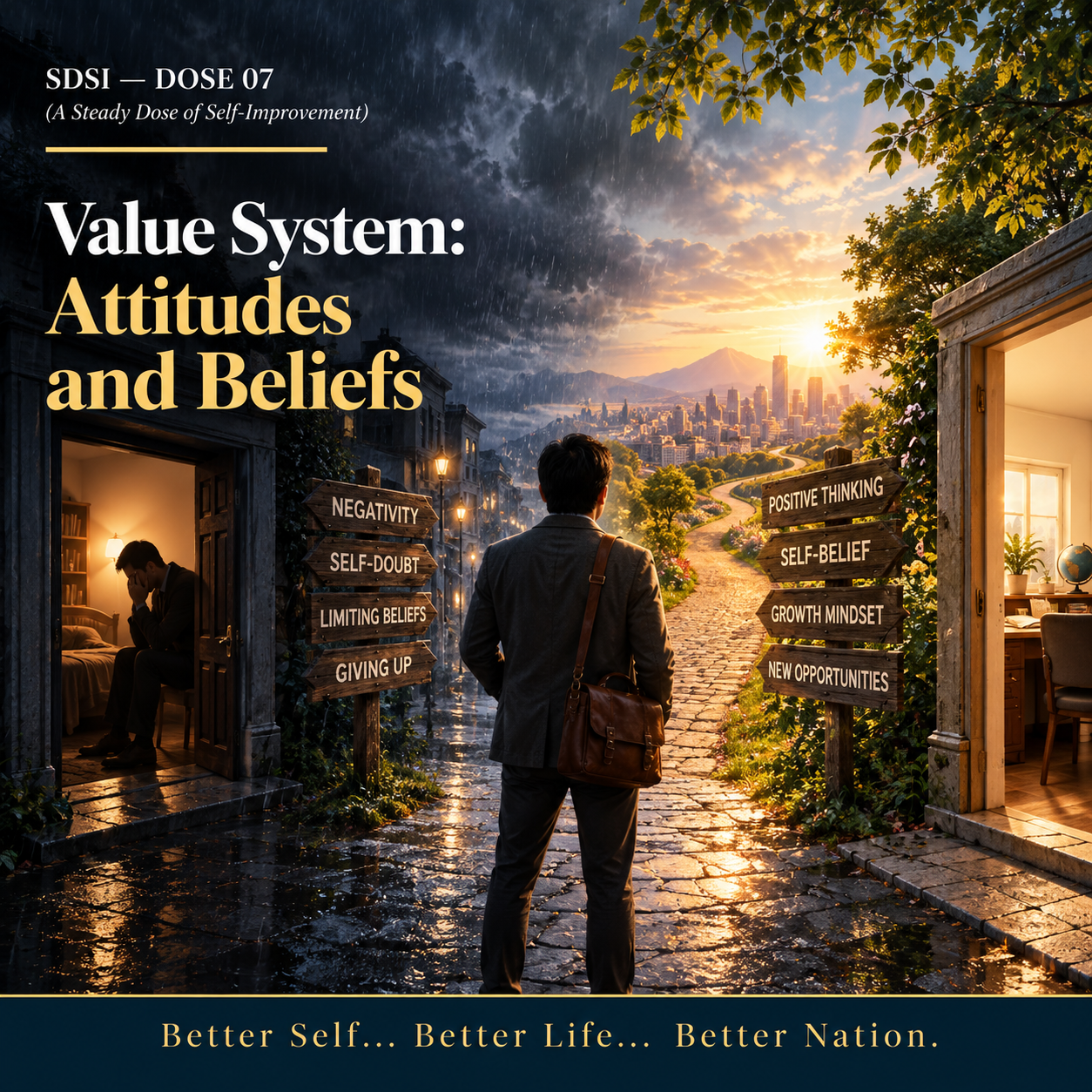
Your value system—the attitudes and beliefs you carry—shapes how you see yourself,
interpret your circumstances, and decide what to do next.
Two salesmen. The same storm. Two completely different mornings.
Two traveling salesmen awaken to heavy rain. The first looks out the window and thinks, No one will buy anything in this weather. He returns to bed.
The second looks at the same storm and thinks, Everyone will be indoors today. This may be the easiest day to find customers. He gets dressed and walks out the door.
The rain is the same. The morning is the same. What differs is the meaning each man gives to the situation—and the action that follows.
We do not respond to circumstances exactly as they are. We respond to them according to what we believe they mean. One person sees rejection as proof that the journey is over; another sees it as a reason to improve and try again. One sees difficulty as an excuse to retreat; another sees it as an opportunity to grow.
This is why our exploration of holistic self-improvement begins with the Value System. Our attitudes and beliefs serve as the lenses through which we view ourselves and the world. They influence our decisions, and our decisions gradually determine the direction of our lives. Skills may tell us how to act, and habits may help us act consistently—but our value system often determines whether we act at all.
I experienced this when I left a comfortable position in the Philippines to pursue ESL teaching in South Korea. The decision required more than qualifications. I had to believe that I was capable of building a new professional life in an unfamiliar country. After three rejections, I could have treated them as evidence that I did not belong there. Instead, I chose to regard them as temporary setbacks. I persisted until I finally received the opportunity that changed the course of my professional life.
As Zig Ziglar famously said, “Your attitude, more than your aptitude, will determine your altitude.” Ability matters, but ability alone cannot take us very far when our beliefs prevent us from using it.
A strong value system does not guarantee that every storm will pass quickly or that every effort will succeed. It equips us to meet adversity with self-belief, take control of what we can, accept personal accountability, think positively without denying reality, maintain proper perspective, adapt when conditions change, and remain guided by purpose.
These attitudes and beliefs are the foundation of everything that follows. Before improving what we can do, we must examine how we think and what we believe—because every lasting change begins within.
When you encounter a setback, what beliefs usually shape your response?
Pause and Reflect
Are those beliefs helping you move forward—or giving you permission to remain where you are?
One Step Forward
Identify one limiting belief influencing a current difficulty. Rewrite it as a more constructive belief that encourages action without denying reality.
Explored in full in Part 2 – Foundations of Holistic Self-Improvement, Section I — Value System ( Attitude & Belief) of A Holistic Approach to Self-Improvement.
Better Self… Better Life… Better Nation.
Full Potential
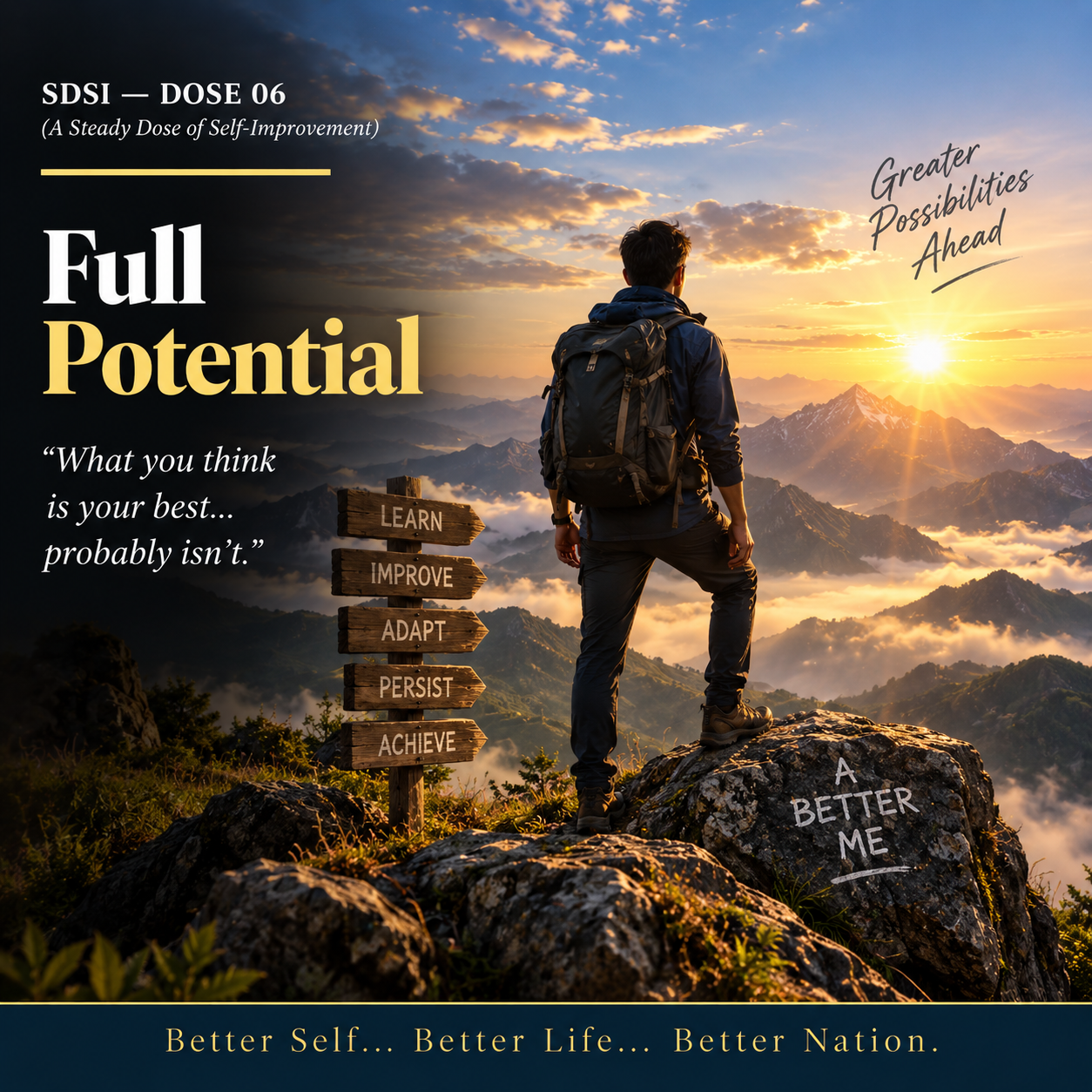
What feels like your ceiling may simply be the point where you stopped testing how far you could grow.
What you think is your best… probably isn’t.
Many highly accomplished people keep reading long after formal schooling has ended. Warren Buffett, Bill Gates, Barack Obama, Oprah Winfrey, and others are known for surrounding themselves with books. Their reading is not merely entertainment; it reflects a deeper commitment to lifelong learning and the refusal to stop growing. Reading is only one path, but it reveals the attitude at the heart of self-improvement: there is always more to learn and more of ourselves to develop.
That pursuit should not be confused with perfectionism. Perfectionism keeps us trapped in constant self-evaluation, often producing frustration and anxiety. Unlocking our full potential means something healthier: deliberately developing our physical, intellectual, emotional, moral, and social capacities so that we become the most capable versions of ourselves. We will never be perfect in every dimension, but we can become better developed than we are today.
One of the greatest barriers is the ceiling we set for ourselves. When an attempt fails, it is tempting to say, “That was the best I could do.” Perhaps it was the best we did on that occasion—but it may not represent the best we can ever become. What feels like our limit may simply be the point at which we stopped learning, practicing, or trying.
The book uses the image of someone stopping only three feet from gold. We rarely know how close another effort, lesson, or adjustment might bring us to the result we seek. Failure does not prove that our potential has been exhausted; it shows us what has not yet worked. Growth requires the humility to learn from that information and the courage to try again.
You will know your ceiling only after you have pushed yourself to find it. Take every opportunity for self-improvement—and when no opportunity appears, create one. Read, practice, seek guidance, and keep developing your abilities. Your full potential is not a label waiting to be discovered. It is a capacity gradually revealed through continuous, deliberate growth.
Pause and Reflect
What “ceiling” have you assumed was fixed even though you have never truly tested it?
One Step Forward
Choose one skill or ability you believe has reached its limit. Spend 20 focused minutes today learning, practicing, or attempting something slightly beyond your usual level.
Explored in full in Part 1, Section III — Self-Improvement and Unlocking One’s Full Potential of A Holistic Approach to Self-Improvement.
Better Self… Better Life… Better Nation.
Dreams and Ambitions
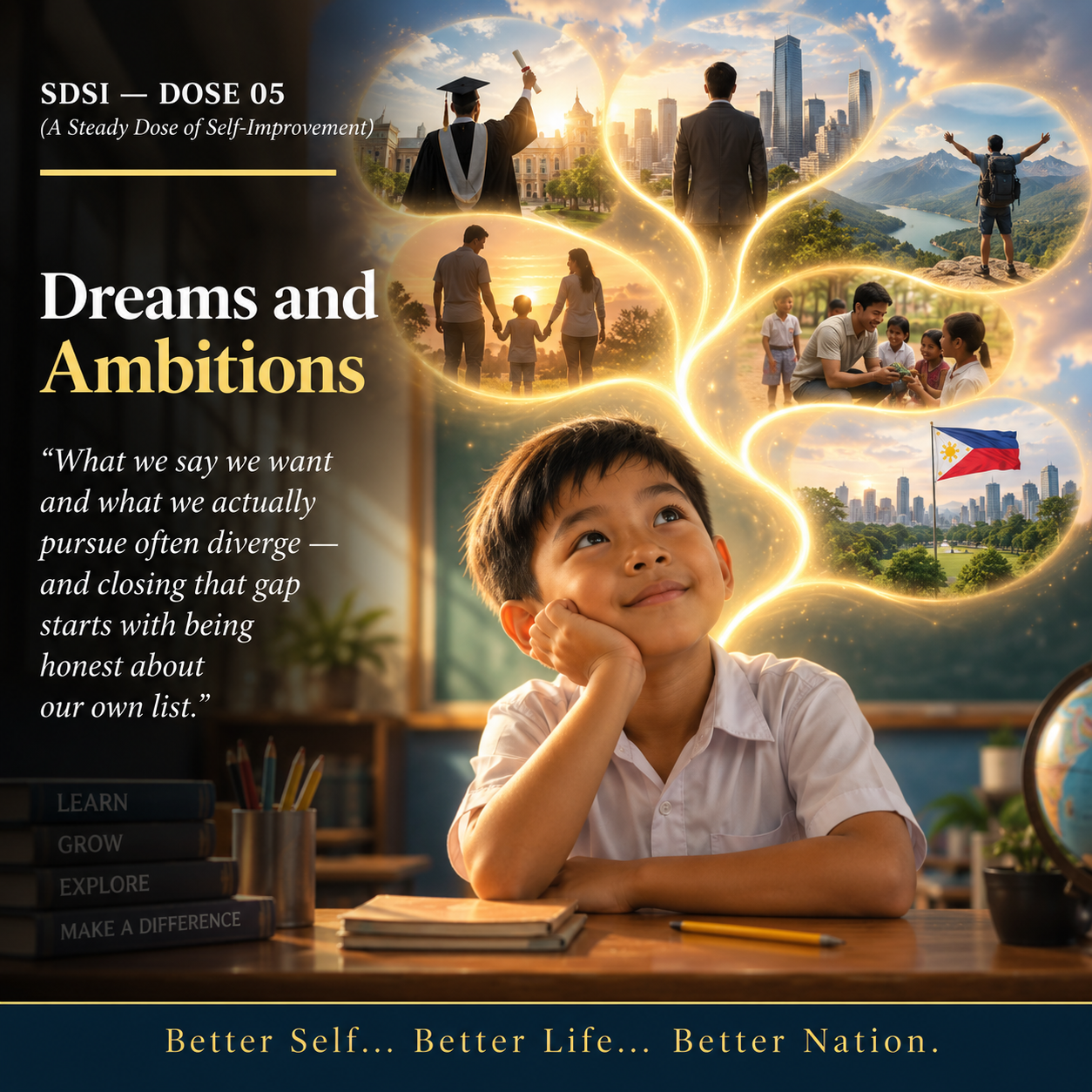
“What we say we want and what we actually pursue often diverge — and closing that gap
starts with being honest about our own list.“

What did you want to be when you grew up?
That question takes me back to second grade, when my teacher asked everY child in the room, “What do you want to be when you grow up?” When my turn came, I searched for an answer that hadn’t already been given. Then I saw it—the photograph of our head of state mounted above the blackboard. “I want to be the president of our country,” I said. My classmates laughed out loud, and I felt the heat of embarrassment rise to my face.
That memory taught me something about the question itself. Childhood is far too early to know what we actually want — most people don’t begin gravitating toward their real interests until adolescence, and even then, the question keeps changing shape as we age.
Ask adults the same question today, in different words, and the pattern repeats. Most people answer: rich. Famous. Influential. Almost nobody says healthy. Happy. Successful. It’s not that these simpler wishes matter less — it’s that they’re often the hardest to actually win, so we quietly stop naming them as goals at all.
John Lennon once wrote “happy” for a school assignment asking what he wanted to be when he grew up. His teacher told him he didn’t understand the assignment. He told her she didn’t understand life.
None of this makes wanting wealth, fame, or influence wrong. The real question worth asking isn’t whether you want more — it’s why.
Pause and Reflect
What’s actually on your list — and is it the list you’d give a child, or the one you’ve quietly settled for?
One Step Forward
Write your real list, unedited for how it sounds to others. Circle the one item you’ve most neglected pursuing.
Explored in full in Part 1, Section I — Dreams and Ambitions of A Holistic Approach to Self-Improvement.
Better Self… Better Life…Better nation.
The Only Thing That Interested Me in BBM’s SONA

There is only one sentence in President Ferdinand Marcos Jr.’s latest State of the Nation Address that truly interests me:
“Kaya dapat nakakintal sa puso’t isipan ng mga Pilipino ang lifelong learning at continuous self-improvement.”
Rendered in English, the statement reads:
“Lifelong learning and continuous self-improvement must be deeply ingrained in the hearts and minds of Filipinos.”
Of everything spoken from the podium, this single statement transcended politics. It did not ask Filipinos to applaud a reported accomplishment, believe another political promise, defend an administration, or condemn its opponents. Its truth does not depend on whether one supports or opposes the President. It speaks to every citizen regardless of political affiliation because it places neither a politician nor the government at the center of national progress. It places the individual Filipino there.
Ironically, this sentence—if translated into meaningful legislation, coherent public policy, and sustained community programs—could yield consequences far more profound than any of the applause lines that echoed through the plenary hall. Yet it received no ovation. Perhaps it drew little enthusiasm because true education rarely offers the immediate spectacle that politics demands. Investing in human capacity is like planting a forest: the seeds sown today may take years—or even generations—to reach maturity. Political applause is immediate but fleeting; educational investment is gradual but enduring.
Strip this statement of the President’s name, voice, and political identity, and it loses none of its validity. A DDS, a Kakampink, a Marcos loyalist, or someone entirely indifferent to politics can recognize its worth. Its truth does not derive from the authority of the speaker, but from the reality it expresses:
- Lifelong Learning develops what people know and can do—strengthening competence in a rapidly changing world of technology, evolving industries, and shifting responsibilities.
- Continuous Self-Improvement develops who they are and how they live—cultivating character, discipline, health, ethics, and civic responsibility.
Together, these twin pillars prepare citizens to adapt, solve complex problems, resist manipulation, and create meaningful opportunities.
To be clear, self-improvement alone cannot fix every broken institution or eradicate corruption. Nor does this perspective grant government officials an escape from accountability—Filipinos must remain relentless in demanding honest, competent, and responsive leadership. However, systemic policy and individual growth must go hand in hand; even the best policies fail when executed by individuals who neglect their own ethical and intellectual growth.
We must abandon the myth that electing a political savior will, on its own, transform the nation. We cannot demand discipline from leaders while tolerating indiscipline in ourselves, condemn dishonesty in public office while practicing it in daily life, or expect national excellence while settling for personal mediocrity.
The most vital message in the SONA was not a grand promise of what the government will do for us, but a timely reminder of what Filipinos must continually do for themselves—and, ultimately, for one another. Lifelong learning and continuous self-improvement do not render government obsolete; rather, they cultivate citizens capable of demanding better governance, electing wiser leaders, building resilient institutions, and sustaining lasting national progress.
The future of the country cannot be left solely in the hands of politicians. It must be built within the hearts, minds, character, competence, and daily conduct of the Filipino people.
Better Self • Better Life • Better Nation



 M.A.D. L I G A Y A