Efficient Time Management
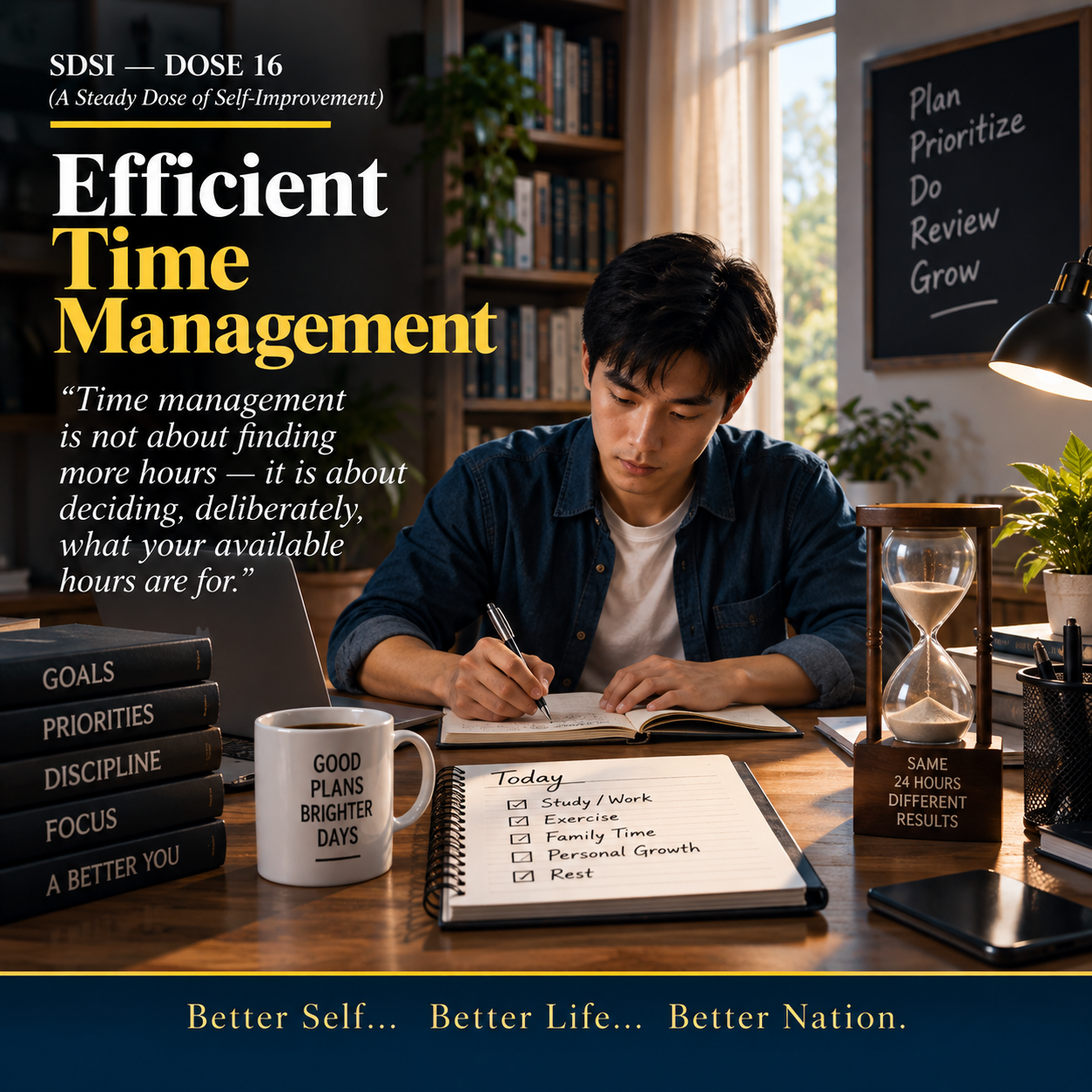
Time management is not about finding more hours—it is about deciding,
deliberately, what your available hours are for.

“If I had some extra time, I could make some extra money.” Jim Rohn’s answer: Forget it. There is no extra time.
Every person receives the same number of chronological hours: 24 each day and 168 each week. However, not everyone has equal freedom over those hours. Work demands, caregiving responsibilities, health conditions, financial circumstances, and long commutes can consume much of a person’s time before any personal choice is made.
Efficient time management does not deny those realities. It asks a more practical question: Within the time I can influence, am I using it for what matters most?
Jim Rohn once recalled a man telling him, “If I had some extra time, I could make some extra money.” Rohn replied that there was no extra time. When midnight arrives, the day is over. Whatever we hope to accomplish must be attempted within the time already available to us.
Laura Vanderkam’s 168-hour framework makes this easier to see. A person who works 40 hours a week and sleeps eight hours each night uses 96 hours, leaving 72. Those remaining hours are not automatically “free”—meals, commuting, household tasks, caregiving, exercise, and rest must come from them. Still, looking at an entire week often reveals possibilities that are hard to notice when we focus on one crowded day at a time.
Benjamin Franklin designed his daily schedule around purposeful blocks of activity. At the beginning of the day, he asked, “What good shall I do this day?” At night, he reflected, “What good have I done today?” His schedule was not merely about filling every hour with work. It connected time use with intention.
Franklin also admitted that maintaining perfect order was difficult. That matters because efficient time management does not mean rigidly controlling every minute. A schedule must guide us without becoming a prison.
Researchers Brad Aeon and colleagues describe time management through three related practices: structuring, protecting, and adapting time. We structure time by creating routines and assigning activities to appropriate periods. We protect it by setting boundaries and declining demands that interfere with important priorities. We adapt it when circumstances change and our original plans are no longer realistic.
Before improving how you use time, however, you must first discover how you are using it now. Memory is unreliable; a written record is much harder to argue with.
A time audit may reveal obvious waste, but it may also reveal something kinder: perhaps you are not lazy or undisciplined at all—perhaps you are carrying more responsibilities than you realized. Either discovery is useful because effective time management begins with truth, not guilt.
You cannot create extra time. But you can become more deliberate with the time that is genuinely yours to direct.
Pause and Reflect
If you recorded every hour for three days, what do you think you would discover about where your time actually goes?
Which activity deserves more of your available time—and which one deserves less?
One Step Forward
For the next three days, record how you use each hour. Mark every entry as essential, useful, restorative, or wasteful. At the end, identify one hour you can use more deliberately.
Explored more fully in Chapter 8 — “Efficient Time Management” of A Holistic Approach to Self-Improvement.
Better Self… Better Life… Better Nation.

Posted on August 31, 2026, in Better Self... Better Life...Better Nation, Competence Framework, Habit Scheme, Holistic Self-improvement, Personal Growth and Development, Self-Improvement, Time Management, Value System and tagged Better Self... Better Life...Better Nation, Competence Framework, Habit Scheme, Holistic Approach To Self-Improvement, Personal Growth and Development, Self-Improvement, Time Management, Value System. Bookmark the permalink. 1 Comment.



So helpful, thanks~
LikeLiked by 1 person