Blog Archives
Staying Focused
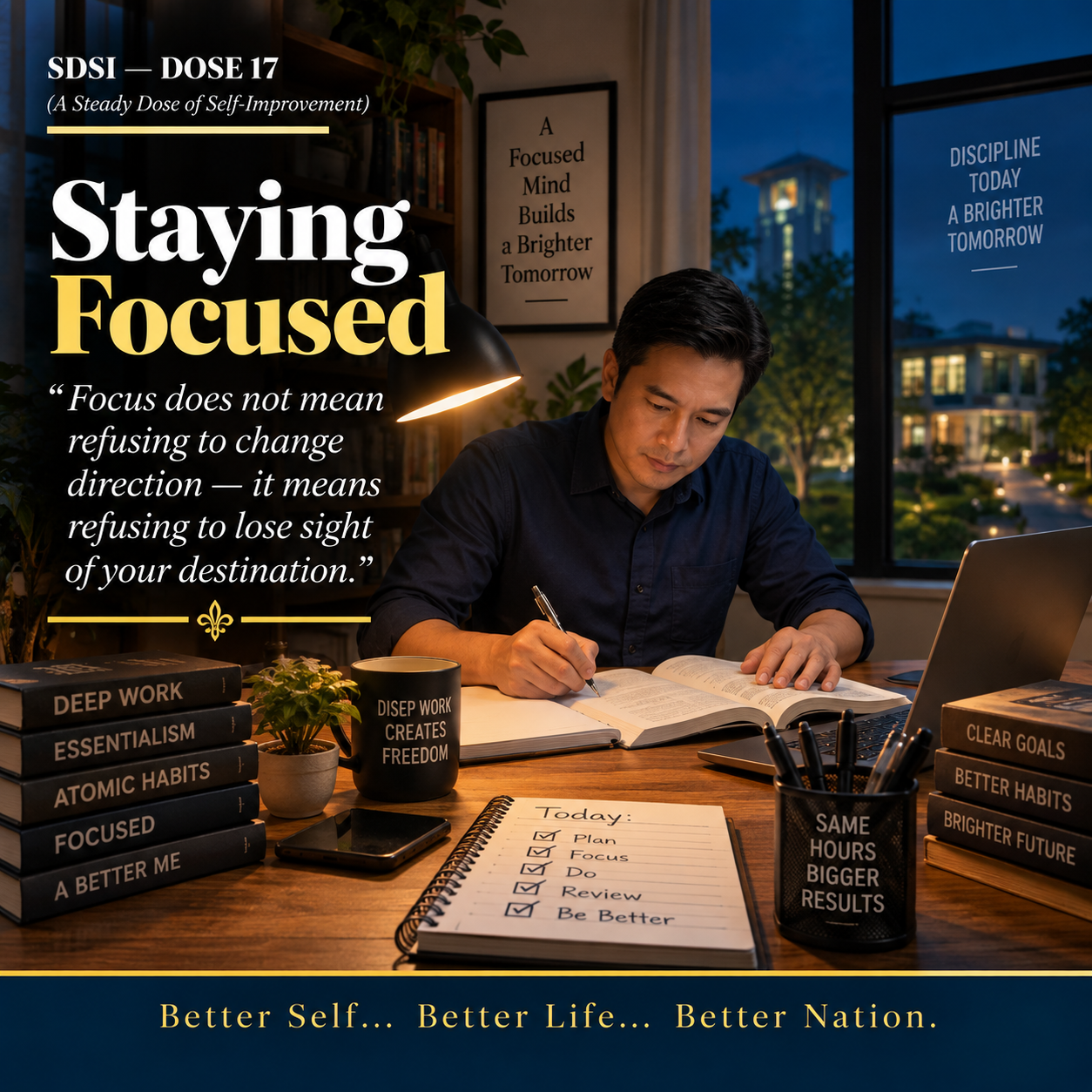
Focus does not mean refusing to change direction—it means refusing to lose sight of your destination.

During my third rejection from a Middle Eastern university, I overheard a panelist say that I could not be considered because I lacked a TESOL certificate.
I was deeply disappointed. I had a bachelor’s degree in English, a master’s degree in Education, and a PhD in Educational Management. I had also completed most of the academic requirements for a master’s degree in English but had been unable to finish the thesis. Added to these qualifications were more than twenty years of teaching experience.
Surely, I thought, all of that should compensate for one missing certificate.
But it did not. The university had a policy: applicants without TESOL certification could not be hired. Whatever the panelists may have thought of my other qualifications, their hands were bound by that requirement.
I could have treated the rejection as proof that overseas teaching was not meant for me. I could have complained that the policy failed to recognize my education and experience. Perhaps I even had legitimate reasons to question it. But neither disappointment nor argument would give me the qualification I lacked.
So I asked myself a more useful question: What can I do next?
I enrolled in a TESOL program and earned the certificate.
That decision taught me something important about staying focused. Focus is sometimes mistaken for stubbornly following one plan. But genuine focus distinguishes between the goal and the route. My goal—to teach overseas—remained unchanged. The route toward it had to be adjusted.
Eventually, I secured a university teaching position in South Korea. The earlier rejections had not ended my journey. One of them had identified a gap I needed to close.
This is why setbacks should be examined before they are accepted as verdicts. Some criticism is unfair and should not control us. But some negative feedback contains useful information. Focus allows us to separate the pain of hearing it from the value of what it may reveal.
Staying focused has become increasingly difficult in a world full of competing goals, constant notifications, and attractive alternatives. Yet distraction does not come only from technology. Even worthwhile activities can pull us away from what matters most. A person can remain extremely busy while making little progress toward the goal that matters.
Focus therefore requires deliberate choices. We must decide what deserves our attention now, protect time for it, and temporarily say no—even to good opportunities that compete with a greater priority.
You do not have to cling to your original method. You may need another qualification, a different strategy, or a longer route than you anticipated.
Change the plan when necessary—but keep your eyes on the destination.
Pause and Reflect
What goal have you nearly abandoned because your original approach did not work?
What useful information might be hidden inside a rejection or criticism you received?
One Step Forward
Choose one important goal. Write down the single obstacle presently blocking it, then identify one concrete action you can take this week to address that obstacle.
Explored more fully in Chapter 9 — “Staying Focused” of A Holistic Approach to Self-Improvement.
Better Self… Better Life… Better Nation.
Before the Journey Begins
Becoming your best self rarely begins with a dramatic transformation; more often,
it begins with one meaningful idea put into practice.

Why did I write a book on self-improvement and create this program – “A Steady Dose of Self-Improvement”?
Not to sell you on overnight transformation — there isn’t one, and I’ve never believed in the ones sold in the self-help aisle. I wrote this book because if even a single person reads it and becomes who they were truly meant to be, that’s a life genuinely changed. That, to me, has always been reason enough.
My own path into this started long before I called it self-improvement. My mother instilled in me the values of faith and self-belief. My parents taught me the importance of education and the discipline of always striving to be the best version of myself. I believed them — enough that I explored them in full in the Introduction of A Holistic Approach to Self-Improvement. After I’d earned the degrees I wanted, I kept looking for a new jar of knowledge to dip my fingers into.
Along the way, I found myself drawing from teachers I never met in person — Jim Rohn, Tony Robbins, Zig Ziglar, Napoleon Hill, Earl Nightingale, and many others whose ideas reached me through books, recordings, and screens exactly when I needed them. I came to think of them as professors in what I call my “Virtual University” — a classroom without walls.
Jim Rohn said it plainly: “Those who seek a better life must first become a better person.” Everything in the chapters ahead stands on that one sentence. Self-improvement, done right, isn’t a single skill or habit fixed in isolation. It touches your beliefs, your abilities, and your daily practices — all at once, all connected.
If you’ve ever doubted yourself, felt overwhelmed by your circumstances, or questioned whether you have what it takes to reach your goals, I want you to know something plainly: you have the capacity to grow, to improve, and to become the best version of yourself. Your journey doesn’t need to begin when everything is perfect. It begins the moment you decide to take the first step.
Pause and Reflect
What part of yourself or your life do you most sincerely want to improve, and why does it matter to you now?
One Step Forward
Identify one area of your life that you want to improve. Write down one small but meaningful action that can mark the beginning of that change.
Explored in full in the Introduction of A Holistic Approach to Self-Improvement.
Better Self… Better Life… Better Nation.
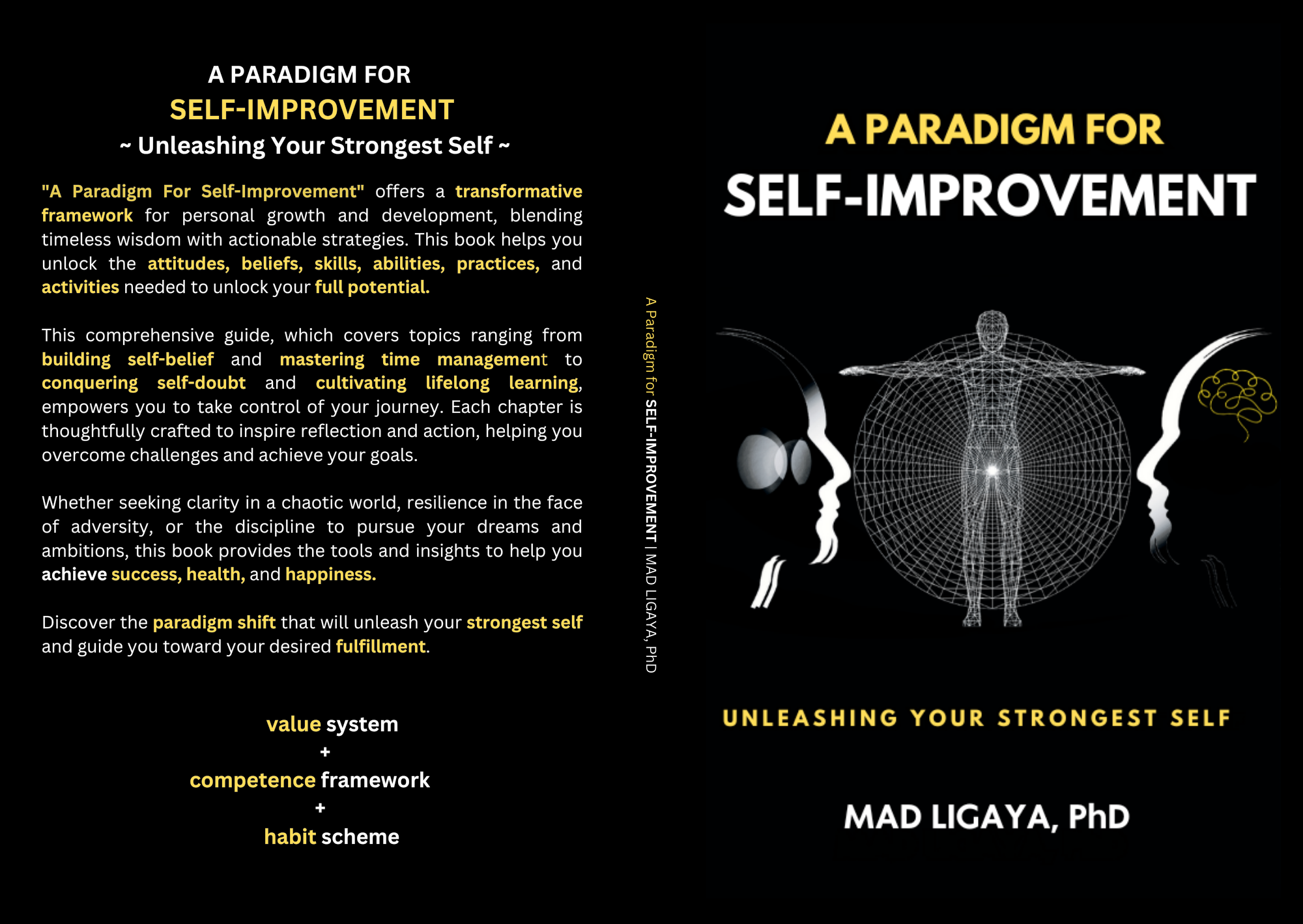
A Paradigm For Self-Improvement: Unleashing Your Strongest Self
This is my book, which has been officially published by Amazon. Please check it out. https://www.amazon.com/dp/B0DT4RGQ9H
To GOD be the GLORY!

__________
FOREWORD
Aside from the values of faith and self-belief that my mother effectively inculcated in me, one key element of personal growth and development embedded into my system even long before I joined the self-improvement bandwagon was lifelong learning. My parents kept telling my siblings and me the value of education, the need to learn new things and skills, and the importance of always striving to be the best and strongest we could be to fulfill our dreams and ambitions.
I believed them to the point that when I had already acquired the degrees I wanted, I looked for a new jar of knowledge where I could dip my fingers. I pushed it further when I realized I had been doing much related to improving my health and acquiring new skills. I decided to focus on personal growth and development.
At first, my affair with self-improvement was just a fling. I thought it was enough that I read self-help books. However, I was not satisfied. I thought adding positive thinking to my faith, self-belief, and lifelong learning was enough. I was wrong. I wanted more.
Then, the unexpected happened. My romance with self-improvement took a serious turn after I watched a film entitled “The Secret.” I saw the DVD of the movie only by accident. The store owner mixed it with other genres of film. When I bought it, I had no idea what it was. There was no synopsis or a brief note explaining anything about it. That was it… everything was what the title suggests—SECRET.
I wondered if it was a mystery thriller or a sci-fi movie. When I played it, I discovered it was a “self-help” film—technically a documentary. I must admit that I first considered the ideas presented preposterous. From the beginning of the film, what I saw and heard appeared as if lifted straight from the pages of a science fiction book, but they also tickled my curiosity, perhaps because I love science fiction.
I continued watching, tried to be open-minded, and thought of the information in the film as tips for personality development. I have always considered anything that advocates positive change worth my time and effort. I watched it a second time, and some exciting segments were a few more. After that, I started using valuable tips I learned from the movie. I even shared the ideas I discovered with my students whenever I saw a connection to the contents of our topic.
Then I decided to do an Internet search for one of the speakers, the one who spoke first in the movie – Bob Proctor. That Internet search led me to his motivational videos on YouTube and links to information and videos of other motivational speakers such as Jim Rohn, Wayne Dyer, Les Brown, Joe Dispenza, John Assaraf, Brendon Burchard, Brian Tracy, Zig Ziglar, Tony Robbins, Simon Sinek, Tom Bilyeu, John Maxwell, and Mel Robbins. I heard them mention Napoleon Hill, Earl Nightingale, and Earl Shoaff, which led me to find them online.
They were all my professors at VU (Virtual University). I religiously watched the videos they posted on their social media platforms, and they taught me well. I consider them my mentors in the field of personal growth and development. Through them, I learned much about constructs related to self-improvement and Positive Psychology—goal-setting, planning, decision-making, time management, well-being, mindset, personal accountability, lifelong learning, good thinking, positive thinking, self-discipline, and more.
I consider them my mentors. They taught me valuable lessons I never learned in school. Thanks to them, I realized that in striving to be the best I can be, as my parents instructed, there are attitudes and beliefs I must pursue and possess, skills and abilities I must learn and acquire, and practices and activities I must carry out and perform. I realized how essential they are for achieving one’s full potential and becoming the best.
Seeing how personal growth and development have benefited me personally and professionally and recognizing that as a teacher, I can help my students and influence my loved ones and dear friends to experience the same, I have embraced self-improvement as an advocacy. I am committed to promoting it. There may be those my mentors from VU could not reach but whom I may be able to. I strive to do so in my humble ways.
To the best of my ability, I aim to plant seeds of motivation and inspiration in others, encouraging them to recognize their potential and embrace the transformative power of self-improvement. I believe that each interaction, no matter how small, has the potential to spark a profound change in someone’s life. Whether through teaching, writing, or engaging in meaningful conversations, I see every opportunity as a chance to leave a positive imprint on those I encounter.
In doing so, I am trying to carry forward the legacy of my mentors, whose wisdom and guidance have shaped my journey. Their influence reminds me that advocacy is not confined to grand gestures but is often reflected in our quiet, consistent efforts to uplift those around us.
My mission is to reach individuals who may feel unseen or undervalued, empowering them to believe in their capacity to grow and succeed.
In my classes, I actively seek opportunities to instill the value of striving to improve. I do the same in informal discussions with friends, loved ones, and sometimes strangers. Whenever I have the chance to discuss something related to self-improvement, I seize it without hesitation.
My approach is grounded in the belief that the desire to grow and evolve is universal, and all it often takes is a spark—a meaningful word, a shared experience, or a heartfelt conversation—to ignite that desire in someone.
It reminds me of how those simple compliments from a couple of teachers in high school inspired me to study harder.
I also write essays on personal growth and development, which I post on my websites and social media accounts. When I realized how much I had already written on the subject, the idea of writing a book on self-improvement emerged. I decided to compile and interconnect everything I had written about personal growth and development into a book.
My motivation for writing this book is clear: I want to offer a guide that could help readers like you achieve their full potential, be the best and strongest version of themselves, and attain fulfillment by achieving what they desire. When I began working on this book, I also had my students in mind. I hope they and other young people like them will read this book like you.
You have dreams and ambitions, but uncertainty can sometimes keep you stuck. You doubt your ability to achieve them. Sometimes, your challenges feel larger than life, your dreams out of reach, and self-doubt gets the best of you. However, I still believe that you have the power to become the highest version of yourself, manifest your dreams, and flourish into becoming the best you.
It is not luck or chance that gets you to the fulfillment of dreams and desires—it is learning the right strategies and applying the focus, determination, and passion you need to pursue your personal and professional endeavors. The future is yours to take.
This book is divided into three parts, each focusing on different aspects of self-improvement. In Part I, we will discuss beliefs and attitudes; in Part II, skills and abilities; and in Part III, practices and activities.
Henceforth, I will collectively refer to beliefs and attitudes as a value system, skills and abilities as a competence framework, and practices and activities as a habit scheme.
The world needs people willing to rise to their full potential, lead purposefully, and contribute to something greater. I believe you are one of those people.
As you read through the following pages, I hope you will find the encouragement, insight, and tools you need to take the next step in your journey. My goal is to inspire you to look at your personal and professional goals not as impossible dreams but as inevitable outcomes that await your dogged determination to succeed.
This book is both a reflection of my journey and an invitation to join me on the path to unlocking the greatness within you. I do not feel like I am already the best version of myself. Thus, my journey towards unlocking my full potential has not ended yet. If you have not started with yours, now is the time to begin.



 M.A.D. L I G A Y A