Author Archives: M.A.D. LIGAYA
Pro-politico or Pro-Filipino?

A Personal Stand
While I was enjoying the Chuseok celebrations here in South Korea, I received two calls on two separate days asking if I could join the “meet-and-greet a politico” at the end of this month at the Philippine Embassy here. I politely declined.
Before extending the invitation, I was first asked about my political sentiments. I candidly said I don’t like to meet any politicos nowadays – not Marcos, nor Duterte, nor any of those pretending to be public servants “pero mandarambong pala.” They are all responsible for the sufferings of the Filipino people. Only those who were born yesterday, blind, and naïve would not acknowledge this. They are ALL guilty and should be held accountable. I’m giving the benefit of the doubt to the neophytes in Congress (who did not serve in the 19th Congress) and new members of the Cabinet.
I told those people who invited me that I have decided not to support any political personality. Amidst all the political turmoil and government dysfunction, I would like to take not a “pro-politico, ” but a “pro-Filipino” stance. Attending that gathering is tantamount to turning a blind eye to their wrongdoings.
Actually, I coined an expression that is very appropriate for those guilty of plunder and malversation of public funds… “BUWAYANG INA N’YO.” I am afraid I might blurt this out when I see a politico nowadays. Just imagine if I were to hurl this invective in the face of one in that gathering.
Half-jokingly, I said I hope my passport will not be revoked because of my political beliefs.
The Semantics of Corruption
I offer no apologies for using the word ‘politico’ (instead of ‘politician’) in the title. The word is considered derogatory, yet it is the most appropriate way to describe most elected (and appointed) members of the legislative and executive branches of our government.
An online dictionary says, “You can describe a politician as a politico, especially if you do not like them or approve of what they do.” Let me ask you, “Do you approve of what those people in the government do?” Another online dictionary defines ‘politico’ this way: “someone who will do anything to win an election.” The worst example of “will do anything” is “vote buying.” Are the politicos you are supporting not guilty of this? Chat GPT puts its best: “Politico suggests a type of politician – often one driven by ambition, opportunism, or self-interest.”
How I hate “Grammarly” for insisting that I use “politician” instead of “politico.” The algorithm must not know that “politician” is too kind a word for our breed of thieves in barongs.
It fails to grasp that “politico” carries the stench of corruption that “politician” politely hides.
And please, let’s stop addressing them as honorable. They don’t deserve it. They are very much the opposite of that word. “Puwede bang ituring na kagalang-galang ang mga dorobo?”
So, I ask you: Are you pro-politico or pro-Filipino?
The Nation Plundered
The politicos are slowly destroying our nation. They will continue to do so unless we take action. Through the years, they have systematically plundered the nation’s coffers. What were once mere allegations are now supported by emerging evidence, showing that members of both the legislative and executive branches have been dividing the national budget among themselves like a cake. Each takes a slice, along with the icing, leaving only crumbs for the Filipino people.
The greater tragedy is that the Filipino electorate continues to vote for the same politicos. Voters in the Philippines often elect members of the same political clans, as if nobody else is capable of leading the country but those from their own clan.
And what have we gained from voting for them? Did our nation prosper under their leadership? Did voting for them put food on your tables or roofs over your heads?
The Filipino people themselves put the reins of government in the hands of a small group of individuals —the political clans in the Philippines. They are the politicos controlling our nation, its organizations, and institutions.
You may disagree with it, but the Philippines is actually not a democracy, but an oligarchy. The government is run, either directly or indirectly, by the country’s oligarchs, who are also politicos.
The Silence of Institutions
And do you think these oligarch-politicos will ever be convicted of plunder and malversation of public funds? Well, hope springs eternal. But the way I see it, “mga dilis lang at bangus ang huhulihin; iyong mga pating at balyena ay pakakawalan.”
Where was the Supreme Court amidst all the brouhahas? Gentlemen and ladies in robes, “Hindi po kayo safe.” I am not a lawyer (and please correct me if I am wrong), but the judicial branch of the government has constitutional authority to review actions of the legislative and executive branches, including the passage and implementation of the national budget, if these acts violate the Constitution.
The Supreme Court had a chance to stop the bleeding — to halt the implementation of a budget marred by secrecy and excess. How? By issuing a temporary restraining order (TRO). They did not (am I right?). Instead, it looked away.
Judicial silence, in times of moral crisis, is complicity dressed in robes.
Was that judicial restraint, political caution, or internal division? Whatever the case, the result was the same: the budget proceeded while constitutional questions lingered unanswered.
The Fourth Estate, Bought and Sold
“Paano na? Kanino tayo tatakbo ngayon?” The nation is plundered by the members of the executive and legislative branches of government, and the judiciary is doing nothing. Can we run to the Fourth Estate, the fourth pillar of our democracy – the press or mass media? Unfortunately, NO! Search for the meaning of “envelope journalism” and you’ll know why I said so.
The media moguls, who are often oligarchs themselves, are businessmen. The media is intended to safeguard the truth and hold power accountable. But when it sells its soul to the highest bidder, it ceases to be the people’s voice and becomes the regime’s echo.
That’s how grave our situation has become in the Philippines. The legislative and executive branches plunder the nation’s wealth with impunity, while the judiciary looks away, pretending blindness in the face of daylight robbery. The fourth estate, once the voice of truth, now speaks in the language of those who can afford to pay for silence. In a nation where justice sleeps and journalism is bought, who then speaks for the Filipino?
The People’s Guilt
Can the Filipinos rely on themselves?
The answer is very disheartening. Filipinos throw mud at the very politicos they helped elect. They fail to see that they, too, have benefited from the money stolen from the nation’s coffers through the cash handed to them during election season. By accepting that money, they become accomplices. Their hands are as dirty as the politicos they condemn.
Were you born yesterday? Are you blind? Are you naive?
Those born yesterday are the ones who do not understand the concept of “command responsibility.” Those who are blind cannot see that the politicos have been siphoning money from the national coffers to their personal bank accounts. Those who are naive pretend not to know that even the politicos they support are guilty of plunder and malversation of public funds.
It’s time to remove the blindfold—and see our nation for what it has become, and how much the politicos have destroyed it.
As a nation, we have a decision to make. “Patuloy ba tayong magpapagamit at magpapauto sa mga tulisang pulitiko?
The Call to Conscience
We, the Filipino people, are the salvation of our nation. If these “buwayang inang” politicos will not heed the call for them all to resign, at the very least, let’s not vote for them in the next election. Let’s remove the oligarchs from the political landscape. Let them enrich themselves through their legitimate businesses, not through our national budget.
Perhaps it is time we stopped pledging allegiance to politicos and started standing for the people, for the Filipinos, for the Philippines. For once in your life, abandon the political personalities you are supporting until you have proven beyond a reasonable doubt that they are not guilty of plunder and malversation of public funds.
To be pro-Filipino is to reject the culture of impunity that thrives in envelopes, offices, and chambers of power. It is believed that love for country begins not in applause for politicos, but in outrage against their deceit.
For the soul of our nation, silence is no longer an option.
What Now, Philippines?
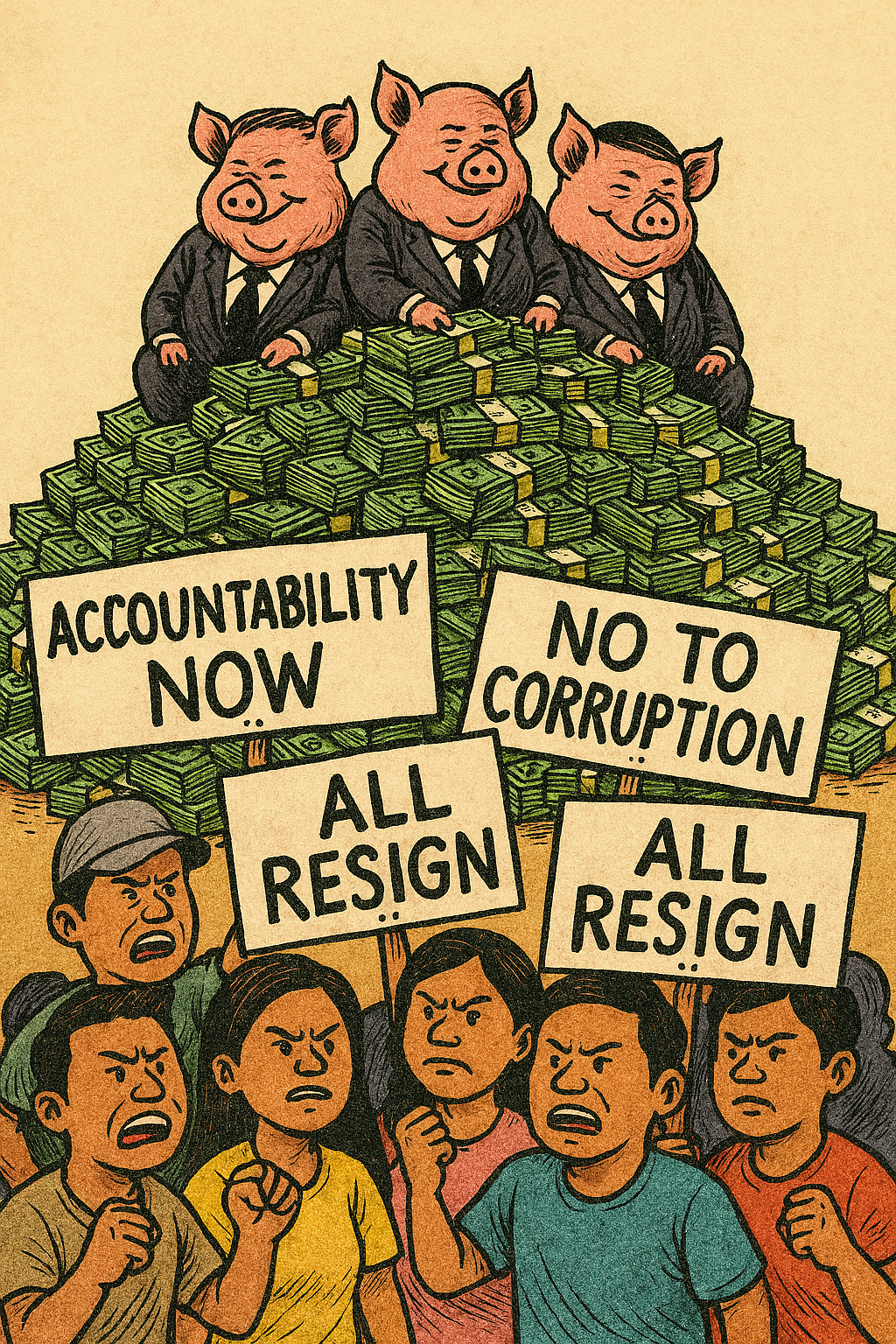
Yesterday, I spoke with a friend here in South Korea, and we discussed the situation in our country. She was as gravely disappointed and angry as I was (just like the millions of our countrymen back home) by the blatant plunder of our national coffers. The story of the flood control program, a tragi-comedy, has taken many twists and turns, and the plot continues to thicken.
We agreed that it was right for the South Korean government to halt its P28-billion loan to the Philippines amid corruption concerns. I added that no financial institution anywhere in the world should lend to the Philippine government until those who stole from the nation’s coffers are brought to justice—and a transparent, foolproof system of government spending is implemented. Mga kapalmuks kayo, mangungutang tapos paghahati-hatian lang ninyo.
We disagreed as to who should be blamed for the flood control project scam. According to her, by virtue of command responsibility, the President is most guilty. She considers it improbable that the Chief Executive did not know about the wrongdoings of his alter egos from the very beginning. Why did it take him three years to expose the corruption happening right under his nose? His duty is supposedly to prevent such corruption practices from happening under his watch. Did he only discover the substandard and ghost flood control projects this year? And why did he exclude himself from blame when he said, “Mahiya naman kayo” during his SONA a couple of months ago? That should have been “Mahiya naman tayo.”
And if these demonic acts of plunder also occurred during the times of Presidents Duterte, Aquino (Noynoy), Arroyo, Estrada, Ramos, and Aquino (Cory), then all of them should be held accountable as well. “Mahiya naman kayong lahat.”
I told her that blaming the President is correct. Still, half of the blame should be borne by the Filipino electorate who voted for those greedy politicians, fattening themselves like pigs in the supposedly august halls of Congress, now nothing more than a stinking sty of corruption.
We deserve the leaders we elect. There are many Filipinos who are very angry with what the politicians are doing, not realizing that they should be partly to blame for what is happening because they voted for those corrupt leaders. The truth is “Nakakahiya tayong lahat.”
Suppose we are genuinely seeking accountability and transparency. Why is nobody suggesting that the yearly National Budget from the time of Cory Aquino (1986) to Marcos (2025) be scrutinized and checked to see how the budget of DPWH (and other government agencies) was allocated each year? It is not only the records of the budget of the DPWH that should be scrutinized but all the departments of the Executive branch. The records will definitely show who, among the Senators and Congressmen (past and present), made “insertions.” A thorough investigation and accounting should be made to determine who among the members of the Executive and Legislative branches of government, past and present, colluded to plunder the nation’s coffers. The truth is written in all those documents.
We also agreed that the Philippine government, as presently constituted, has lost its credibility to govern. Which branch of government is trustworthy now? The Executive or the Legislative branch?
That is for you (the readers) to answer. But as far as I and the friend I talked to yesterday are concerned, it’s scary to entrust the future of our nation to anybody from Malacañang, the House of Representatives, and the Senate.
What about the Judiciary? Can the Filipino people trust our Justices? Did they perform their solemn duty to intervene and restore constitutional order when they were flooded with petitions challenging the constitutionality of the 2025 General Appropriations Act (GAA)? What happened to their hearings? Did they do something to prevent the kleptomaniacs from dipping their hands into jars of people’s money? None that I could recall (and please correct me if I am wrong).
If none of the three branches of government could be unequivocally trustworthy, what about the fourth estate, the media? Do they genuinely care about the Filipino people? My answer is simple: they are too busy building their business empires.
But if neither government nor media can be trusted, then the responsibility ultimately falls on us, the Filipino people.
The last question we addressed in our conversation was, ‘What should be done?’
What should the Filipinos do now?
I was surprised that she was thinking the same thing I was… REVOLUTION.
We agreed that all the investigations being done by both the lower and upper chambers of Congress on the flood control project anomalies will amount to nothing. Even the planned independent commission cannot be expected to be genuinely independent. The loyalty of the members belongs to the authorities that appointed them.
Politicians have their way of sweeping under the rug the messes of their colleagues. They have mastered the art of compromise to such an extent that, in the end, only the lowly contractors will serve prison time.
Meanwhile, the equally guilty, high-ranking individuals in the government—who belong to wealthy and powerful families—will only receive a slap on the wrist.
Honestly, I have entirely lost my faith in our government. I don’t know who among them can be trusted. Even the international community has doubts about the moral ascendancy of our leaders to hold the reins of government. The South Korean government is the first to cast doubt on the trustworthiness of our government. And soon, other countries may. For the first time in my life, I find myself hesitating to say I’m from the Philippines.
Somehow, the only credible government institution now is the Military. They are our “second-to-last” hope. They need to take control of the government, either peacefully or by force. Everybody in the government must resign. The Military must investigate the widespread corruption and send to jail all those who are found guilty. They must do a comprehensive audit and accounting of all government expenditures. They must start with the yearly National Budget from the time the Marcos dictatorship ended up to this year. They should not leave any stone unturned.
The crooks must be prevented from running for any public office. When finally justice is served, the military shall order new elections to elect a new government.
If the military will not take over, we could be heading in the direction that the Indonesians and the Nepalese went. We must not allow the present government officials to continue running the affairs of government.
As I said before, the Military is our “second-to-last” hope. But our final hope—the true hope—rests with us, the Filipino people.
It’s time to breach party lines and set aside ideological differences. Let’s stop supporting any politician and stand together in love for our country. The slogan should be clear: “Save Our Nation,” not “Save a Politician.” We have been exploited and betrayed by greedy politicians for too long—it’s time to take back our country.
And when the time comes to exercise our freedom of suffrage again, we must vote for the most qualified leaders. It’s time to weed out the politicians and choose leaders who are true statesmen, not career (greedy) politicians.
It’s time to reclaim our nation. The time is now. When we march to the streets, bring no party banners, only our nation’s flag.
The Floodgates of Command Responsibility

The Secretary of Public Works and Highways (DPWH) appears to be taking all the blame as the scandal surrounding the flood control projects unfolds. The question is this: Whose conscience will get inundated with guilt if we open the floodgates of command responsibility?
Suppose we adhere to every aspect of the command responsibility framework. Shouldn’t someone be uttering the well-known phrase, popularized by U.S. President Harry Truman, “The buck stops here”?
Who should be saying, “The final responsibility rests with me”?
Who is conscientious enough to say, “I take full responsibility”?
Nobody is doing so. Instead of doing a Harry Truman, the mayors, governors, congressmen, and senators are all doing a “Pontius Pilate.” I will not be surprised if, in the days to come, these Honorable Gentlemen and Ladies will also do a “Judas Iscariot.”
I don’t know if President Bongbong Marcos was correct in using the pronoun “kayo” when he said “Mahiya naman kayo” in his latest State of the Nation address. I think it should have been “Mahiya naman tayo.” He would have gained more admiration had he used “tayo” instead of “kayo.” While the DPWH is directly responsible for implementing flood control projects, the President, as the head of the executive branch, bears ultimate accountability for ensuring proper oversight. At least, His Excellency is now correcting the acts of omission and commission (and yes, the “commission,” if you get what I mean). He should be given credit for that, although “prevention” would have been preferable to “correction.”
Did you see how some local executives, congressmen, and senators crucified the DPWH officials and contractors? Did they not know about the substandard and ghost flood control projects in their respective localities? Did they not really know about the corrupt practices happening right under their noses? Come on, we were not born yesterday.
Nobody will believe you, even if you deny to death that you know nothing about the substandard and ghost flood control projects. It is improbable that nobody informed you that these mega projects are being undertaken in your jurisdiction. As a VIP (being an elected official), nobody in their right mind would construct anything in your backyard without notifying you. Furthermore, it is impossible that nobody whispered to you about “for the boys.” Whether you accepted or rejected it, only you and God know.
Don’t be a “Pontius Pilate.” You may not be guilty of accepting anything passed under the table, but why are you not brave enough to say that you actually turned a blind eye? Don’t act now as if you are the champions of your constituents and during TV interviews hurl all those invectives against those who are now tagged as suspects in the “flood control project scams.” Your act of washing your hands on national television didn’t go unnoticed. It’s not funny at all. If only we had an intelligent electorate, I doubt you would get reelected because of it.
We need to answer the following two questions:
“Is it proper for the House of Representatives to conduct an inquiry into the flood control project scam?”
“Is it proper for the 12 remaining senators from the 19th Congress to join the ongoing investigation of the Senate’s Blue Ribbon committee on the same issue?”
Just asking!
There is another web whose strands we need to trace aside from command responsibility. It’s the web of corruption. The webs of command responsibility and corruption are connected.
Who is responsible for the Congressional appropriations for the 2025 National Budget’s subpar and ghost flood control projects?
Who is brave enough to say, “I bear ultimate responsibility”?
Who, after a deep reflection, would say, “The final decision and its consequences are mine to bear”?
And please don’t mind me asking a last question:
Whose bank accounts fattened through the scam involving the flood control project?
Puwede po bang makabalato?
Teaching Styles, Students’ Motivation, and Grit as Correlates of Students’ Performance in English
One of the constructs we examined in this study was “motivation to learn English.” Why do learners study the language? Gardner dichotomized motivation to acquire a second language into “instrumental” and “integrative.” To explain it, a person is instrumentally motivated to learn another language if their reason falls into one of two categories: academic (to achieve good grades or secure a certification) or economic (to ensure a better salary). If a person attempts to acquire proficiency in a language for personal or cultural reasons (to communicate effectively and integrate into the society or culture of the language’s speakers), they are integratively motivated.
I presumed (and you are probably also) that our Korean students, who served as respondents in this study, are instrumentally motivated. They study English for academic and economic reasons. I was wrong. The results of our research have shown that our students are more integrally motivated than instrumentally.
Being motivated to learn English instrumentally does not mean that you are not integratively interested in acquiring proficiency in the language, or vice versa. It means only that your motivation is stronger in one area over the other.
What Matters (6)
(A Short Story – Last of 6 Parts)
My wife knew we were meeting up and had cooked dinner, inviting us to eat at our place.
“Wow, that’s fantastic!” Jay exclaimed when I shared the news. “This is a perfect opportunity to meet your family as well!”
“Okay,” I said. “Jay, Chris, you shouldn’t drive. You’re pretty drunk. Just join me in my Jeep instead.” Chris protested but eventually agreed. As for Mario, he seemed fine to drive himself, so I allowed him to take his car. This way, I wouldn’t have to worry about moving their cars back after dinner. When I returned the case of beer to the store, I entrusted Chris and Jay’s cars to the owner, and they just needed to pick them up before closing time that evening.
The drive to my house was smooth, with Mario trailing behind us. I noticed that Chris and Jay were nodding off as we drove. Less than 20 minutes later, we arrived home to find our gate already open.
Once we parked, Jay and Chris hopped out of the Jeep. As soon as Mario arrived, we moved deeper into our yard. It felt like the perfect evening was just beginning.
Our front yard features a neatly tended garden where my partner and our children cultivate various kinds of flowers and soft green shrubs that add life and brightness to the space. Our house is partially hidden behind the trees of chico and mango.
“Is that a Toyota Hi-Ace van yours?” Chris asked, eyeing the vehicle parked in a separate garage on the left side of our front yard.”
It is. We bought it two years ago. My wife relies on it for her business, and it’s our go-to for family trips,” I replied.
“Have you ever considered turning it into a rent-a-van business?” Jay suggested.
“Actually, that’s exactly what I’m doing! It’s become a valuable source of income for me, and I receive inquiries at least twice a week,” I explained with enthusiasm.
“Wow, your house is impressive,” Jay observed.
“It’s a big house, and you have a spacious yard. I thought this was still the old house we visited when we were in high school,” Mario added.
“This is nothing compared to Jay’s house. I had the old one demolished, and with every good harvest of rice and vegetables, my wife and I built this new one gradually,” I shared proudly.
At that moment, the door to our house opened.
“Come on in!
Maxene opened the door. She greeted me and kissed me on the cheek.
“Brothers, this is Maxene, our youngest.”
She greeted all three of my friends and kissed their hands as a sign of respect.
“How old is she, bro?” Mario asked.
“She’s in Grade 12. Next year, she’ll be in college. Where’s your mom, sweetheart?”
“They’re in the hut at the back. They’re preparing the food.”
“Let’s go to the back, guys.”
“Your house’s interior is nice, Mon,” Chris commented.
“My sister designed it. She graduated in Fine Arts.”
“And Mon,” Mario whispered to me, “You have everything here.”
“Your TV is bigger than mine. This is what you call a fully-furnished house.” Jay mused.
“My wife invested in all of this, bro. She does well with her small grocery in the market.”
“You have a desktop computer here, Mon. And a laptop and a tablet. Why don’t you try using them?” Chris asked.
“My kids and my wife use those. I never get a chance to use them. Besides, I am not a techie.”
We exited our house through the back door.
“Front yard, flowers and trees… backyard vegetables. You’re not wasting any space Mon.” Mario quipped.
“I am a farmer. I think planting is my life.”
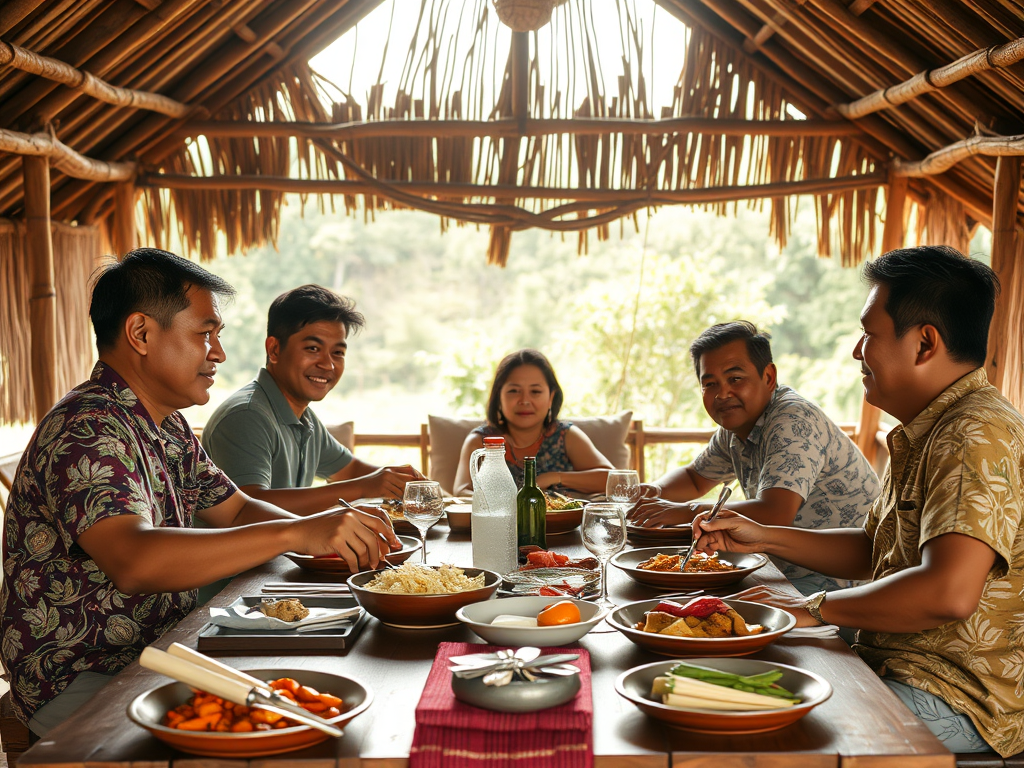
By the time we reached the hut behind our house, the food was ready. It was already late afternoon, and darkness was beginning to settle in, so the lights were on.
“Wow, is it your birthday, Mon? There’s so much food—adobo, fried bangus, salted eggs, chop suey,” Jay remarked.
“By the way, everyone, this is my one and only, Eliza,” I said.
My wife kissed me on the cheek as she greeted my friends. Marco, my son, did the same.
“Wow, your wife is absolutely stunning, bro,” Mario exclaimed.
“Definitely, she’s gorgeous,” both Chris and Jay chimed in.
“I don’t see it that way, but oh, Mon… your friends know how to flatter,” my wife joked, a playful smile on her face.
“Madame, we’re just telling the truth. And please accept our apologies if we’ve caused any trouble,” Mario said with genuine respect.
“Oh, it’s nothing at all! You don’t need to worry,” she replied warmly.
“By the way, Mommy, let me introduce you to my amazing classmates: Jay, Chris, and Mario. They are all successful and well-known.”
“Well-known? Are we celebrities? Mario said.
“Successful… and maybe a touch arrogant,” Jay quipped with a smirk.
“This is my eldest son, Marco. He’s set to graduate next year.”
“What are you majoring in, Marco?” Mario inquired.
“Chemical Engineering, sir.”
“Please, don’t call me, or any of us, sir. We are your uncles. So call us tito, okay.”
My son nodded in agreement.
“And, Mon, when Marco graduates, please reach out. I can easily connect him with great job opportunities in Saudi Arabia.”
“Wow, I truly appreciate that, bro,” I said, excitement bubbling within me.”
Before we started eating, my wife invited us to say grace. My friends seemed surprised and hesitated before bowing their heads to pray.
That’s just how my wife is. She has taught me and our children the importance of prayer and faith in the Lord, and we go to church every Sunday.
After the prayer, Maxene served the rice, and a quiet calm fell over the hut. I noticed that my friends took turns glancing at my family.
“Well, there goes an angel,” I said, breaking the silence.
“Okay, since I’m the shyest in the group, I’ll take the first bite,” Chris suggested.
“Eliza, kids, come join us,” Jay invited.
“Sure… we’ll join you in a bit,” both my children replied.
Eliza sat beside me, and my kids sat behind us. As I ate, Maxene gently massaged my back.
“Dad, doesn’t your back hurt?” Maxene asked.
“No, sweetheart. I’m fine.”
I noticed how my friends kept staring at our family as they ate. I didn’t know what they were thinking, but I could tell from the subtle smiles on their faces and their gentle nods that they were happy with what they saw. It reminded me of how my teachers used to look at me when I’d answer questions correctly in class.
We finished our dinner, and my family helped with the cleanup while my friends remained alone in the hut.
“Maxene, could you please make your uncles some coffee and me some green tea?” I asked.
“Oh, hija, please make mine green tea also.” That was Mario.
My friends were quiet after the meal. Even when we started drinking our coffee and tea, the silence lingered. I wasn’t sure why—perhaps the drinks had an effect, or maybe they were just tired after spending nearly six hours together. Eventually, they all turned to look at me at the same time.
“Hey, guys. What’s up? Do I have something on my face?” I asked.
Jay smiled and replied, “I’m so happy for you.”
“Why is that?” I wondered.
“Just keep it up, bro,” he said.
I understood what Jay meant.
“Do you remember back in high school when we discussed our dreams and goals in life?” Chris asked. “While we all talked about cars, houses, money, jobs, and whatnot, I remember Mon saying he just wanted to be happy and live a good life.”
A brief silence followed.
“Chris… am I right? You scoffed at Mon when he said those things,” Jay asked.
Chris vehemently denied it.
“I just happened to marry a good woman. She has strong faith in God. And, ah…”
“…and she just happened to marry a good man,” Jay cut in.
“That’s Mon for you. He never brags. He’s always the quiet one, just listening to everything we say,” Mario added.
“Why is it that all the women I meet are rejects? They’re only good in bed. Does your wife have a sister, bro? Introduce me to her,” Chris said.
“Come on, Chris. She does… but I don’t want their lives to go astray.”
“You’re something else, bro,” Chris laughed.
“I envy you, Mon,” Mario said. “If I hadn’t gone abroad, maybe my family would still be intact.”
“You wouldn’t have gotten rich if you only worked here in the Philippines.”
We fell silent for a moment.
“What is the price of my wealth? What good is my money?” I looked at Mario, who suddenly seemed serious.
“I don’t know either. I don’t want to think about it,” Chris replied.
Jay added, “What is the actual value of wealth and success? I have been thinking lately, with what I have been going through, what does matter in life?
“Come on, Jay. We’re tough dudes. You’ll be fine. You’ll get past that and live long. The four of us will live long. Together we’ll celebrate our 100th birthday.” Chris replied.
The hut fell silent after Chris made that statement. I broke the silence again.
“Wait… wait… enough with the serious talk. The important thing, guys, is that we’re still alive. We still have time to fix what needs fixing. As long as we’re alive, we can still pursue our dreams and create new ones.”
Jay nodded while Chris bowed his head. Mario went outside for some fresh air.
“Mon, find me some land for sale around here,” Mario said. “There’s something about this place that feels different. It feels like my chest is lighter. I don’t know why.”
“Sure, bro. I know of some farmers who want to sell their land nearby.”
“Okay, I want to have a farm. I am interested in organic farming. It is what I want to do after my stint in Saudi. I hope you can help me develop it if it happens.”
“Why not?” I replied.
As the evening came to a close, my friends finished their coffee and prepared to leave. The warmth of the gathering lingered, but it was time for them to head home. We promised to meet again the next time Mario was in town. Jay joked about ensuring he’d still be alive when Mario returned, while Chris eagerly mentioned introducing us to the woman he hoped to marry.
From our terrace, I watched as my friends climbed into Mario’s car. The light from the post near our gate bathed them in a soft glow, casting long shadows across the yard. Jay pulled out a cigarette, but instead of lighting it, he tossed both the cigarette and the lighter into the night.
In that moment, I felt a sense of peace. I looked over at my family, gathered in their favorite nook on the terrace. I realized how much my life and that of my friends had changed. From the dreams we shared in high school to the lives we’re living now, we’ve come full circle. And though our paths had diverged, there was still time—time to grow, to repair what needed fixing, and to continue chasing the dreams that kept us going.
Life, I thought, is about the moments we share, the people we love, and the time we still have.
>END<
What Matters (5)
(A Short Story – Fifth of 6 Parts)

“Why are you talking like that, bro? You’ve been acting strange all day,” I said to Jay.
Jay lowered his head and sighed deeply. We all waited anxiously for him to respond. It felt like an eternity before he finally spoke again.
“Guys, I have prostate cancer. Stage 1.”
Chris shook his head in disbelief while Mario placed an arm around Jay’s shoulders. I wasn’t too surprised by this revelation; I had a feeling Jay was struggling with something like this because he had hinted at health issues before.
“That’s why, Mario, when I saw your Facebook post about your vacation and we just happened to run into each other, I asked if we could all get together. I thought… I thought maybe…”
Jay’s voice trailed off, tears brimming in his eyes, raw and vulnerable.
“Well, it turns out Mario’s not the most dramatic among us… It’s you, Jay. But it’s not the end of the world. There’s a cure for that.”
Chris expressed his thoughts bluntly, and while I almost wanted to chastise him for it, he did have a valid point. Hearing about Jay’s struggles was disheartening, but he had no choice but to confront the situation head-on.
“I’m terrified because my dad lost his battle with prostate cancer. I fear I might have inherited it,” Jay confessed.
We fell silent, absorbing Jay’s vulnerable admission. Mario and Chris chimed in, revealing their own health challenges. Both struggled with high blood pressure and kidney issues that required significant medication. Chris even shared that if his treatment didn’t clear his kidney stone, surgery could be on the horizon.
One thing I am grateful for is that I don’t have any health problems that require doctor visits or medication. Since I’ve been driving for a living, I’ve been following a health program on the radio and adhering to all the advice I hear. The only issues I face are occasional knee and back pain after working on the farm.
“Don’t worry, bro. I’ll take you to a great urologist I know at St. Luke’s. We’ll find a way to fix this. I’ll help you,” Mario assured Jay.
“Thanks, Mario. Thanks, guys. I feel a little better now that I’ve shared this with you. You’re the only ones who know about my condition.”
“Wait, your wife and kids aren’t aware of this yet?” Chris asked, raising an eyebrow in surprise.
“Mon… Jay’s still single,” Mario chimed in, a hint of concern in his voice.
It struck me how little I really knew about my friends. If I were more connected on social media, perhaps I’d be more in tune with their lives.
“Jay, you can do this. I know you’re strong. You’ll be better by the time we meet again on Mario’s next trip home,” Chris said as he opened more bottles of beer and offered me one.
“I’ll pass, Chris. I still have some left in mine,” I replied.
“Oh, come on, Mon, don’t cheat again,” he teased.
Their laughter filled the room, but they respected my limits when it came to drinking. They understood that while they could down three beers in the time it took me to finish one, I didn’t handle hard liquor well.
“Next week, we’re going to address your issue, Jay,” Mario declared, his tone a blend of seriousness and support. “But right now, I need to concentrate on something else…” He suddenly hesitated, as if grappling with whether to share more. I could sense that he was carrying an emotional weight. Could it be time for Mario to reveal his own struggles?
“Sorry… I need to focus on wrapping up the case I filed against my wife.” Just as I anticipated.
“Yes, I filed for adultery against her three years ago, and the judgment is coming next week. That woman and her lover are about to face the consequences,” Mario explained with palpable intensity.
He recounted the entire saga: the man who betrayed him was their business partner, and his wife had been unfaithful for nearly a decade before he uncovered the truth. A mutual friend had stepped up, alerting him to the betrayal through a Facebook message.
“Do you have kids? What did they say about it?” Jay asked.
“They’re furious with their mother. They couldn’t care less if she goes to jail. We have two sons, both college graduates and engineers. They work alongside me in Saudi Arabia, and my employers have recognized their talents as well.”
The conversation shifted into deeper territory as we focused on the topic of family. I wasn’t surprised by the struggles Mario and his wife faced; it’s a reality many couples encounter when one partner works abroad. While the opportunity for a better future exists through such arrangements, they can also lead to complications if the spouse left at home cannot resist temptation.
“By the way, Mon… Chris… do either of you have families?” Mario inquired, genuinely curious.
I nodded in response, eager to share about my family, but Chris jumped in before I could.
“I have two kids… but no wife.”
Chris seemed to be beaming in confidence when he said that. He stopped abruptly and looked at us.
“Why? Did you guys not even react? I said I have two kids… but no wife.”
“Come on, Chris, we’re not surprised by that anymore. I was even thinking that you have more than 5 children from different women.” Jay retorted. “We know you chase women for a living.”
“Actually, I’m in hot water again. Another woman is demanding child support from me. She says she’s going to sue if I don’t step up. I told her it’s time for a DNA test; she needs to prove I’m the father,” Chris replied, a hint of annoyance coloring his voice.
“Suit yourself, bro. Just be careful—you might end up with more than you bargained for, like HIV, hopping from one ‘hole’ to another,” Jay cautioned, his tone tinged with genuine concern.
“Mario, I’m a wise guy. I always use protection when I’m not sure of the ‘owner’ of the hole I’m entering,” Chris shot back, grinning cheekily.
“What about the two kids you’ve already recognized as yours?” Jay asked.
“They’re with me. Their mothers don’t want to take care of them, so my live-in partner is helping me raise them.”
Chris didn’t seem fazed by the complexity of his life. It seemed as though he was okay with the messiness of things. I didn’t want to judge him, but I couldn’t help but wonder what kind of life his two kids would have with two different mothers. And now, there was a possibility that it might be three kids. What if his live-in partner got pregnant? If Chris were my brother, I’d probably have slapped him back to his senses.
I didn’t get a chance to talk about my family because the conversation shifted to Chris’s chaotic love life. We advised him to straighten up, especially for the sake of his kids.
The drinking continued, and conversations flowed easily. By around six in the evening, we were surrounded by empty beer bottles, and Mario’s Chivas was nearly finished too. Jay and Chris seemed a bit tipsy, while Chris eventually grew quiet and appeared close to nodding off. Every time he started to snore, Jay would nudge him to wake him up. Surprisingly, Mario seemed unaffected; he was clearly used to drinking. I had only managed to finish three bottles of beer, with half a bottle still remaining, so I was doing fine. Eventually, it was just Mario and me left talking.
Jay and Chris got out of the jeep. While Jay went to a nearby tree to relieve himself, Chris ended up throwing up. I went over to rub Chris’s back to help him. At that moment, my phone rang—it was my wife calling.
“Excuse me, guys. My wife’s calling,” I said.
“Uh-oh, trouble’s coming. The commander’s on a roll call,” Chris joked.
To be continued…

What Matters (4)
(A Short Story – Fourth of 6 Parts)
Mario got out of his car, carrying a plastic bag. He was also wearing a long-sleeve shirt, just like Jay, but without a tie.
“Bro, finally, we’re all together again,” Mario said, his voice a little choked up as he hugged each of us one by one.
“Damn, bro, you’re still so dramatic,” Chris said.
“No, he’s just missed us,” Jay replied.
“Wait, let’s sit first. Wow, I think these are the same rocks we used to sit on when we used to hang out here,” Mario said.
Mario opened the plastic bag he was carrying.
“This is for you, Jay. It’s a perfume. I know how much you love fragrances. And Mon, I got you a new phone—it’s a Galaxy S25 Ultra, the latest from Samsung.”
“Wow, bro, this is too much. This is expensive,” I said.
“It’s fine, Mon. Don’t worry about it. Jay told me yesterday when I called him that your phone looks old,” Mario replied.
Jay and I both hugged Mario and thanked him sincerely.
“Perfect timing! I should make a Facebook account for you, bro,” Chris said. “And what’s this? What’s in here?”
“It’s Viagra.”
We all laughed at what Mario had said.
“Hey, just so you know, I don’t need Viagra. Mine is always standing at attention whenever I command it. It tends to get excited whenever I see pretty women.”
“Is that so?” Jay challenged, raising an eyebrow. “What I learned in psychology is that guys who boast about their prowess are the ones suffering from ED.”
“ED? As in Echo Delta? What does that mean?” Chris asked.
“Erectile dysfunction,” I clarified, keeping the mood light.
Another round of laughter ensued
“As if you don’t know me, boys.”
“Come on, Chris, we know you too well,” Jay teased.
“It’s not Viagra; it’s a watch. A G-Shock,” Mario interjected.
What Jay and Chris said about Mario was true. He must have a good job in Saudi Arabia. I was happy for my friends; they had achieved their dreams. It’s tough to predict what will happen in a person’s future. You can never be sure what will become of your classmates and friends when you all go your separate ways after high school or college. It’s not necessarily true that only those who top the class—the valedictorians and honorees—will have the best future. No one can say for sure if the best students from the past will be the ones who succeed and prosper, as seen in the cases of Chris and Mario.
Truth be told, they were lazy students and considered the class slackers, often absent from school. Jay was the smartest of our group, while Mario was the weakest academically; however, out of the three of us, he was the wealthiest. He had the nicest car and treated the gifts he brought for us as if they were nothing special.
“Hey, Mon, I think I’m going to melt from your gaze. Stop staring at me like that,” Mario said.
“Sorry bro. You’re just truly impressive.” I responded, admiring his enthusiasm.
“Wait, wait… now that we’re all here, let’s take some pictures. It’s groupie time, guys!” Chris exclaimed.
The three of them took turns snapping pictures of the group. We acted like kids, scrambling to get into position.
“Great news! The pictures are live on Facebook,” Jay announced with a grin. “Don’t worry, Mon, I’ll get your account set up soon, and you can check them out. By the way, check out my profile pic! Still looking sharp, right?”
“Hold on, though. I’m getting pretty hungry. Can we grab a snack first?” Mario chimed in.
“Aren’t we supposed to hit the basketball court?” Chris teased, raising an eyebrow.
“Let’s do that next time. I didn’t bring my jerseys.” Jay suggested.
“Hey, Mon, I think I’m going to melt from your gaze. Stop staring at me!”
“Yeah, I’m hungry too,” Chris agreed. “Hey, Mon, where’s a good restaurant around here? You probably know a lot since you drive here every day.”
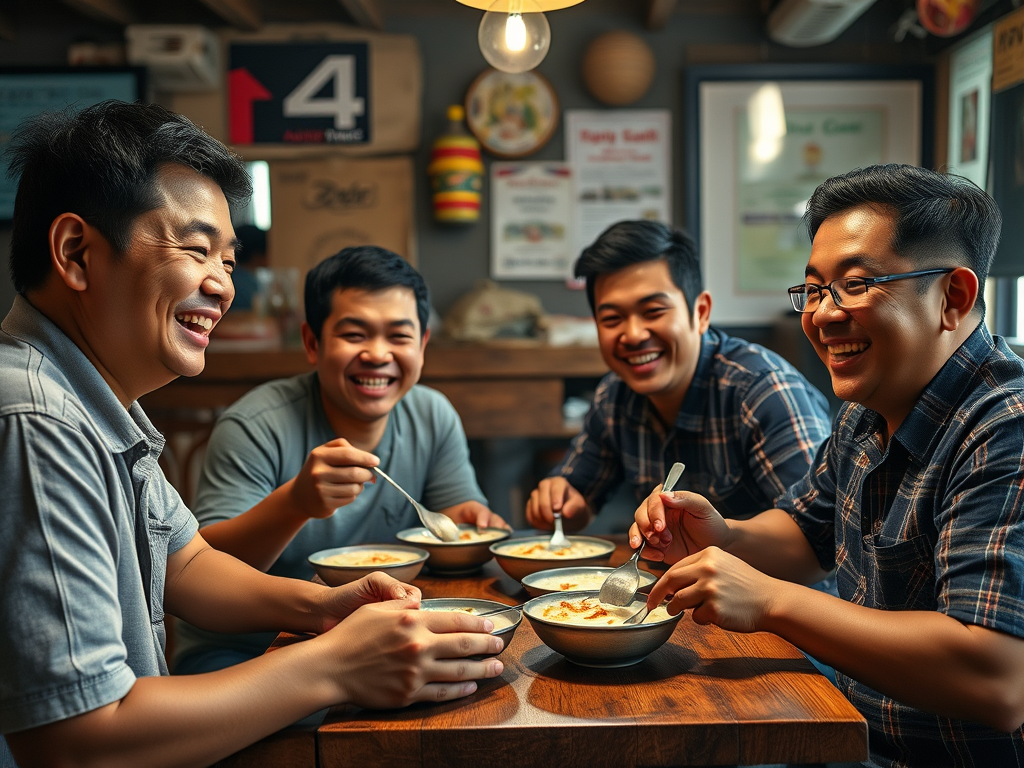
“Actually, I want LTB, Chris. Why venture far when Mang Isko’s lugawan is just a stone’s throw away?” Mario pointed to the familiar lugawan we used to frequent.”Wow, how cheap… lugaw, tokwa, baboy.”
“Alright, Chris, if you have your heart set on a restaurant, go ahead. But I’m all for Mang Isko’s lugawan, Mario. Mon, let’s indulge in some delicious LTB!”
Jay started walking toward the lugawan, and Mario and I followed.
“Hey, wait, I’m coming too! LTB sounds great,” Chris said.
We had the lugawan to ourselves, and it was sad to find out that Nanay Mameng and Mang Isko had passed away. Their children were now running the store and lugawan.
As the three of them sat down, I waited for our LTB order. I watched my friends happily chatting. Among the three, Jay looked the oldest, with a lot of gray hair. He was probably stressed from all the work and studying he did, which made his hair turn gray quickly. I checked the mirror hanging by the door of the lugawan to see if I had any gray hairs yet. Thankfully, I didn’t. Mario and Chris each had a few gray hairs, but Mario’s forehead had also become wider, possibly due to the heat in Saudi Arabia that caused his hair to fall out.
Chris stood up and took a selfie, showing his playful side. He even got one with me. He is taller than all of us. He always played center whenever our section formed teams in high school. Although Jay was the shortest of the four of us, he was also the most handsome, with a mestizo appearance. Mario and I were about the same height.
With the lugawan’s self-service setup, I stepped up to fetch our orders when they were finally ready, eager to enjoy and strengthen our bond over good food and great company.
“Wow, it’s been ages since I last had LTB,” Mario exclaimed. “But wait, Mon… are you just having lugaw with egg?”I nodded in response.
“Are you on a diet?” Chris inquired. “That’s probably the reason your belly isn’t bulging like mine, which makes me look like I’m pregnant.”
“Yeah, right,” Jay interjected. “And have you noticed, Chris? Mon’s chest and arms are getting bigger.”
“I’m just buff from driving and working in the fields, brothers,” I replied with a smile.
“What about you, Jay? Why do you look like you’ve lost weight?” Mario asked.
“Well… I think it’s probably due to lack of sleep. I’ve been buried in paperwork. The life of a school administrator is tough,” Jay admitted.
Though we had simple food, our spirits were high. They even ordered another round of LTB, but I was fine with just one. While we ate, we reminisced about all the crazy things we did back in high school. It was a fun conversation filled with laughter and teasing.
After we finished eating, Chris and Mario suggested going out for a drink.
“I know a karaoke bar in the next town that’s open from 3:00 PM until dawn. Let’s make it a night to remember—come on, we’ve got cars!” Chris said, his excitement infectious.
“Let’s not go there, bro. The trip is long, and it would be a waste of time. It would be better if we just bought some beer at the store and drank inside Mon’s jeep. It’s more refreshing, and the experience will be unique,” Jay suggested.
“Yeah, you’re right, Jay. Let’s not go far so we can keep chatting,” Mario agreed.
“Okay, okay, of course, the majority wins. Here’s Mon. He won’t vote; he’s always neutral. Alright, I’ll go buy the beer so we can start right away.”
So, as Jay suggested, we ended up drinking inside my jeep. He was right; it was indeed a unique experience—drinking inside a jeep. Chris bought the beer, and I picked up some peanuts and chicharrón to go with it. Thankfully, I had cleaned the jeep after my last trip. We were delighted when Mario also took out his Chivas Regal and imported cheddar from his car. He even had a shot glass! Chris grabbed a case of beer.
“Well, just like before, no one leaves until this is finished… and Mario’s Chivas too. I also bought plastic cups and ice cubes in case you want it cold,” Chris said as he passed us the open beer.
“To our reunion of handsome guys… CHEERS!” Jay said.
That’s how our drinking started, and our never-ending conversation continued.
“Why did we only think about meeting up now?” Mario asked. “Let’s make this a regular thing. Otherwise, it’ll probably take another 25 years before we do it again. How should we do it? What about every two years, whenever I’m on vacation? Or maybe every four years?”
“Not every four years… I might not make it!” Jay said.
We suddenly went quiet.
To be continued…