Blog Archives
No Love Lost Between the Catholic Church and Duterte
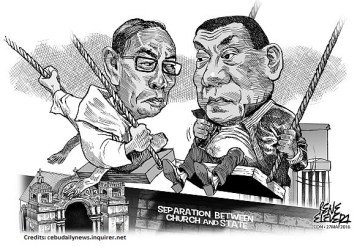
During the campaign period for the May-2016 presidential derby, a few (or is it many or all?) Catholic bishops and priests openly expressed their disapproval of then candidate Rodrigo Duterte. Reportedly, priests used their homilies to dissuade the Catholic faithful from voting for the mayor of Davao City.
But they failed.
Whether the bishops and the priests like it or not, Duterte is the Philippine president for the next 6 years.
Before the May, 2016 elections, Duterte could be remembered saying, “I said let this election be a sort of a referendum, a sort of a plebiscite for the church and me.” And the Filipino people have spoken.
The Catholic Church, by taking sides and for singling out Duterte, initiated the animosity between them and the soon-to-be head of the Philippine government. It can be said that the clergy fired the first shots and they are supposedly wise enough to know that the outspoken Duterte, win or lose, will retaliate. They unwittingly stirred up a hornet’s nest.
For all the verbal salvos fired against him by the bishops and the priests the strongest response by Duterte was “the Catholic Church is the most hypocritical institution.” He has gone as far as accusing the bishops of not keeping their vow of celibacy. The incoming Philippine president also added that the clergymen sought favors such as cars from politicians.
Duterte threatened to expose what he termed as the sins of the past committed by the Church including priests whom he alleged to have had affairs with women. He even claimed that he was sexually abused by a priest when he was a child.
He urged the Catholic Church to just observe the “separation of the Church and the State” and not meddle with the affairs of the government.
After Duterte’s rants and shocking insults, the biggest church organization in the Philippines started singing a different tune.
Before the May 9 elections, one of the most outspoken among the bishops who attacked Duterte’s candidacy was Archbishop Socrates Villegas. The bishop has a reputation of saying what he needs to say but his response to Duterte’s tirades against the Church could be construed as generally reconciliatory. He said, “Mine is the language of peace that refuses the dark magic of revenge. Mine is the silence of respect for those who consider us their enemies but whose good we truly pray for and whose happiness we want to see unfold.”
But while the Archbishop spoke of the nobility in silence, a Catholic priest (whose name I don’t wish to divulge but he knows I’m referring to him should he get to read this article) continued his attack against president-elect Rodrigo Duterte. The exact words he wrote (as a comment to an article about the incoming Philippine President which he posted on his Facebook) goes, “6 years tau [sic] magtitiis.”
Translation: “We’ll suffer for six years.”
Duterte is yet to serve a day in office but the priest is seemingly certain that the Philippines will suffer during his term.
Can he see the future? Definitely not but one thing for sure the priest knows Philippine history. He knows pretty well that for 333 years, not just 6 years, the Filipinos suffered tremendously in the hands of Spanish conquistadores, aided by the Catholic Church. The priest, I’m sure, have read Dr. Jose Rizal’s “Noli Me Tangere” and knows one of the characters called Padre Damaso.
“Are the Spaniards really gone? Is Padre Damaso just a fiction character? Ask Duterte!
2016 Elections: Postscripts

During the campaign period leading to the May 9 presidential derby in the Philippines, Duterte’s opponents were quick to point out that he had no well-defined economic policies in the platform of government he was presenting. His political opponents pounced on this for they perceived the absence of a solid plan for the country’s economy as a weakness of the then candidate for the most powerful seat in the government.
Even the members of the Makati Business Club, an organization of the richest and most influential businessmen in the Philippines, lamented Duterte’s vague economic agenda. They dismissed as lacking in substance, at least in their point of view as businessmen, the speech he delivered when they invited him in to speak in a forum. They expected him to give definitive statements about the conduct of business in the country should he he win (which he did.)
But notwithstanding the absence of clear economic programs (and an assortment of issues hurled against him) the mayor of Davao City garnered almost 16 million of votes to secure a clear mandate from the Filipino electorate. Surprisingly, he has more votes than Aquino, the outgoing president who also tried to dissuade the voters from choosing Duterte by emphasizing that should he win all the economic gains the country had in the past 6 years will be wasted.
In an interview conducted a few hours after the May 9 elections, when the results were unequivocally showing that he would be the 16th President of the Philippine Republic, he unabashedly admitted that economics is not his strong suit. Thus, he intends to hire the best economic minds. To Aquino’s credit, the presumptive president even hinted at continuing the incumbent government’s economic programs.
But why then that the voters did not mind the absence of clear-cut economic policies in Duterte’s to-do lists as a candidate then. The answer is simple…the problem is not the economy. If it is, the people should have voted for Roxas, the economist.
The truth is the problem of the Philippines is not the economy. The economic woes of the country are just the results of deep-seated social problems and failures of existing systems that cannot be solved by an economist. Such problems can only be uprooted by a strong leader, a leader who cannot be manipulated by scheming politicians and businessmen. The Philippines needs a leader who has a strong political will, a political will that cannot be bent by influential lobbyists. Thus, the Filipino voters cast their lot on Duterte.
The programs Duterte are putting in his presidential pipeline are not economic policies per se but they have profound economic implications. For many times that he mentioned in his campaign sorties that it is the job of the government to create an environment that is not only conducive to economic development but where the citizens and foreigners also feel safe and secured.
By eradicating corruption and red tape in all the branches of government he will be creating an atmosphere favorable for the conduct of business and would eventually make the country a haven for both domestic and foreign investments. Specifically, he wants to shorten the processing of papers when transacting business with any agency of the government.
By obliterating criminality and drugs, he will make the citizens focus on improving the quality of their life without fear of getting victimized by petty criminals. Parents can rest assured that their children will not become a victim of drugs.
By increasing the salaries of policemen and soldiers he will strengthen law enforcement which is sorely needed in the maintenance of peace and order. He will boost the morale of policemen and soldiers and make them feel more dignified.
By increasing the salaries of teachers he will make them more effective in the delivery of education which, undoubtedly, is a key component in national development.
By promoting Federalism, he will bring a final solution to the country’s century-old Muslim separatist problem. There will finally be equitable allocation of government resources where people in their respective regions will finally have a chance for self-determination.
It is hard to dispute that all these acts will bring tremendous economic benefits, indirect it may be.
He clearly pointed out that the days of unscrupulous elements in society are numbered, that people should avoid committing acts inimical to the interest of the Filipino, that people can do anything that makes the Filipino comfortable, and that nobody will be allowed to do things that will make his countrymen uncomfortable.
In the interview on May 9th, he proclaimed that he has nothing in mind but the interest of the Filipino people, and nothing follows.
My President?
Who got my nod in the Philippine presidential derby when I cast my vote at the Philippine embassy in Seoul yesterday (April 16th)?
I don’t know… nobody knows (only the Man above), if I made the wrong choice. I would have a glimpse of the wrongness or rightness of my decision after 3 years. However, let me reserve my judgment on the performance of the President I chose in 2022.
My choice hinged on several premises.

I love my country and I am proud to be a Filipino. But my nationalism doesn’t make me blind not to accept the fact that majority of my countrymen lack discipline. They are abusive of the liberties that democracy bestowed them forgetting that with freedom comes responsibility.
That being said, my conscience dictated that I vote for a President capable of reminding the citizenry to exercise their freedom without disregarding the rule of law and to protect their dignity without trampling on somebody else’s.
I am aware of the accusations hurled against him as regards the Davao Death Squad. The problem with human rights activists is they cry a howl when those involved in drugs get killed. But did they say anything about the victims of drug dealers and drug pushers? What about those who were raped by drug addicts, those whose family members were robbed and killed by them. What about those families that were destroyed because of the drug menace?
The utter disregard for law by many in the Philippines has come to a point that sometimes there’s a need to resort to extra-judicial means to restore order and to promote justice. It sounds radical and it can be argued that that in itself is a “disregard of law.” But when democratic processes are failing and society is about to crumble somebody has to take the lead, put the law in his hands and restore order for the benefit of the majority.
We’ve got to choose between “honorable” thieves who, with money and influence, can play around the so-called “rule of law” and continue to ransack the national treasury and a leader who may disregard the rule of law when the situation calls for it so justice will be served and order in society be restored.
We’ve got to decide which kind of leader we want. Do you wish to have somebody who is afraid to restore death penalty because it is contrary to the teachings of the Catholic Church who, with a majority of the voters being Catholics, may campaign against him or her? Or would you rather have a Chief Executive who is not willing to give criminals a safe haven where they could freely ply their deadly and dangerous trades.
I decided to tick the box in the ballot opposite the name of the presidential candidate who will not babysit corrupt officials and criminals. I don’t care how that candidate would do it. For me, the only way to succeed against corruption and criminality is to use “iron hands.”
We need a President who can’t be manipulated by scheming politicians. He (yes… it’s a he I chose) must be a strong leader who will not bend to the whims and fancies of anybody and can’t be swayed by opinions when performing his duties.
That is the reason I voted for this President.
He has the capability to instill discipline in the different branches of government. The country needs a President whose strong presence would make public officials perform their constitutional duties to the best of their ability and avoid any wrongdoings… a leader who will bring back the essence of accountability in public service.
We need a leader not afraid to crack the whip against corrupt officials and send them to rut in jail, a leader who is not afraid to lock horns with the members of the House of Representatives and the Senate and admonish them when they are deemed to be just spewing their saliva in endless debates and not taking actions on important legislation…a leader who will not have second thoughts to “interpret” the laws in manner he sees fit if he detects incompetence and complacency among his colleagues in the Judiciary.
The President I chose is unafraid to make unpopular decisions and try new things.
I want him to be President because he said he’ll try Federalism.
The Philippines has a unitary government where national and local affairs are controlled by the central or national leadership. Considering the socio-economic performance of the Philippines as a nation for the past decades, it is safe to say that the current form of government has failed.
For a geographically fragmented country inhabited by people belonging to different ethnolinguistic groups, Federalism may be a better form of government. It is said “If it ain’t broke, don’t fix it.” But it is! The system in place is defective therefore it must be replaced.
The one who earned my nod in the presidential derby said that Federalism will eliminate the problem of unfair distribution of funds between the local government and the national government and the decades-long Muslim insurgency in the South. And I believe him.
I want him to be the next President because it’s about time the Philippines experienced meaningful change.
Change is coming!
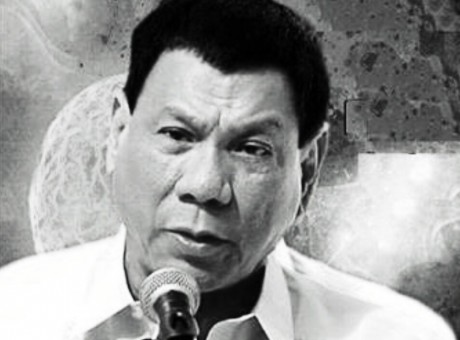
Yes, my president is DUTERTE.
On the 2016 Elections (5th of a series)
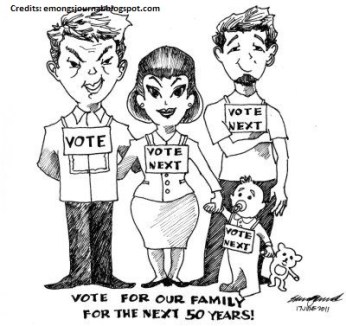
In the Philippines, politics have become a monopoly of the rich and powerful.
Scrutinize the records of the executive and legislative branches of the government, look for the names of those who got elected as President, Vice-President, Senators and Congressmen/Assemblymen and those appointed in the Cabinet since time immemorial and you’ll find out that majority of them come from “de buena familia. ” Most of them come from the most powerful clans of the Philippines, the rich mestizos… scions of the “hacienderos” and their loyal “assistentes” during the Spanish period. Even politics in the provinces, towns and cities are lorded over by these families.
The said families also own the country’s conglomerates. In their hands is a deadly concoction of power and money.
It is not difficult to figure out why most of the country’s powerful politicians come from the richest families of the land…they have interests to protect and agenda to permeate. Result: political dynasties.
The following is an article this writer penned on political dynasties in the Philippines.
—–
Consider this… A politician, let’s say a mayor, can no longer seek reelection due to term limits. So, his wife will run for the position he previously held. Then that politician will run for another post…as governor perhaps. Assuming both the politician and his wife win and luckily get re-elected until they reach their term limits, would it be the end? Would their thirst for power (and the corresponding benefits) be finally satiated?
NO!!! The couple will ask their son or daughter (or a grandson…or a granddaughter…or an in-law) to run for the positions they are about to vacate. What about the mother? She will seek the position vacated by the husband-politician. She will run as governor. What about the husband? He will perhaps run either as congressman or even senator. In case all family members win then for years that the power will run circles within the same family. The son (or daughter) is a mayor, the mother a governor and the father either as congressman or senator. When term limits are reached then they will just run for the position that a family member would vacate. Some siblings, and even in-laws, in the family are also occupying minor positions in the geographical units where they reside.
There are no political dynasties in the Philippines!!!
It is only by coincidence that the country has a president who happens to be a son of a former president and a senator and who has relatives in both the Senate and House of Representative. It is also just by coincidence, not by design, that Philippines has a vice-president whose daughters are a senator and a representative and whose son is a city mayor? Call it also a coincidence that all over the archipelago we have senators and congressmen whose wives (or mistresses), husbands, siblings, sons, daughters and in-laws are either senators and congressmen like themselves or governors or mayors or what-have-you?
Then of course they will tell the people that they do not belong to a political dynasty…but a family of public servants.
The same family names…same genes…in the seats of power in the country for decades now. RESULT? Same dismal economic and socio-political performance for the country.
—–
Not that there are no Filipinos aside from them who capable of serving the country as leaders, it’s just that these members of the elite have so much money and manpower and a powerful machinery that whoever lock horns with them during elections would almost certainly be biting the dust. The other thing is, the Filipino people keep writing their names in the ballots.
On the 2016 Elections (4th of a series)
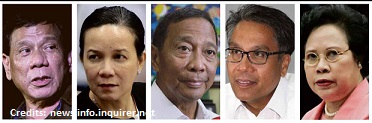
Down to 5 presidential aspirants (in alphabetical order, not the writer’s order of preference)… Binay, Duterte, Poe, Roxas, and Santiago. With only three months left before the elections, the presidential race is beginning to heat up. Things will get more exciting once the official campaign period kicks off.
The bets for the presidency have already bared their platforms of government for the scrutiny of the voting populace. They, even if the official campaign period is yet to begin, have been posting and airing their respective campaign ads in print, broadcast and social media with each of them attempting to convince the electorate that he/she is the best and most qualified to lead the country in the next six years. They are taking turns in courting the voters promising, as usual, the moon and the stars should they get elected. They and their legion of supporters have been making rounds in the provinces holding meetings and performing activities intended to increase their chances of winning. Their respective “dirty tricks departments” have been doing their best as well to open their opponents’ cans of worms to tarnish their reputation and make them less competitive.
Analyses and results of pre-election surveys show how fickle-minded are the voters. Different candidates ended at the top of voting preference at different period of times.
Had elections been held a couple of years ago Binay would have won. However, his popularity bubble burst when pricked by accusations of corruption hurled against him and his family. His place as the most preferred presidential aspirant was taken over by Poe whose ascension to the Senate was undoubtedly aided by the popularity of her father, the late Fernando Poe, Jr., the action king of Philippine cinema. It is also the FPJ factor that may catapult her to the most powerful seat in Malacañang.
But the voter preference meter for the 2016 elections suffered another fluctuation when Poe was said to have actually renounced her Filipino citizenship some years back to become an American thereby making her technically not qualified to seek the highest position in the land. When COMELEC barred Poe from running for President for the aforementioned, down went her numbers in the surveys.
It was at that juncture that Duterte’s popularity started to gain ground. The Filipinos who are tired of decades of cronyism, patronage and political compromises saw a glimmer of hope in the feisty mayor of Davao city. Duterte saw his steady climb in the surveys which made him finally decide to throw his hat into the presidential derby after dillydallying for sometime.
However, he committed a serious blunder that may have permanently damaged his quest for the presidency. In one of his trademark verbal outbursts, he was construed to have cursed Pope Francis. It did not sit well with the Filipinos, most of whom are devout Catholics. As to whether Duterte’s candidacy recovers from that miscue or not will be made known after the 2016 presidential joust.
The other candidate known for feistiness is Santiago. She continues to occupy the bottom of election surveys and it is believed that it may take a miracle for her to say that “the third time’s the charm.” Santiago is seeking the presidency for the third time.
Quietly lurking on the shadows of the leaders in the surveys is the administration’s bet, Roxas. He has yet to occupy the top of the voters’ preference but make no mistake about it, he is seriously contending for the presidency. He has no less than the backing of the government ran by the members of the political party where he belongs and the endorsement of the incumbent President. However, such endorsement from a President who has been making some unpopular decisions as of late may be seen more as a kiss of death rather than a shot in Roxas’ arms. But who knows if the Cory factor still weaves a political magic. The yellow army of Cory Aquino may have not forgotten yet how he unselfishly gave way to Noynoy during the 2010 elections.
Santiago and Poe know too well how is it to run against an administration bet. The former lost to Fidel V. Ramos in the 1992 elections and the latter’s father, FPJ, failed in his presidential bid against Gloria Macapagal-Arroyo in the 2004 polls. Both Santiago and FPJ led the pre-election surveys. Even early election results then showed them leading comfortably. But they both ended up runner-ups to the eventual winners. They cried foul to high heavens but to no avail.
The most recent (January-2016) Pulse Asia survey shows Poe on top again. This came on the heels of the Supreme Court’s decision declaring that the COMELEC can’t cancel Poe’s candidacy (yet). Surpisingly, Roxas, statistically tied Binay, and Duterte at 2nd place. While Roxas was up 3 points from his 17 percent rating in December, 2015, Binay and Duterte suffered a decline of 10 points and 3 points, respectively. Poe’s ratings jumped by nine points from 21 percent raising speculations (and fears) that she might win come May 9.
So, will there finally be a “Poe” in Malacañang in 2016? Not if the other contenders can help it. Binay and Duterte, however, must seriously do some damage control for the issues bedevilling them at the moment. Roxas on his part is uncertain whether being identified with an administration whose gains in the economic front were stained by the blood of 44 members of the Special Action Force who got killed in the Mamasapano encounter and cursed by the country’s senior citizens whose hopes of getting an additional P2,000 monthly pension was vetoed by the very President who endorsed his candidacy. Santiago, on the other hand, need to dish out a magical performance out of her bag of political theatrics in order to convince the voters that she’s got what it takes to be a President of the Philippine Republic.
As it is, those leading in the pre-election surveys may have the edge yet nobody knows for sure who will win. But one thing certain and inevitable, just three more months and Noynoy will relinquish the presidency to whoever wins the 2016 Elections.
On the 2016 Elections (3rd of a series)

How many of the registered voters in past elections can proudly claim that not even once that they sold their votes? Hard to say so it is difficult to choose which quantifier to use at the beginning of the next paragraph. Should it be all, many, some, several or a few? Just feel free to fill-out the blank.
_____ voters expect to be paid before they go to the precincts to cast their votes. Normally, midnight before the actual election day (or the wee hours of the morning of that day).
Had this writer used all or many he may be accused of committing the fallacy of hasty generalization. Perhaps the safest to fill-out the blank with would have been some.
This is the other side of the coin. Politicians buy their way to victory because the voters are selling their votes. There’s a causality dilemma involved…the politicians are buying votes because the voters offered to sell them or the voters are selling their votes because the politicians offered to buy them. Either way, “it takes two to tango.”
This is the sad reality in the country’s electoral process. Vote buying is rampant. It usually happens in the few days leading to the election day.
Let’s paint a scenario. Say there are 3 candidates for a mayoralty race in a town or city. All of them would offer a certain amount for each voter. The highest bidder will get the vote. The first candidate may be offering the usual P500 per vote but the second candidate who may promise P1000 would be preferred of course. However, if the third candidate would be willing to give P1,500 then he gets the nod of the voters, unless on the 11th hour one of the two other candidates will offer more than what the 3rd one promised.
The voter writes in the ballot the name of the candidate who gives him more money but gets to pocket as well all the amount promised by the other candidates. The total earnings of each voter would be the sum of the amount all the candidates promised. That’s only from the mayoralty bets. What about the money coming from candidates for other positions, national and local? Just do the Math. There’s indeed much money that circulate during elections.
Usually, the campaign leaders and trusted assistants of candidates are the ones going around to distribute the payroll. Supposedly, the wheeling and dealing are done discretely. Of course, none of the incumbent local and national officials will admit that they used their millions to secure their victory in the polls. They will deny it to death but only those who were born yesterday would say that stories about vote buying are not true.
The voters selling their votes thought that they have nothing to lose but instead they have a few thousand bucks to earn from what they’re doing not realizing that governance is a serious matter that should be put in the hands of the most qualified leaders and not in the dirty fingers of the ones using money for them to ensure victory during elections. Or probably they know… they just don’t care. The few bucks they would get is all that matter.
The voters selling their votes need to realize that they indirectly contribute to corruption in the government. The scheming politicians are just more than willing to spend millions during elections but they make sure they recoup the millions they spent for paying the voters and much more by getting involved in kickbacks and shady deals while in power and by dipping their hands into the coffers of the government. Only a few of them get caught in the process because they know how to work their way around existing laws and regulations.
More often than not that voters complain about the performance of local and national leaders. They forget the maxim that says “You deserve the leaders you elect.” The electorate must always remember what Thomas Jefferson once said, “The government you elect is the government you deserve.”
On The 2016 Elections (2nd of a series)

How many of the country’s incumbent local and national officials can come forward and with a head held high say that they did not buy their way to victory?
The painful truth is that elections have turned out to be a business venture. Politicians are like businessmen who if they hope to win must be willing to make an investment.
How much should a politician invest? Do a rough estimate.
According to the Commission on Elections, there are roughly 56.4 million voters in the Philippines for the 2016 elections. Republic Act 7166 allows campaign expenses of P10 per voter for candidates for President and Vice-president and P3 for other candidates. But those who were not born yesterday know that candidates for national and local elections spend way much beyond what the laws allow.
There is a bill pending in the House of Representatives seeking to increase the allowable campaign expenses. If approved, presidential candidates will be allowed to spend P50 (vice-presidential and senatorial bets P35 and local candidates P30) for each voter.
But beyond what the statutes allow, a candidate has to dig deeper into his pocket if he hopes to win. Vote-buying is no longer a secret making this writer say that election now is nothing but a business venture. It is no longer the best and most qualified candidates getting elected but the ones who have enormous financial resources.
A candidate willing to pay at least P500 for every voter is likely to win. The percentage for winning gets higher if the one seeking an elective position has the capacity of making that amount higher…like P1000 for each vote.
Now, do the Math if you wish to know how much a candidate needs to prepare for his election bid. Include the amount needed for campaign advertisement, salaries of campaign leaders per geographical unit (province, town, city, barangay, districts or zones) depending on which position being sought, and other miscellaneous expenses. Don’t forget to add the amount a candidate is willing to pay for each voter (multiplied by the number of voters.)
For the millions of pesos those candidates extricate from their coffers what do they wish to get in return?
It’s not difficult to determine what drives people to run for election. It could be A, B or C with A being a political position is a business venture for which they expect to get returns for their investments and a whole lot of profit (How? Use your imagination!!!), B it being an opportunity to wield power allowing the one who holds it to protect personal and family interests and to advance other personal motives and agenda, and C love for public service.
The citizens who care are hoping it’s the C. For those who sell their votes it doesn’t matter whichever.


 M.A.D. L I G A Y A