Blog Archives
What We Filipinos Ought To Realize (2)
(2nd of 4 parts)

We also need to exercise our right to vote seriously. Refusing to sell our votes is only the first step. It’s about time that we should also set certain standards that candidates should measure up to before we write their names on the ballot – standards that are over and beyond the qualifications set by our Constitution for candidates seeking a particular public office.
It’s time for us to realize also that some personalities are venturing into politics not because they want to serve the people but because they think that they are so popular and such popularity could easily catapult them into a public office. Power, like fame, is also addicting. Some of these famous people running for elective positions want to have both.
An interesting question to answer is, “How many showbiz and sports personalities holding public office now were elected not because they are both qualified and capable to lead but because they are popular?”
There are other questions that we need to answer as honestly as we should – “What did those actors, actresses, singers, TV personalities, basketball players, boxers, and other celebrities who used their popularity to win contribute to the improvement of the quality of life in the localities where they were elected?” Those among them who were lucky to become President, Vice President, Senators or Congressmen (or were given cabinet posts), did they contribute anything to national development?” “What good if any did their ‘star power’ bring to politics and governance in the Philippines?”
If all those seasoned and veteran politicians who have master’s and doctorate degrees in law, economics, political science, public administration, and business administration and have been in public service all their life could hardly move the needle forward on socio-economic development, what do we expect from showbiz, media, and sports personalities who suddenly turned into politicians only because they are immensely popular and that they know that Filipino voters could easily be deceived. Do they honestly think that the skills and knowledge needed to run a public office can be acquired by taking crash courses in leadership and management?
Sadly speaking, this is how politicians and celebrities-turned-politicians think of Filipino voters – they can not only be bought and but they are also unintelligent. Most of those running for public office consider the Filipino voters cheap and ignorant – cheap because they are willing to sell their votes for a small amount of cash and ignorant because they don’t know how to choose the right candidate for a position.
Choosing the most qualified and capable among sets of candidates is not rocket science. We can evaluate their qualifications corresponding to the position they are seeking. We can check their track record. We can hear them talk during the campaign period both in person and through any form of media. We can determine who among them are eloquent and could articulate their platform of government and who are dumb and merely banking on their popularity so they could get the support of unsuspecting voters or they have truckloads of money to buy votes. If we find those celebrities truly qualified, capable, and sincere in their desire to serve this country and they are the best among the candidates vying for an elective position, then we should vote for them. But if upon examination of their credentials and background you’ll find nothing but their popularity, you’ve got to make the right decision – vote for the most qualified.
We have to separate the wheat from the chaff. We need to exercise due diligence in distinguishing the qualified and capable candidates from the pretenders. Electing leaders unto whom we give the mandate to lead – unto whom we pin our hopes for a better nation – is not a game. Elections are not popularity contests.
Governance is a serious business and should be done on a full-time basis. One cannot be a public servant on a part-time basis who would attend to her/his duties and obligations only when there are no shooting sessions for movies and TV shows or there are no practices or games to play as athletes in any sport.
We should never entrust a public office to clowns.
What We Filipinos Ought To Realize (1)
(1st of 4 parts)

If we, Filipinos, think that our leaders by themselves could deliver us to the proverbial “promised land”, then we are gravely mistaken. If we think that among them is a messiah who could bring about the socio-political and economic reforms needed to make our country progressive and peaceful, then we are hallucinating.
It is not because nobody among them is qualified and capable to lead the Philippines to greatness. It’s just that nation-building doesn’t work the way we think it does – that it can be done single-handedly by whoever we elect as President.
That actually is one (probably the worst) of our major problems as people – the mindset that the leaders we elect have magic wands they can wave to solve all of society’s ills and all of our nation’s problems. This is the prevailing belief among Filipinos. We pin our hopes for a brighter future on our leaders. We expect them – the governors of our provinces, the mayors of our towns and cities, and the captains of our barangays to solve all of our problems. We expect them to weave their magic and cast their spell then when the smoke dissipates we suddenly live a better life. We, think of our congressmen and senators as witches and wizards who through their out-of-this-world powers could make our country a better place to live in. We think that our President is Ironman and the members of the cabinet as the rest of the Avengers who could slay all of our nation’s Thanoses. Well – they are not.
It’s time to wake up. We need to realize that those elected (and appointed) politicians and leaders manning the executive, legislative, and judicial branches of our government are not superheroes. They don’t have superpowers. They cannot solve all of the nation’s problems by themselves. They need our support as citizens. Each citizen – rich or poor, professional or not – has a role to play. Each of us should contribute to nation-building.
What can ordinary citizens do to help make the Philippines a better nation?
Let us begin by not selling our votes during elections.
We expect too much from our government yet we are not voting for the best and most qualified among those seeking public office during elections. Instead, most of us write in the ballot the names of the candidates who are willing to buy our votes.
Vote-buying is an open secret in our country. It is freaking rampant. It has seemingly become the norm. It’s making the electoral process lost its essence. Leaders are elected not on the strength of their qualifications, abilities, and platform of government but on the power of the money they are capable of paying each voter who would promise to cast their votes for them.
On the eve of an election day, bidding wars begin. Once candidates get the information that their political rivals offer a certain amount for each voter, they will likely double that. Starting price is usually P500. Then candidates will try to maneuver until the price becomes P1000 per vote. The desperate among the politicians would sometimes cough up P2000 (or even more) for each voter.
Would elected officials admit that they are guilty of vote-buying?Of course not. So, we could only wonder how many percent of our elected officials literally bought the positions they are currently occupying.
Stopping this culture of vote-buying and selling is difficult but it has to be done. One thing that we need to realize is that the leaders we put into office should have the moral ascendancy to lead. It is difficult, if not impossible, to look up to leaders whom we know cheated their way to their offices. They are not credible as leaders. We could not apply the principle of “public office is a public trust” when we know that the persons occupying public offices “bought” their mandate. These scheming politicians feel that the office they are occupying is their “private property” because they paid for it. They can do therefore as they please and their constituents cannot and (shouldn’t) complain because they have been paid.
Those who thought that they duped the politicians by taking the money they offered to them are wrong. They were so happy with that P500 (or P1000… make it P2000) which they received. Such amount is nothing as compared to the millions of pesos they will get when the politicians dip their dirty hands into the coffers of government. The money those politicians use to buy votes are considered an investment. Once they get elected, they would make sure that they will get the return of their investment… with the corresponding interest.
Then we complain about how our government is performing. What kind of performance would we expect from politicians to whom we awarded the mandate to lead not because they are qualified and capable but because they have the money to buy votes?
As Thomas Jefferson puts it, “The government you elect is the government you deserve.”
This is what every Filipino needs to realize. Suffrage is not just a right but a moral obligation as well. It’s not for sale. Don’t reason out that you’re selling your votes because someone’s buying. “It takes two to tango.” Both vote-buyers and vote-sellers are guilty of this wrongdoing.
Don’t expect the politicians to stop buying votes. They would never do that. Politicians will do everything to ensure they would get elected and have the power they crave so much to have. It is not public service they are thinking of when they ran for elective positions. Power, as they say, is addicting. They want it so badly and on top of that, they salivate so much for the accruing benefits and the opportunities that they would get once they are in position. And only those who were born yesterday don’t know what benefits and opportunities are those.
What Do Filipinos Need To Realize (3)
(Third in a Series)
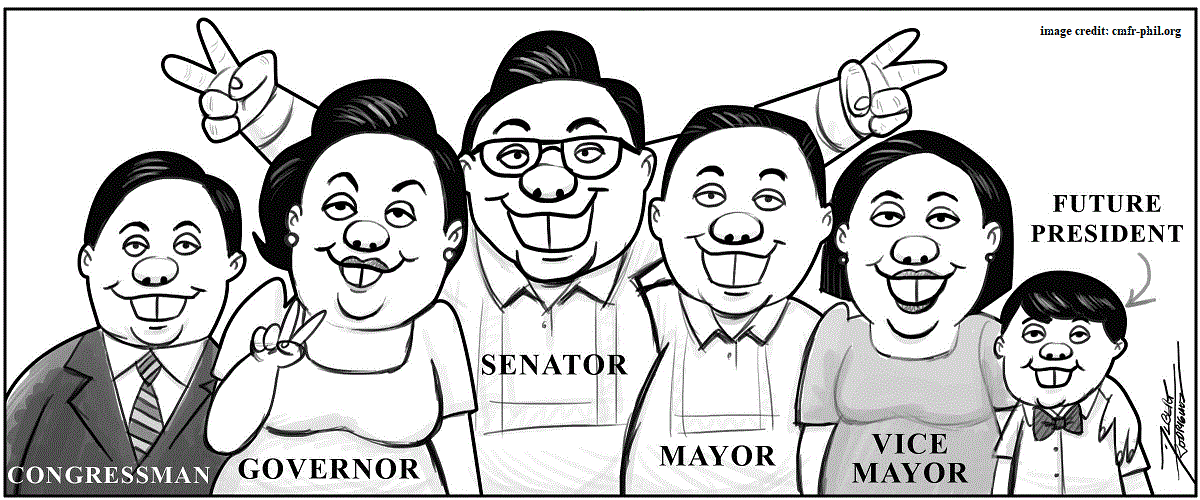
We’re complaining about political dynasties, right? But haven’t we Filipinos realized that we are so guilty of creating the political dynasties in the Philippines? Yes, we have to admit it. We allowed the same politicians and their family members to lord it over in the Philippine political landscape.
When a politician, let’s say a mayor, could no longer run for re-election due to term limits, what would the honorable gentleman do? Turn his back on politics? Of course not! Power is so addicting. So many of those who experienced to be at the helm of either local or national politics (and enjoyed the benefits, including those “passed under the table”) would not just quit politics nor pass the torch to another person.
So, what would happen?
His wife would run for the position he previously held. Then that politician would run for another post – as governor perhaps. Most of the time, Filipino voters would allow them to win and usually they would be able to mesmerize (or buy) the voters to luckily get re-elected until they reach their term limits. Would it be the end? Would their thirst for power (and the so-called “benefits”) be finally satiated?
HELL NO!
The couple would ask their son or daughter (or a grandson – or a granddaughter – or an in-law) to run for the positions they would vacate. The shocking thing (and you might not believe it), there are times that siblings, or even husbands and wives, would not give way to the other and so member of the same family would slug it out in the political arena. Anyway, this is not about family members squabbling in the political arena – this is about the political dynasty their families created.
Let’s continue then.
Let’s go back to the mother who just reached her term limit as mayor. Would she go back to being a full-time mother and wife? You were born only yesterday if you don’t know the answer to that question. Yes – she would run for the post vacated by the husband-politician. The husband would then aim for a higher position – run either as congressman or even senator. In case all family members win then for years that the power will change hands within the same family. The son (or daughter) is a mayor, the mother a governor and the father either as congressman or senator. When term limits are reached then they will just run for the position that a family member would vacate. Some siblings, and even in-laws, in the family are also occupying minor positions in the geographical units where they reside.
Did that family created their political dynasty? No! We ourselves did it. We Filipinos created the political dynasties in the Philippines.
And how did (have) these members of a few beholden families whom we allowed (are allowing) to exclusively hold the reins of our government – local to national – perform (been performing)?
You are either blind or dumb if you don’t know the answer to that question.
How many of the available positions in the Philippine government, local and national, are held by the same families who have been the gods and goddesses of Philippine politics since time immemorial? Most of them are offspring of the peninsulares who survived “America’s power grab” at the turn of the 20th century. They decided to stay in the country and reaped the dividends for doing so. And it’s not only the politics that they dominate. With the enormous fortune they inherited from their Spanish parents/grandparents (which the Americans allowed them to keep), they also control the country’s economy. That’s why Filipinos would sometimes jokingly ask – “Did the Spanish rule really end?”
Only a few pure-blooded Filipinos and foreign expatriates of Chinese origin who became wealthy when the Americans took their turn to colonize the Philippine had the financial resources to challenge the Spanish mestizos for political supremacy in the Philippines, especially after the American granted the Filipinos their independence after the World War II. Some of them succeeded and when they experienced how intoxicating power is, they (and their offsprings) kept running and we kept electing them as if nobody else were qualified.
It is no longer surprising to know that politicians occupying national positions have one, or two family members and in-laws occupying seats in the local government.
Filipinos might ask – “When would having the same people from the same families passing the reins of leadership to each other in both the national and local governments after elections end?”
That’s up to the Filipino voters.
So, we should not wonder why we as a nation could barely move the needle on socio-political stability and economic progress.
Socio-political stability and economic progress are the most important metrics that we ought to use when evaluating the performance of these leaders who are members of the few families whom we allowed to lord it over in Philipppine politics. We keep electing them then keep our fingers crossed that they will deliver.
According to Albert Einstein, “insanity” is doing the same thing over and over again and expecting a different result.
Why in the world we expect a better-performing government when we keep electing the same politicians from the same families? Are we insane?
On Political Dynasties in the Philippines
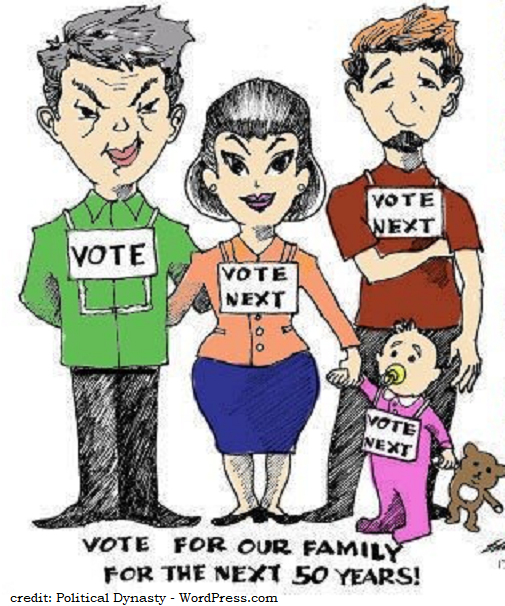 A politician, let’s say a mayor, could no longer run for re-election due to term limits, what would the honorable gentleman do? Turn his back on politics? Of course not! Power is so addicting. So many of those who experienced to be at the helm of either local or national politics (and enjoyed the benefits, including those “passed under the table”) would not just quit politics nor pass the torch to another person.
So, what would happen?
His wife would run for the position he previously held. Then that politician would run for another post – as governor perhaps. Assuming both the politician and his wife win and luckily get re-elected until they reach their term limits, would it be the end? Would their thirst for power (and the so-called “benefits”) be finally satiated?
Not by a long shot!
They are just starting to build a political dynasty.
The couple would ask their son or daughter (or a grandson – or a granddaughter – or an in-law) to run for the positions they would vacate. The shocking thing (and you might not believe it), there are times that siblings, or even husbands and wives, would not give way to the other and so member of the same family would slug it out in the political arena. Anyway, this article is not about family member squabbling in the political arena – this is about the political dynasty their families created.
Let’s continue then.
Let’s go back to the mother who just reached her term limit as mayor? Would she go back to being a full-time mother and wife. I think you know the answer. She would run for the post vacated by the husband-politician. The husband would then aim for a higher position – run either as congressman or even senator. In case all family members win then for years that the power will change hands within the same family. The son (or daughter) is a mayor, the mother a governor and the father either as congressman or senator. When term limits are reached then they will just run for the position that a family member would vacate. Some siblings, and even in-laws, in the family are also occupying minor positions in the geographical units where they reside.
That’s political dynasty.
What’s my beef with political dynasties? Let me answer that question with the following questions:
“How (did they perform) are they performing as leaders?”
“What is the current economic, social and political condition of the country?”
“Is the Philippines marching towards progress with them holding the reins of government?”
Of course you know the answers to the questions aforementioned.
How many of the available positions in the Philippine government, local and national, are held by the same families who have been the gods and goddesses of Philippine politics since time immemorial? Most of them are offspring of the peninsulares who survived America’s power grab at the turn of the 20th century. Eventually they stayed in the country and reaped the dividends for doing so. And it’s not only the politics that they dominate. With the enormous fortune they inherited from their Spanish parents/grandparents, they also control the country’s economy. That’s why Filipinos would sometimes jokingly ask – “Did the Spanish rule really end?”
Only the pure-blooded Filipinos and foreign expatriates of Chinese origin who became wealthy when the Americans took their turn to colonize the Philippine had the financial resources to challenge the Spanish mestizos for political supremacy in the Philippines, especially after the American granted the Filipinos their independence after the World War 2 . Some of them succeeded and when they experienced how intoxicating power is, they themselves established their political dynasties.
It is no longer surprising to know that politicians occupying national positions have one, or two (I hope not all) family members and in-laws occupying seats in the local government.
You might ask – “When would having the same people from the same families passing the reins of leadership to each other in both the national and local governments after elections end?”
It might not!
Why?
It would require for a candidate to have sacks (if not truckloads) of money to win in an election in the Philippines.
You were probably born yesterday if you don’t understand what I mean.
Rare are real public servants getting elected in the Philippines. The ones in position, usually, are the rich and powerful – those who could buy votes. Politicians buy votes because most (I’m not saying all) Filipino voters sell their votes to the highest bidders.
Midterm election in the Philippines is on May, 2019.
Will the Filipinos sell their votes again?
Will the political dynasties continue their reign?
Only God knows!
PWEDE PO BANG MAGTANONG?

Sa paligid ay igala ang paningin
Mayroon bang nagbago sa bayan natin,
Asam na pag-unlad atin na bang narating,
Kapayapaang hangad atin bang angkin?
Tigilan na ang pagbulag-bulagan
Mata mo’y imulat sa katotohanan
Bayan nati’y lugmok sa kahirapan
‘Di makamit asam na kapayapaan
Ang tanong, “Sino ang dapat na sisihin?”
Sino ba ang hindi tumupad sa tungkulin?
Mga pinuno bang iniluklok natin,
O imaheng katitigan mo sa salamin?
Pinunong halal lang ba ang may tungkulin
Na paglingkuran ang inang-bayan natin?
Kung doon sa hapag mo’y walang pagkain
Sila nga lang ba ang dapat na sisihin?
Kaninong pinuno ka ba nasiyahan?
‘Di ba’t silang lahat ay iyong pinintasan?
Palaging may mali, palaging may kulang,
Kay hirap sundin ng iyong pamantayan.
Subalit kung ika’y aking tatanungin
May nagawa ka ba para sa bayan natin?
Sobra-sobra kung pinuno’y batikusin
Eh ikaw, “Ano ba ang kaya mong gawin?”
Para kasing kay talino mo’t kay galing
Eh ‘di sige mungkahi ko iyong sundin
Maging pinuno iyo kayang subukin
At problema ng bayan iyong lutasin
Kung hindi kaya aba’y manahimik ka!
H’wag ka nang makisawsaw sa pulitika!
Ang gawin mo sana’y maghanap-buhay ka
Ang itaguyod… sarili mo’t ang pamilya
Sa halip na pulitika ang atupagin
Buhay mo muna ang dapat na ayusin
Dahil kapag tagumpay… iyong narating
Maging ang bayan mo’y makikinabang din.
Reading Between (and Beyond) the Lines of Espinosa and Dayan
 When finally the long arms of the law caught up with them, Kerwin Espinosa, a big-time drug lord from Eastern Visayas, and Ronnie Dayan, Senator De Lima’s driver-lover, were made to appear in the Senate and the House of Representatives, respectively. The upper and lower chambers of the Philippine Congress are currently conducting congressional inquiries related to the government campaign against illegal drugs.
Both Espinosa and Dayan are believed to be holding vital information about the illegal drug trade in the Philippines thus they are regarded as key witnesses in the congressional inquiries. Their eventual capture and appearance in the Congress hearings were considered as welcome developments.
Espinosa testified in the Senate on November 23, 2016 and Dayan in the House of representatives the day after. Both of them opened the proverbial “can of worms.” Many of the things they said may already be common knowledge but hearing them directly making the confirmations was demoralizing, to say the least.
Espinosa, who probably was still smarting over his misfortunes and still trying to cope with the tragic death of his father, named policemen and high ranking PNP officers involved in the illegal drug trade. He provided shocking narratives of how the police in his areas of operation in the Visayas turned a blind eye on his illegal activities in exchange for millions of protection money from him. In addition, he divulged that even the policemen themselves were peddling drugs. But what may be considered as his biggest revelation was Senator De Lima receiving drug money from him.
But while Espinosa was visibly irate for those accused of murdering his father while in prison were also present in the hearing, Dayan was seemingly the opposite. He appeared to be relaxed and was in good spirits. Contributing to that was perhaps the fact that humor was interspersed in the manner that the hearing in the House of Representatives was carried out.
There were two key points made by Dayan in his testimony. Firstly, he confirmed that he was indeed, Senator De Lima’s lover and that they had an affair for 7 years. Lastly, he admitted receiving money from Espinosa in behalf of the senator.
Now, what do we make out of the testimonies made by Espinosa and Dayan? What’s there between (and beyond) the lines of the depositions they delivered?
Reaction to the secrets Kerwin and Ronnie revealed differ. Not surprising anymore is the fact that opinions and views expressed by both the ordinary citizens and their leaders depended on which side of the political fence they are standing.
The so-called “yellow brigade,” members and supporters of the Liberal party and their allies who are perceived to be anti-Duterte and would understandably oppose the programs and advocacies of the incumbent President, came to the rescue of the beleaguered lady-senator.
On the other hand, the ones championing the drive of the government to eradicate the country’s drug problems, find more reasons to grill and subject to unwarranted ridicule the human rights advocate turned senator.
Dayan corroborated Espinosa’s claim that Sen. Delima accepted drug money. That’s the cake. The icing was his full disclosure of their affair that has been circulating in the rumor mill for the past years.
The gossip-hungry nation seemed to have forgotten about the cake and feasted merrily on the icing. The icing was so sweet that it even appeared to have gotten the better of the lawmakers who were conducting the hearing. During the said hearing, the members of the House of Representatives focused so much on the details of the love affair between the lady-senator and her former security aide-driver.
The real issue is how true is it that the former Chairperson of the Commission on Human Rights and Justice Secretary accepted drug money. Serious accusations indeed. That is what really matters and should be the main focus of the inquiry.
As to her culpabilities emanating from her past romantic affairs with Dayan (and a certain Warren Cristobal) is up to the members of the Senate Ethics Committee and the Supreme Court. If found guilty of wrongdoings she could be kicked out from the Senate and might be disbarred on account of immorality. She could even go to jail if adultery can be charged against her.
Those supporting Senator De Lima were quick to bring attention to the inconsistencies in the affidavits executed by Espinosa and Dayan. They mentioned in particular the conflicting dates as to when Espinosa gave Dayan the supposed drug money.
Do inconsistencies in the dates and time in the affidavits of Espinosa and Dayan make their testimony false? When two persons met and they cannot identify the exact time and date they did so does it mean that they did not actually meet?
While the dates may be conflicting, both men acknowledged that money changed hands…that Espinosa gave Dayan a certain amount and Dayan confirmed that he received it…and that the money landed in Senator De Lima’s coffers.
Experts believe that Espinosa and Dayan are holding their cards close to their chests. They have not divulged everything they ought to say for reasons only them know. But as it is, their testimonies have confirmed that drug syndicates have already infiltrated the different branches of the government and the ranks of the Philippine National Police. They have, indeed, corrupted the government officials and police officers.
Espinosa’s testimony in particular have left the following questions mercifully begging for answers.
Why did it take this long before the government addressed the illegal drug trade? What have the governments in the past done to curb the problem?
If any of past governments would claim they have done something then they have to explain why the number of drug-dependent Filipinos have reached more than 3 million and why the number of drug traders increased by the thousands .
The more perplexing question is, “How come that drug dealers could continue with their drug trade even if they were behind bars?” Senator De Lima has a lot of explaining to do. She really need to explain why right under her nose, as Secretary of Justice who’s in charge of Bureau of Corrections, the drug trade flourish in the country’s penitentiary. The senator also needs to disprove the claims made by convicted drug lords that she received money from them.
Conflicting may be are the details in the testimonies of Espinosa, Kerwin and the high-profile inmates in the national penitentiary but what those accusers are saying are too difficult to ignore.
Another question is, “How deep has the drug syndicates penetrated the country’s police force and the different branches of the government? How many police officers, judges, senators, congressmen and local and national officials are protectors of drug syndicates?
General Dela Rosa, the head of the Philippine National Police, cried in exasperation upon realizing during that Senate inquiry how much credibility his organization have lost.
Espinosa’s revelations have shown how complicated the drug problem in the Philippines is and how full is President Duterte’s plate.
If only the government’s drive against drugs be viewed using not only the lens of extra judicial killing.
Killing Innocent Civilians (KIC)

We’ve been hearing (and reading) a lot about the (alleged) extra-judicial killings (EJK) in the Philippines. The president of this island nation, Rodrigo Duterte has been peppered with a lot of criticism, both in his (my) country and overseas, for the increasing number of deaths attributed on the government’s war against drugs. As of September 30, 2016, there has been more than 2,800 suspected addicts and drug dealers killed.
It is understandable for the United Nations to be concerned and say a mouthful about these extra-judicial killings happening in the Philippines. But has the United Nations been doing anything (or, at least, been saying anything) about killing of innocent civilians (KIC) in different parts of the world.
The United Nations, in a way, called the attention directly of Duterte, asking him to explain.
What about Obama? Has his attention been called by the United Nations to explain the spate of mass shootings and indiscriminate killings of African-Americans happening in his country?
So, is this a matter of when it is the government of a poor nation allegedly committing a crime against humanity the United Nations will have to say something but turns a blind eye when it is a government of a rich powerful country committing the same. The US police are allegedly shooting helpless civilians in broad daylight and the United Nations has yet to issue a policy statement on the matter.
When we argue that the war on drugs can be approached in a way that does not necessitate killing why don’t we also say that peace in Syria can be achieved without carpet bombing a community where properties are utterly destroyed and hundreds of innocent lives are lost.
Compare the more or less 2,800 suspected addicts and drug dealers killed in the Philippines to the number of innocent civilians the US, UK and Russia killed in the hundreds of airstrikes they made in countries where they are fighting terrorists.
So, is it a case of the human rights of those dead drug addicts and drug dealers matter and the lives of those innocent civilians getting killed in war-torn areas don’t.
Have the United Nations reprimanded these countries? Why won’t the United Nations ask the countries aforementioned to find a peaceful resolution to the conflicts in these areas in the Middle East without resorting to killing the ones they call terrorists?
Of course that’s not possible. The only way to deal with suicidal terrorists who are out to disrupt peace and indiscriminately kill, is to fight them tooth and nail, hoping that when the smoke dissipates it is the good that remains standing. That is the same with the drug dealers in the Philippines. They are worse than the terrorists because it is the family, the basic foundation of our society, that they are destroying. They will never stop selling drugs. It is so unfortunate but the only way for them to cease plying their dangerous and life-ruining trade is to kill them (but only when they refuse to surrender and opt to fight authorities.)
As Duterte said in one of his press briefings, both Philippine’s EJK and America’s KIC are appalling. But between killing a drug dealer and a drug addict (who has the potential of becoming a thief, a rapist, and a murderer) and an innocent peace-loving African-American, which one deserves more condemnation?
Remember when Duterte was interviewed by a foreign correspondent about the rising number of drug addicts and drug dealers getting killed in the Philippines and he responded by calling that correspondent’s attention to US policemen killing innocent African-American civilians? Well, to date, more addicts and drug dealers and innocent African-American civilians are getting killed in the Philippines and in the US, respectively.
It is a question of whose lives should the Philippine authorities value more, those of the drug addicts and drug dealers or those of the innocent people getting victimized by the drug menace.
But it seems that the world media is ganging-up on President Duterte for the way he chose to wage war against drug dealers. The world media has suddenly become concerned about killings. What about digging into the allegations of Prof. John Mc Murtry, a world-renowned Canadian philosopher, who argues that “the United States holds the world record of illegal killings of unarmed civilians and extrajudicial detention and torturing of prisoners who are detained without trial.” [1]
I know that the people who make up the U.S. government are decent, peace-loving and God-fearing individuals. This is the reason that I am inclined not to believe Mc Murtry’s imputations. He probably was just hallucinating when he opined that the U.S. government is a gigantic mass-murdering machine which earns profit through waging war.
__________



 M.A.D. L I G A Y A