Category Archives: Strong Self-Belief
Conquering Self-Doubt
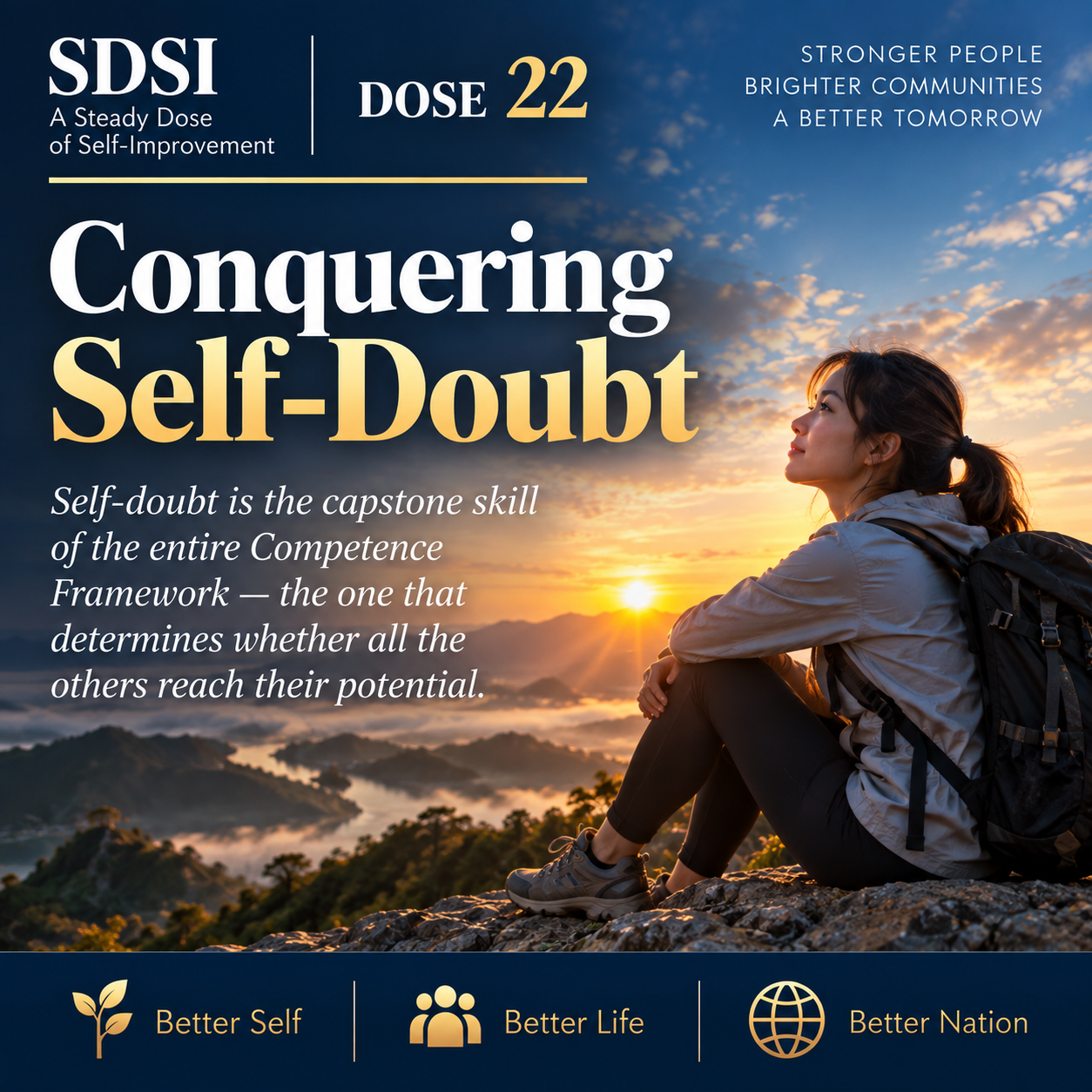
Self-doubt is the capstone challenge of the Competence Framework—the one that determines whether
all our other abilities are ever fully used.

What if self-doubt belongs on the list of deadly sins?
Perhaps that question goes too far. Ordinary self-dOubt is neither evil nor necessarily harmful. Sometimes it protects us from arrogance. It makes us examine our preparation, recognize our limitations, and seek the help or training we genuinely need.
But self-doubt becomes destructive when it continues speaking even after the evidence has answered it.
It whispers that you are not intelligent enough, capable enough, or worthy enough to succeed. It dismisses every accomplishment as luck, every compliment as politeness, and every opportunity as something intended for somebody better. Given enough authority, it does more than make you uncomfortable—it prevents you from using the abilities you already possess.
I know that voice.
It has asked me who I thought I was to teach abroad, present research, write books, and advocate self-improvement. It did not disappear when I earned another degree, accumulated years of teaching experience, published my work, or stood before international students. Whenever I attempted something larger, the same question returned in a different form:
Who do you think you are?
Eventually, I learned to answer it with evidence.
I am someone who has faced unfamiliar situations and learned. I am someone who has been rejected and continued. I am someone who has completed difficult work before. None of this guarantees that everything I attempt will succeed. It simply proves that self-doubt is not qualified to declare what I cannot do.
Conquering self-doubt does not mean silencing it forever. Even accomplished people occasionally question themselves. The goal is not to become so confident that we ignore our weaknesses or assume that we cannot fail. That is not confidence; it is carelessness.
The goal is to place self-doubt in its proper position. Let it ask questions, but do not let it deliver the final judgment. Examine what it says. If it identifies a real deficiency, improve. If it merely repeats an old fear that contradicts the evidence, proceed despite it.
This is why conquering self-doubt completes the Competence Framework. You may manage your time efficiently, remain focused, think before acting, make purposeful decisions, communicate effectively, and maintain balance. But if you continually doubt your right or ability to use those skills, much of your potential will remain untouched.
You do not need absolute certainty before taking the next step. You need sufficient preparation, honest evidence, and the courage to act while a little uncertainty remains.
Self-doubt may accompany you.
It simply must not lead you.
Pause and Reflect
What opportunity have you avoided because you doubted yourself?
What evidence from your own life challenges that doubt?
One Step Forward
Write one sentence naming a capability you genuinely possess. Beneath it, list three experiences or accomplishments that provide concrete evidence for it.
Explored more fully in Chapter 14 — “Conquering Self-Doubt” of A Holistic Approach to Self-Improvement.
Better Self… Better Life… Better Nation.
Strong Self-Belief
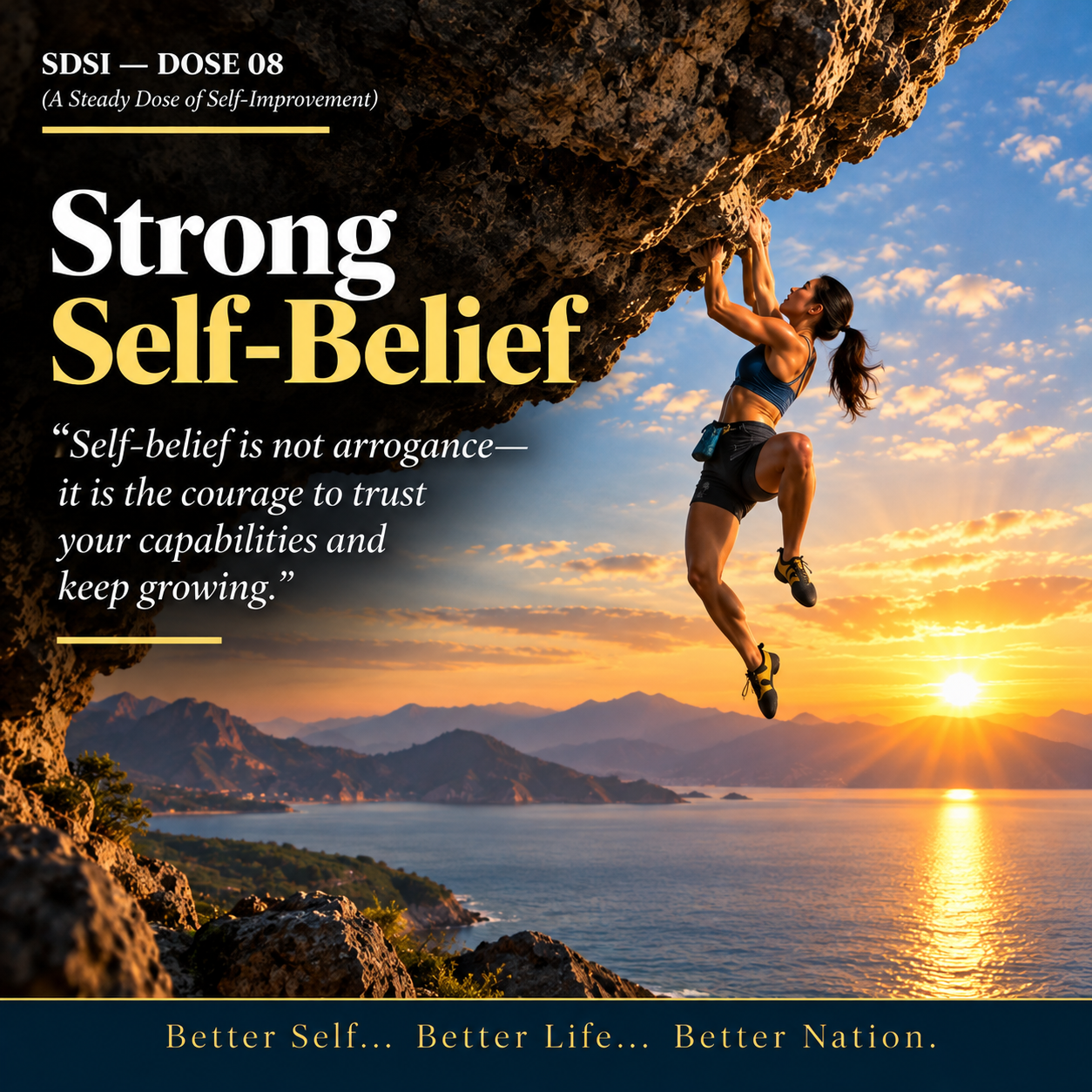
Self-belief is not arrogance—it is an honest recognition of your capabilities and the courage
to move forward while continuing to improve.

Other people’s disbelief does not kill a dream. It is the self-doubt that follows it home.
One image from the Gospel of Mark has stayed with me: “No one pours new wine into old wineskins, or the wine will burst the skins.” In its biblical context, the passage speaks of the incompatibility between the new and the old. But it also offers a powerful metaphor for personal growth.
The knowledge, skills, and habits we acquire through self-improvement are like new wine. Yet when we try to contain them within an old identity built on fear, inadequacy, and self-doubt, our growth becomes difficult to sustain. We may receive opportunities but feel unworthy of them. We may develop new abilities but remain afraid to use them. We may know what must be done but still believe we are incapable of doing it.
Strong self-belief provides room for growth.
This does not mean pretending that we can do everything. Self-belief is not self-conceit, nor is it blind confidence. It is the grounded conviction that says: I know what I can do. I recognize what I still need to learn. I trust that through effort, preparation, and persistence, I can become more capable than I am today.
Sometimes, self-belief comes before action and gives us the courage to begin. At other times, it develops after we act, struggle, learn, and discover evidence of our own capability. We do not need absolute confidence before taking the first step. We need only enough belief to take it—and then allow each honest effort to strengthen that belief.
Michael Jordan offers a familiar example. As a sophomore, he did not make his high school’s varsity basketball team. He could have accepted that disappointment as a final judgment of his ability. Instead, he trained harder, improved, and eventually became one of basketball’s greatest players. His confidence was not merely something he declared. It was strengthened through disciplined work, repeated failure, and measurable improvement.
This is what separates self-belief from wishful thinking. Wishful thinking says, I will succeed because I want to. Self-belief says, I can learn, prepare, persevere, and become capable of succeeding.
People will sometimes question your plans, underestimate your abilities, or judge your future according to your present limitations. Their disbelief may hurt, but it does not have the power to end your dream—unless you carry it home, make it your own, and allow it to become self-doubt.
Listen to criticism when it contains truth. Learn what you still need to learn. But do not surrender your future to someone else’s limited view of what you can become.
Believe enough to begin. Work enough to produce evidence. Then let that evidence teach you to believe even more.
Pause and Reflect
When has someone’s reaction caused you to question something you genuinely wanted to pursue?
What evidence from your own life shows that you are more capable than you sometimes believe?
One Step Forward
Write one sentence affirming a capability for which you have real evidence—and identify one action you will take today to strengthen it further.
Explored in full in Part 2 – Section I – Chapter 1 ( Strong Self-Belief) of A Holistic Approach to Self-Improvement.