Blog Archives
Value System: Attitudes and Beliefs
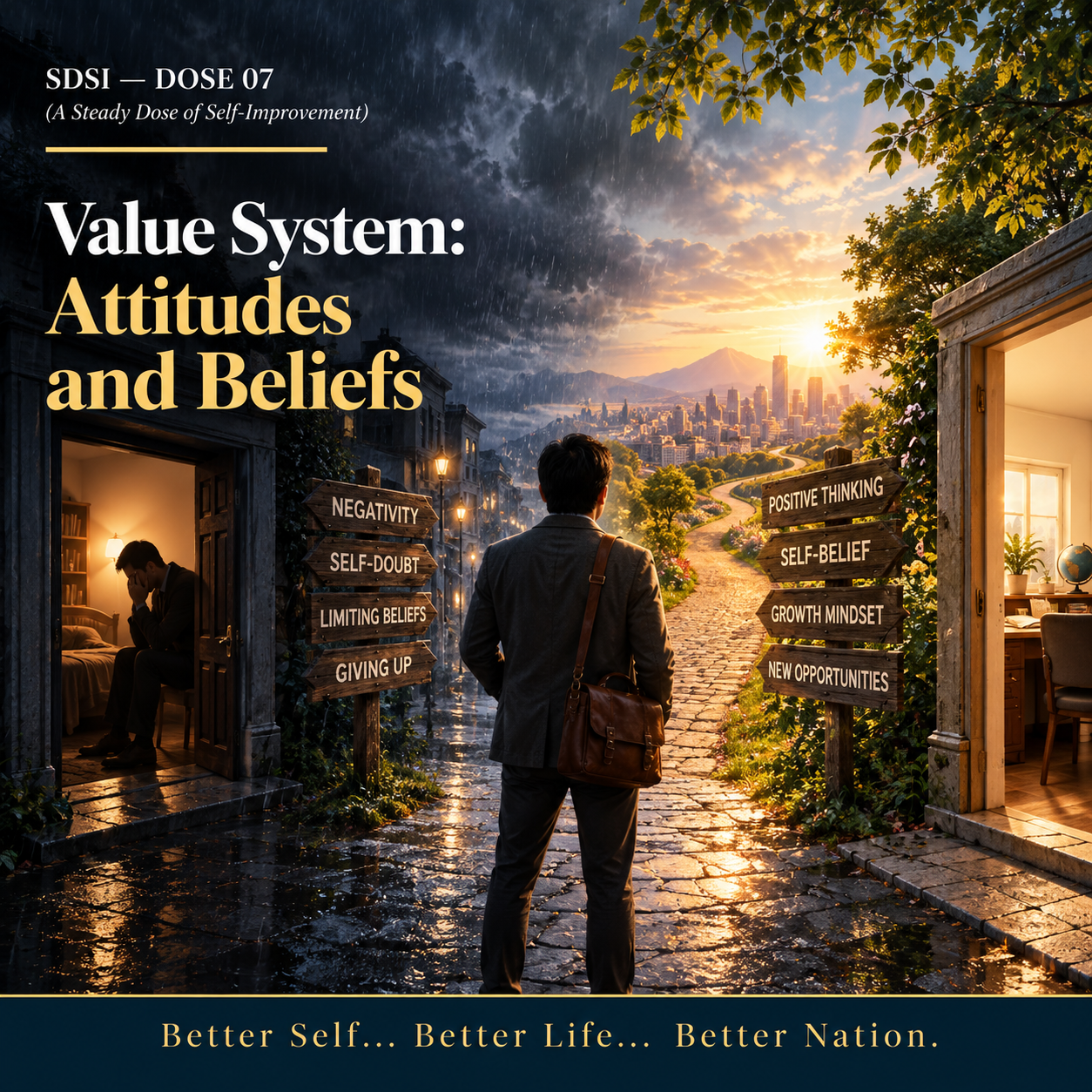
Your value system—the attitudes and beliefs you carry—shapes how you see yourself,
interpret your circumstances, and decide what to do next.

Two salesmen. The same storm. Two completely different mornings.
Two traveling salesmen awaken to heavy rain. The first looks out the window and thinks, No one will buy anything in this weather. He returns to bed.
The second looks at the same storm and thinks, Everyone will be indoors today. This may be the easiest day to find customers. He gets dressed and walks out the door.
The rain is the same. The morning is the same. What differs is the meaning each man gives to the situation—and the action that follows.
We do not respond to circumstances exactly as they are. We respond to them according to what we believe they mean. One person sees rejection as proof that the journey is over; another sees it as a reason to improve and try again. One sees difficulty as an excuse to retreat; another sees it as an opportunity to grow.
This is why our exploration of holistic self-improvement begins with the Value System. Our attitudes and beliefs serve as the lenses through which we view ourselves and the world. They influence our decisions, and our decisions gradually determine the direction of our lives. Skills may tell us how to act, and habits may help us act consistently—but our value system often determines whether we act at all.
I experienced this when I left a comfortable position in the Philippines to pursue ESL teaching in South Korea. The decision required more than qualifications. I had to believe that I was capable of building a new professional life in an unfamiliar country. After three rejections, I could have treated them as evidence that I did not belong there. Instead, I chose to regard them as temporary setbacks. I persisted until I finally received the opportunity that changed the course of my professional life.
As Zig Ziglar famously said, “Your attitude, more than your aptitude, will determine your altitude.” Ability matters, but ability alone cannot take us very far when our beliefs prevent us from using it.
A strong value system does not guarantee that every storm will pass quickly or that every effort will succeed. It equips us to meet adversity with self-belief, take control of what we can, accept personal accountability, think positively without denying reality, maintain proper perspective, adapt when conditions change, and remain guided by purpose.
These attitudes and beliefs are the foundation of everything that follows. Before improving what we can do, we must examine how we think and what we believe—because every lasting change begins within.
When you encounter a setback, what beliefs usually shape your response?
Pause and Reflect
Are those beliefs helping you move forward—or giving you permission to remain where you are?
One Step Forward
Identify one limiting belief influencing a current difficulty. Rewrite it as a more constructive belief that encourages action without denying reality.
Explored in full in Part 2 – Foundations of Holistic Self-Improvement, Section I — Value System ( Attitude & Belief) of A Holistic Approach to Self-Improvement.
Better Self… Better Life… Better Nation.
Full Potential
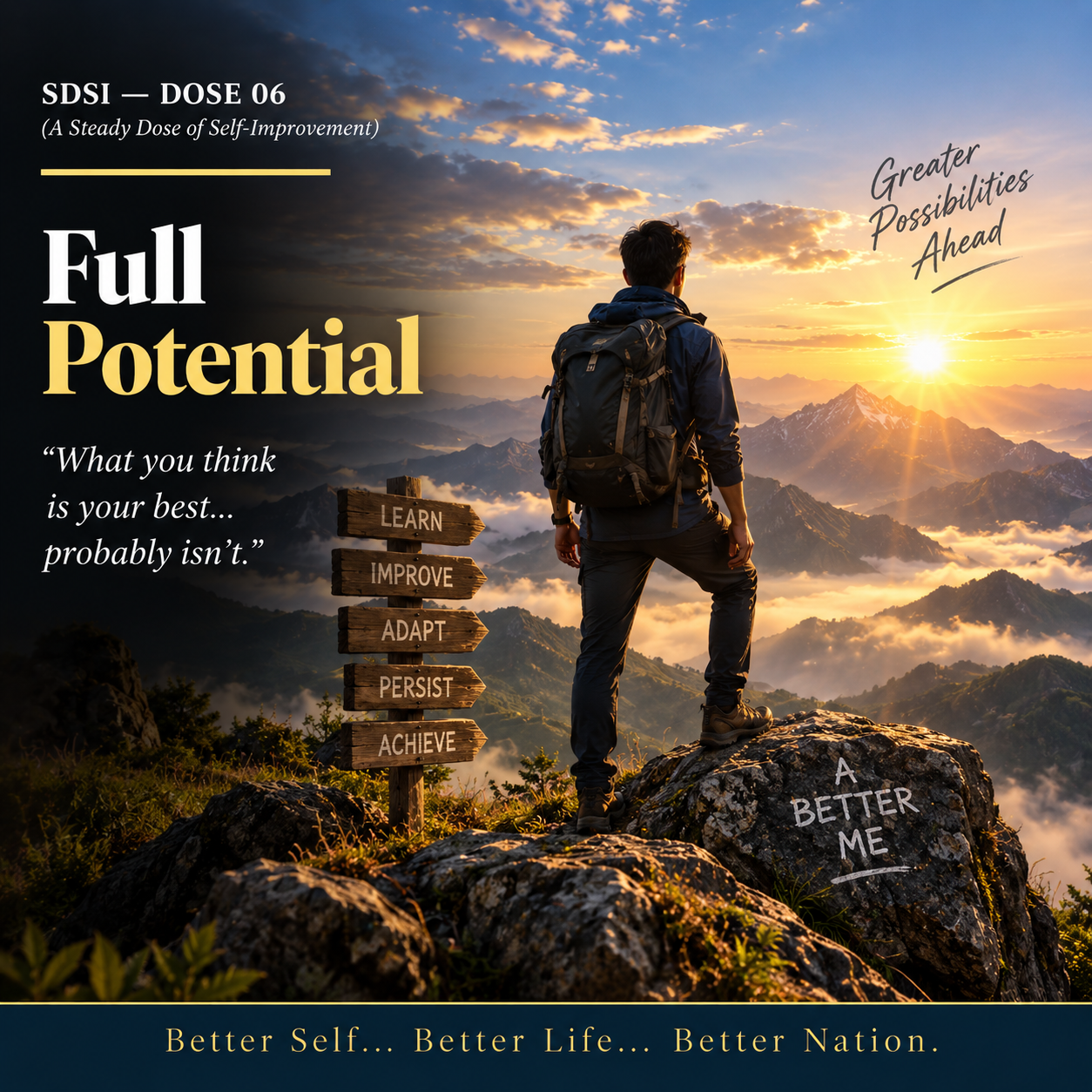
What feels like your ceiling may simply be the point where you stopped testing how far you could grow.
What you think is your best… probably isn’t.
Many highly accomplished people keep reading long after formal schooling has ended. Warren Buffett, Bill Gates, Barack Obama, Oprah Winfrey, and others are known for surrounding themselves with books. Their reading is not merely entertainment; it reflects a deeper commitment to lifelong learning and the refusal to stop growing. Reading is only one path, but it reveals the attitude at the heart of self-improvement: there is always more to learn and more of ourselves to develop.
That pursuit should not be confused with perfectionism. Perfectionism keeps us trapped in constant self-evaluation, often producing frustration and anxiety. Unlocking our full potential means something healthier: deliberately developing our physical, intellectual, emotional, moral, and social capacities so that we become the most capable versions of ourselves. We will never be perfect in every dimension, but we can become better developed than we are today.
One of the greatest barriers is the ceiling we set for ourselves. When an attempt fails, it is tempting to say, “That was the best I could do.” Perhaps it was the best we did on that occasion—but it may not represent the best we can ever become. What feels like our limit may simply be the point at which we stopped learning, practicing, or trying.
The book uses the image of someone stopping only three feet from gold. We rarely know how close another effort, lesson, or adjustment might bring us to the result we seek. Failure does not prove that our potential has been exhausted; it shows us what has not yet worked. Growth requires the humility to learn from that information and the courage to try again.
You will know your ceiling only after you have pushed yourself to find it. Take every opportunity for self-improvement—and when no opportunity appears, create one. Read, practice, seek guidance, and keep developing your abilities. Your full potential is not a label waiting to be discovered. It is a capacity gradually revealed through continuous, deliberate growth.
Pause and Reflect
What “ceiling” have you assumed was fixed even though you have never truly tested it?
One Step Forward
Choose one skill or ability you believe has reached its limit. Spend 20 focused minutes today learning, practicing, or attempting something slightly beyond your usual level.
Explored in full in Part 1, Section III — Self-Improvement and Unlocking One’s Full Potential of A Holistic Approach to Self-Improvement.
Better Self… Better Life… Better Nation.
Dreams and Ambitions

“What we say we want and what we actually pursue often diverge — and closing that gap
starts with being honest about our own list.“

What did you want to be when you grew up?
That question takes me back to second grade, when my teacher asked everY child in the room, “What do you want to be when you grow up?” When my turn came, I searched for an answer that hadn’t already been given. Then I saw it—the photograph of our head of state mounted above the blackboard. “I want to be the president of our country,” I said. My classmates laughed out loud, and I felt the heat of embarrassment rise to my face.
That memory taught me something about the question itself. Childhood is far too early to know what we actually want — most people don’t begin gravitating toward their real interests until adolescence, and even then, the question keeps changing shape as we age.
Ask adults the same question today, in different words, and the pattern repeats. Most people answer: rich. Famous. Influential. Almost nobody says healthy. Happy. Successful. It’s not that these simpler wishes matter less — it’s that they’re often the hardest to actually win, so we quietly stop naming them as goals at all.
John Lennon once wrote “happy” for a school assignment asking what he wanted to be when he grew up. His teacher told him he didn’t understand the assignment. He told her she didn’t understand life.
None of this makes wanting wealth, fame, or influence wrong. The real question worth asking isn’t whether you want more — it’s why.
Pause and Reflect
What’s actually on your list — and is it the list you’d give a child, or the one you’ve quietly settled for?
One Step Forward
Write your real list, unedited for how it sounds to others. Circle the one item you’ve most neglected pursuing.
Explored in full in Part 1, Section I — Dreams and Ambitions of A Holistic Approach to Self-Improvement.
Better Self… Better Life…Better nation.
Better Self… Better Life… Better Nation
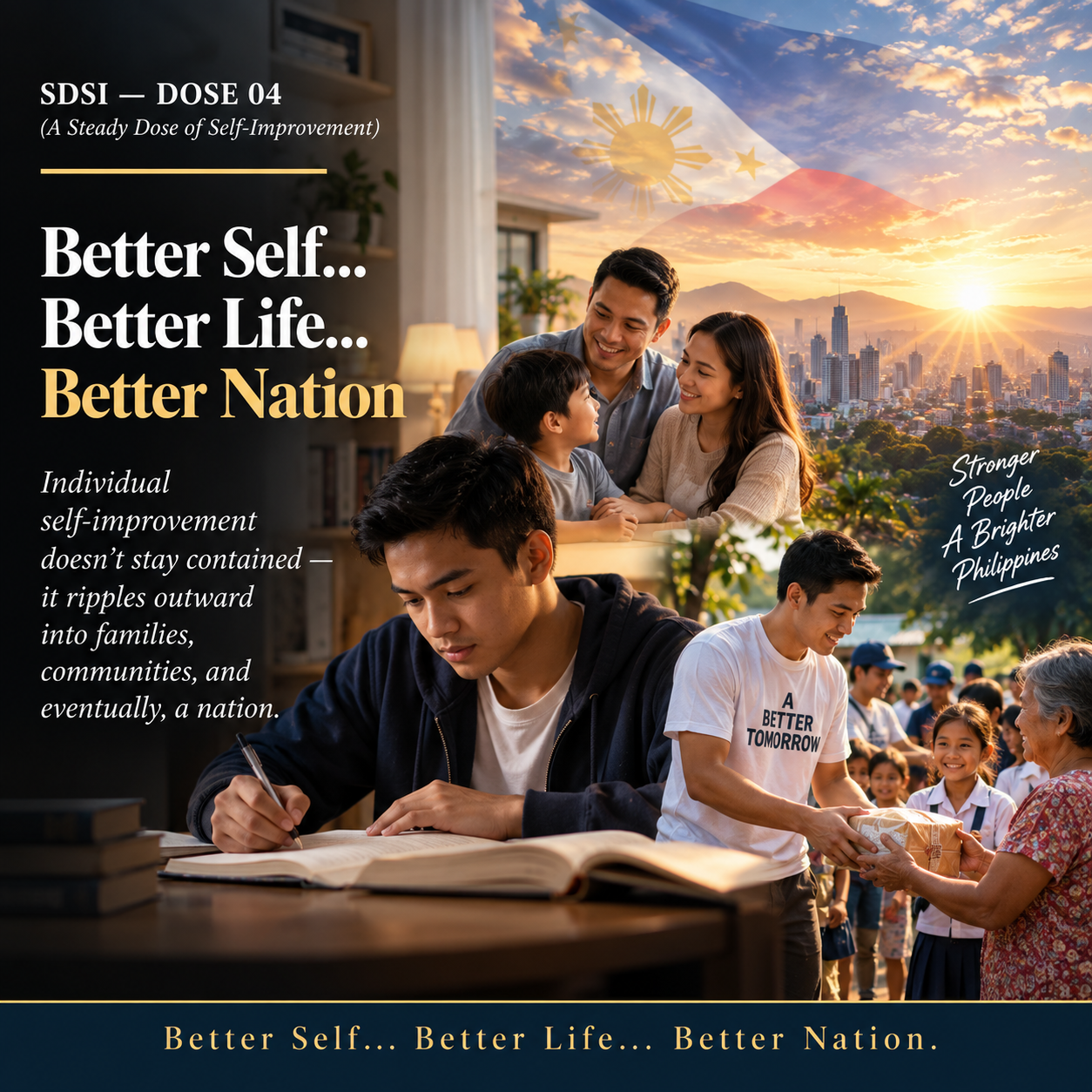
Individual self-improvement doesn’t stay contained — it ripples outward
into families, communities, and eventually, a nation.
What does one person’s self-improvement have to do with a nation?
At the heart of my self-improvement advocacy is a simple but powerful conviction: personal transformation can become a foundation for national progress.
Better Self… Better Life… Better Nation.
Self-improvement begins with the individual, but its influence need not end there. As people become more principled, capable, disciplined, and responsible, they become better equipped not only to improve their own lives but also to contribute meaningfully to their families, communities, and nation.
- Better Self — developing one’s values, competence, habits, and self-discipline.
- Better Life — using that growth to pursue health, happiness, success, and fulfillment.
- Better Nation — better individuals becoming responsible citizens who contribute rather than merely wait for political leaders to solve everything.
Building better citizens does not remove the government’s responsibility to provide honest, competent, and accountable leadership. It simply recognizes that national progress cannot be entrusted to political leaders alone.
A better nation cannot be built by citizens who continually search for political saviors while neglecting their own character, competence, discipline, and responsibilities. We must demand better leaders—but we must also strive to become better people.
The journey toward a better nation does not begin only in palaces, government offices, or polling places. It also begins quietly within every person who chooses to become more principled, capable, disciplined, and responsible.
I didn’t write this book believing it would reach millions. I wrote it believing that if even one person reads it and becomes who they were meant to be, that ripple is worth every year it took to finish.
Pause and Reflect
Where do you see your own growth already spilling over into someone else’s life?
One Step Forward
Think of one person your growth could affect today. Do or say one thing for them that reflects who you’re becoming.
Better Self… Better Life… Better Nation.
About the Title – Why “A Holistic Approach”?
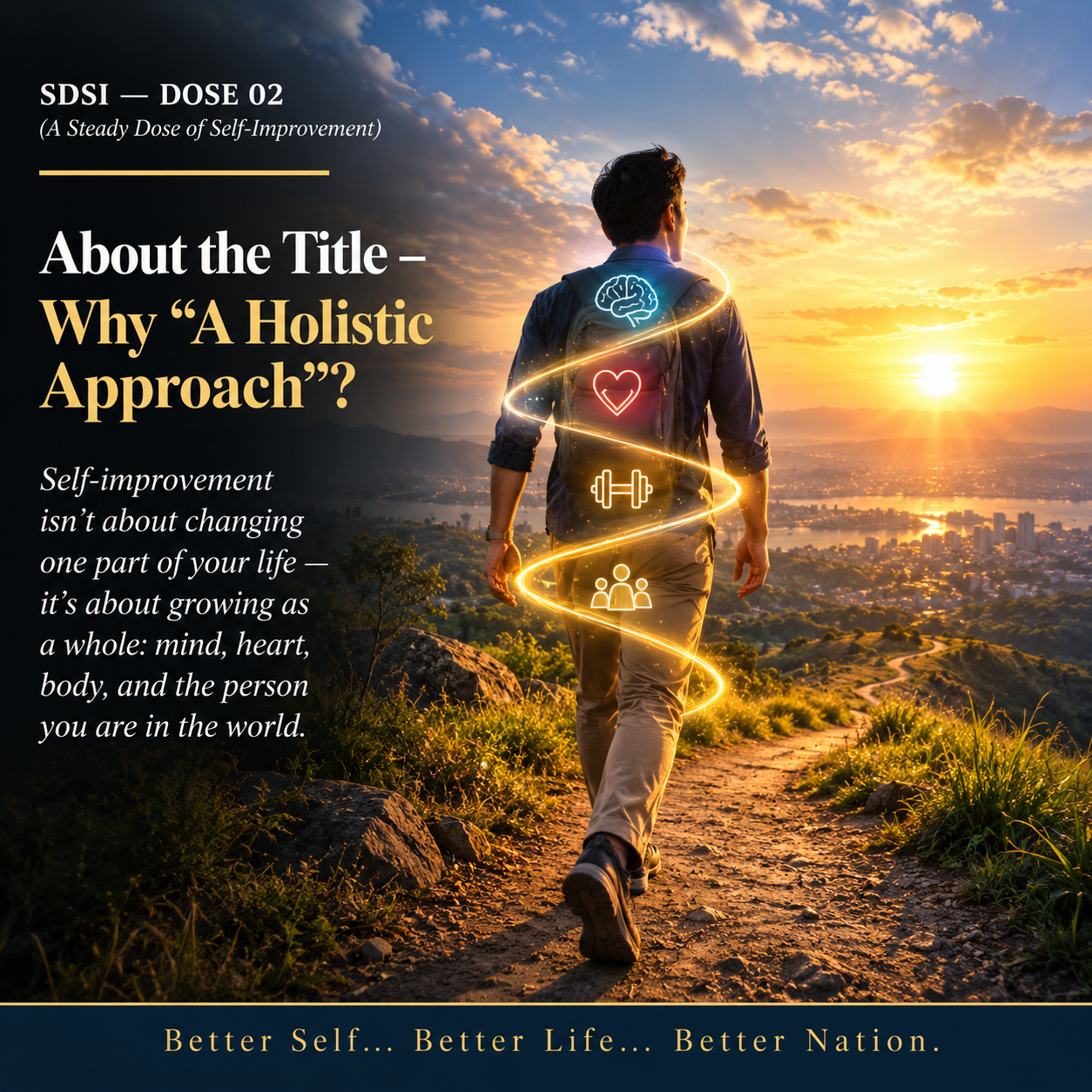
Self-improvement fails when it’s treated as a single fix; this book is holistic because lasting change
requires belief, skill, and habit working together.
Why “holistic”? Why not just “self-improvement”?
Because I tried the narrow version first, and it didn’t work.
I thought reading self-help books was enough. It wasn’t. I thought adding positive thinking on top of my faith and self-belief would complete the picture. I was wrong again. I wanted more — and I couldn’t yet name why.
The turning point came almost by accident. I bought a DVD titled “The Secret” without knowing what it was — the store had mixed it in with other genres, no synopsis, nothing to explain it. I watched it skeptical, then curious, then genuinely changed. That led me to Bob Proctor, and from there to a long list of thinkers — Jim Rohn, Tony Robbins, Wayne Dyer, Napoleon Hill, Dale Carnegie, Earl Nightingale.
What struck me across all of them was this: none of them treated self-improvement as one lever to pull. Every lasting example of growth I found required cultivating the right attitudes and beliefs, developing real skills and abilities, and consistently practicing the right daily habits. Not one of these in isolation. All three, together.
This book is organized around that conviction — a Value System, a Competence Framework, and a Habit Scheme, held together by self-discipline. It’s not a shortcut. It’s a fuller map.
Pause and Reflect
Which single area have you been trying to fix on its own, while the rest quietly stayed the same?
One Step Forward
Name the one dimension — belief, skill, or habit — you’ve most neglected. Write one sentence describing what giving it real attention would look like this week.
Explored in full in the Preface of A Holistic Approach to Self-Improvement.
Better Self… Better Life… Better Nation.
Before the Journey Begins
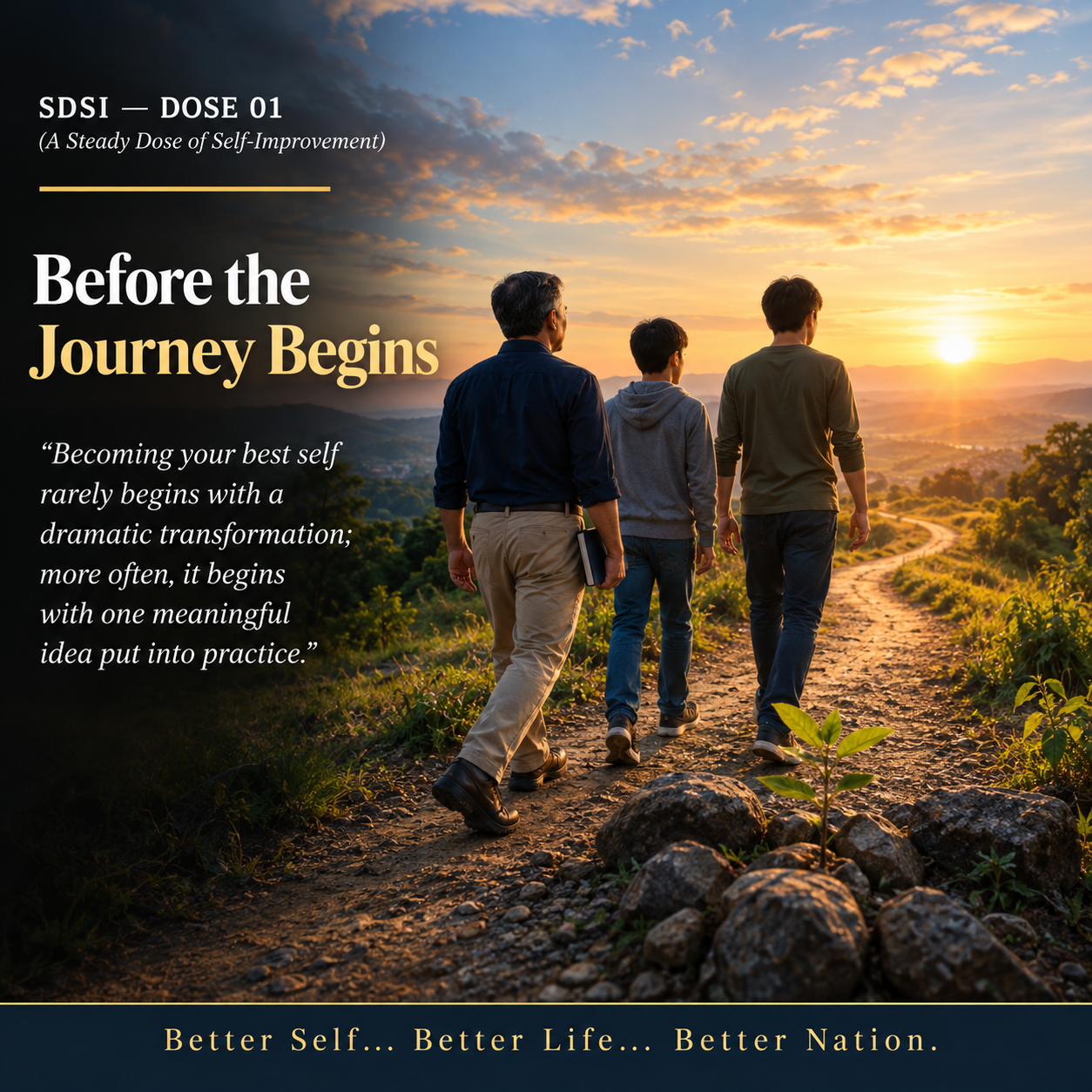
Becoming your best self rarely begins with a dramatic transformation; more often,
it begins with one meaningful idea put into practice.
Why did I write a book on self-improvement and create this program – “A Steady Dose of Self-Improvement”?
Not to sell you on overnight transformation — there isn’t one, and I’ve never believed in the ones sold in the self-help aisle. I wrote this book because if even a single person reads it and becomes who they were truly meant to be, that’s a life genuinely changed. That, to me, has always been reason enough.
My own path into this started long before I called it self-improvement. My mother instilled in me the values of faith and self-belief. My parents taught me the importance of education and the discipline of always striving to be the best version of myself. I believed them — enough that I explored them in full in the Introduction of A Holistic Approach to Self-Improvement. After I’d earned the degrees I wanted, I kept looking for a new jar of knowledge to dip my fingers into.
Along the way, I found myself drawing from teachers I never met in person — Jim Rohn, Tony Robbins, Zig Ziglar, Napoleon Hill, Earl Nightingale, and many others whose ideas reached me through books, recordings, and screens exactly when I needed them. I came to think of them as professors in what I call my “Virtual University” — a classroom without walls.
Jim Rohn said it plainly: “Those who seek a better life must first become a better person.” Everything in the chapters ahead stands on that one sentence. Self-improvement, done right, isn’t a single skill or habit fixed in isolation. It touches your beliefs, your abilities, and your daily practices — all at once, all connected.
If you’ve ever doubted yourself, felt overwhelmed by your circumstances, or questioned whether you have what it takes to reach your goals, I want you to know something plainly: you have the capacity to grow, to improve, and to become the best version of yourself. Your journey doesn’t need to begin when everything is perfect. It begins the moment you decide to take the first step.
Pause and Reflect
What part of yourself or your life do you most sincerely want to improve, and why does it matter to you now?
One Step Forward
Identify one area of your life that you want to improve. Write down one small but meaningful action that can mark the beginning of that change.
Explored in full in the Introduction of A Holistic Approach to Self-Improvement.
Better Self… Better Life… Better Nation.
A Steady Dose of Self-Improvement

As Jim Rohn said, “Those who seek a better life must first become a better person.” You don’t need a magic pill to become a better person. That pill does not exist anyway. What you need is “A Steady Dose of Self-Improvement.”
“A Steady Dose of Self-Improvement (SDSI)” is a continuing educational and reflective series. My objective in launching this project is to present, through concise and accessible installments, the central ideas of my book, A Holistic Approach to Self-Improvement: A Practical Guide to Becoming Your Best Self.