Blog Archives
Conquering Self-Doubt
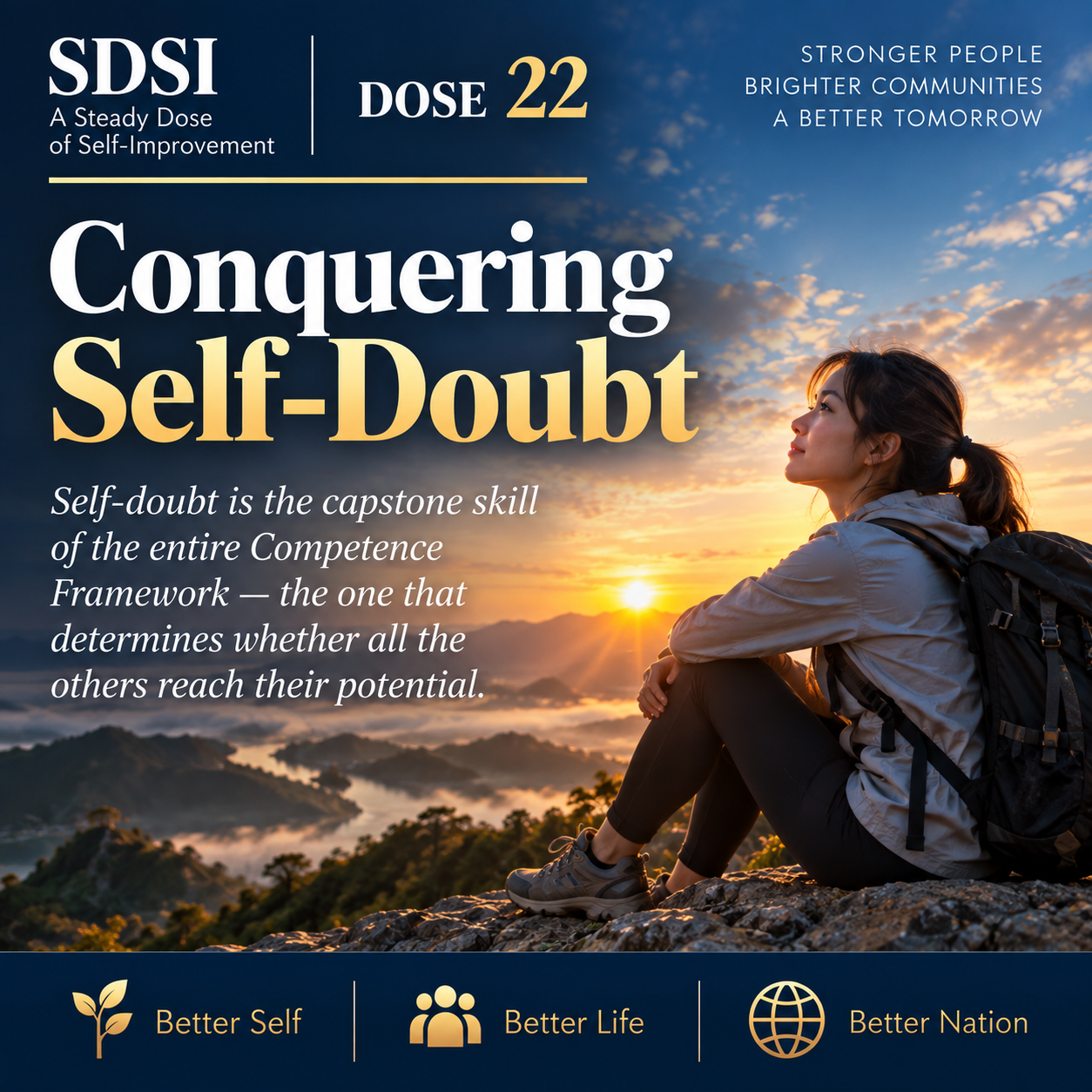
Self-doubt is the capstone challenge of the Competence Framework—the one that determines whether
all our other abilities are ever fully used.

What if self-doubt belongs on the list of deadly sins?
Perhaps that question goes too far. Ordinary self-dOubt is neither evil nor necessarily harmful. Sometimes it protects us from arrogance. It makes us examine our preparation, recognize our limitations, and seek the help or training we genuinely need.
But self-doubt becomes destructive when it continues speaking even after the evidence has answered it.
It whispers that you are not intelligent enough, capable enough, or worthy enough to succeed. It dismisses every accomplishment as luck, every compliment as politeness, and every opportunity as something intended for somebody better. Given enough authority, it does more than make you uncomfortable—it prevents you from using the abilities you already possess.
I know that voice.
It has asked me who I thought I was to teach abroad, present research, write books, and advocate self-improvement. It did not disappear when I earned another degree, accumulated years of teaching experience, published my work, or stood before international students. Whenever I attempted something larger, the same question returned in a different form:
Who do you think you are?
Eventually, I learned to answer it with evidence.
I am someone who has faced unfamiliar situations and learned. I am someone who has been rejected and continued. I am someone who has completed difficult work before. None of this guarantees that everything I attempt will succeed. It simply proves that self-doubt is not qualified to declare what I cannot do.
Conquering self-doubt does not mean silencing it forever. Even accomplished people occasionally question themselves. The goal is not to become so confident that we ignore our weaknesses or assume that we cannot fail. That is not confidence; it is carelessness.
The goal is to place self-doubt in its proper position. Let it ask questions, but do not let it deliver the final judgment. Examine what it says. If it identifies a real deficiency, improve. If it merely repeats an old fear that contradicts the evidence, proceed despite it.
This is why conquering self-doubt completes the Competence Framework. You may manage your time efficiently, remain focused, think before acting, make purposeful decisions, communicate effectively, and maintain balance. But if you continually doubt your right or ability to use those skills, much of your potential will remain untouched.
You do not need absolute certainty before taking the next step. You need sufficient preparation, honest evidence, and the courage to act while a little uncertainty remains.
Self-doubt may accompany you.
It simply must not lead you.
Pause and Reflect
What opportunity have you avoided because you doubted yourself?
What evidence from your own life challenges that doubt?
One Step Forward
Write one sentence naming a capability you genuinely possess. Beneath it, list three experiences or accomplishments that provide concrete evidence for it.
Explored more fully in Chapter 14 — “Conquering Self-Doubt” of A Holistic Approach to Self-Improvement.
Better Self… Better Life… Better Nation.
Striking Work-Life Balance
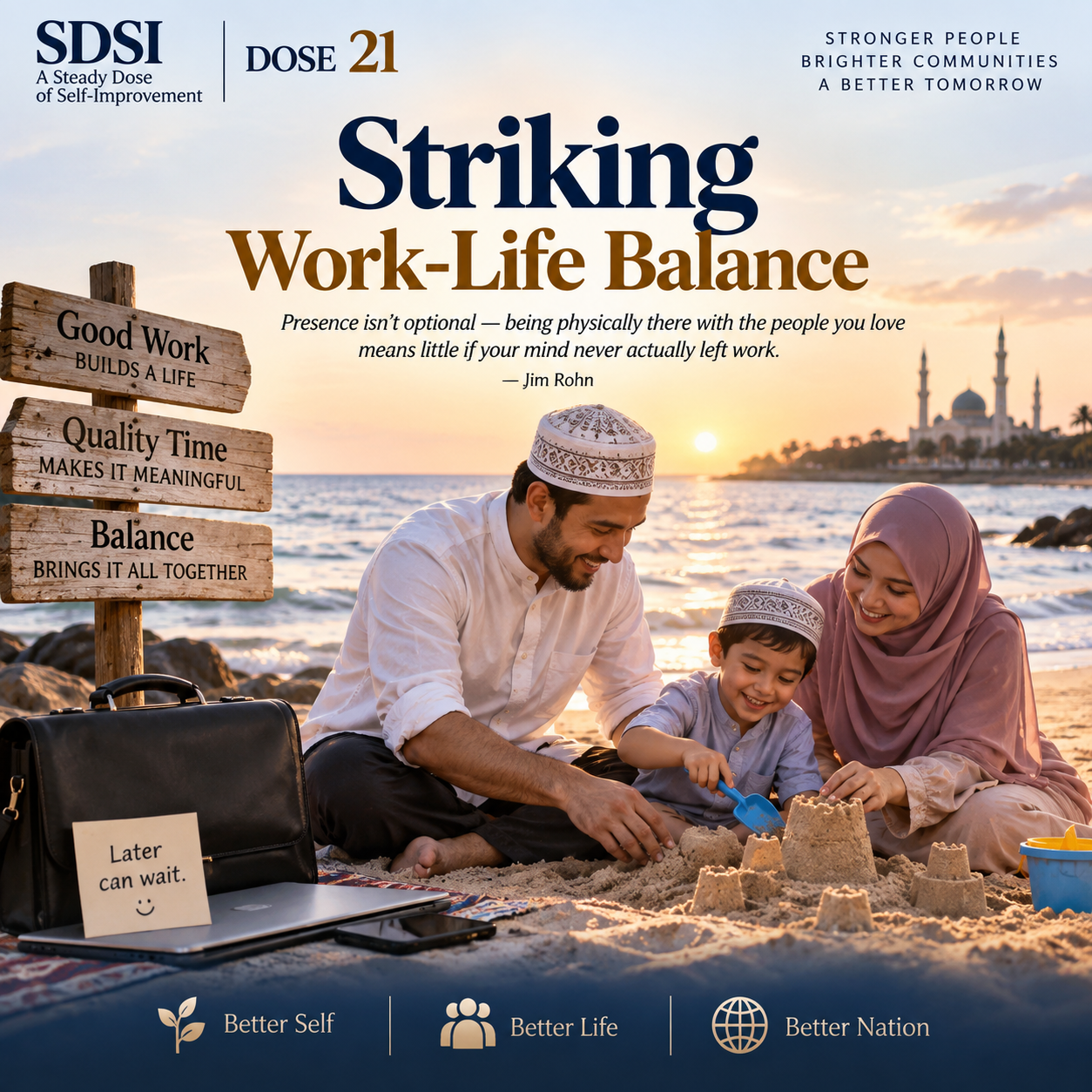
Presence isn’t optional — being physically there with the people you love means little
if your mind never actually left work.
Jim Rohn once took his family to the beach. He brought his briefcase.
Striking a balance between personal undertakings and professional endeavors is easier said than done. Yet few things matter more to the quality of our lives than getting this balance right. A life tilted too far toward work may make us productive while leaving us personally impoverished. But neglecting meaningful work and responsibility can also deprive us of the sense of purpose and accomplishment they provide.
Work-life balance is not simply a matter of dividing our hours equally between work and home. It depends not only on the time we spend physically at work, but also on the energy, focus, and attention that work continues to demand after we leave.
You can leave the office and still be psychologically at work — replaying problems, answering messages, planning tomorrow, or worrying about what remains unfinished. True balance therefore requires something more difficult than simply going home: learning to mentally disengage from work when work is done.
Jim Rohn illustrated this lesson with a simple story. He recalled taking his family to the beach while bringing his briefcase along. His family was not pleased. The lesson was unmistakable: being physically present with the people you love is not enough if your attention remains somewhere else.
Presence isn’t optional.
When you’re with your family, be with your family. When you’re resting, allow yourself to rest. When you’re working, give your work the attention it deserves. Balance comes not from giving everything equal time, but from giving each part of life the attention it deserves when its time comes.
Arianna Huffington learned a similar lesson far more painfully. After collapsing from exhaustion and injuring herself, she began questioning conventional definitions of success built primarily around money and power. Her experience eventually helped shape her advocacy for a broader measure of success—one that includes well-being, wisdom, wonder, and our capacity to live fully.
My own experience teaching at a university in South Korea has given me something I have learned not to take for granted: protected time outside work. My teaching schedule and semester breaks have allowed me time to write, connect with family, pursue personal projects, and simply rest.
That experience has taught me that time away from work is not necessarily time taken from productivity. Properly used, it can replenish the very energy, creativity, and perspective that make productive work possible.
Work is an important part of life.
But work is not life itself.
The goal is not to work less simply for the sake of working less. Nor is it to divide every day neatly into equal portions. The goal is to build a life in which professional accomplishment does not require sacrificing the people, experiences, health, and moments that make accomplishment worth having.
Pause and Reflect
When you’re with the people you love, are you truly present — or is work still occupying your mind?
One Step Forward
Choose a specific time after which you won’t check work messages tonight. Hold that line, even if it feels uncomfortable.
Explored in full in Chapter 13 — Work-Life Balance of A Holistic Approach to Self-Improvement.
Better Self… Better Life… Better Nation.
Effective Communication
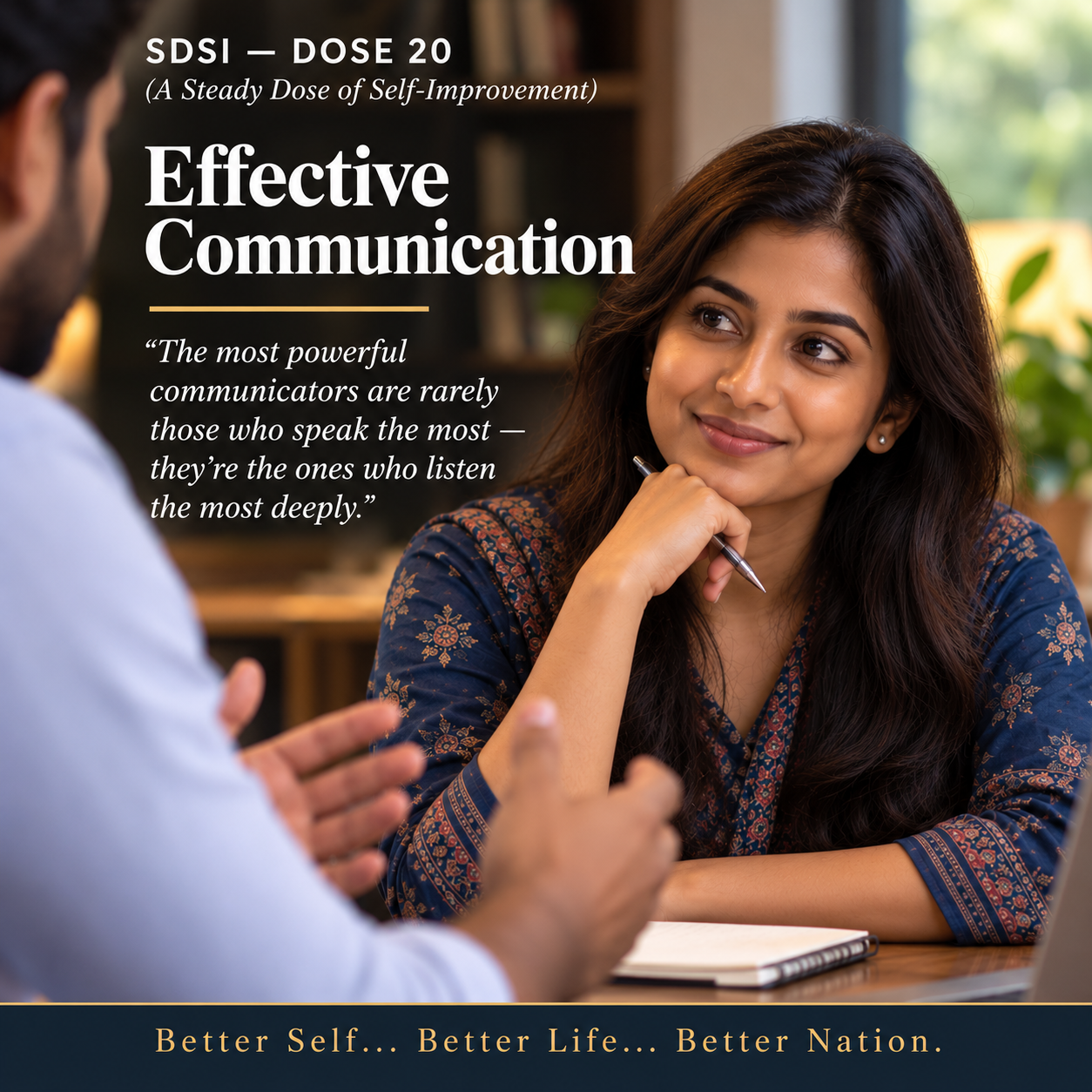
The most powerful communicators are rarely those who speak the most — they’re the ones who listen the most deeply.
Nelson Mandela’s greatest communication skill wasn’t his speeches. It was his listening.
Of all the skills in the Competence Framework, effective communication may be the most universally required. Every relationship you build, every idea you want to share, every conflict you hope to resolve depends on your ability to communicate clearly, honestly, and with genuine attention to the person on the other side of the conversation.
At its simplest, communication is the exchange of information. But effective communication is more specific: it’s communication that achieves its intended purpose — the message sent is the message received, understood, and responded to appropriately. That requires five elements working together: sender, message, channel, receiver, and feedback, all shaped by context and threatened by noise.
Nelson Mandela, who appears in several chapters of this book for good reason, was one of the most powerful communicators of the 20th century. What made him extraordinary wasn’t rhetorical brilliance alone, but the quality of his listening. He studied his opponents carefully, understood their perspectives before engaging them, and found language that could reach across divides rather than deepen them.
Oprah Winfrey built one of the most successful media empires in history largely on her capacity for active listening. In her interviews, she was famous for making her subjects feel genuinely heard, which led them to share more openly and authentically than they had with almost anyone else. She understood that the most powerful communicators are often not those who speak the most, but those who listen the most deeply.
Active listening means giving the speaker your full, undivided attention: no phone, no mental composing of your response while they’re still talking. After someone speaks, reflect back what you heard: ‘So what I’m hearing is…’ This simple practice dramatically reduces misunderstandings and signals that the other person has genuinely been heard — the precondition for any productive exchange.
Pause and Reflect
What is the biggest barrier to effective communication in your own life — and what would change if you removed it?
One Step Forward
In your next conversation, practice reflecting back what you heard before responding. Notice how it changes the exchange.
Explored in full in Chapter x — Effective Communication of A Holistic Approach to Self-Improvement.
Better Self… Better Life… Better Nation.
Purposeful Decision-Making
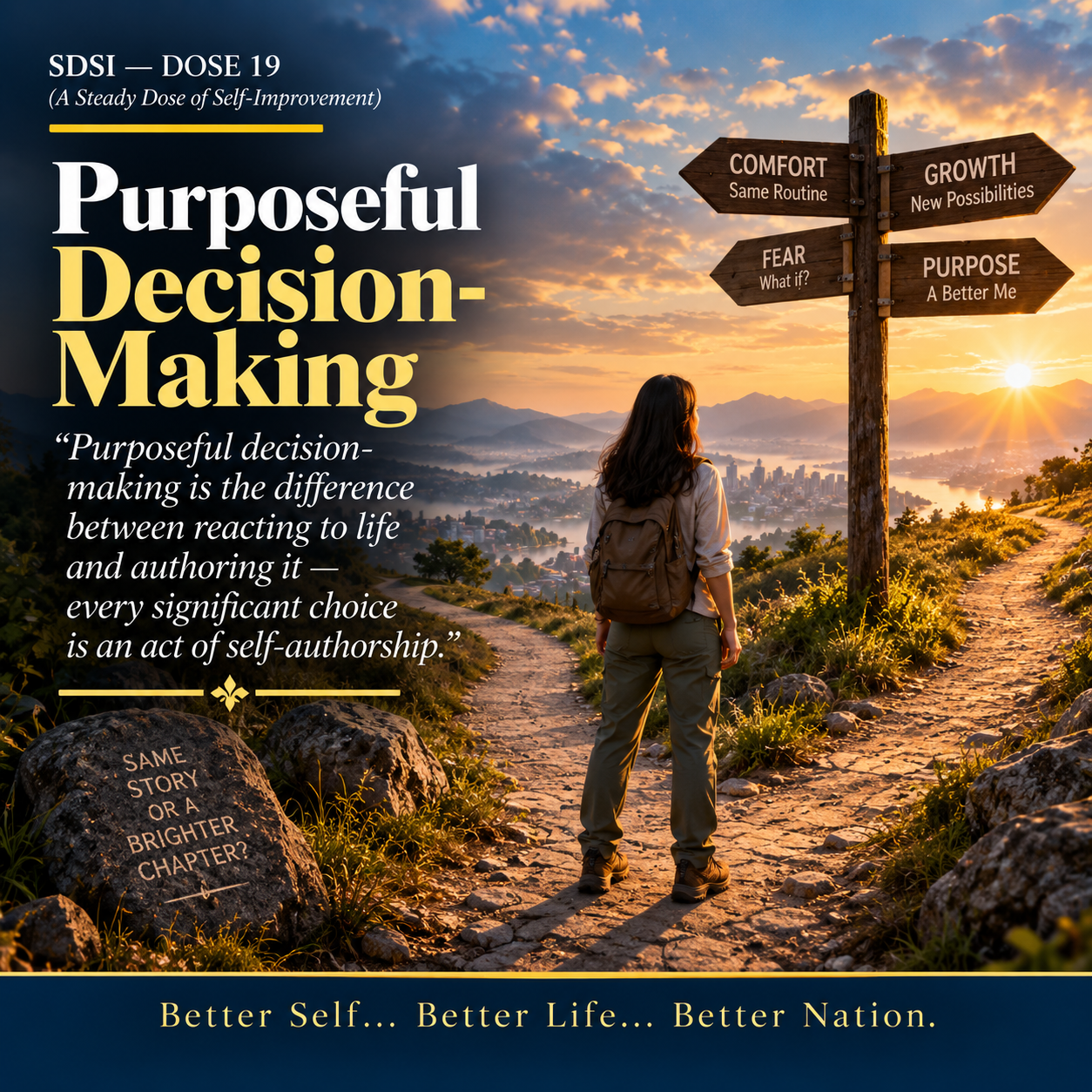
Purposeful decision-making is the difference between reacting to life and authoring it —
every significant choice is an act of self-authorship.
Are you where you are by design, or by default?
Your life is the product of the chain of decisions youUve made since you began taking control of it. Every choice, from the inconsequential to the life-altering, has shaped the person you are today. And every decision from this moment forward will continue shaping who you become.
Purposeful decision-making is the practice of making choices consciously aligned with your values, goals, and long-term vision, rather than choices driven by habit, fear, or the path of least resistance. It is the difference between reacting to life and authoring it. Pause and look honestly at where you are. Are you there by design, or by default?
In the year before I decided to leave the Philippines to teach ESL in South Korea, I found myself in what I can only describe as my own version of Chuck Noland’s deserted island in Cast Away — stranded in positions that, despite their prestige, were draining rather than fulfilling. I had served as a school principal and a dean. I chose not to stay, because I had no peace of mind and knew I would not grow.
My loved ones considered it reckless. I had a good position, a decent salary, other income. Some cited an upcoming government post with job security. But I applied for ESL positions abroad anyway, faced rejection from three Middle East universities, learned what I was missing, obtained a TESOL certificate, and was eventually hired in South Korea. That single decision, made in early spring of 2013, reshaped everything.
It was not an impulsive leap. It was a calculated risk, made with full awareness of what I was putting on the line and faith in my preparation and values. Mel Robbins was right: I was one decision away from a completely different life. And I made that decision on purpose. As the character Socrates says in Peaceful Warrior: ‘Life is a choice. You can choose to be a victim or anything else you would like to be.’ I chose. And I have no regrets.
Pause and Reflect
Is there a decision you’ve been avoiding that you know, deep down, needs to be made? What’s holding you back?
One Step Forward
Write down one decision you’ve been putting off. List what you’re afraid of, and one small first step you could take this week regardless.
Explored in full in Chapter 12 — Purposeful Decision-Making of A Holistic Approach to Self-Improvement.
Better Self… Better Life… Better Nation.
Thinking First
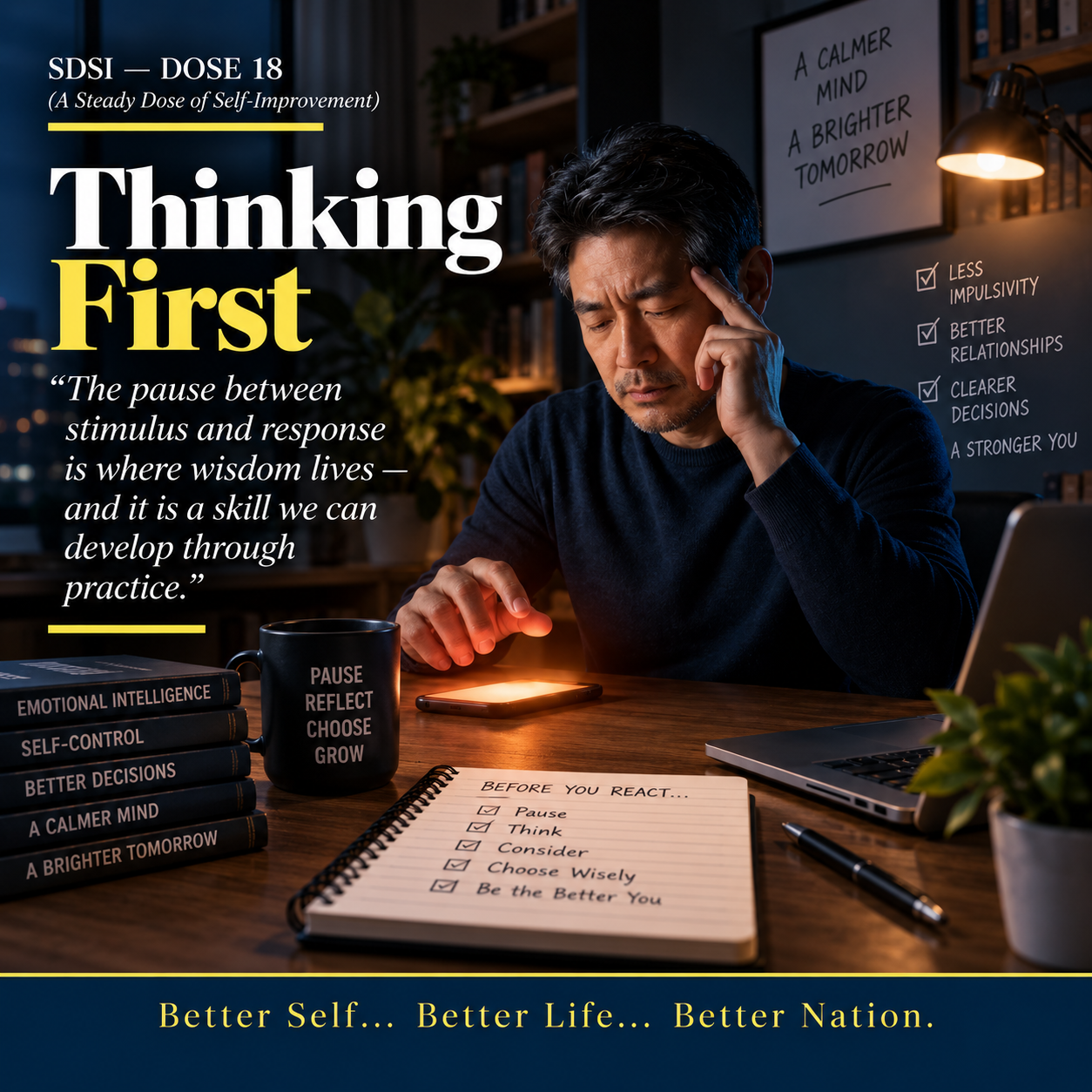
The pause between stimulus and response is where wisdom lives—and it is a skill we can develop through practice.
Every word you have regretted saying and every action you have wished you could take back probably began the same way: you reacted before you thought.
When something angers, frightens, embarrasses, or offends us, emotion can rise with remarkable speed. Before we have fully understood what happened, harsh words may already have escaped our lips, an impulsive message may have been sent, or an action may have been taken that cannot easily be undone.
This does not mean that we are helpless victims of our emotions. Emotional reactions may come quickly, but they do not always have to determine what happens next. We can learn to create a small but crucial space between what we feel and what we do.
A statement often associated with Viktor Frankl describes this space as the place where our freedom to choose resides. Although the exact wording cannot be reliably traced to Frankl, the principle reflects one of his central teachings: circumstances may influence us, but we retain some freedom in choosing how we respond to them.
Even a brief pause can allow us to consider what an impulsive reaction might overlook: Did I understand the situation correctly? Will my words solve the problem or worsen it? Am I responding to what actually happened—or merely to what I felt?
Abraham Lincoln understood the value of such restraint. When deeply angered or disappointed, he sometimes wrote what became known as “hot letters.” He poured his frustration onto the page but did not immediately send what he had written. One famous example was his strongly worded letter to General George Meade after the Battle of Gettysburg. Lincoln placed it aside, and it remained unsigned and unsent. The letter released his anger without letting it control his final action.
We may never write to generals or make decisions affecting an entire nation, but we face smaller versions of Lincoln’s choice every day. We decide whether to answer an insulting remark, send an angry message, confront someone immediately, or wait until we can speak with greater clarity.
Thinking first does not mean suppressing emotion or refusing to defend ourselves. It means giving reason enough time to join the conversation. Sometimes two seconds will be enough. At other times, we may need two minutes, two hours, or even two days.
The important thing is to build the habit while the stakes are low. Then, when the stakes are high, the pause will already be there.
Pause and Reflect
Think of the last thing you said that you wish you could take back. What might have changed if you had paused before saying it?
One Step Forward
The next time you feel a strong reaction rising, pause and count slowly to two before responding. Notice whether your first reaction still feels like your best response.
Explored in full in Chapter 10 — Thinking First of A Holistic Approach to Self-Improvement.
Better Self… Better Life… Better Nation.
Efficient Time Management
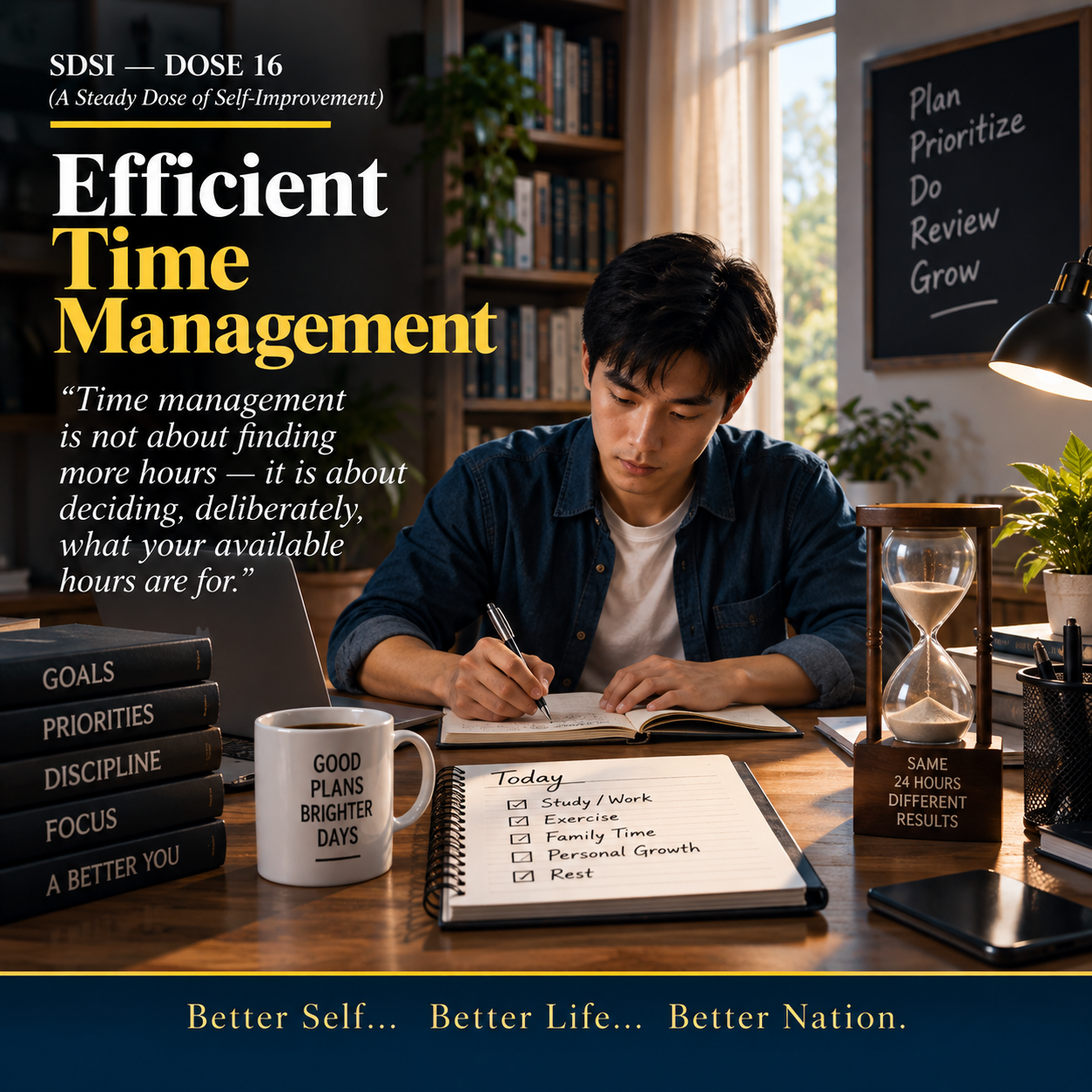
Time management is not about finding more hours—it is about deciding,
deliberately, what your available hours are for.
“If I had some extra time, I could make some extra money.” Jim Rohn’s answer: Forget it. There is no extra time.
Every person receives the same number of chronological hours: 24 each day and 168 each week. However, not everyone has equal freedom over those hours. Work demands, caregiving responsibilities, health conditions, financial circumstances, and long commutes can consume much of a person’s time before any personal choice is made.
Efficient time management does not deny those realities. It asks a more practical question: Within the time I can influence, am I using it for what matters most?
Jim Rohn once recalled a man telling him, “If I had some extra time, I could make some extra money.” Rohn replied that there was no extra time. When midnight arrives, the day is over. Whatever we hope to accomplish must be attempted within the time already available to us.
Laura Vanderkam’s 168-hour framework makes this easier to see. A person who works 40 hours a week and sleeps eight hours each night uses 96 hours, leaving 72. Those remaining hours are not automatically “free”—meals, commuting, household tasks, caregiving, exercise, and rest must come from them. Still, looking at an entire week often reveals possibilities that are hard to notice when we focus on one crowded day at a time.
Benjamin Franklin designed his daily schedule around purposeful blocks of activity. At the beginning of the day, he asked, “What good shall I do this day?” At night, he reflected, “What good have I done today?” His schedule was not merely about filling every hour with work. It connected time use with intention.
Franklin also admitted that maintaining perfect order was difficult. That matters because efficient time management does not mean rigidly controlling every minute. A schedule must guide us without becoming a prison.
Researchers Brad Aeon and colleagues describe time management through three related practices: structuring, protecting, and adapting time. We structure time by creating routines and assigning activities to appropriate periods. We protect it by setting boundaries and declining demands that interfere with important priorities. We adapt it when circumstances change and our original plans are no longer realistic.
Before improving how you use time, however, you must first discover how you are using it now. Memory is unreliable; a written record is much harder to argue with.
A time audit may reveal obvious waste, but it may also reveal something kinder: perhaps you are not lazy or undisciplined at all—perhaps you are carrying more responsibilities than you realized. Either discovery is useful because effective time management begins with truth, not guilt.
You cannot create extra time. But you can become more deliberate with the time that is genuinely yours to direct.
Pause and Reflect
If you recorded every hour for three days, what do you think you would discover about where your time actually goes?
Which activity deserves more of your available time—and which one deserves less?
One Step Forward
For the next three days, record how you use each hour. Mark every entry as essential, useful, restorative, or wasteful. At the end, identify one hour you can use more deliberately.
Explored more fully in Chapter 8 — “Efficient Time Management” of A Holistic Approach to Self-Improvement.
Better Self… Better Life… Better Nation.
Competence Framework: Skills and Abilities
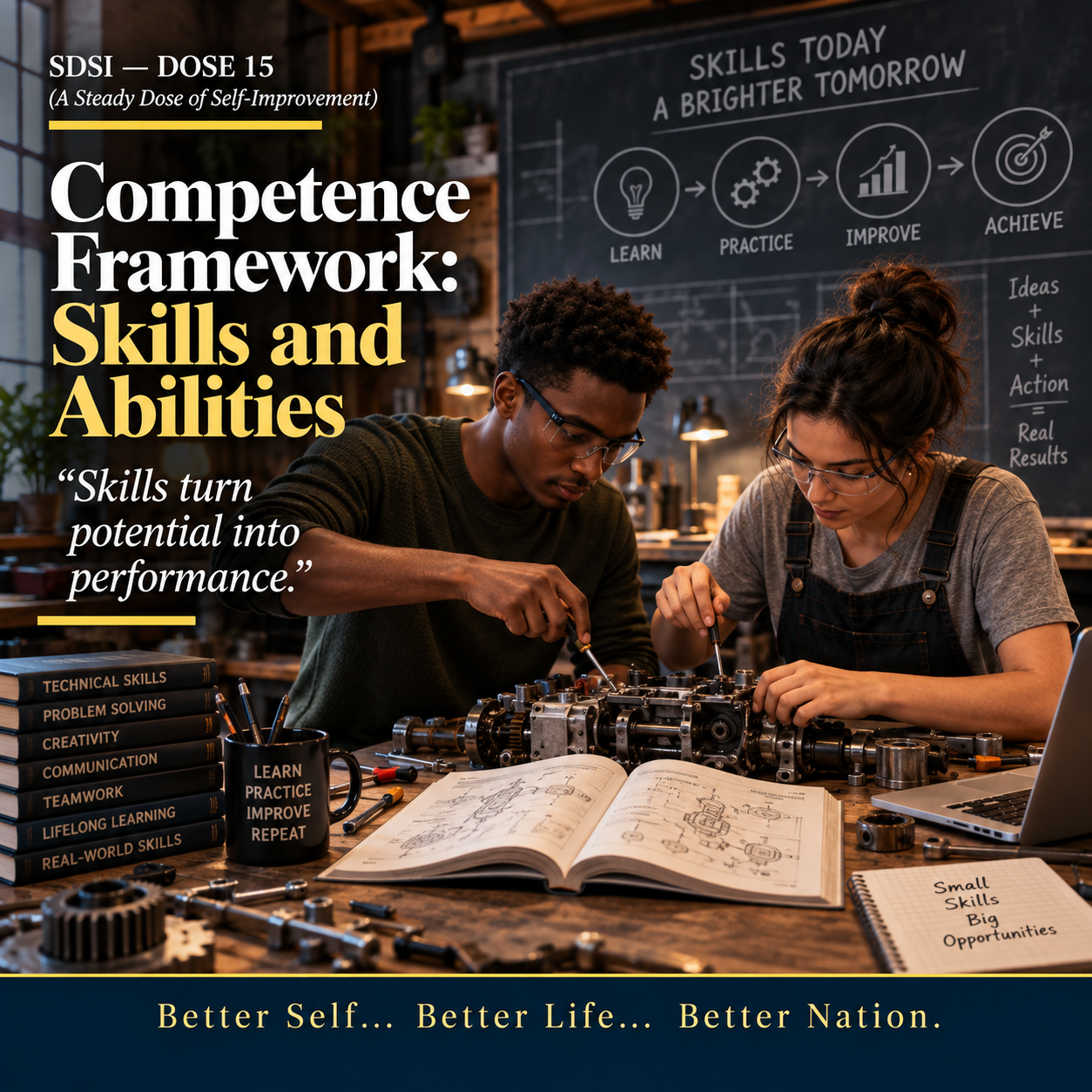
Belief alone is not enough — without the skills to act on it, powerful
convictions produce nothing but inspired inaction.

Your value system is the engine. Your competence framework is the transmission.
In the previous section, we explored the attitudes and beliefs that form the foundation of any meaningful self-improvement journey. Together, they form a value system strong enough to carry you through whatever challenges lie ahead. But a solid foundation alone is not enough. What you build on top of it matters just as much.
Think of it this way: your value system is the engine. Your competence framework is the transmission. Without the engine, there is no power. But without the transmission, that power never reaches the wheels. You need both, working together, to move.
Seven skills consistently appear in the profiles of those who succeed, and their absence consistently explains why others fall short: efficient time management, staying focused, thinking first, purposeful decision-making, effective communication, creating work-life balance, and — the capstone of them all — conquering self-doubt. You can manage your time flawlessly and communicate brilliantly, but if self-doubt runs unchecked, none of those other skills will ever reach their full potential.
I did not arrive in South Korea fully formed as a high performer. The move itself was an act of faith, and what followed required deliberate development of each of these seven skills. I had to manage my time more carefully than ever before, balancing teaching, advising, research, and writing. I had to stay focused on long-term goals even when the novelty of a new country made distraction effortless. I had to think carefully before speaking in a professional culture different from my own.
I had to communicate across language and cultural barriers with students, colleagues, and administrators. I had to protect my personal time and my connection with family back home, so I could sustain performance over years rather than burn out in months. And I had to conquer the recurring self-doubt that whispered: Who do you think you are, writing books, presenting research, building something new? None of these skills came naturally. They were built — through practice, failure, and reflection.
Pause and Reflect
Which of the seven skills — time management, focus, thinking first, decision-making, communication, work-life balance, or conquering self-doubt — do you most need to build right now?
One Step Forward
Pick the one skill you’re weakest in. Write one small, specific way you’ll practice it this week.
Explored in full in Part 2, Competence Framework of A Holistic Approach to Self-Improvement.