Blog Archives
Conquering Self-Doubt
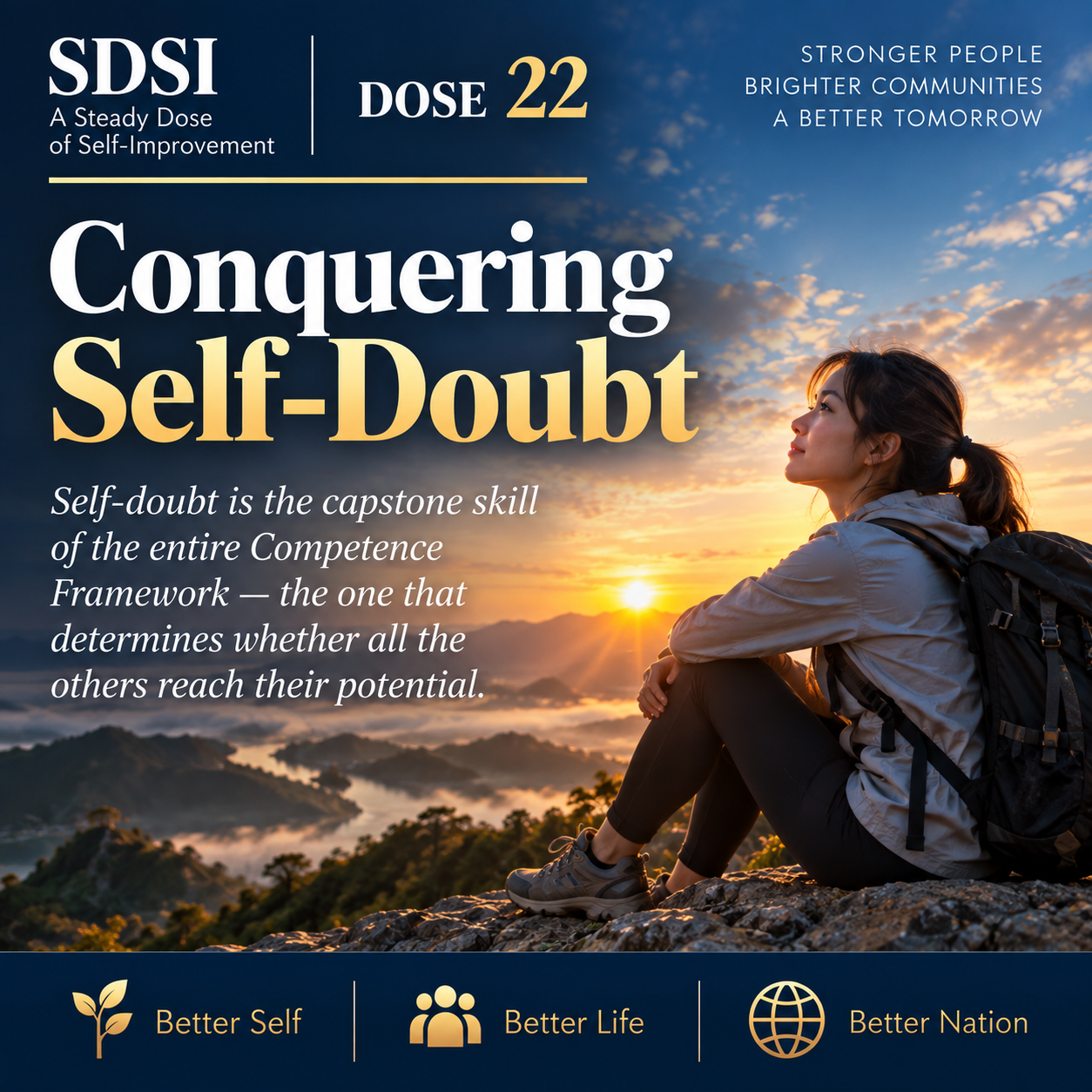
Self-doubt is the capstone challenge of the Competence Framework—the one that determines whether
all our other abilities are ever fully used.

What if self-doubt belongs on the list of deadly sins?
Perhaps that question goes too far. Ordinary self-dOubt is neither evil nor necessarily harmful. Sometimes it protects us from arrogance. It makes us examine our preparation, recognize our limitations, and seek the help or training we genuinely need.
But self-doubt becomes destructive when it continues speaking even after the evidence has answered it.
It whispers that you are not intelligent enough, capable enough, or worthy enough to succeed. It dismisses every accomplishment as luck, every compliment as politeness, and every opportunity as something intended for somebody better. Given enough authority, it does more than make you uncomfortable—it prevents you from using the abilities you already possess.
I know that voice.
It has asked me who I thought I was to teach abroad, present research, write books, and advocate self-improvement. It did not disappear when I earned another degree, accumulated years of teaching experience, published my work, or stood before international students. Whenever I attempted something larger, the same question returned in a different form:
Who do you think you are?
Eventually, I learned to answer it with evidence.
I am someone who has faced unfamiliar situations and learned. I am someone who has been rejected and continued. I am someone who has completed difficult work before. None of this guarantees that everything I attempt will succeed. It simply proves that self-doubt is not qualified to declare what I cannot do.
Conquering self-doubt does not mean silencing it forever. Even accomplished people occasionally question themselves. The goal is not to become so confident that we ignore our weaknesses or assume that we cannot fail. That is not confidence; it is carelessness.
The goal is to place self-doubt in its proper position. Let it ask questions, but do not let it deliver the final judgment. Examine what it says. If it identifies a real deficiency, improve. If it merely repeats an old fear that contradicts the evidence, proceed despite it.
This is why conquering self-doubt completes the Competence Framework. You may manage your time efficiently, remain focused, think before acting, make purposeful decisions, communicate effectively, and maintain balance. But if you continually doubt your right or ability to use those skills, much of your potential will remain untouched.
You do not need absolute certainty before taking the next step. You need sufficient preparation, honest evidence, and the courage to act while a little uncertainty remains.
Self-doubt may accompany you.
It simply must not lead you.
Pause and Reflect
What opportunity have you avoided because you doubted yourself?
What evidence from your own life challenges that doubt?
One Step Forward
Write one sentence naming a capability you genuinely possess. Beneath it, list three experiences or accomplishments that provide concrete evidence for it.
Explored more fully in Chapter 14 — “Conquering Self-Doubt” of A Holistic Approach to Self-Improvement.
Better Self… Better Life… Better Nation.
Purpose-Driven
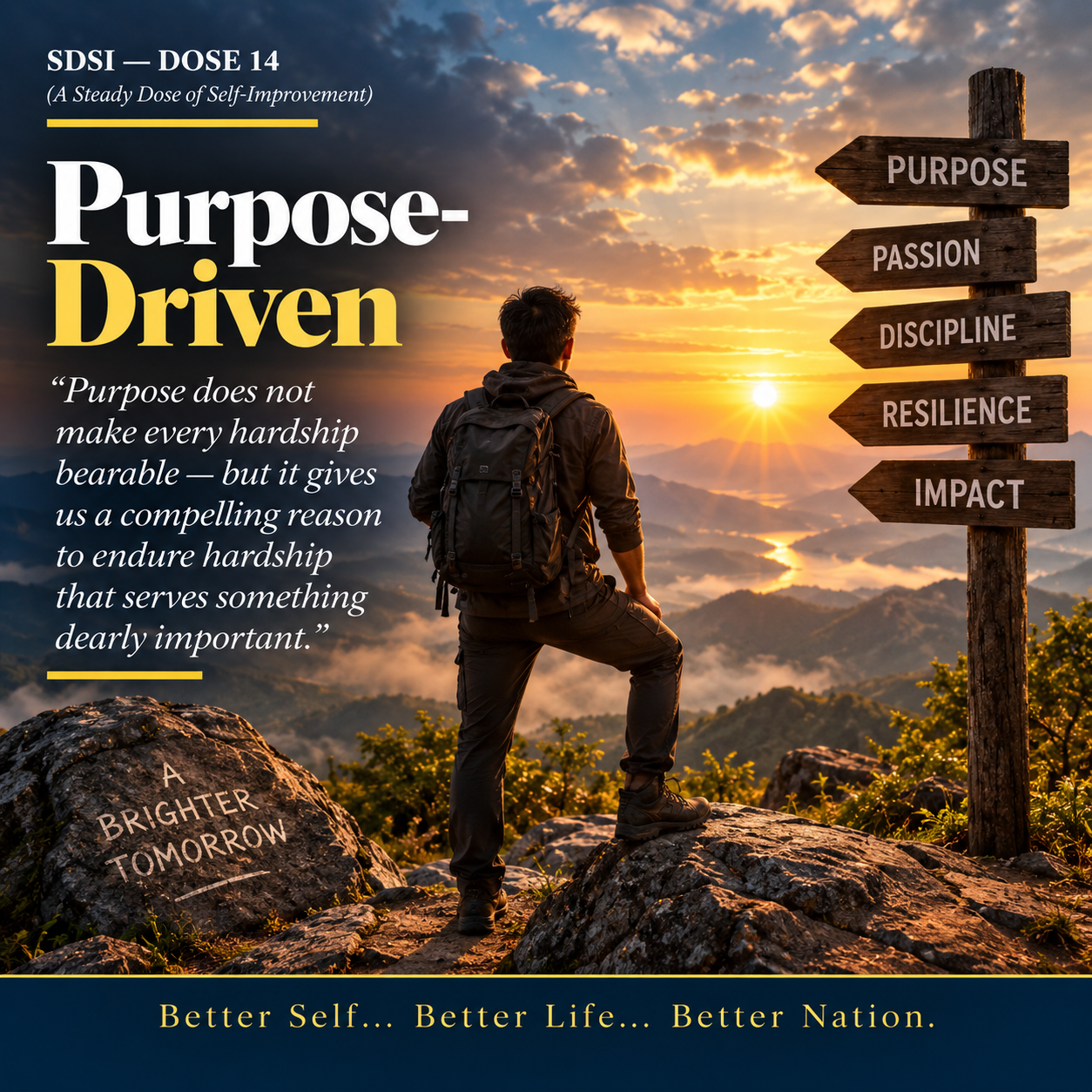
Purpose does not make every hardship bearable—but it gives us a compelling reason to endure
hardship that serves something deeply important.

“He who has a why to live can bear almost any how.”
This statement, commonly attributed from Friedrich Nietzsche, expresses a truth that many people discover while pursuing difficult goals: purpose is not a decoration placed on top of ambition. It is the foundation beneath it.
Ambition tells us what we want to achieve. Purpose tells us why achieving it matters.
Marie Curie became the first person to receive two Nobel Prizes and remains the only individual awarded Nobel Prizes in two different scientific categories. She pursued her scientific work in an era when women faced formidable barriers in education and science. Her devotion to investigating radioactivity did not remove those barriers, but it gave her a reason to continue working despite them.
Nelson Mandela spent 27 years in prison for his struggle against apartheid. Imprisonment deprived him of freedom, separated him from his family, and subjected him to years of hardship. Yet the democratic and nonracial South Africa he envisioned remained larger than his immediate suffering. His purpose did not make prison painless, but it helped prevent imprisonment from becoming the end of his mission.
Purpose does something motivation alone cannot reliably do: it can remain when enthusiasm disappears.
Motivation often rises when progress is visible, recognition is received, or success appears close. It can weaken when work becomes repetitive, rewards are delayed, and setbacks accumulate. Purpose reaches deeper because it reconnects the effort with the reason the effort began.
However, being purpose-driven does not mean stubbornly pursuing every goal forever. Sometimes circumstances change. Sometimes the method is ineffective, or the goal itself no longer reflects who we are becoming. Purpose allows us to change the route without abandoning the destination. It helps us distinguish between an obstacle that must be endured and a warning that requires us to reconsider our direction.
A goal without a meaningful reason behind it is fragile. Once inconvenience outweighs excitement, it becomes easy to surrender. A goal anchored in purpose is more resilient because the work serves something beyond immediate comfort, praise, or reward.
Your purpose does not need to impress the world. It may be caring for your family, educating young people, creating something meaningful, serving God, improving your community, or becoming capable of helping others. What matters is that it is genuinely yours—and important enough to influence how you use your time, abilities, and life.
When the path becomes difficult, purpose does not promise that you will never become tired.
It reminds you why resting is different from quitting.
Pause and Reflect
What meaningful purpose lies beneath one of your most important goals?
Would you still consider that goal worthwhile if recognition and immediate rewards were delayed?
One Step Forward
Complete this sentence: “I am pursuing __________ because __________.” Read your answer, then take one small action today that serves that reason.
Explored more fully in Part 2 — Section I — Chapter 7, “Purpose-Driven,” of A Holistic Approach to Self-Improvement.