Blog Archives

K-DREAM (Part 1)
(First of 3 Parts)

Korean motifs are slowly replacing American imprints in our culture as Filipinos. More and more of my compatriots say annyeonghaseyo instead of hello and gamsahamnida instead of thank you. Oppa has become a popular endearment for women calling their boyfriends or husbands and telling them saranghaeyo instead of “I love you.” We Filipinos are so enamored of K-pop and K-drama, which have greatly influenced our lives. The youngsters, in particular, embrace the music of their K-pop idols and dress the way they do.
In my country, especially in urban areas, restaurants offer samgyeopsal, bibimbap, Korean ramen, and other famous Korean dishes. Products made in South Korea are flooding our supermarkets and grocery stores. It is no longer surprising to find soju sold in sari-sari stores and shared by Filipinos when they dine and wine.
Should we be concerned? Are we losing our Filipino identity? We’re not. Our culture is just entering a new phase of development. Remember that culture is dynamic, never static. It evolves continuously.
It is common knowledge that Hallyu engendered the ongoing assimilation of Korean influences into our culture. This phenomenon depicts the popularity of South Korean pop culture, not only in our country but globally. Yes, we’re not the only ones obsessed with Korean cultural content. It was reported that by 2022, there were more or less 177 million Hallyu fans worldwide.
Hallyu is one of the 26 Korean words added to the Oxford English Dictionary. When translated to English, the word literally means Korean Wave. With the way that this cultural phenomenon struck the world, tsunami, instead of the word wave, would have been a better term. But tsunami is a Japanese word, and given the history of these countries, the word may not rhyme politically.
The gigantic waves of music, TV shows, and movies from the southern portion of the Korean peninsula reached our shores at the turn of the 21st century. Since then, our TV stations have regularly aired many Korean dramas dubbed in Filipino. Korean movies with English or Filipino subtitles are shown in Philippine movie theatres. Magazines and the entertainment sections of newspapers regularly featured K-pop artists and other Korean TV and movie personalities. Before we knew it, the Korean brand had already profoundly penetrated the Filipino consciousness.
Admittedly, I knew little about South Korea before the Korean Wave came. I remember checking the encyclopedia for information about the Korean War when I took World History in college. At that time, I was researching wars America fought for an article I wrote for our school paper, and the Korean War from 1950 to 1953 was one of them. Then, I discovered that our country sent troops to help South Koreans ward off the Communist invasion from north of its borders.
Without the help of the United Nations’ international forces, the Korean peninsula might have fallen under Communist rule. The thought that soldiers from my country helped in not allowing that to happen made me feel proud. Imagine this – had it been Kim Jong-un ruling the whole of Korea now (and his father and grandfather in the past), there would have been no Hallyu to talk about. Instead of K-pop and K-drama, the hot topics could have been K-missile and K-nuke.
Just imagine how dreadful a picture of the war-torn Korean peninsula the things I read about it created in my mind. It was horrible, to say the least. The narrative of the death and destruction was a clear indictment of the futility of war. Those three years were perhaps one of the darkest chapters in the history of South Korea. It was comparable to the three years that my country was under Japanese occupation during the Second World War, as well as the period between 1898 and 1901 when the Filipino revolutionaries helplessly fought a war against the much superior American forces who grabbed the Philippine archipelago from the Spaniards.
However, before completing my university education, I had another chance to read more about South Korea. That was when the country hosted the 1988 Summer Olympics. The sporting event put the land south of the 38th parallel line all over the news. It triggered my curiosity, prompting me to check not only the pages in the encyclopedia about the Korean War but also books written about the country, magazine articles featuring it, and the newspapers covering the Olympics at that time.
I saw a country different from what those pages about the Korean War created in my mind. I discovered that the nation called the “Land of the Morning Calm” rebounded from the horrors of the Korean War and eventually became very progressive. Then I wondered at that time and asked – “What did the South Koreans do that enabled them to, like the legendary Phoenix, rise from the ashes of a horrendous war and even become only the second country in Asia to host the world’s biggest summer sporting event?” Why could they afford to host such an event that would cost them millions and millions (if not billions) of dollars?
My perception of South Korea changed overnight from a country impoverished, war-stricken, and divided into modern and progressive. The pity I felt for the Koreans when they were ravaged by the war during the early 1950s was replaced by amazement and… envy.
As the years passed, I learned more and more about South Korea through traditional media and the Internet, which eventually became more accessible than when I was a university student. I got to hear more and more Korean music and see more and more Korean dramas.
I will never forget how in 2006, the Korean drama Jewel in The Palace would make me stop whatever I do at night to ensure I see all of it. I was so glued to it. Is it because of the story or the pretty face of Lee Young-ae, the actress who played the role of Jang Geum (the drama’s lead character)? I really don’t know. It may be the setting. I am a student of World History, and the story provides a glimpse of how life was in the Korean peninsula during the Chosun dynasty. The Koreanovelas “Stairway to Heaven,” “Lovers in Paris,” “Winter Sonata,” and “Baker King” were the ones that introduced me to contemporary life and society in South Korea. The first Korean movie I watched was “Please Teach Me English.” The supervisor of the Teaching English to Speakers of Other Languages (TESOL) certificate program, which I attended in 2009, recommended it.
These cultural imports from South Korea made me want to visit the country like many Filipinos. I wanted to visit the places in the country that I could only see on TV programs and movies. I wanted to visit Seoul and go to Gangnam and Myeongdong. I wanted to have a summer vacation on the island of Jeju. I wanted to try soju and maekju, and the combination of the two – somaek. I wanted to taste kimchi and eat Korean dishes prepared and served by Korean chefs. I wanted to try tteokbokki, pyo haejangguk, and kalguksu, together with plenty of banchan (side dishes) in a restaurant in South Korea, not in Korean restaurants or the mall’s food courts in my native land. I wanted to meet actual Korean people and mingle with them. Once, I even jokingly told a friend I wanted to have a Korean girlfriend. In short, I desired to have an authentic Korean experience. My K-dream – “Korean dream” – is taking shape and getting embedded in my consciousness.
That urge strengthened when I decided to take the TESOL certificate program. That was when I watched my first Korean movie, the one I previously mentioned – “Please Teach Me English.” South Korea was mentioned by the program coordinator as one of the countries considered the premiere destination for ESL teachers. The said movie gave me a glimpse of the state of English education in that country. There’s a scene in that movie where Young-ju, the lead character played by the actress Lee Na-young, could be seen eating a page of an English dictionary, believing that it would improve her vocabulary. That part of the movie embodies how much of a big deal it is to learn English for South Koreans.
Thus, since teaching abroad is an option in the career path I set for myself, should I have the opportunity to teach overseas, why not in South Korea? My K-dream suddenly evolved, and I no longer just wanted to have an authentic Korean cultural experience but to work there as an English teacher.
Then I did what I had to do for that dream to come true. I completed my training in TESOL, and I left no stone unturned. I searched the Internet for job openings for ESL teachers in South Korea. At that time, I was also suffering from job burnout. I got physically and emotionally exhausted from my job as a school administrator, and I wanted to return to being a plain teacher.
Then Came The “Layered Meat”
 Unabashedly that I made a confession in my article entitled “Love at First Bite” that I fell in love with kimchi. I have to admit though that with all the luscious Korean… DISHES, I wasn’t faithful to kimchi. I would later fall in love with other Korean foods.
Almost everyday that my new friends and colleagues would introduce me to a new local dish during my first few days here in South Korea. However, when I recalled what the doctor in the Philippines said during my medical examination before I flew here – that I need to lose weight – I slowed down a bit.
Then came the three-layered meat and the realization that losing weight is (and has always been) a “mission impossible.”
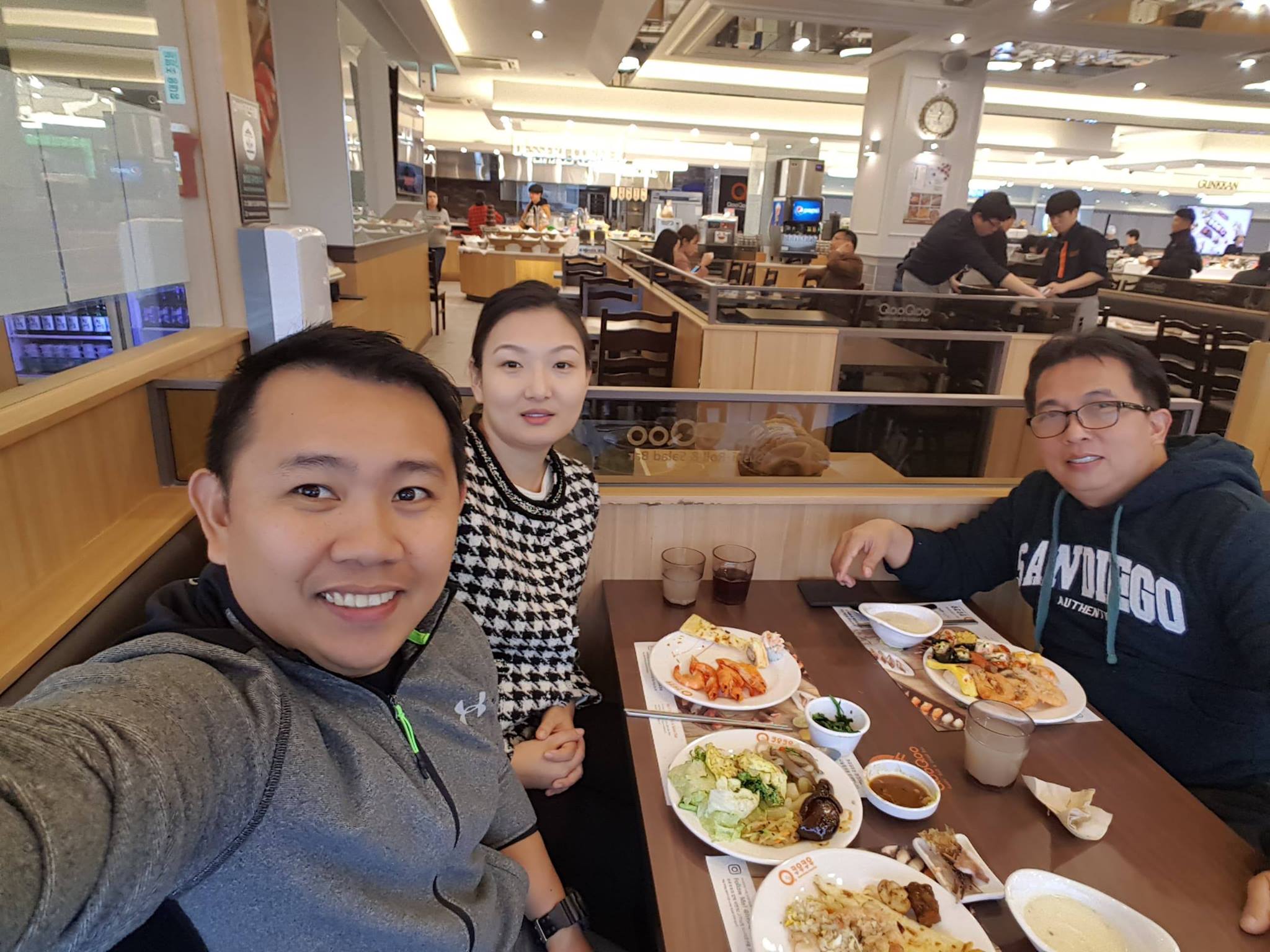
Before my first week in South Korea ended, we were given a treat by a fellow professor from the Philippines – Randy. He brought me and two other foreign professors (Deborah and Kenn) to a restaurant serving 삼겹살 (Samgyeobsal). That was after we claimed our Alien Registration Card (ARC) from the immigration office in Pusan to legitimize our stay in this country.
It isn’t enough to just say that I have tasted samgyeobsal that night. For me it was more than just eating pork belly. I don’t intend to sound dramatic but I guess it would be more appropriate for me to say that that night “I experienced samgyeopsal” instead of “I ate it.”
I consider the experience very special.
Why?
It’s a culture thing.
As we entered the restaurant, I saw Randy and the other professors remove their shoes. I did the same. We were escorted by an ahjussi (a middle-aged man) to a table and immediately left us after getting our order. There were no chairs, not like the set-up in that restaurant in the hotel where we had the orientation for our students. We sat on the floor. So, for the first time that I would experience eating while seated on the floor. I wasn’t comfortable sitting cross-legged but as soon as the ahjussi returned and placed on our table what sir Randy ordered, I forgot about my discomfort and started salivating.
Along with the slices of pork belly, we were given plenty of lettuce, perilla leaves, and enoki mushrooms. There were also raw onions, garlic and green chili peppers. We were also served with lots of small side dishes which the Koreans call 반찬 (banchan). Not to be missed among the dishes in the small plates is kimchi. There was a plethora of food in front of us. I promised not to eat much that night.
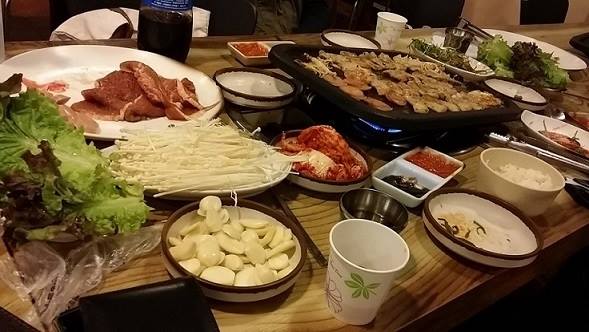
The ahjussi turned the portable gas griller on and the grilling began. As sir Randy held with a tong a slice of pork belly, like a teacher, he explained what samgyeopsal literally means: 삼- sam (three), 겹 – gyeop (layered), 살 – sal (flesh). His impromptu lecture did not end there. When the meat was cooked, he explained how to eat samgyeopsal the Korean way, that was after I excitedly picked up a piece of the cooked meat and had my first bite. He took a piece of meat, dipped it on a sauce then placed it on a leaf. Not done yet, he also added garlic and rice too. Then he rolled it up and stuffed it into his mouth.
“That’s the way the Koreans do it,” he said.
He made another roll and asked me to open my mouth. I hesitated at first because it was a little awkward. He explained that when dining Korean males usually do that and nobody would suspect them of “bromance.” So, I allowed him to stuff it in and returned the favor shortly after.
We learned quickly how to enjoy samgyeopsal . It was either sir Rhandy’s a good teacher or it was just our hunger. It didn’t take long before we had to order another round of pork belly.
There were two varieties of dipping sauces given to us by the ahjussi. Sir Randy told us that one is 쌈장 (ssamjang) and the other one 소금과 후추 기름 장 (sogeumgwa huchu gileum jang).
The kimchi served tasted differently from the one I first tried. There was no trace of sweetness. It was plain spicy.
While we were enjoying the “feast,” sir Randy who has been here in South Korea for a long time, recommended other Korean dishes that he said he was sure I would come to like.
The other customers in the restaurant were enjoying their samgyeobsal with 맥주 (maegju) and 소주 (soju). We wanted to also but we had class the following day.
We were one in saying that it was a sumptuous dinner.
For me, it was not a simple dinner. It was a wonderful cultural experience.
What about my promise not to eat much that night? Well, promises are meant to be broken.
Love At First Bite
I am a foodie. The extra pounds around my waist is a testament to that. So, when I came here (South Korea) I was excited to finally try the dishes which I saw only on television shows and in movies in my country.
The first food I ate here in South Korea was (drum roll, please)… biscuits from the Philippines. I wasn’t able to eat anything Korean immediately when I and sir Kenn (a fellow professor from the Philippines) arrived at the Busan International Airport. I was not thinking of food at that time. I was looking for at least a cup of coffee then, not because of hunger nor my usual craving for caffeine. I just wanted to feel something warm in my hands which started to go numb. It was freezing cold that morning and hunger was the least of my worries. The only thing I wanted was to reach our destination at Gyeoungju-si and wrapped myself up with the thickest of blanket I could find there.
My jacket wasn’t thick enough for my body to enjoy the early spring weather trying to give me an icy cold welcome. I didn’t have time to open my travelling bags because we had a bus to catch. It was my fault to believe what some friends back home told me that it’s not that cold here during spring. For a body used to either a hot or a VERY HOT weather, experiencing a negative two for the first time was literally a chilling experience.
As soon as I reached the apartment reserved for me by 경주 대학교 (Gyeoungju University), the first school where I worked here, I immediately unpacked and got myself another jacket. It was only when I was warm enough that I started to feel hungry and realized that I was actually a time zone away from my family. Back home, my wife would make sure that whenever hunger strikes there’s food I could grab from either the fridge or the table.
I waited for another day to officially get introduced to Korean dishes that I had the chance to see only on TV through the Korean dramas that Filipinos like me are so fond of watching. I found it amusing that aside from wishing me well for the Korean adventure I was about to embark on, my family and friends kept telling me that finally I would have a chance to try the legendary 김치 (kimchi).
Then finally the day came that something Korean would travel my digestive tract. I got that chance during the orientation for the university students held at the Concorde Hotel (Bomun Lake Resort, Bodeok-dong, Gyeongju-si, Gyeongsangbukdo). Of course, I was excited to meet my fellow professors from other countries and have my first encounter with Korean university students. But I was, I think, more excited to have my first dining experience in South Korea. What made it more exciting was the fact that after that night, the taste of kimchi would no longer be a mystery to me.
Right after the orientation, I joined the foreign professors and university officials and we all headed to the restaurant of the hotel. As we approached the dining hall, the ambrosial smell characteristic of hotel lobbies was replaced by a savory waft that was unlike any combination of aroma my sense of smell was used to. It made me hungrier and more excited.

There were four of us who shared one of the tables reserved. Already there (on the table) before we sat down were lots of 반찬 (banchan), or side dishes, mostly vegetables, including Korea’s “most-talked-about” kimchi.
I dived in. The first Korean food I tried was (drum roll again, please)… kimchi.
Despite my struggles with the chopsticks, I managed to pick a small chunk of this famous fermented cabbage. The smell, as I expected, was biting and pungent. Its tanginess was nothing new to me because in the Philippines there are items in our cuisine that I could say are perhaps more biting and more pungent than kimchi. What about the taste? It’s garlicky, salty and of course spicy. The first one I tried then had a combination of sweetness and spiciness. I was told that there are more than 100 known varieties of kimchi.
After my first bite, I immediately wanted more of it. Yes, I came to like kimchi. I don’t know why, let me just say that it was “love at first bite.” It is so hard to explain as to why I would consider meals incomplete without a serving of this side dish.

The main meal served was a kimchi-based dish called 김치 찌개 (kimchi-jjigae). Kimchi-jjigae is kind of stew where kimchi (preferably older or more fermented) is mixed with pork, seafood and diced tofu. I could handle spicy foods like this one. There are two problems though when I eat them. First, I sweat too much. Second and last, I probably would have up to two orders of extra rice. I was a little overweight when I came to South Korea. One of the things I set as goal when I came here was to get rid of the “belt bag.” With foods like kimchi-jjigae, I realized that night that losing weight is an impossible dream.
I completely abandoned my weight concerns when sir Randy, also a fellow professor from the Philippines, told me that the following day he would make me try 삼겹살 (samgyeobsal).
Kimchitized
There is a strong possibility that when we visit a country as tourists or stay there for a long time to work, we might experience culture shock. It happened to me here in South Korea. But mine is a culture shock unlike any other. It was like I was shocked, not to my dismay, but to my delight.
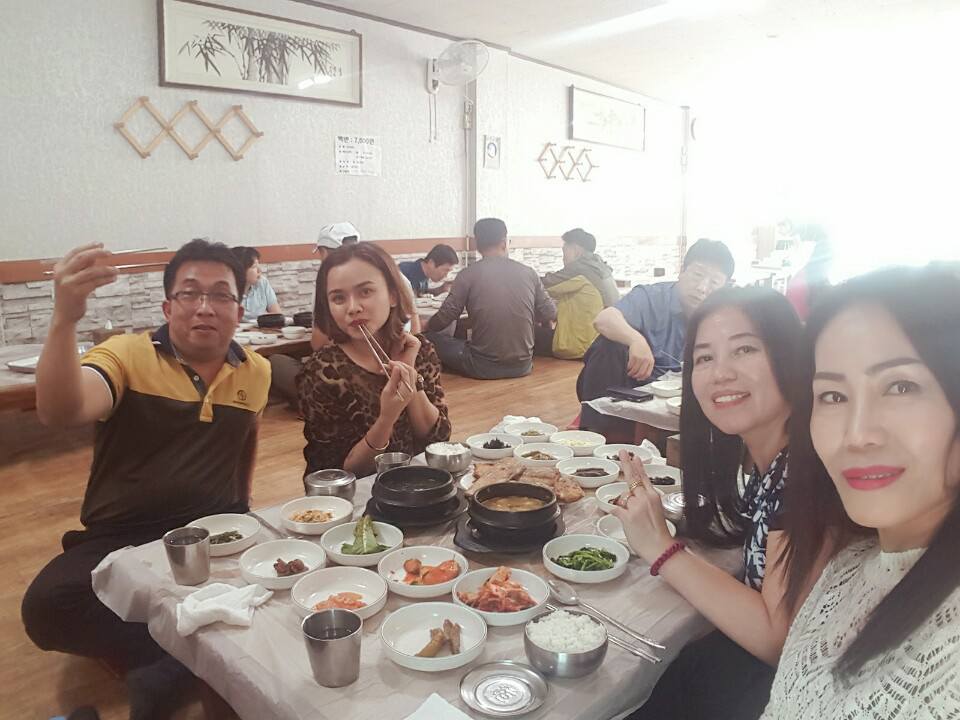
Which part of Korean culture did that?
It’s their FOOD!
That’s right! It’s the food. When I had my initial encounters with this element of Korean culture, I was shockingly delighted. I loved it.
I couldn’t find the right word to describe the experience. So, pardon me for coining a new word – KIMCHITIZE.
Am I the first one to use this word? (Please tell me if not.)
Anyway, KIMCHITIZE is a verb. It means “to cause a foreigner to like (or fall in love with) Korean dishes/foods.”
For the purpose of this essay, I need the past participle form of the verb – KIMCHITIZED.
The first Korean food that landed on my tongue was Korea’s fabled kimchi and the first Korean dish that traveled the full length of my digestive tract was kimchi-jjigae.
It was love at first bite. I was readily kimchitized!
It’s not much with the newness to me of the Korean cuisine. I have actually read a lot of literature about Korean dishes before. Even the Korean dramas we Filipinos are fond of watching in the Philippine give us a glimpse of what South Koreans cook and eat. What I consider, if I may say it again – “shockingly delighting” – are some things that I consider peculiar about the food part of Korean culture.
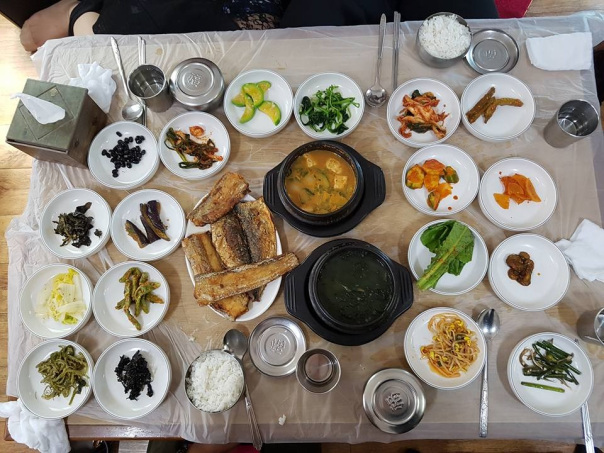
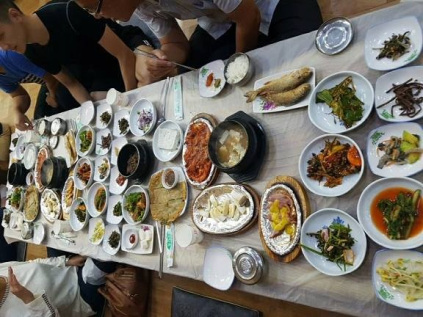
The first one I consider unusual are the side dishes (반찬 – banchan). No! Not the side dishes per se but the amount. Look at the photos and you’ll see what I mean. That’s a plethora of side items. The main dish is drowned in a sea of side dishes. It’s too many that you can easily say goodbye to weight loss once you see them scattered on a table. So inviting. It’s so hard not to pick one with your chopsticks, spoon or – fingers. You would promise “just this one” until that one becomes two – then three – then more.
The first time I experienced that shocking delight of having lots of side dishes was when for the first time I tried 삼겹살 (samgyeobsal). Aside from the leaves, there were plenty of side dishes like steamed eggplant, soybean sprouts, cucumber salad, and some more I could no longer recall.
Shockingly delighting also, for me, is the Koreans’ romance with green leaves. They love wrapping their meat with leaves, particularly lettuce and perilla. I got accustomed to just dipping grilled meat into a plate of salt or a bowl of soy sauce and vinegar combined then they’re ready to be eaten. For the Koreans, it’s different. They will get a leaf, spread it flatly on their palm then carefully pile there meat, grilled garlic, and a side dish or two. Then they carefully roll it making sure that it’s securely wrapped before stuffing it into their mouths.
It surprised me also to see how my Korean friends would ordinarily munch green pepper and garlic as if it’s just another kind of fruit or vegetable. I am okay with the garlic, though I had to grill it first. I bravely tried the green pepper once my bravery was gone in just a few seconds. My friends laughed at how I perspired and my face turned so red that time. Since then I avoided it like a plague and would politely say no whenever offered.
They say that there are four phases of culture shock namely, honeymoon, frustration, adjustment and acceptance. In my case, it started with honeymoon and jumped right away to the final phase of acceptance. There were no frustrations at all. But wait! I remember that I passed through the adjustment period anyway.
And here’s what I did in the adjustment period – I needed to punch another hole on my belt because with all the mouth-watering Korean dishes/foods out there waiting to be discovered losing weight is going to be a mighty struggle.
__________
Below is a link to the articles about some of the Korean dishes/foods I have been enjoying here in South Korea.
Bakit Espesyal Ang Unang Araw Ko Sa South Korea
Madaling araw ng ikalawa ng Marso taong 2013 nang ako’y umalis ng Pilipinas sakay ng Asiana Airlines. Bandang alas-otso na ng umaga nang ito’y lumapag sa Pusan International Airport. Kasabay ko noon si G. Kenn Lachenal. Pareho kaming patungo sa South Korea upang magturo ng English sa Gyeoungju University.
Aaminin kong sabog ako noong panahong iyon, hindi sa droga, kundi sa napakadaming isipin tungkol sa mga mahal ko sa buhay at pangamba sa panibagong hamon na pinili kong harapin.
Labag sa kalooban kong lisanin ang mga mahal ko sa buhay, ngunit kaylangan. Ayaw ko rin sanang talikuran ang paraaalang pinaglikuran ko bilang Principal ng halos isang taon. Subalit ayaw na ayaw kong nagpapadaig sa aking emoyson, ayaw kong hindi gawin ang isang desisyon dahil nagpatalo ako sa mga emosyon. Pinag-isipan kong mabuti ang aking pag-punta sa South Korea upang magturo. Hindi ito biglaang desisyon. Bahagi ito ng mga plano ko. Isa itong balak na dumating na ang panahon upang isakatuparan at hindi ko papayagan ang mga emosyon ko upang ako’y pigilan.
Hindi ang pagnanais na makatanggap ng mas malaking sahod ang pangunahing dahilan kaya ako nagbalak mangibang bansa. Malaki ang sahod na tinatanggap ko bilang Principal noong panahong iyon. Malaking magpasahod sa mga principal nila ang mga Pakistani employers ko. Bukod pa nga sa may kinikita ako bilang academic consultant sa isang technical school at part-time teacher sa isang kolehiyo. Sapat ang kinikita ko sa Pilipinas kung tutuusin. Nakapagpatayo nga ako ng bahay. Ang problema – hindi na ako komportable sa loob ng aking “comfort zone.”
Nakaramdam kasi ako noon ng matinding pagkaumay sa pagsu-supervise ng mga guro’t empleyado. Parang walang pagbabago – wala ng hamon. May kulang… kulang na gusto kong hanapin. Hindi nakatulong na may ilang personal na problema akong dapat ayusin. Napakalinaw na kaylangan ko ng isang napakalaking pagbabago sa aking buhay kung nais kong manatili ang aking katinuan. Kinaylangan kong mangibang bayan para sa isang panibagong panimula.
Pakiramdam ko noo’y nasa isang deadend ako at batid kong merong mundo sa likod ng mga deadends. Iyon ang gusto kong puntahan… lakbayin.
Ang sabi nga ni Jake Sully, ang main character sa pelikulang “Avatar,” “Sometimes your whole life boils down to one insane move.” At katulad din ni Jake, may pangamba man ay sigurado ako sa aking gagawin bago ako tumalon upang makipagbuno at mapaamo ang sariling kong “Toruk.”
Dalawang bagay ang baon ko ng magpunta ako sa South Korea – tiwala sa sarili at pananalig sa Diyos. Laging ito ang kumbinasyong ginagamit kong panangga sa lahat ng pagsubok at panungkit sa ano mang inaasam kong makamit.
Ang tiwala ko sa sarili at pananalig sa Diyos ay parang sandwich. Meron itong palaman – sipag at tiyaga.
Hindi swerte ang hanap ko sa bansang pinuntahan, hindi ako naniniwala sa swerte. Naniniwala ako na “Nasa Diyos ang awa, nasa tao ang gawa.” Ang pakay ko ay sumulat dito ng bagong kabanata sa aking buhay – bagong yugto sa tadhanang naniniwala akong ako ang dapat gumuhit. Batid kong dapat lang na doblehin ko ang aking sipag at tiyaga.
Unang byahe ko iyon palabas ng bansa at mabuti na lamang na nakasabay ko si G. Lachenal. Bukod na sa matulungin ay sanay siyang bumiyahe sa labas ng bansa. Kaya medyo kampante ako. Sa Gyeoungju University nga din s’ya pupunta kaya nakakatiyak na akong hindi ako maliligaw.
Nang makarating kami sa Pusan International Airport ay nagulantang ako sa lamig. Nanuot ito sa suot kong jacket. Buong akala ko ay dahil tapos na ang winter at noo’y papasok na ang spring ay parang sa Baguio na lang ang lamig. Mabuti na lang at ang nasakyan naming bus papuntang Gyeoungju-si ay nakaandar ang heater. Antok na antok ma’y hindi ko magawang matulog sa biyahe dahil tinitignan ko ang bawat lugar na madaanan. Lahat ay bago sa aking paningin. Wika ko sa sarili’y, “Heto na ako sa South Korea.”
Matapos ang halos dalawang oras na biyahe ay nakarating kami sa Gyeoungju-si. Ang sumalubong sa amin ay G. Mark Celis. Siya ang naghatid sa amin sa apartment na aming titirhan, si G. Lachenal sa “white house,” ako nama’y sa “blue house.” Hindi sa Washington D.C. at Seoul ang “white house” at “blue house” na nabanggit ko. Iyon lang ang tawag sa mga apartments na provided ng Gyeoungju University para sa mga professors nila na galing ng ibang bansa. Kulay iyon ng pintura ng apartment. Meron din “yellow house” at “green house.”
Bago umalis si G. Celis ay tiniyak n’yang maayos ang unit na magsisilbi kong tirahan at ipinakilala din n’ya sa akin ang isa pang Pinoy na professor din sa Gyeongju University – si Dr. Randy Tolentino, nakatira rin sa “blue house.”
Pumasok na ako sa aking kwarto at doon ko unang naramdaman ang pakiramdam ng literal na nag-iisa, malayo sa mga mahal sa buhay at nasa isang lugar na hindi ko kabisado. Nakatayo lamang ako, hindi ko malaman kung ano ang una kong gagawin.
Nang medyo mahimasmasan ako’y binuksan ko ang aking maleta at unti-unti inayos ang mga dala kong gamit.
Tahimik ang paligid, wala akong marinig kundi ang mga sarili kong yabag at kaluskos. Nakakapanibago. Wala ang nakasanayan kong tahol ng mga aso, tilaok at putak ng mga manok, maingay na tambutso ng motor at ang malakas na stereo ng mga kapitbahay ko sa Pilipinas.
Matapos kong ayusin ang mga damit at gamit ko’y bigla nanamang naramdaman ko ang sobrang lamig at nagsimula na rin akong makaramdam ng gutom. Walang laman ang refrigerator na nandoon. Nakakapanibago talaga. Sanay akong kapag kumalam ang sikmura ko, buksan ko lang ang refrigerator at solve ang problema ko. Malinis ang maliit kong lamesa. Sa ibabaw nito’y walang tray na may lamang prutas. May gas stove kaya lang wala naman akong lulutuin. Wala na nga ako sa Pilipinas. Pinagtyagaan ko na lang ang biscuit na ipinabaon sa akin ng aking butihing may.bahay
Naalala ko na kaylangan ko nga palang tawagan ang aking mga mahal sa buhay sa Pilipinas upang ibalitang nakarating ako ng malualhati sa South Korea. Nang kuhanin ko ang aking cellphone ay noon ko pa lamang na-realize na hindi ko nga pala na-activate ang aking sim na roaming. Pakiramdam ko’y napakatanga ko, napamura ako ng hindi oras. Hindi ako makakatawag, ang cellphone ko’y magagamit ko lamang na parang music player.
Aaminin kong sa pagkakataong iyon ay inatake ako ng matinding kalungkutan. Gutom pa rin ako kahit naubos ko na halos ang baon kong biscuit. Nanginginig sa lamig. Nabibingi sa katahimikan – nagiisa’t walang makausap. Nangangamba rin ako na na baka nagaalala na nang masyado ang mga mahal ko sa buhay na naghihintay ng balita mula sa akin.
Sa pagkakataoong iyon ay naramdaman ko ang totoong kahulugan ng HOMESICK. Iyon eh matapos lamang ang ilang oras pagkalapag ko sa South Korea.
Pero sa kalagitnaan ng kalungkutang iyon ay napatingala ako sa langit at naala-ala kong ang pagtungo ko sa bansang ito’y naidulog ko na sa panalangin ng maraming beses. Hindi ko alam kung bakit pero sa pagkakaalam ko’y wala akong panalanging hindi n’ya dininig kaya. Ginawan ko nga iyon ng tula sa English. Anim na pantig lang…
HE answers.
Just wait.
Have faith!
Hihiga na sana ako upang lunurin na lang sa tulog ang gutom ko’t kalungkutan nang makarinig ako ng mga katok sa aking pintuan. Si Dr. Tolentino. Pumasok s’ya at nakipagkwnentuhan sa akin. Taga Iloilo siya. Hayun, at least may kausap na ako. Habang kami’y nag-uusap ay tinignan niya ang lutuan ko’t itinuro kung paano iyon i-operate. Maaring napansin n’yang giniginaw ako kaya’t itinuro din n’ya kung papaano gamitin ang floor heater. Medyo na-relax ako sa pagtulong na ginagawa n’ya noon. Binuklat n’ya ang mga drawer sa bandang kusina at doo’y nakakita s’ya ng ilang de-lata na hindi pa naman expired na maaaring sadyang iniwan ng dating nakatira doon. Umalis siya sandali at pagbalik ay may bitbit siyang ilang balot ng noodles at mga 3-in-1 coffee.
Nagulat ako sa generosity na ipinakita ni Dr. Tolentino na kalauna’y tinawag ko na lamang na sir Randy. Animo’y matagal na n’ya akong kakilala. Umalis ulit s’ya sandali at nang pagbalik niya’y sinabing, “Halika na brod, nakaluto na girlfriend ko, kain tayo.” Sumunod ako sa kanyang unit. Nagulat ako pero hindi na ako nagpakipot pa, hindi dahil sa talagang ako’y gutom sa pagkakataong iyon kundi dama ko ang sinseridad ng imbitasyon n’ya at nakakahiyang tanggihan.
Mainit ang mga inihaing pagkain, ngunit mas higit ang init ng pagaasikasong ipinakita sa akin nina sir Randy at ng kasintahan n’yang si Nikki na taga-China. Susubo na sana ako nang biglang nagdasal muna si sir Randy bilang pasasalamat, lumalalim at tumataas ang pagtingin ko sa kanya sa nakita kong iyon. Sa unang subo ko ay nangilid ang luha ko sa kabutihang loob na nasaksihan ko sa kanila at sa kung gaano sumagot ng panalangin ang Panginoon. Nang napatingin sa akin ang magkasintahan ay pasimple kong sinabi na sinisipon yata ako kaya ako naluluha.
Pagkakain ay inihatid ako ni sir Randy sa aking unit, may bitbit pa s’yang ilang lutong pagkain. Sabi ko’y, “Sobra-sobra na ito bro!” Ngumiti siya’t sinabing aalis silang magkasintahan papuntang Daejon at gusto lang n’yang matiyak na may kakainin ako hanggang kinabukasan. Tapos bumalik s’ya sa kanyang unit at kumuha ng kasirola, kawali ang pakuluan ng tubig, pati ilang coffee sticks. Hindi ko alam kung ano ang sasabihin ko sa kanya noon, gusto ko s’yang yakapin sa pagtulong na ginagawa n’ya.
Hindi doon natapos ang pagtulong sa akin ni sir Randy. Nang malaman n’yang hindi ko magamit ang SIM ko na roaming ay ipinahiram nya sa akin ang isa n’yang smart phone at ang kanyang i-pod bago sila umalis at iniwang bukas ang kanyang wifi sa kwarto upang makagamit ako ng internet.
Wala na akong masabi sa pagkakataong iyon. Gasgas na paulit-ulit na “thank you” na sinasabi ko. Gusto ko sana s’yang yakapin pero nagmamadali s’yang umalis. Nang makalabasa siya ng unit ko’y napapikit na lamang ako at tahimik na nagpasalamat sa Kanya. Hindi naman ako mabait na tao. Mahina ako’t makasalanan. Mapagpala’t mapagmahal lamang talaga ang Panginoon sa mga tumatawag sa Kanya.
Napakapalad ko na sa unang araw ko pa lamang sa South Korea ay nakatagpo ako ng mga kaybigang katulad nina Randy at Nikki. Higit pa sila sa kaybigan – sila’y mga kapatid kong nanggaling sa ibang sinapupunan. Sila ang dahilan kung bakit espesyal ang unang araw ko sa South Korea.
Sina Randy at Nikki ay mga patotoo na napakabuti ng Panginoon.
Limang Taon Na…Limang Taon Pa Sana
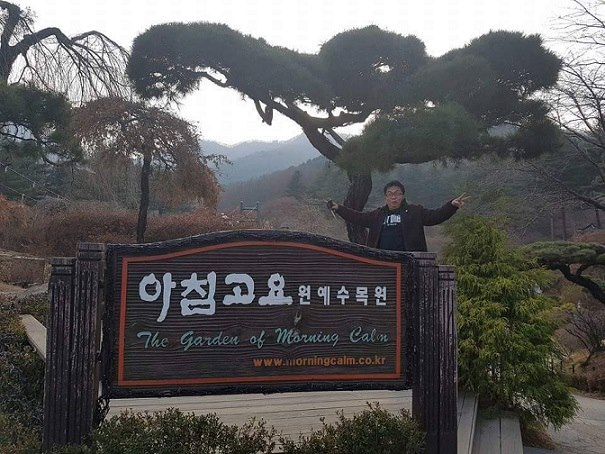 Mahigit limang taon na pala ako dito sa South Korea. Salamat sa Dakilang Maykapal sa pagkakataong ito. Mahaba-habang panahon na rin akong nagtatrabaho dito bilang guro sa isang unibersidad. Sana’y kaloobin ng Panginoon na manatili ako dito ng mas matagal pa.
Napakagandang oportunidad para sa akin na makapagturo dito. Hindi lamang dahil sa sahod. Alam na ng lahat na mas mataas ang kinikita ng mga “professionals” na nabigyan ng pagkakataon na sa ibang bansa makapagtrabaho. Dito kasi, bukod sa pagtuturo ay nakakapagsulat ako. Napakahalagang bahagi ng buhay ko ang pagsusulat – isang bagay na napakahirap gawin sa Pilipinas dahil maghapon ang trabaho. Kung school administrator ka pa, katulad ko noon, ay kakainin ng trabaho mo pati ang gabi. Kung may accreditation eh pihadong nanakawin nito maging ang madaling araw mo. Minsan (o kadalasan?), maging Sabado’t Linggo eh may mga gagawin pa rin. Kaya sa Pilipinas hindi ako nabigyan ng oras ang hilig ko sa pagsusulat.
Dito sa South Korea eh magtuturo lang ako ng walong (8) 2-hour subjects sa loob ng isang linggo at naglalagi sa office ko ng dagdag na tatlong (3) oras para sa student consultation at paperwork. Ang bawat 2-hour subject pa eh kaylangang ituro lang ng 100 minutes. Apat na araw lang ang pasok ko, dalawa doon eh half-day pa.
Kaya napakadami ng oras ko para makapagsulat. Sa dami nga ng bakanteng oras eh may panahon pa akong makapag-basa at pag-aralan ang mga gusto kong matutuhan. Dito nga eh natuto akong gumawa ng sarili kong website kung saan lahat ng mga katha ko eh doon ko ipina-publish.
Hindi swerte ang naghatid sa akin sa bansang ito. Hindi ako naniniwala sa swerte. Nagsunog ako ng kilay at naglaan ng panahon para dito. Gumastos ako’t nagsakripisyo. Pinaghandaan ko ito’t ipininalangin ng taimtim. Ang maging ESL teacher at makapagturo sa ibang bansa ay bahagi ng “career path” na inilatag ko para sa aking sarili maraming taon na ang nakakaraan.
Nasa crossroads ako noong taong 2011. Kung totoo ngang may mid-life crisis ay iyon na marahil ang pinagdaanan ko noon. Naramdaman kong may mga drastic changes akong dapat gawin sa buhay at sa aking propesyon. Napakarami kong tanong noon at alam kong ang kasagutan eh wala sa Pilipinas. Dalawang taon pa ang lumipas bago sa wakas eh napunta ako dito sa South Korea.
Marami akong inaplayang universities sa ibang bansa noong 2011 hanggang 2012. Kadalasang native speakers of English na mga guro ang hinahanap nila. Pero alam ko ring may ilang Pilipino na nagtuturo ng English sa ibang bansa kaya hindi ako sumuko sa paghahanap. At sa wakas, matapos akong mabigo sa 2 personal interviews para sa 2 universities sa Middle East, sa pangatlong pagkakataon, isang university sa South Korea ang nagbukas ng pintuan at ako’y pinatuloy.
Heto nga’t naka-limang taon na ako. Nagtuturo ako hindi lamang ng English. E-1 visa holder ako kaya pwede rin akong magturo ng content subjects. Sa kasalukuyan ay pinagtuturo din ako ng university namin sa Graduate School nito. Hindi lamang mga Koreano ang tinuturuan ko, maging mga foreigners man. May mga PhD at MBA students ako na galing sa mga bansa sa Africa as iba’t-ibang sulok ng Asia.
Dalawang beses akong nakakauwi ng Pilipinas sa isang taon – tuwing winter at summer break dito sa South Korea. Bayad kaming mga professors na nagtuturo sa mga universities sa bansang ito sa buong isang taon kaya kahit bakasyon eh tuloy ang sweldo namin.
Sa isang taon eh katumbas ng tatlong buwan na nasa Pilipinas ako kapiling ng mga mahal ko sa buhay. At kapag nandito naman ako eh mula umaga hanggang ako’y gising na nakabukas lang ang aking Skype kapag wala akong pasok. Parang nasa bahay din lang ako dahil nakikita ko ang ginagawa ng mga mahal ko sa buhay. Naririnig ko hindi lamang ang kanilang mga boses kundi pati ang mga kantang pinapakinggan nila, ang tahol ng mga aso namin, at maging ang tilaok at putak ng mga manok doon. Kaya hindi ako tinatalaban ng homesick. Hindi rin ako dinadalaw ng inip dahil sa lakas ng internet connection eh napakadaming pelikula ang pwedeng ma-download at napakadaming educational and motivational videos na pwedeng panoorin sa YouTube. Dagdag pa na alam ko kung paano hanapin sa Internet ang mga live na palabas ng paborito kong NBA. At kung ayaw ko naman manood eh may sariling gym ang university na pwede kong puntahan at mga hiking trails sa mga bundok na pwedeng lakaran. May hideway ako sa isang bundok dito kung saan ako minsan nagbababad para magbasa, magsulat, uminom ng beer mag-isa, at matulog.
Pangalawang tahanan ko na ang South Korea. Kapag kinaloob nga ng Panginoon ay gusto kong maka-limang taon o higit pa na makapagturo dito. Totoo ngang “Land of the Morning Calm” ang bansang ito. Dito ay kumalma ang katauhan ko. Natutuhan kong maging mahinahon, maghinay-hinay. Dito ay natuto akong mag-isip ng maayos bago gumawa ng desisyon. Nagkaroon ng mas malinaw na direksyon ang aking buhay dito.
Dito, dahil nga sa nakakahalubilo ko ang mga taong iba’t-iba ang wika at kulay ng balat ay natutuhan ko ang mas malalim na kahulugan ng respeto sa kapwa-tao.
Dito sa South Korea ay mas nakilala ko ang aking sarili. Higit sa lahat, natutuhan ko kung paano manalangin ng mas taimtim.
Paskong OFW

Walang simbahang dito’y mapupuntahan
Upang misa de gallo ay maipagdiwang
Sa bibingka’t puto-bumbong natatakam
Salabat na mainit walang makuhanan
Hanap-hanap ko ang mga batang paslit
Na tuwing gabi sa Disyembre’y nangungulit
Sintunado man kung sila ay umawit
Himig nilang pamasko’y nais madinig
Hinahanap ko’y parol na maliwanag
Walang matanaw makulay na Christmas lights
Wala ring Christmas trees na kumukutitap
Ganito ang pasko sa ibayong dagat
Ngunit ‘di bale nang wala iyong lahat
Kung ngayong pasko kita ay mayayakap
Ihain ma’y bibingka lang at salabat
Basta’t kapiling ka’t kamay mo’y aking hawak
Pagkaing masarap maghahanda pa ba
Kung sa noche buena ako’y mag-iisa
Aking christmas lights ‘di na sisindihan pa
Nang dibdib ‘di madurog sa pangungulila
 M.A.D. LIGAYA



 M.A.D. L I G A Y A