Category Archives: Philippine Culture
How Colonialism Shaped the Filipino Character
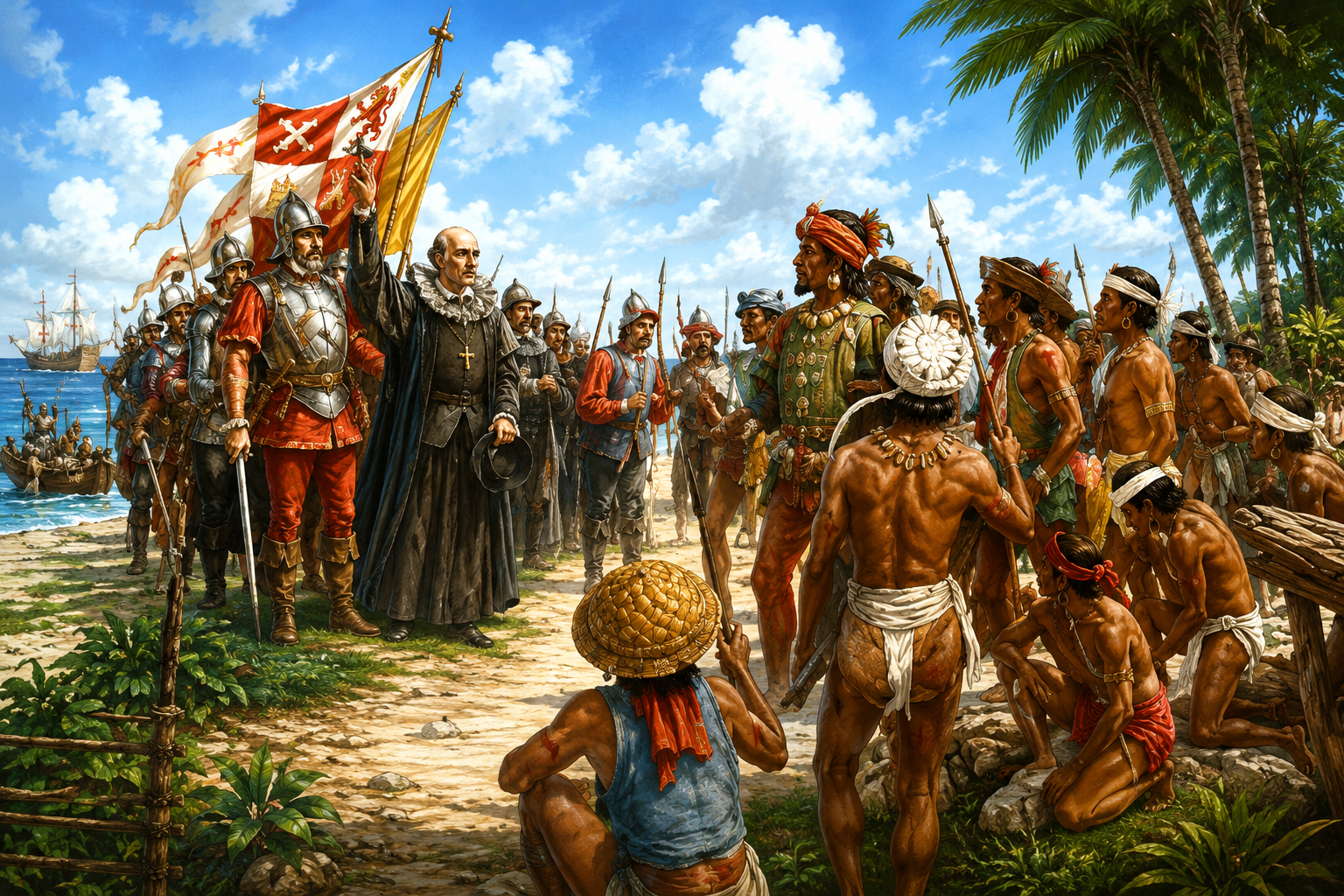
Ask a hundred Filipinos what makes a Filipino a Filipino, and you will likely get a hundred different answers — hospitality, resilience, family, faith, humor, an uncanny gift for finding joy in hardship. Ask a hundred more, and darker answers will surface too: a fatalism that shrugs at misfortune, a habit of measuring themselves against foreigners and coming up short in their own eyes, a suspicion of the next province that borders on hostility. Both sets of answers are true. Neither tells the whole story on its own.
This four-part essay is an attempt to tell that fuller story — not by cataloging Filipino traits as though they simply exist, the way eye color or height exists, but by asking where they came from. A people’s character is not accidental. It is built, layer upon layer, from the specific things that happen to them over specific centuries, under specific rulers. For the Filipino, those centuries were largely colonial ones: 333 years under Spain, nearly half a century more under the United States. To understand the Filipino today without reckoning with those years is to admire a house’s furniture while ignoring the foundation on which it was built.
This essay draws on historical record as much as personal reflection — the documented mechanisms of colonial administration alongside the lived, inherited patterns still visible in Filipino life today. Where the two meet is where this essay lives.
Part One lays that foundation, tracing the Filipino from a people already possessed of their own culture and governance before any galleon arrived, through the long violence of Spanish rule, to the betrayal that followed when a nation Filipinos had mistaken for an ally simply became their next colonizer.
Part Two turns to what survived — and what may have even been strengthened — through all of it: the hospitality, the resilience, the family loyalty and communal spirit that colonization tested but did not break.
Part Three turns to the cost — the fatalism, the regionalism, the colonial mentality that took root during those same centuries, planted deliberately by rulers who profited from a people divided against themselves and unsure of their own worth.
Part Four brings both halves together, arguing that the strength and the wound were never separate stories. They came from the same three hundred years, visited on the same people, and they live on, side by side, in the same national character today.
The writer does not pretend to have the final word on Filipino identity — no single essay could. But for a people whose history has too often been written by outsiders, and too rarely examined by themselves, even an incomplete reckoning is worth attempting. As you read what follows, you might find it useful to ask the same questions of your own family, your own province, your own habits of thought — because the history in these four parts is not abstract. It is, in some quiet way, still writing itself through each of us.
Understanding the wound is the first task. What a Filipino chooses to do with that understanding — for himself, his family, his country — is a separate reckoning, for another time. But understanding why we are the way we are remains the first step toward deliberately deciding who we choose to become next.
K-DREAM (Part 3)
(Last of 3 Parts)

For me, it is amazing how this country has gone this far, leaving my native land behind in the race to prosperity and stability. I want to know in what areas we Filipinos should improve if we intend to catch up with the South Koreans, and the rest of the world, in that race.
My desire to figure that out led me to read more about the history of this country. In the process, I discovered certain uncanny similarities between our historical experiences. South Korea and my native land are colonized nations and earned independence after the Second World War, and both countries embraced the democratic form of government. Additionally, just like in my country, the development of democracy in South Korea was also interrupted by military takeovers. And what a coincidence that martial law in this country and mine was declared in 1972. Was it also a coincidence that influential military leaders in both countries were removed via popular revolt in the mid-1980s?
Unfortunately, the similarities in the historical development of South Korea and my country stop there. We took different paths in building our nations from the ashes of colonization, the Second World War, and military juntas. However, the results differed even when the two countries were under totalitarian regimes with identical circumstances. Historians assert that it brought rapid industrialization to South Korea but, unfortunately, economic stagnation in the Philippines.
I really tried hard to figure out what happened. What went wrong for my country, and conversely, what did the South Koreans do correctly? To think that in the 1950s, while my country was soaking in the glory of being Asia’s second most robust economy, the Korean peninsula plunged into a devastating war.
I tried to probe deeper into this nation’s history to find the answers to the following questions I have in mind.
How did the South Koreans slay the ghosts of a bitter colonial past?
How did they survive the devastation wrought by the Korean War?
How did they triumph over internal political turmoil while trying to ward off a belligerent neighbor in North Korea?
How did the South Koreans accomplish all of those mentioned above and eventually catapult themselves to their current lofty position in the global community?
In my probe, I learned what the South Koreans did in 1998 at the height of the Asian financial crisis. They willingly donated their gold – jewelry (including their wedding rings), medals and trophies, good luck keys, and what have you. This they did to help save their economy during that crisis. As reported, the collective weight of the gold they donated may not be much. But more significant than the corresponding monetary value of their donation was the willingness of the South Koreans to make personal sacrifices for their country. Will the Filipinos do the same? I am not sure.
I call what the South Koreans did then an act of nationalism. If it’s not, then I don’t know what is. It is the same sense of nationalism that emboldened them to resist one military junta after another… to sacrifice their lives and limbs to lay the democratic foundations of their country, which eventually became a fertile ground that nurtured the economic prosperity they are currently enjoying.
Yes, my fellow Filipinos also sacrificed and resisted a dictatorship and, in the process, have even created the blueprint for a bloodless revolution – the EDSA revolution. But why were the Korean people able to ride the momentum of their victory after toppling a dictator to collectively bring their nation to prosperity, but we Filipinos could not? After both countries were ruled by dictators in 1972 and eventually returned to democracy approximately in 1987, where are they now economically and socio-politically speaking? ANSWER – South Korea is among the top 15 economies in the world, and the Philippines is far below the ranking. How did this happen?
My search for answers to questions that kept piling up prompted me to further my probe. After turning pages in the history of South Korea and my country, I decided to factor in variables that affect a country’s socio-political and economic development.
We know that nation-building is affected by geographical location, the pervading climate, political stability, natural resources, and human resources. Arguably, there are other factors, and those that I identified are obviously important. But the most vital in a country’s quest for development on all fronts is human resources. How far a country goes in terms of overall growth is contingent upon the quality or nature of its people.
National character is the construct used to embody the quality or nature of a group of people living in a country. Using Hofstede’s Cultural Dimension Theory (Hofstede’s 6-D Model) and the results of the extensive research done by its proponents on the cultures of 118 countries, I decided to make a simple comparative analysis of the national characters of South Koreans and Filipinos, hoping to find reasons why the latter is eating the dust of the former in the race to global significance.
I discovered that the Philippines is a highly hierarchical society, while South Korea is only slightly hierarchical. People in hierarchical organizations are said to embrace the notion that power is naturally unequally distributed and believe there is nothing they can do about it. They defer too much to their leaders, thinking that they are infallible.
That’s how we Filipinos are. We embrace the politicians we decided to follow to the point of fanatism, and we support them to a fault. The South Koreans also respect their leaders, but they strongly demand accountability.
Filipinos and South Koreans are collectivist societies, but the latter do not embrace individualism like the former. We Filipinos may have somehow absorbed the individualistic tendencies of our colonizers.
Filipinos are not so collectivistic. As a matter of fact, we are afflicted with a trait that we need to overcome if we wish to make our nation great. That trait is “kanya-kanya” – the tendency to think of personal, family, and group interests over and above general welfare. The South Koreans are quite the opposite. They consider the welfare of the many as necessary, if not more important than their personal interests. No wonder, as I previously mentioned, they donated their gold during the financial crisis in 1998. I also witnessed first-hand how the South Koreans willingly obeyed the restrictions set by their government during the early onslaught of the COVID-19 pandemic. Their leaders did not need to implement a “hard lockdown” like other countries did, including mine. The citizens strictly wore their masks, observed social distancing, and avoided leaving their homes unless necessary. They have shown their willingness to sacrifice for the greater good.
What is the reason behind the success of the political upheavals in my country in the 1980s not translating to meaningful socio-political and economic gains? Was it because they were driven not by the collective will of the Filipino people but by partisan politics?
What was clearly articulated in the findings of the extensive research done by the proponents of Hofstede’s 6-D Model is that the cultural dimensions of power distance (hierarchy) and collectivism/individualism are significantly positively correlated with wealth or prosperity. The Korean experience had me inferring that the less hierarchical and more collectivistic a society is, the more progressive it could become. And this has all the more expanded my K-dream. I wish Filipinos, like the South Koreans, would be less hierarchical and more collectivistic. Like them, we should demand accountability from our leaders. Like them, let’s think of the general welfare over and above our personal, group, and party interests. An important component of thinking for the common good is remembering our civic responsibilities, including contributing whatever we can to nation-building. But while we hold our leaders accountable, we should not forget that we, as citizens, have accountability too. Nation-building is a shared responsibility between leaders and citizens.
We must ask if Filipinos knowingly copied hook, line, and sinker the socio-political and economic models of our colonizers, or were we unknowingly indoctrinated or coerced to adopt them? Either way, what is clear is that we have yet to get desirable results. After decades of applying their economic and socio-political systems, our country is where it is now. Our needle of success as a nation needs to be moving. But we have been trying to fit the square peg of the countries that colonized us into our round hole. And to no avail. It’s not working. It’s time for us to rethink our strategies for nation-building. And this brings me to the culmination of my K-dream. I wish that we Filipinos give the South Korean economic, social, and political models a try. Let’s see what will happen if we embrace not only the popular culture of the South Koreans but also the standards and values that brought them to where they are now.
What Do Filipinos Need to Realize (4)
(Last in a Series)
The first three parts of this series of articles identified our serious faults as Filipinos – we sell our votes, we use questionable standards when choosing leaders, we treat elections as if they are popularity contests allowing immensely popular but inexperienced and incompetent celebrities to win, and we either keep restoring from the “recycle bin” the same traditional politicians or replace them with a family member.
Our inability to choose the right leaders is clearly one of the factors preventing us from reaching our full socio-political and economic potential as a nation.
We know that the government plays the most essential role in leading all efforts to make this country progressive. We need the best leaders if we really want to become a “developed nation.” It is our responsibility as citizens to select the best ones to hold the reins of government. Unfortunately, we keep failing to do so.
The funny thing is that after we put them into power – the politicians who won because they have the money to buy votes, celebrities-turned-politicians who are inexperienced and incompetent, and “recycled politicians” and the members of their political dynasties – we expect them to perform well. After every election, we expect a better-performing government.
And why would we expect a different government – a more effective one – when we know that we keep electing the same politicians or use the same old rotten standards when choosing new leaders?
Let us revisit Albert Einstein’s definition of insanity – “Doing the same thing over and over again and expecting a different result.”
But assuming that one day we restore our sanity and finally we refuse to sell our votes – finally we learn to elect into office the most deserving and most qualified among candidates – would the wheels of national development start rolling?
Not quite yet!
There’s one more problem, a problem more serious than our failure to vote wisely and conscientiously. The more serious problem of Filipinos, as mentioned in the first part of this series, is the mindset that that the leaders we elect are solely responsible in solving all of our society’s ills and nation’s problems.
We view our relationship with the state at the vantage point of “self-entitlement.” We think that it is the duty of our leaders to give us “this and that.” We say that the government should do “this and that” for us. See, we expect too much from leaders whom we don’t even choose using the best and most appropriate standards.
Is it the duty of the government to provide each citizen with food, cloths, and shelter?
Of course not!
What the government does, generally speaking, is to formulate, implement, and enforce the laws of the land, to build infrastructure, to ensure peace and order, and to create economic and other opportunities that would help its citizens enjoy the conveniences of life and have the best chance to get good education and find or create means of livelihood.
It is also not the duty of the government to provide everybody a job?
One of the functions of the government is to create an environment that would promote economic growth. They have to make sure that businessmen would be encouraged to invest and initiate businesses activities thus creating job opportunities. But jobs are not given in a silver platter. We have to search for job openings and apply and make sure that we have the required qualifications for the jobs we want. Getting ourselves ready for employment is a personal responsibility. The government will not deliver to our doorsteps the jobs that we want.
The government itself is also an employer but it cannot possibly provide each citizen with a job. It is also impossible for the private sector to employ everybody. That’s just the reality. Harsh it may be. Those who won’t get employed, or do not want to work for others because they have better plans for themselves, could perhaps succeed as entrepreneurs.
Not everybody would get a college degree. Not everybody are trained and destined to be in a workplace – either in the corporate world or in the academe. Some of us will be factory workers, sales clerks, farmers, fishermen, plumbers, drivers, gardeners, or what-have-you. It doesn’t matter whatever jobs we have for as long as they are decent and they allow us to earn a living honestly.
Don’t reason out that you came from a poor family and your parents could not send you to school to get a good education and have a better chance for a better life.
This is just how many of us Filipinos are. When we don’t succeed in life, when things don’t turn the way we expect them to, when we are not doing well in the different areas of our personal lives, we are always ready to check our “blame list” to find somebody or something to put the blame on. And our favorite whipping boy – the government. When we are done accusing our leaders for not doing their job well causing us to become losers, we next vent our ire on our parents saying that they did not work hard enough to ensure that we live a good life when we become adults.
We need to throw away that “blame list” for whether we like it or not we are personally responsible and accountable for our success and failure. There comes a time in our lives when we should become be self-sufficient, a time when we, not the government nor our parents, decide for ourselves and take full control of our destiny.
We Filipinos need to realize that unless we recognize our faults and change there’s no way our country becomes progressive and “developed.” We will never gain the respect of the community of nations if we remain the way that we are now.
Something was said by John F. Kennedy that we should reflect upon – “Ask not what your country can do for you – ask what you can do for your country.”
We Filipinos need to realize that there are two requirements for a country to become progressive and developed – good government and cooperative citizenry. Remove one and a country is doomed. The citizens and their leaders need to work harmoniously towards achieving national goals. There’s no other way. Both of them need to work hard. They have to work hand in hand.
What Do Filipinos Need To Realize (3)
(Third in a Series)
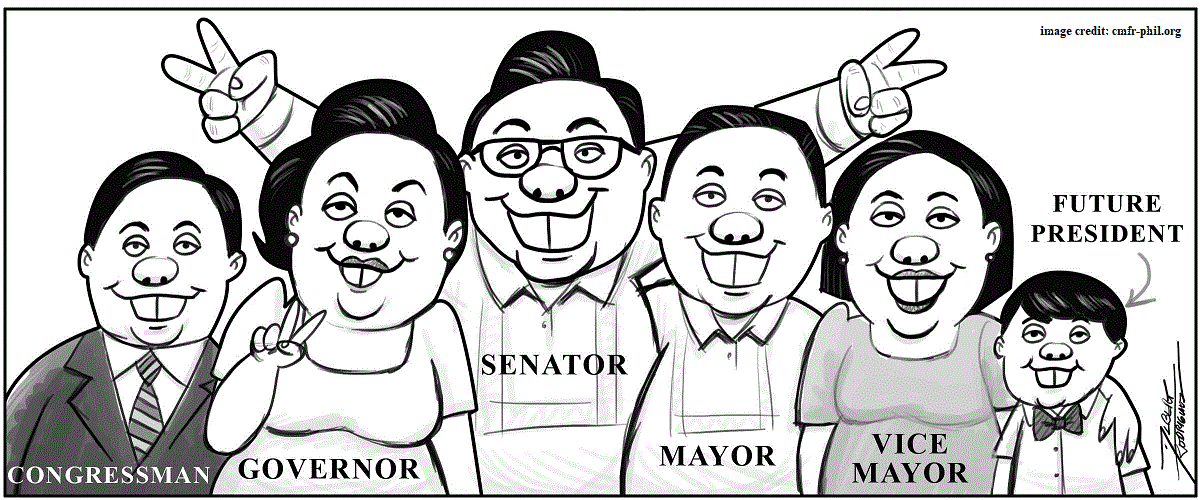
We’re complaining about political dynasties, right? But haven’t we Filipinos realized that we are so guilty of creating the political dynasties in the Philippines? Yes, we have to admit it. We allowed the same politicians and their family members to lord it over in the Philippine political landscape.
When a politician, let’s say a mayor, could no longer run for re-election due to term limits, what would the honorable gentleman do? Turn his back on politics? Of course not! Power is so addicting. So many of those who experienced to be at the helm of either local or national politics (and enjoyed the benefits, including those “passed under the table”) would not just quit politics nor pass the torch to another person.
So, what would happen?
His wife would run for the position he previously held. Then that politician would run for another post – as governor perhaps. Most of the time, Filipino voters would allow them to win and usually they would be able to mesmerize (or buy) the voters to luckily get re-elected until they reach their term limits. Would it be the end? Would their thirst for power (and the so-called “benefits”) be finally satiated?
HELL NO!
The couple would ask their son or daughter (or a grandson – or a granddaughter – or an in-law) to run for the positions they would vacate. The shocking thing (and you might not believe it), there are times that siblings, or even husbands and wives, would not give way to the other and so member of the same family would slug it out in the political arena. Anyway, this is not about family members squabbling in the political arena – this is about the political dynasty their families created.
Let’s continue then.
Let’s go back to the mother who just reached her term limit as mayor. Would she go back to being a full-time mother and wife? You were born only yesterday if you don’t know the answer to that question. Yes – she would run for the post vacated by the husband-politician. The husband would then aim for a higher position – run either as congressman or even senator. In case all family members win then for years that the power will change hands within the same family. The son (or daughter) is a mayor, the mother a governor and the father either as congressman or senator. When term limits are reached then they will just run for the position that a family member would vacate. Some siblings, and even in-laws, in the family are also occupying minor positions in the geographical units where they reside.
Did that family created their political dynasty? No! We ourselves did it. We Filipinos created the political dynasties in the Philippines.
And how did (have) these members of a few beholden families whom we allowed (are allowing) to exclusively hold the reins of our government – local to national – perform (been performing)?
You are either blind or dumb if you don’t know the answer to that question.
How many of the available positions in the Philippine government, local and national, are held by the same families who have been the gods and goddesses of Philippine politics since time immemorial? Most of them are offspring of the peninsulares who survived “America’s power grab” at the turn of the 20th century. They decided to stay in the country and reaped the dividends for doing so. And it’s not only the politics that they dominate. With the enormous fortune they inherited from their Spanish parents/grandparents (which the Americans allowed them to keep), they also control the country’s economy. That’s why Filipinos would sometimes jokingly ask – “Did the Spanish rule really end?”
Only a few pure-blooded Filipinos and foreign expatriates of Chinese origin who became wealthy when the Americans took their turn to colonize the Philippine had the financial resources to challenge the Spanish mestizos for political supremacy in the Philippines, especially after the American granted the Filipinos their independence after the World War II. Some of them succeeded and when they experienced how intoxicating power is, they (and their offsprings) kept running and we kept electing them as if nobody else were qualified.
It is no longer surprising to know that politicians occupying national positions have one, or two family members and in-laws occupying seats in the local government.
Filipinos might ask – “When would having the same people from the same families passing the reins of leadership to each other in both the national and local governments after elections end?”
That’s up to the Filipino voters.
So, we should not wonder why we as a nation could barely move the needle on socio-political stability and economic progress.
Socio-political stability and economic progress are the most important metrics that we ought to use when evaluating the performance of these leaders who are members of the few families whom we allowed to lord it over in Philipppine politics. We keep electing them then keep our fingers crossed that they will deliver.
According to Albert Einstein, “insanity” is doing the same thing over and over again and expecting a different result.
Why in the world we expect a better-performing government when we keep electing the same politicians from the same families? Are we insane?
On the Poll That Says “Most Filipinos trust US, not China” – A Case of National Amnesia or Triumph of US Indoctrination?

There is something more to that poll that says “most Filipinos trust US, not China” than meets the eyes. It affirms two things. First, Filipinos suffer from a national amnesia and second, the Americans completely succeeded in indoctrinating the people whom then US President McKinley referred to as “savage warriors” and “little brown brothers.1”
Majority of Filipinos trusting the US is a classic case of amnesia. It seems to support the perception that Filipinos tend to have short memory so much so that they easily forget the lessons of history.
Others would dismiss the idea that Filipinos have short memory. It’s just that the Christian in them would make them easily forgive and forget.
But have Filipinos really forgotten the atrocities committed against them by the Americans during the Philippine-American War (1898-1901)?” Or is it a case of them not knowing what really happened.
The world today, even the Filipinos themselves know little (or nothing) about what has been described by historians as the “first Vietnam”, where US troops first used tactics such as strategic hamleting and scorched-earth policy to “pacify” the natives2.
It’s very convenient for people from other countries to criticize Duterte, the Philippine president, for his stance against the Americans. If only they would bother to scan the pages of Philippine history they would know.
Like the Filipinos, the rest of humanity is suffering from amnesia…selective amnesia that is. It’s difficult to fathom why the world chose to remember only the atrocities committed by the Nazis during the Second World War and forget about the wrongdoings inflicted by the US and the other colonial powers upon the people they colonized.
The world thinks that Duterte’s anti-American sentiment stemmed only from the supposed attempt of the president of the US (Obama) to lecture him in an international gathering about the alleged extra-judicial killings in the Philippines. There was more to it… much more than the irony that the leader of a country who massacred thousands of Filipinos, including children and women, would take the moral high ground to lecture about “killings.”
For the most steadfast of the Duterte critics from other countries and the Filipinos who have forgotten their history here are links you can check…
But despite all of the wrongdoings inflicted upon them by the Americans, why then, according to the poll, Filipinos trust the US more than China?
That’s the result of years of American indoctrination.
Education is a powerful tool of indoctrination. Today’s generation of Filipinos are the offsprings of the children taught by the Thomasites (American teachers named after the ship, the USS Thomas, which brought them to the Philippines) to accept their rule. They did not only teach those young Filipinos the three R’s but also indoctrinated them about the greatness of America, its ways, ideas, values, culture3.
The indoctrination of that generations of Filipinos after the Philippine-American war was a tremendous success. “One look at our society say it all: the preference for American products, the promotion of materialism and hedonism, and a general obsession for all things American. No matter how Filipinos try to deny it, the Americans have succeeded in molding us into their ideal “little brown brothers.4”
The funny thing is Rappler, citing a survey conducted in 2013 by the Pew Research Center, said that “Filipinos like the US even more than Americans5.”
And would it be wrong to presume that none of the history books distributed in Philippine schools during their occupation of the archipelago ever mention about the brutal campaign the Americans waged in the Philippines to pacify the Filipinos?
“Until the lions have historians, tales of the hunt shall always glorify the hunters,” says an African proverb.
President Duterte showing (during the most recent ASEAN meeting held in Laos) photos where US soldiers could be seen posing with dead Filipino Muslims was just a right thing to do. With that act both the Filipinos and the world were reminded of some basic historical truths about the US.
What basic historical truths are those?
The US did not come to liberate Philippines from Spain but to join the competition for empire among the wealthy and powerful countries of the West and to establish a strong presence in the Pacific that would enable them to protect their economic interests.1 They duped Emilio Aguinaldo, the leader of the revolt against Spain, into believing that they didn’t need any colony. 6
The double-crossing of Aguinaldo was completed when the US concluded with Spain the Treaty of Paris without concurring with the Filipino people.6
The US was not at all benevolent to Filipinos. “The atrocities of American troops included: the torture of suspected rebels; refusing to take prisoners; wholesale massacres of entire villages of men, women and children and starvation resulting from relocating large populations.7”
Worst of all, the new colonial masters extinguished the flames of Filipino nationalism.
When the US decided to flex its muscles in the Pacific by colonizing the Philippines, Filipino nationalism which was struggling to develop was nipped in the bud. That dark period in the history of Filipino people was referred to as the “Era of Suppressed Nationalism6. Advocate independence from the US and the Filipinos would get either death penalty or a long prison term (Sedition Law, 1901). A simple display of the Filipino flag (Flag Law, 1907) would also get them into trouble6.
The young Filipinos today should be given an honest-to-goodness account of what really happened during the American occupation, particularly in its early years. They need to be presented with an objective analysis of the REAL reasons the Americans came, how it affected the development of Filipino nationalism and how their presence shaped Philippine politics.
It’s not to teach them to hate the Americans but for them to become aware of their past and decide whether or not US should be trusted.
Historical awareness will give the young Filipinos a better understanding of their identity. It will enable them to develop a proper perspective in appraising the current state of things in the country.
References:
[1] Brewer, Susan (2013, October 22). Selling Empire: American Propaganda and War in the Philippines. The Asia-Pacific Journal, Vol. 11, Issue 40, No. 1, October 7, 2013. [Cited 2016 October 29] Available from: http://www.globalresearch.ca/selling-empire-american-propaganda-and-war-in-the-philippines/5355055
[2] American Occupation of the Philippines . [Cited 2016 October 28] Available from: http://www.colorado.edu/AmStudies/lewis/2010/usoccupy.htm retrieved 10-28
[3] Simbulan, D. The modern principalia, the historical evolution of the Philippine ruling oligarchy, Quezon City: University of the Philippines Press; 2005.
[4] Eight Dark Chapters of Filipino-American History We Rarely Talk About (FilipiKnow) [Cited 2016 October 29] Available from: http://www.filipiknow.net/philippine-american-history/
[5] Filipinos like the U Even More Than Americans Do – PEW Research (Rappler) [Cited 2016 October 2016] Available from http://www.rappler.com/nation/56085-philippines-usa-pew-research.
[6] How colonialism shaped the Filipino character (Blog post) [Cited 2016 October 2016] Available from http://www.globalresearch.ca/selling-empire-american-propaganda-and-war-in-the-philippines/5355055.
[7] Ablett, Phillip. Colonialism In Denial: Us Propaganda In The Philippine-American War [Cited 2016 October 2016] Available from https://www.academia.edu/352646/Colonialism
_In_Denial_Us_Propaganda_In_The_Philippine-American_War?auto=download


 M.A.D. L I G A Y A