How Colonialism Shaped the Filipino Character (1st of 4 parts)
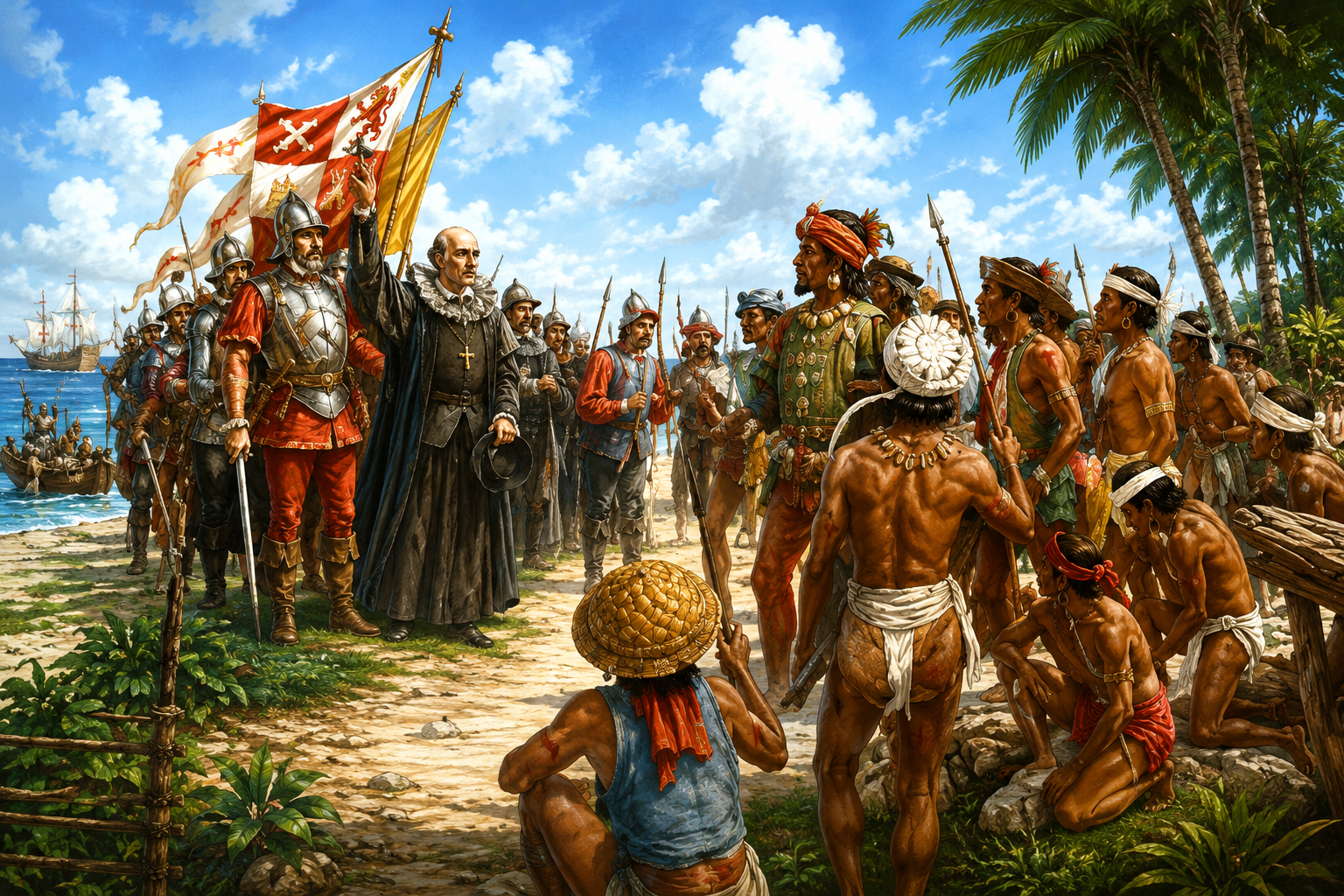
To better appreciate who and what the Filipino is, one has to decipher the Filipino psyche and identify the factors that contributed to its formation. An in-depth analysis of the character of this people would require a thorough examination of their history and racial origins. Filipinos cannot be figured out by leaning on stereotypes or by viewing them through a supremacist lens.
Those who claim to know Filipinos simply by piecing together information from the internet are gravely mistaken. Those who form assumptions after reading a news item or two — without even checking the credibility of the source — should hold their horses.
The pre-colonial Filipino belonged to a race whose culture and gene pool were already a mix of Negrito, Indones, Malay, Arab, Hindu, and Chinese influences, a spirit shaped, for better or worse, by the geography of the islands and their climate. A genetic and cultural identity was already flourishing in this part of Southeast Asia before the Portuguese explorer Magellan and his Spanish expedition landed in Mactan in 1521. A national identity was still evolving when the Spaniards, led by Miguel Lopez de Legazpi, returned in 1565 to establish a stronghold in what the Europeans would later call “Las Islas Filipinas.”
Long before any galleon touched these shores, the islands were already organized into barangays — communities governed by a datu, bound by custom rather than written code, where land and harvest were often held and worked in common. Women held real standing in that world: many served as babaylan, ruling as spiritual and healing authorities in their own right, in a system where leadership did not automatically bypass them the way it would under the friars and the patriarchy they imported. Mutual aid between neighbors — the impulse that would later be called Bayanihan — was already a fact of daily life, not a virtue invented by hardship. The Filipino, in other words, arrived at the colonial encounter already possessing values worth protecting, not empty of them.
The 1989 discovery of the Laguna Copperplate proved — or affirmed what historians had long suspected — that a well-organized form of government based on customary law existed in the Philippines long before the Spaniards arrived [1]. The pre-colonial Filipino was no lost soul waiting to be rescued from the Dark Ages. If anything, it may have been the other way around: the arrival of the Europeans could just as easily have disrupted a culture already on its own path of development, for better or worse. A people was already becoming something, and that becoming veered off course the moment Western colonizers succeeded in subduing them.
For 333 years, the Filipinos lived at the mercy of the Spanish conquistadors. Scattered revolts broke out across the country to overthrow the invaders from the Iberian Peninsula, but each was crushed in turn. The most significant of these was the uprising led by Francisco Dagohoy in Bohol, which lasted more than 80 years (1744–1829). These early attempts to overthrow Spanish rule failed for three reasons: they lacked a unifying national character, were confined to limited geographic areas, and were driven by narrow, localized grievances rather than a shared national cause [2]. It was not until the 1896 revolution that Filipino resistance finally succeeded, leading to the declaration of Philippine independence in 1898.
That mercy, it must be said, was never absolute. Spain’s writ never fully reached the Muslim sultanates of Mindanao and Sulu, nor the highland peoples of the Cordillera — both of whom resisted colonization throughout, and in the case of the Moro sultanates, arguably never fully surrendered at all. What follows in this series, then, is largely the story of the lowland, Christianized Filipino — the majority experience, but not the whole of it. The character traced here is real, but it is not universal, and any honest reckoning with what colonization did to “the Filipino” should say so plainly.
But independence was short-lived.
The Americans, whom the Filipinos believed had come to help them build a republic, had other plans. They persuaded Emilio Aguinaldo, leader of the revolt against Spain, that America had no interest in claiming a colony — that they had come only to free the natives from Spanish rule. In reality, the Treaty of Paris of 1898 saw Spain cede the Philippines to the United States for $20 million, worth well over half a billion dollars today — one of the terms the two powers negotiated and concluded without so much as consulting the Filipino people. The Filipinos watched, powerless, as Spain — too proud to surrender to the very “Indios” it had enslaved for centuries — surrendered instead to the Americans.
Would the Americans really have paid the Spanish that enormous sum and walked away with nothing in return? Hell no — that’s what any geopolitical expert would tell you. America, an emerging world power at the time, needed a foothold in the Pacific, and the Philippines was the ideal prize. So, contrary to the promise Aguinaldo later admitted he had naively believed, the Americans declared the Philippines a territory ceded to them by Spain.
This betrayal was a bitter blow to the Filipinos. After centuries of resisting Spanish domination, they had finally hoped to chart their own destiny as a nation — only to find themselves facing a new colonial master. The search for freedom was far from over.
When the Spaniards withdrew, the Filipinos took up arms against a far more powerful American force. It was David against Goliath — and in this telling, Goliath won. But it did not end for lack of trying: the Filipinos stood their ground and fought as fiercely as they could, gallantly resisting for three long years before losing the Philippine-American War (1899–1902).
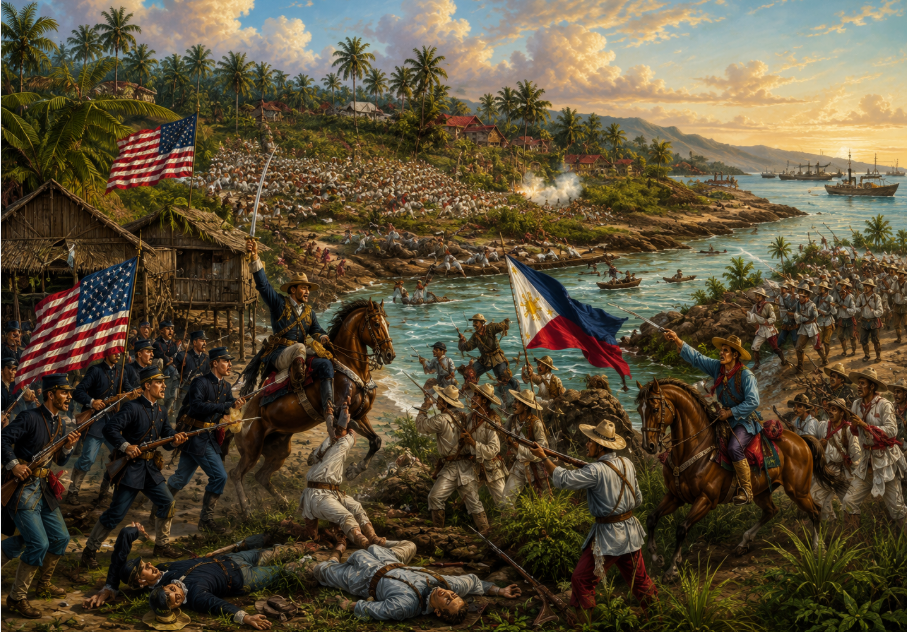
And so the Philippines changed hands once more — from the Spanish yoke to the American.
Once in control, the Americans moved quickly to make sure no second uprising would follow the first. Laws like the Sedition Law of 1901 — which imposed death or long imprisonment on anyone who so much as advocated independence, even by peaceful means — and the Flag Law of 1907, which banned the display of the Philippine flag anywhere in the country, extinguished what little remained of the nationalist fire the revolution had lit [9].
As the Philippines transitioned from Spanish to American rule, elements of both cultures became woven into Filipino society, leaving a deep imprint on the nation’s values, traditions, and even its gene pool. The policies each colonizer enforced in turn undeniably shaped the evolution of the Filipino character.
The 20th century saw the rise of a distinct post-colonial Filipino identity — a fusion of Asian and European influences, shaped by a history of colonization and hardened by resilience in the face of frequent natural disasters. This character continues to evolve even now, blending the past with contemporary influences.
The parts that follow will trace exactly that transformation — the hospitality, resilience, and close family ties that colonization tempered rather than created; the fatalism, regionalism, and colonial mentality it left behind as open wounds; and, in the end, the paradox of a people whose greatest strength and deepest self-doubt trace back to the very same three centuries.
How did these centuries of colonization shape the Filipino character? How did Spanish cruelty and American betrayal mold the values and traits of the Filipino people? These questions remain central to understanding what it means to be Filipino today.
___________________________
[1] philippinestudies.net
[2] asianjournalusa.com
[3] http://www.thefilipinomind.com
Notes: Images used were taken from the following sites:
lifestyle.inquirer.net
angelsinasphere.wordpress.com
http://www.boundless.com
How Colonialism Shaped the Filipino Character (2nd of 4 Parts)

Posted on October 18, 2015, in Colonization, Filipino Values and Traits, Phiilppines, Philippine History and tagged Colonialsim, Filipino Values and Traits, Philippine History, Philippines. Bookmark the permalink. 3 Comments.



That’s an excellent introduction. Thank you for sharing .
LikeLiked by 1 person
Thanks!
What inspired (or shall I say agitated) me to write this piece was a discussion I had with an expat here in South Korea. In that chat I had with that member of the Aryan race, the racist spikes of his rhetoric pricked my Filipino pride, but I kept my composure. He tried to sweeten his queries with his seeming interest in our national affairs and a mention of some of our good traits but his over-all discourse was unmistakably adorned with supremacist underpinnings.
LikeLike
Reblogged this on HARDPEN'S PORTFOLIO.
LikeLike