Category Archives: Hofstede’s Cultural Dimension Theory
K-DREAM (Part 3)
(Last of 3 Parts)

For me, it is amazing how this country has gone this far, leaving my native land behind in the race to prosperity and stability. I want to know in what areas we Filipinos should improve if we intend to catch up with the South Koreans, and the rest of the world, in that race.
My desire to figure that out led me to read more about the history of this country. In the process, I discovered certain uncanny similarities between our historical experiences. South Korea and my native land are colonized nations and earned independence after the Second World War, and both countries embraced the democratic form of government. Additionally, just like in my country, the development of democracy in South Korea was also interrupted by military takeovers. And what a coincidence that martial law in this country and mine was declared in 1972. Was it also a coincidence that influential military leaders in both countries were removed via popular revolt in the mid-1980s?
Unfortunately, the similarities in the historical development of South Korea and my country stop there. We took different paths in building our nations from the ashes of colonization, the Second World War, and military juntas. However, the results differed even when the two countries were under totalitarian regimes with identical circumstances. Historians assert that it brought rapid industrialization to South Korea but, unfortunately, economic stagnation in the Philippines.
I really tried hard to figure out what happened. What went wrong for my country, and conversely, what did the South Koreans do correctly? To think that in the 1950s, while my country was soaking in the glory of being Asia’s second most robust economy, the Korean peninsula plunged into a devastating war.
I tried to probe deeper into this nation’s history to find the answers to the following questions I have in mind.
How did the South Koreans slay the ghosts of a bitter colonial past?
How did they survive the devastation wrought by the Korean War?
How did they triumph over internal political turmoil while trying to ward off a belligerent neighbor in North Korea?
How did the South Koreans accomplish all of those mentioned above and eventually catapult themselves to their current lofty position in the global community?
In my probe, I learned what the South Koreans did in 1998 at the height of the Asian financial crisis. They willingly donated their gold – jewelry (including their wedding rings), medals and trophies, good luck keys, and what have you. This they did to help save their economy during that crisis. As reported, the collective weight of the gold they donated may not be much. But more significant than the corresponding monetary value of their donation was the willingness of the South Koreans to make personal sacrifices for their country. Will the Filipinos do the same? I am not sure.
I call what the South Koreans did then an act of nationalism. If it’s not, then I don’t know what is. It is the same sense of nationalism that emboldened them to resist one military junta after another… to sacrifice their lives and limbs to lay the democratic foundations of their country, which eventually became a fertile ground that nurtured the economic prosperity they are currently enjoying.
Yes, my fellow Filipinos also sacrificed and resisted a dictatorship and, in the process, have even created the blueprint for a bloodless revolution – the EDSA revolution. But why were the Korean people able to ride the momentum of their victory after toppling a dictator to collectively bring their nation to prosperity, but we Filipinos could not? After both countries were ruled by dictators in 1972 and eventually returned to democracy approximately in 1987, where are they now economically and socio-politically speaking? ANSWER – South Korea is among the top 15 economies in the world, and the Philippines is far below the ranking. How did this happen?
My search for answers to questions that kept piling up prompted me to further my probe. After turning pages in the history of South Korea and my country, I decided to factor in variables that affect a country’s socio-political and economic development.
We know that nation-building is affected by geographical location, the pervading climate, political stability, natural resources, and human resources. Arguably, there are other factors, and those that I identified are obviously important. But the most vital in a country’s quest for development on all fronts is human resources. How far a country goes in terms of overall growth is contingent upon the quality or nature of its people.
National character is the construct used to embody the quality or nature of a group of people living in a country. Using Hofstede’s Cultural Dimension Theory (Hofstede’s 6-D Model) and the results of the extensive research done by its proponents on the cultures of 118 countries, I decided to make a simple comparative analysis of the national characters of South Koreans and Filipinos, hoping to find reasons why the latter is eating the dust of the former in the race to global significance.
I discovered that the Philippines is a highly hierarchical society, while South Korea is only slightly hierarchical. People in hierarchical organizations are said to embrace the notion that power is naturally unequally distributed and believe there is nothing they can do about it. They defer too much to their leaders, thinking that they are infallible.
That’s how we Filipinos are. We embrace the politicians we decided to follow to the point of fanatism, and we support them to a fault. The South Koreans also respect their leaders, but they strongly demand accountability.
Filipinos and South Koreans are collectivist societies, but the latter do not embrace individualism like the former. We Filipinos may have somehow absorbed the individualistic tendencies of our colonizers.
Filipinos are not so collectivistic. As a matter of fact, we are afflicted with a trait that we need to overcome if we wish to make our nation great. That trait is “kanya-kanya” – the tendency to think of personal, family, and group interests over and above general welfare. The South Koreans are quite the opposite. They consider the welfare of the many as necessary, if not more important than their personal interests. No wonder, as I previously mentioned, they donated their gold during the financial crisis in 1998. I also witnessed first-hand how the South Koreans willingly obeyed the restrictions set by their government during the early onslaught of the COVID-19 pandemic. Their leaders did not need to implement a “hard lockdown” like other countries did, including mine. The citizens strictly wore their masks, observed social distancing, and avoided leaving their homes unless necessary. They have shown their willingness to sacrifice for the greater good.
What is the reason behind the success of the political upheavals in my country in the 1980s not translating to meaningful socio-political and economic gains? Was it because they were driven not by the collective will of the Filipino people but by partisan politics?
What was clearly articulated in the findings of the extensive research done by the proponents of Hofstede’s 6-D Model is that the cultural dimensions of power distance (hierarchy) and collectivism/individualism are significantly positively correlated with wealth or prosperity. The Korean experience had me inferring that the less hierarchical and more collectivistic a society is, the more progressive it could become. And this has all the more expanded my K-dream. I wish Filipinos, like the South Koreans, would be less hierarchical and more collectivistic. Like them, we should demand accountability from our leaders. Like them, let’s think of the general welfare over and above our personal, group, and party interests. An important component of thinking for the common good is remembering our civic responsibilities, including contributing whatever we can to nation-building. But while we hold our leaders accountable, we should not forget that we, as citizens, have accountability too. Nation-building is a shared responsibility between leaders and citizens.
We must ask if Filipinos knowingly copied hook, line, and sinker the socio-political and economic models of our colonizers, or were we unknowingly indoctrinated or coerced to adopt them? Either way, what is clear is that we have yet to get desirable results. After decades of applying their economic and socio-political systems, our country is where it is now. Our needle of success as a nation needs to be moving. But we have been trying to fit the square peg of the countries that colonized us into our round hole. And to no avail. It’s not working. It’s time for us to rethink our strategies for nation-building. And this brings me to the culmination of my K-dream. I wish that we Filipinos give the South Korean economic, social, and political models a try. Let’s see what will happen if we embrace not only the popular culture of the South Koreans but also the standards and values that brought them to where they are now.
Examining National Character and Development in Selected Southeast Asian Countries and South Korea
A research paper published in the ASEAN-Korea Centre’s official publication and later presented at an international conference
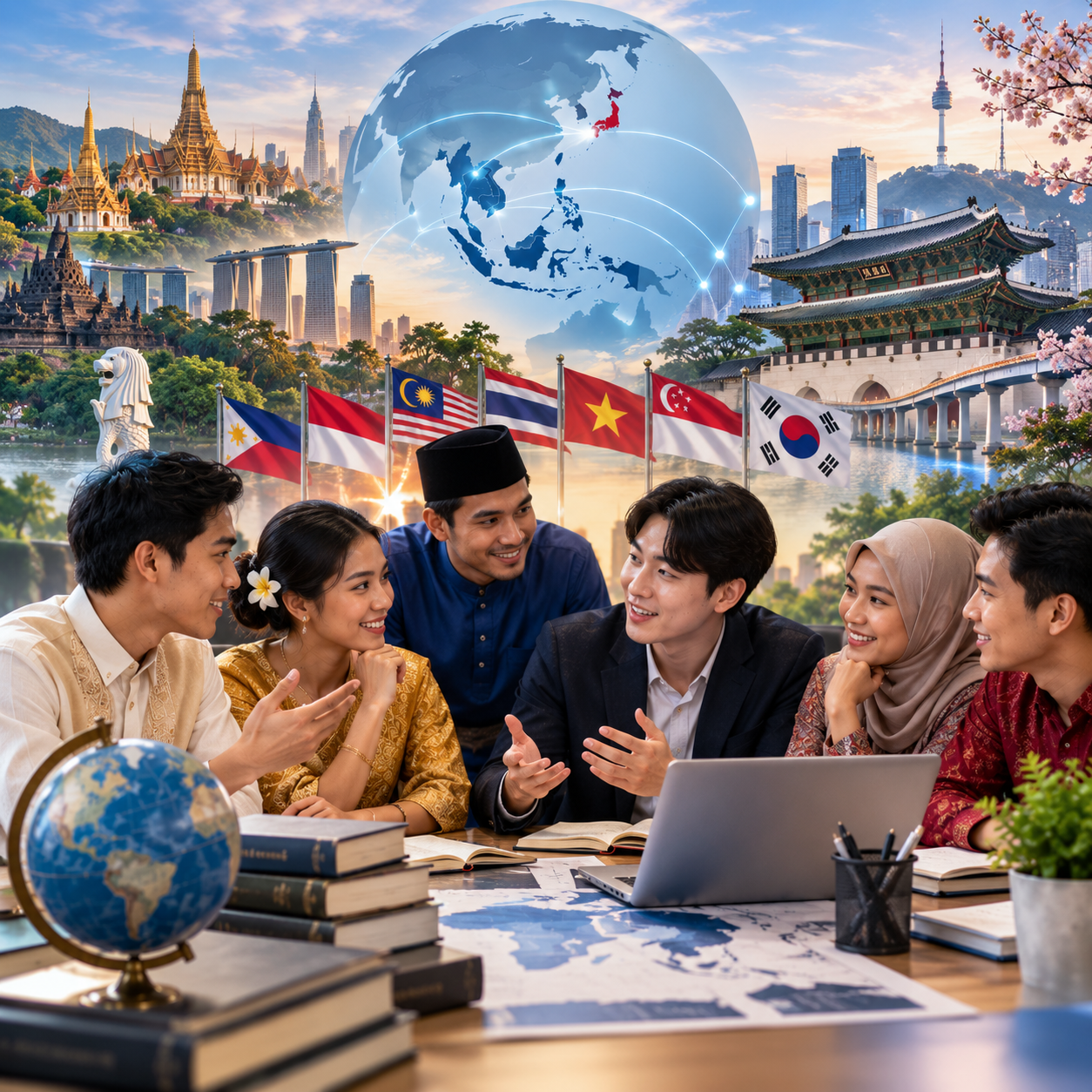
Examining National Character and Development in Selected Southeast Asian Countries and South Korea
Massuline Antonio D. Ligaya, LPT, PhD
A scholarly essay published by the ASEAN-Korea Centre under the Council of ASEAN Professors in Korea (CAPK) Essay Series
CAPK Essay #2 | December 20, 2021
Presented at the 3rd Biennial International Conference on International Relations, August 11–12, 2022, Bandung, Indonesia
Summary
This scholarly essay examines whether differences in national character might help illuminate differences in socio-economic and human development among South Korea, Malaysia, the Philippines, and Vietnam. Rather than treating national character simply as a collection of personality traits, the essay approaches it through cultural, socio-economic, and political lenses. At its core is a broader question: to what extent might the shared cultural orientations of a people be associated with the development achieved by their nation, and what lessons might selected Southeast Asian countries draw from South Korea’s development experience?
The analysis adopts a descriptive-comparative approach and uses two principal frameworks. National character is examined through Hofstede’s six dimensions of national culture: power distance, individualism versus collectivism, masculinity versus femininity, uncertainty avoidance, long-term versus short-term orientation, and indulgence versus restraint. National development, meanwhile, is viewed primarily through the Human Development Index (HDI), which incorporates indicators of health, education, and standard of living. The essay relies on secondary data and previously published sources rather than original survey, experimental, or other primary data.
The inquiry is organized around four central concerns: how the national character of the four countries may be described using Hofstede’s cultural dimensions; how their levels of development compare using HDI; what inferences may reasonably be drawn concerning the relationship between cultural orientations and national development; and what selected Southeast Asian countries might learn from South Korea’s socio-economic and political development experience.
The comparative analysis identifies notable differences among the four countries. Within the data used in the essay, South Korea emerged as the least hierarchical, most collectivist, most long-term oriented, and most restrained of the four societies examined. It also ranked highest in human development. Among the three Southeast Asian countries, Malaysia recorded the strongest HDI performance, while the Philippines and Vietnam ranked lower on several development indicators.
Particular attention is given to long-term orientation as a potentially important feature of the South Korean development experience. The essay considers Korea’s emphasis on education, investment in research and development, strong work orientation, future-oriented planning, and expectations of accountability from public leaders as cultural and institutional characteristics that may have accompanied the country’s rapid transformation. These characteristics are considered not in isolation, but within the wider historical, educational, economic, and political environment in which South Korean development occurred.
The analysis, however, does not establish that Hofstede’s cultural dimensions caused the differences in development observed among the four countries. The relationships discussed are interpretive inferences based on cross-national comparison and secondary evidence rather than statistically tested causal effects. Indeed, the essay itself recognizes difficulties in interpreting national cultures exclusively through standardized dimensional scores. Some apparent tensions are noted between Hofstede’s classifications and observable characteristics of South Korean society—for example, Korea’s classification as relatively feminine and highly uncertainty-avoidant alongside its intense competitiveness and record of technological innovation.
The essay consequently treats the South Korean experience not as a model that Southeast Asian countries should simply reproduce, but as a source of potentially transferable lessons. Among the areas identified for consideration are sustained investment in education, research and development, long-term planning, cultivation of human resources, and public accountability. The implication is not that countries should adopt Korean cultural characteristics wholesale, but that policymakers may examine particular practices and orientations and determine which are compatible with their own histories, institutions, and cultural circumstances.
Importantly, the discussion also recognizes that national development should not be judged by economic achievement alone. South Korea’s extraordinary economic and educational progress is considered alongside social concerns associated with a highly demanding society, including long working hours, low fertility, divorce, and suicide. The essay therefore offers a qualified view of development: material prosperity and international competitiveness are important, but the human and social costs accompanying development must also be considered.
Overall, the essay suggests that national development emerges from a complex interaction of culture, institutions, human resources, education, leadership, policy choices, and historical circumstances. National character may provide one useful lens through which differences among countries can be explored, but it should not be treated as a single or deterministic explanation for why some nations develop more rapidly than others.
Scholarly Contribution
The essay contributes a theory-guided, cross-national perspective on national character and development by bringing Hofstede’s cultural framework into conversation with HDI and other socio-economic indicators. Its value lies less in demonstrating causal relationships than in using systematic comparison to raise questions about how cultural orientations, institutions, education, leadership, and long-term policy choices may interact in shaping national development.
A further contribution is its attempt to move discussion of South Korea’s development beyond economic statistics. By considering cultural orientations alongside education, research and development, governance, and human well-being, the essay encourages a broader understanding of what other developing societies might—and might not—learn from the Korean experience. Its central implication is one of selective learning rather than simple imitation: practices that have contributed to South Korea’s progress may offer useful lessons, but their relevance must be evaluated within the particular cultural and institutional contexts of other nations.
Keywords: national character; national development; culture; Hofstede’s Cultural Dimensions; Human Development Index; South Korea; Southeast Asia
Publication Information
The essay was published on December 20, 2021, as CAPK Essay #2 through the ASEAN-Korea Centre / Council of ASEAN Professors in Korea.
Full Text
The full text of this publication is available upon request. Researchers, educators, students, and other interested readers who wish to obtain a copy may contact the author through this website or by email at madligaya@gmail.com.



 M.A.D. L I G A Y A