Author Archives: M.A.D. LIGAYA
Ang Talong Ni Father
 Heto pong si Father ay mayroong hardin
At talong ang noo’y doon nakatanim
Isang araw nang mga bunga’y aanihin
Biglaang mga bisita’y nagsidating.
Naroo’y si lola Basyang, isang biyuda
Kasama’y si Luring, matandang dalaga
At nang mga talong kanilang nakita
Biglaang nanlaki kanilang mga mata.
“Ang talong po ba ninyo’y puwedeng hawakan?”
Ang tanong kay Father nitong lola Basyang.
“Basta ba paghawak mo’y hinay-hinay lang.”
Ang wika ng pari bilang katugunan.
“Ah father …” Wika naman ni aling Luring.
“Ang talong po ninyo’y kay sarap himasin.
Mahaba’t kay kinis ang sarap kagatin.”
Ani father, “Inyo po munang lutuin.”
“Naku… naku kayo po eh sobrang pilya.
Kung talong ko’y gusto n’yo, sige dampot na.”
“Ay thank you po! Ang bait mo father talaga.”
Ang sabay na sabi ng soltera’t biyuda
“Oh bakit po tatlo ang inyong kinuha
Gayong kayo naman po eh dadalawa?”
At ang kasagutan ng biyuda’t soltera –
“Eh uulamin po namin itong isa.”
Human rights victimization and self-esteem of university students: Mediating effects of hope and moderating effects of human rights awareness
A research paper published in a Scopus-indexed journal

Human Rights Victimization and Self-esteem of University Students: Mediating Effect of Hope
and Moderating Effects of Human Rights Awareness
Massuline Antonio D. Ligaya & Chang Seek Lee
Indian Journal of Public Health Research & Development, Vol. 9, No. 9, September 2018, pp. 1138–1142
DOI: 10.5958/0976-5506.2018.01151.8
Research Summary
Human dignity lies at the heart of human rights, and violations of those rights can have important psychological consequences. Because self-esteem reflects an individual’s sense of self-worth and personal dignity, experiences of human rights victimization may undermine how people perceive and value themselves. This study examined the relationship between human rights victimization and self-esteem among university students in South Korea, while investigating two psychological and cognitive factors that might help explain or alter that relationship: hope and human rights awareness.
The study involved 233 university students selected through purposive sampling from universities located in Seosan City, Chungcheongnam Province, and Mokpo City, Jeonnam Province. The participants had a mean age of 22.6 years; 149 were female and 84 were male. Established instruments were used to measure human rights victimization, hope, human rights awareness, and self-esteem. The scales demonstrated acceptable to high internal reliability. Data were analyzed using SPSS and Hayes’ PROCESS macro, with bootstrapping employed to examine mediation and moderation effects.
Correlation analysis revealed that human rights victimization was significantly and negatively associated with self-esteem (r = −.452, p < .01), hope (r = −.324, p < .01), and human rights awareness (r = −.132, p < .05). In contrast, hope was strongly and positively related to self-esteem (r = .601, p < .01), suggesting that students with greater hope also tended to possess higher levels of self-esteem.
The mediation analysis provided further insight into this relationship. Human rights victimization had a significant negative effect on hope, while hope had a significant positive effect on self-esteem. Bootstrapping confirmed a significant indirect effect, demonstrating that hope mediated the relationship between human rights victimization and self-esteem. In other words, victimization was associated with diminished hope, which in turn was associated with lower self-esteem. Conversely, maintaining or strengthening hope may help protect an individual’s sense of self-worth in the face of adverse experiences.
The study also found that human rights awareness moderated the relationship between victimization and self-esteem. The interaction between human rights victimization and human rights awareness was statistically significant, indicating that the association between victimization and self-esteem varied according to students’ level of human rights awareness. This finding highlights awareness of one’s rights as an important factor in understanding how experiences of victimization relate to psychological well-being.
Taken together, the findings show that the consequences of human rights victimization cannot be understood solely through the direct relationship between victimization and self-esteem. Psychological resources such as hope and an individual’s awareness of human rights form part of a more complex process through which experiences of victimization are associated with self-perception and well-being. The study therefore points toward educational and institutional interventions that strengthen students’ hope, awareness of their rights, and capacity to respond constructively when those rights are violated.
Research Contribution
The study contributes to the literature on human rights and psychological well-being by moving beyond a simple victimization–self-esteem relationship and examining both a mediating and a moderating mechanism. By identifying hope as a mediator and human rights awareness as a moderator, it offers a more nuanced account of the factors associated with university students’ self-esteem following experiences of human rights victimization. The findings also provide a basis for universities to consider human rights education and hope-enhancing interventions as complementary approaches to supporting students’ psychological well-being.
Keywords: human rights, human rights victimization, human rights awareness, self-esteem, hope, university students, mediation, moderation
Full Text
The full text of this publication is available upon request. Researchers, educators, students, and other interested readers who wish to obtain a copy may contact the author through this website or by email at madligaya@gmail.com.
Beyond Positive Thinking

Some people would say that “life sucks.”
Really!?
I adhere to the dictum that “Life is what we make it.” I believe then that when people say that “life sucks” it’s because that’s the way they made it to be. The kind of life we live is defined by the mind-set we have. It is one’s way of thinking that would make life suck. It is the negative attitude towards life that make people fail in their undertakings – it is what makes them unhappy and dissatisfied. It’s in the midst of all their failures, sadness and dissatisfaction that they say “life sucks.”
People are seemingly not sold on the idea that their way of thinking affects the way they live life and would determine whether or not they succeed. It is hard for them to accept that it is their innate responsibility to examine their way of thinking and ensure that it doesn’t stand in their way to happiness and success. This is something I learned so late in life. How I wish I had learned so when I was younger.
I have heard a lot of things about positive thinking before but it was only around 2009 that I started digging deeper into the idea and it took a few more years before I really became serious about it.
I realized that there is more to positive thinking than veering away from negative thoughts and shedding off negative attitudes.
It all began when I watched a film entitled “The Secret.” I saw the DVD of the movie by accident. The store owner mixed it with regular movies. When I bought it, I had no idea what it was. There was no synopsis, not even a brief note explaining anything about it. That was it… everything was what the title suggests – SECRET.
I thought it was either a mystery-thriller or a sci-fi movie. When I played, it I found out that it was some kind of a “self-help” film. It was technically a documentary. I have to admit that at first I considered the ideas presented as preposterous. Things I was seeing and hearing from the beginning of the film were like lifted straight from the pages of a science fiction book… but at the same they also tickled my curiosity.
So, I continued watching and tried to be open-minded and thought of the information in the film as tips for personality development. I have always considered anything that advocates positive change as worth my time and worth trying. I watched it a few more times after that and even shared the ideas I learned to my students whenever I would see a connection to the contents of the topic we’re discussing.
Then I decided to do an internet search for one of the speakers in the documentary who impressed me the most – Bob Proctor. That internet search led me to his (Bob Proctor’s) motivational videos on YouTube and to links to information and videos of other motivational speakers such as Wayne Dyer, Les Brown, Jim Rohn, Joe Dispenza, Brendon Burchard, Brian Tracy, Zig Ziglar, Tony Robbins, Simon Sinek, Tom Bilyeu, John Maxwell and Mel Robbins.
I watched the videos of the said speakers and searched for electronic copies of the books they have written. At first, it was like once a week that I would play their videos on YoutTube until such time that I started doing it everyday – in the morning and at night. It became part of my daily routine.
I found out later that Napoleon Hill, Earl Nightingale, and Earl Shoaff came ahead of the motivational speakers previously mentioned. My constant browsing of the internet intended to quench what has seemingly become an insatiable thirst for ideas for personality development led me to the works of one of the “pioneering figures of modern inspirational thoughts” – James Allen. His most famous book – “As A Man Thinketh” – set straight everything I learned about positive thinking.
Dr. Joe Dispenza’s book “Evolve Your Brain: The Science of Changing Your Mind” provided enough science into the positive thinking paradigm that wiped out whatever doubts I had about it. I love the way Dr. Wayne Dyer incorporated Asian philosophies into that paradigm and the infusion of practical wisdom and humor to it by Jim Rohn and Les Brown.
Then John C. Maxwell made me think the way I think. His book “Thinking For A Change” reminded me of the value of effective and creative thinking. His suggestions on how to be more focused and creative in the way people should think are very practical but tremendously effective.
I didn’t take everything I read and heard from motivational speakers hook, line, and sinker. I always had my filters and my critical lens ready when I listened to talks and read books. I analyzed their ideas carefully and (without judging and doubting) tried to see which ones work for me and which writers and speakers make sense.
The one thing those motivational speakers succeeded in doing was to change my mind-set. They taught me how to look at things using a positive perspective. They had confirmed what I believed all along that whatever we become is the sum total of all the decisions we make… that a person is in-charge of his own destiny. It is a personal belief I started forming after reading W.E. Henley’s “Invictus” way back in college.
The process of my personal transformation was rather slow and I got to observe things in my life changing for the better only in 2013.
When positive thinking succeeded in changing my perspectives on life, things in my life improved, particularly in the areas of relationships, health, work, and finances.
One day I just woke up and realized that things are the way that they are. People are who they are. They talk, behave and think the way they want, whether I like it or not. I can not change them. I can not change the system of the government, the policies in my workplace, the attitude of my co-workers, the character of my friends and loved ones. The only things I could change are those that I could control directly – my words, actions, and my thoughts. It is my perspective that must change. I need to have paradigm shift as Bob Proctor would put it.
I did exactly that. I changed my perspective and it is continuously evolving. I’m not saying that everything in my life now is perfect. One thing I could say though is I am happy with who I am, what I have, and where I am. Perhaps the life I live now is what Brendon Burchard would describe at the end of his videos as – “a charged life.”
I fully embraced self-sufficiency and personal accountability.
People wrongly think that positive thinking is just that – thinking. It’s merely the springboard. Great things happen to people when they start changing their mindset – from negative to positive. What would make positive thinking weave its magic is the corresponding positive actions you undertake.
Positive thinking without positive action doesn’t work. Brian Tracy added one more to the equation – “One must have an organized plan of action.” He added that action without planning is the cause of every failure, underachievement, frustration, time wastage, anxiety, and stress.
So, it’s not just a person needing to think positively and that’s it. Action and planning are needed.
All motivation gurus advocate the setting of goals. They strongly suggest that people should have their daily, weekly, monthly, and yearly goals… on top of their long-term goals. They also identified two qualities that a person must have in order for positive thinking to work – self-discipline and self-sufficiency.
For me, self-discipline is the most difficult obstacle to hurdle. Old habits die hard. It’s true, but somehow I am succeeding in slaying the bad ones – albeit slowly.
I know it’s not easy to change one’s perspectives on anything especially if such perspectives are already deeply anchored in the person. “You can’t teach an old dog new tricks.” Right? Allow me to be literal on that idiomatic expression and let me add this – “… but people are not dogs.”
Ang Pagsulat Ng Tula
 Hindi madaling sulatin ang tula. Totoong mahirap ang maging makata.
Sa lahat ng dyanra ng panitikan, ang tula ang pinakamahirap sulatin. Hindi gawang biro ang pagsama-samahin sa iisang kabuuan ang mga elemento nitong tugma, sukat, saknong, talinghaga, at kariktan. Kaylangan ding malalim ang balon ng talasalitaan ng sinumang susulat ng tula. Doo’y iigib siya ng mga salitang katumbas ng damdami’t kaisipang nais ipahayag.
Hindi sa mas madaling magsulat ng maikling kuwento o nobela. Hindi rin gawang biro ang pagapangin sa banghay ng kuwento ang mga elemento nitong tagpuan, tauhan at tunggalian. Subalit ang mga sumusulat ng kuwento ay maginhawang nakakagamit ng maraming pahina hanggang matumbok nila ang kasukdulang ng kuwento at marating ang wakas. Si Leo Tolstoy ay nangailangan ng mahigit kalahating milyong salita upang tapusin ang nobela niyang pinamagatang “War and Peace.”
Sa kabilang banda, ang makata’y mayroon lamang isang pahina ng papel, minsan nga kalahati lamang nito, upang ipahayag ng malinaw at buo ang kanyang saloobi’t iniisip. Ang mga Hapon, sa anyo ng tula nilang tinatawag na Haiku, ay kapiranggot na bahagi lang ng papel ang kaylangang gamitin sa dahilang ang naturang tula’y binubuo ng isang saknong lamang na may tatlong taludtod na ang gitna’y may pitong pantig at ang una’t huli’y tig-limang pantig.
May mga dagdag pang hamon sa mga makata kapag kanilang nilakbay ang mundo ng taludturan.
Mahirap bumagtas sa daan ng kalungkutan habang ikaw ay nakangiti. Hindi rin puwedeng sumagwan sa ilog ng kasiyahan habang nakasakay ka sa bangkang yari sa luha. Ang luhang ididilig sa mga taludtod ng tula upang ito’y mamunga ng kalungkutan ay iniigib ng makata sa balon ng mapapait niyang karanasan.
Tanging ang puno ng kalungkutan ang puwedeng pitasan ng luha at tanging ang hardin ng kasiyahan ang puwedeng tubuan ng nakangiting bulaklak. Kung aakyat ang makata sa puno o dadalaw sa hardin ay nakadepende sa uri ng damdaming nais niyang ipahayag.
Kung meron man ay iilan lamang ang mga makatang kayang humahalhak habang gumagapang sa balag ng malungkot na taluduturan.
Mas magandang pakinggan ang kudyapi ng lumbay kung ito’y hihipan ng isang makatang minsa’y halos malunod sa sariling luha dahil sa isang karanasang nagdulot sa kanya ng matinding kapanglawan. Ang tambuli naman ng kagalakan ay puwede lamang hipan ng makatang narating na ang kasukdulan ng saya na tuwing ito’y naaalala ay nangingiti ito o natatawa kahit siya ay nag-iisa.
Ngunit ang buhay ay isang musikerong tinuturuan ang makata na kayang hipan ang kudyapi ng lumbay o tambuli ng kagalakan sa ano mang pagkakataon na kanyang naiisin.
Kung ang intensyon ng makata’y hasikan ng butil ng luha ang kanyang mga taludtod upang doo’y yumabong ang hapis ay kanyang susundutin ng karayom ang pilat na iniwan ng isang sugat ng kahapon hanggang umagos mula rito ang dugo ng kalungkutan. Hindi ito pagiging masokista bagkus ay isang sakripisyo na dapat gawin ng makata. Dapat kasing nararamdaman niya ang ano mang damdaming nais ilatag sa mga saknong ng kanyang tula.
Kaya nga tunay na alagad ng sining ang makata. Kaya niyang paikutin sa kanyang kamay ang mga emosyon. Katulad ng isang artista sa entablado, umiiyak… matapos ang ilang saglit ay biglang tatawa.
Minsan ay mali ang pakahulugan ng mga tao sa makata. Kapag ang sinulat niya’y puno ng pagsisisi at kalungkutan dahil hiwalayan ang temang binalangkas sa tula ay inaakala ng mga bumabasa na ang makata’y minamahal pa rin ang isang taong nakahiwalayan at nais na ito’y muling bumalik. At ang taong nag-aakalang siya ang pinatutungkulan sa tula’y minsa’y parang nagmamalaki pa’t nagbubunyi.
Huwag kalimutang ang makata’y alagad ng kanyang sining. Ang makata’y hindi alipin ng nakaraan, masaya man o malungkot. Ang tunay na makata’y inaalipin ang nakaraan. Pinaglilingkuran siya nito. Pinagkukunan niya ng ano mang nais sulatin ang panahong lumipas.
Binabalikan ng makata ang nakaraan para maghanap lamang ng inspirasyon. Binabalikan ng makata ang nakaraan upang may paghugutan ng emosyon…upang siya ay magalit, mainis, mangiti o matawa…upang muling maramdaman kung paano umibig at mabigo…kung paano magtaksil at pagtaksilan…upang muling mangarap…upang muling maramdaman kung paaano mabigo, bumangon at magtagumpay.
Sorry Honey!
 “Honey! Sira na yata ang electric fan.”
Ang wika ng kanyang misis kay mang Teban.
“Pakisuyo nga, pwede bang iyong tignan?”
“Sorry darling! I am not an electrician!”
Tila nagulat sa sagot na nadinig,
Napabuntong-hininga kawawang misis,
Tiniis na lamang ang matinding init,
At siya’y nagpatuloy sa paglilinis.
At nang dumating pang-display na inorder…
“O pakipako na lang nito sa pader.”
At ang sagot ni mang Teban kay kumander,
“Sorry darling! But I am not a carpenter!”
At pagkatapos, si mang Teba’y nagbihis,
Pasipol-sipol pa nang ito’y umalis,
Iniwan ang asawang inis na inis,
Hating-gabi na nang siya ay bumalik.
Nang ang pintua’y binuksan ni mang Teban,
Siya’y nagulat sa eksenang dinatnan –
Umaandar na ang sirang electric fan…
Si misis – display sa pader, minamasdan.
“Wow! Fixed na pala ang mga problema mo.”
“Yes!” Sagot kay mang Teban ng misis nito.
“Pag-alis mo… may dumaang estranghero,
Pumayag naman siyang tulungan ako.”
“Ngunit ang loko’y may hininging kapalit
Magbake ako ng cake o – kami’y magtalik.”
“Aba, oportunista pala ang lintik.”
Wika ni mang Tebang, halatang naiinis.
“Kaya’t pinagbigyan ko na’t sobrang kulit.”
“Ha? You mean ipinag-bake mo siya ng cake?
Sumagot ang misis, parang kinikilig –
“Sorry honey! I’m not a baker. I shouldn’t bake.”
Sa Kuwarto Ni Father
 Tinungo ni father likod ng simbahan
Doon si sister kanyang natyempuhan
Dahan-dahang ito’y kanyang nilapitan
Nalingong madre ay kanyang tinanguan.
Sila’y tumingin sa kaliwa’t sa kanan
Ang nandoon ay silang dalawa lamang
Pagkatapos niyon sila’y nagngitian
Halos pabulong silang naghuntahan.
“Wala ka bang gagawin mamayang gabi?”
Madre’y di makasagot, mata’y nanlaki.
“Okay lang naman sister kung kayo’y busy.”
Di naman sapilitan… pwedeng tumanggi.”
“Teka po father…pwede naman po ako
Tatapusin ko lang ang pagrorosaryo
Ayaw ko kasi na ika’y magtatampo
Sige mamayang gabi…magkita tayo.”
“Salamat sister…ako’y pinaunlakan
Sa kwarto ko mamaya, ako’y puntahan”
“Sa kwarto po n’yo?” Madre ay nagulantang.
Si father tumango’t madre’y nginitian.
Sumapit ang gabi, bandang alas-otso
Itong si sister ay kabadong-kabado
Sa TIRAHAN ni father siya’y tumungo
Nakita n’yang bukas pintuan ng kwarto.
At ang sabi ng madre, “I’m here now father.”
Kumatok pa’t nagtanong…”Father, are you there?”
Pari’y tumugon…”Come in I’m waiting sister.”
Dugtong pa nito’y…”Please push the door then enter.”
“Ay Diyos ko po father… bakit po madilim?
Naku po… ano ba ang ating gagawin?
Naku po father… mahabag ka sa akin,
Pwede po bang ilaw ay ating buhayin?”
Bumukas ang ilaw madre’y nagulantang –
Kasama ni father… dalawang sakristan.
Cake at ng regalo siya’y inabutan
Kinantahan dahil kanyang kaaarawan!
Then Came The “Layered Meat”
 Unabashedly that I made a confession in my article entitled “Love at First Bite” that I fell in love with kimchi. I have to admit though that with all the luscious Korean… DISHES, I wasn’t faithful to kimchi. I would later fall in love with other Korean foods.
Almost everyday that my new friends and colleagues would introduce me to a new local dish during my first few days here in South Korea. However, when I recalled what the doctor in the Philippines said during my medical examination before I flew here – that I need to lose weight – I slowed down a bit.
Then came the three-layered meat and the realization that losing weight is (and has always been) a “mission impossible.”
Before my first week in South Korea ended, we were given a treat by a fellow professor from the Philippines – Randy. He brought me and two other foreign professors (Deborah and Kenn) to a restaurant serving 삼겹살 (Samgyeobsal). That was after we claimed our Alien Registration Card (ARC) from the immigration office in Pusan to legitimize our stay in this country.
It isn’t enough to just say that I have tasted samgyeobsal that night. For me it was more than just eating pork belly. I don’t intend to sound dramatic but I guess it would be more appropriate for me to say that that night “I experienced samgyeopsal” instead of “I ate it.”
I consider the experience very special.
Why?
It’s a culture thing.
As we entered the restaurant, I saw Randy and the other professors remove their shoes. I did the same. We were escorted by an ahjussi (a middle-aged man) to a table and immediately left us after getting our order. There were no chairs, not like the set-up in that restaurant in the hotel where we had the orientation for our students. We sat on the floor. So, for the first time that I would experience eating while seated on the floor. I wasn’t comfortable sitting cross-legged but as soon as the ahjussi returned and placed on our table what sir Randy ordered, I forgot about my discomfort and started salivating.
Along with the slices of pork belly, we were given plenty of lettuce, perilla leaves, and enoki mushrooms. There were also raw onions, garlic and green chili peppers. We were also served with lots of small side dishes which the Koreans call 반찬 (banchan). Not to be missed among the dishes in the small plates is kimchi. There was a plethora of food in front of us. I promised not to eat much that night.
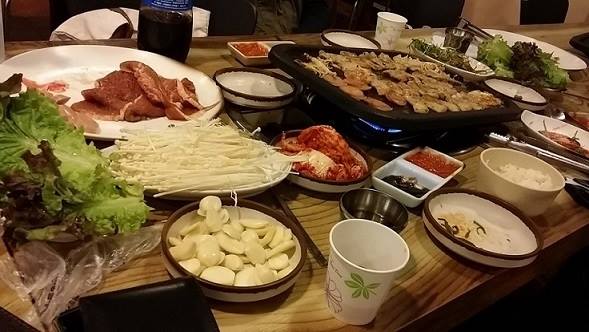
The ahjussi turned the portable gas griller on and the grilling began. As sir Randy held with a tong a slice of pork belly, like a teacher, he explained what samgyeopsal literally means: 삼- sam (three), 겹 – gyeop (layered), 살 – sal (flesh). His impromptu lecture did not end there. When the meat was cooked, he explained how to eat samgyeopsal the Korean way, that was after I excitedly picked up a piece of the cooked meat and had my first bite. He took a piece of meat, dipped it on a sauce then placed it on a leaf. Not done yet, he also added garlic and rice too. Then he rolled it up and stuffed it into his mouth.
“That’s the way the Koreans do it,” he said.
He made another roll and asked me to open my mouth. I hesitated at first because it was a little awkward. He explained that when dining Korean males usually do that and nobody would suspect them of “bromance.” So, I allowed him to stuff it in and returned the favor shortly after.
We learned quickly how to enjoy samgyeopsal . It was either sir Rhandy’s a good teacher or it was just our hunger. It didn’t take long before we had to order another round of pork belly.
There were two varieties of dipping sauces given to us by the ahjussi. Sir Randy told us that one is 쌈장 (ssamjang) and the other one 소금과 후추 기름 장 (sogeumgwa huchu gileum jang).
The kimchi served tasted differently from the one I first tried. There was no trace of sweetness. It was plain spicy.
While we were enjoying the “feast,” sir Randy who has been here in South Korea for a long time, recommended other Korean dishes that he said he was sure I would come to like.
The other customers in the restaurant were enjoying their samgyeobsal with 맥주 (maegju) and 소주 (soju). We wanted to also but we had class the following day.
We were one in saying that it was a sumptuous dinner.
For me, it was not a simple dinner. It was a wonderful cultural experience.
What about my promise not to eat much that night? Well, promises are meant to be broken.