Category Archives: Filipinos in South Korea
South Korea: In the Eyes of an Expatriate (3)
(Last of 3 parts)

I really tried hard to figure out what happened. What went wrong for my country and conversely, what did the South Koreans do correctly? To think that in the 1950s, while my country was soaking in the glory of being Asia’s second strongest economy, the Korean peninsula plunged into a devastating war.
I tried to probe deeper into this nation’s history to find the answer to the following questions: 1. How were the South Koreans able to slay the ghosts of a bitter colonial past?; 2. How did they survive the devastation wrought by the Korean war?; and 3. How did they triumph over internal political turmoil while at the same trying to ward off a belligerent neighbor in North Korea?
How were the South Koreans able to accomplish all of the aforementioned then eventually catapult themselves to their current lofty position in the global community?
Then I found out what the South Koreans did in 1998 at the height of the Asian financial crisis. They willingly donated their gold – jewelry (including their personal wedding rings), medals and trophies, good luck keys, and what have you. This they did to save their economy during that crisis. The collective weight of the gold they donated may not be that much. But more significant than the corresponding monetary value of their donation was the willingness of the South Koreans to make a personal sacrifice for their country. I call that nationalism. If it’s not then I don’t know what is. It is the same sense of nationalism that emboldened them to resist one military junta after another… to sacrifice their lives and limbs to lay the democratic foundations of this country which eventually became a fertile ground that nurtured the economic prosperity they are currently enjoying.
I also learned about the collectivist culture of these people. They think first of the general welfare over and above their personal interests. This I witnessed first-hand when I saw how the South Koreans willingly obeyed the restrictions set by their government during the early onslaught of Covid-19. There was no need for their leaders to implement a “hard lockdown,” the way other countries did, including mine. The citizens just strictly wore their masks, observe social distancing, and avoided leaving their homes unless it was necessary. They are willing to sacrifice for the greater good.
I think I found the answer to what enabled the South Koreans to attain prosperity and stability – the combination of their nationalism and collectivist culture. I may be wrong but I could not really see any other possible reasons for their success as a nation. There is nothing more potent of a mix for nation-building than the combination of the two. And if they keep using this formula, the future of this nation is secured.
Other expatriates living in this country may not see things here the way I am seeing them. To them the observations I made may not be a big deal. To me, given the situation in my country now, they are.
If only my countrymen would consider including the South Korean model of nationalism and collectivism among the things from this country that we allow ourselves to be influenced by. We should try to find out if we could also propel our own native land to greatness if we would try to emulate the way South Koreans profess their love for their country. We need to see if we could also make our country better if like them we would put the greater good over and above our personal interests.
We copied hook line and sinker (Or was it forced down our throats?) the socio-political and economic models of our colonizers and we are not getting desirable results. Obviously, our needle of success as a nation is barely moving. We have been trying to fit our colonizers’ square peg into our round hole. It’s not working. It’s time for us to rethink our strategies for nation building. Why don’t we try the South Korean model? Let’s see what will happen if we embrace, not only K-dramas, K-pop, and kimchi but also the values that brought the South Koreans to where they are now.
South Korea: In the Eyes of an Expatriate (2)
(2nd of 3 parts)

I started mingling with real Korean people – real men and women and not fictional characters. I dined with them, drank their wine and beer, ate their kimchi and their delicious dishes, and spoke (a little) of their language.
I witnessed their way of life and even adopted some parts of it. I saw what’s inside their houses, their theatres, their bars, restaurants, and coffee shops. I have entered their museums, strolled in their parks, and hiked in their mountains.
Through daily encounters with my Korean students, colleagues, and friends, I was also able to probe into their character. I confirmed that just like what I saw in their dramas, South Koreans fall in love, get angry, feel sad and happy, and suffer from anxiety and stress. In short, just like me or any average human being from any part of the world, they also ride the roller coaster of emotions. They do have strengths and weaknesses too. They are not faultless… like me. Anyway, nobody is. They also have fears and uncertainties. But just like me and anyone else, they have dreams and ambitions. They have plans and a vision of a good life in the future for themselves and their families.
I discovered more. I found out that their prosperity is not a myth. Those things I saw in Korean dramas and movies that indicate how progressive and modernized their country is are not fictitious. Their provinces, cities, and towns are effectively interconnected by impressive highway systems that how I wish we could also have in my country of origin. How I wish that our telecom companies could provide us with internet connectivity as fast as South Korea’s.
With everything that I have seen and experienced, I could not help but compare this country to mine. I could not help but be envious of the South Koreans for what they have accomplished as a nation. As I stayed here longer, my “How I wish!” list grew longer. How I wish that in my country, packages could be left in front of our doors, even for days, not fearing that somebody would steal them. How I wish we could also send to prison our politicians who would be found guilty of wrongdoings without fearing that when a political ally would become the next president they would be granted a pardon. How I wish we would take research as seriously and meticulously as the Koreans do.
Whatever metrics I used for the comparison, it was a mismatch with this country always ending up on top after all the comparative analyses I performed except for this – my country has a younger population where the median age is less than 26 years. For this country, it’s more than 40 years. I will no longer be citing other statistics like those of life expectancy, GDP, and international ranking of universities. South Korea’s numbers are far more superior to my country’s.
In addition, South Korean students perform better in Math and Science as compared to the youth of my country. If there is any consolation though, I and my countrymen scored higher in English proficiency.
But does it matter if we in our country are better at English? Does it make my country better than South Korea? The answer is obvious – NO. There is no direct correlation between a country’s English proficiency and its economic performance. If there is, then why does this country, as of 2021, rank as the world’s 10th biggest economy while mine barely made it to the list of newly-industrialized countries?
Don’t get me wrong, I am not putting my country down while I am seemingly extolling South Korea. I love the country where I was born and I am proud to be its citizen. I am just wondering how come this country has gone this far leaving my native land way behind in the race to prosperity and stability.
My desire to figure that out led me to read more about the history of this country. In the process, I discovered certain uncanny similarities between our historical experiences. Both South Korea and my native land are colonized nations and earned independence after the second world war. Both countries embraced the democratic form of government thereafter. Additionally, just like in my country, the development of democracy here in South Korea was interrupted by military takeovers, and what a coincidence that martial law in our countries was declared both in 1972. Was it also a coincidence that powerful military leaders in both countries were removed via popular revolt in the mid 1980s?
Unfortunately, the similarities in the historical development of this nation and mine stop there. We took different paths in building our nations from the ashes of colonization, the second world war, and military juntas.
South Korea: In the Eyes of an Expatriate (1)
(1st of 3 parts)
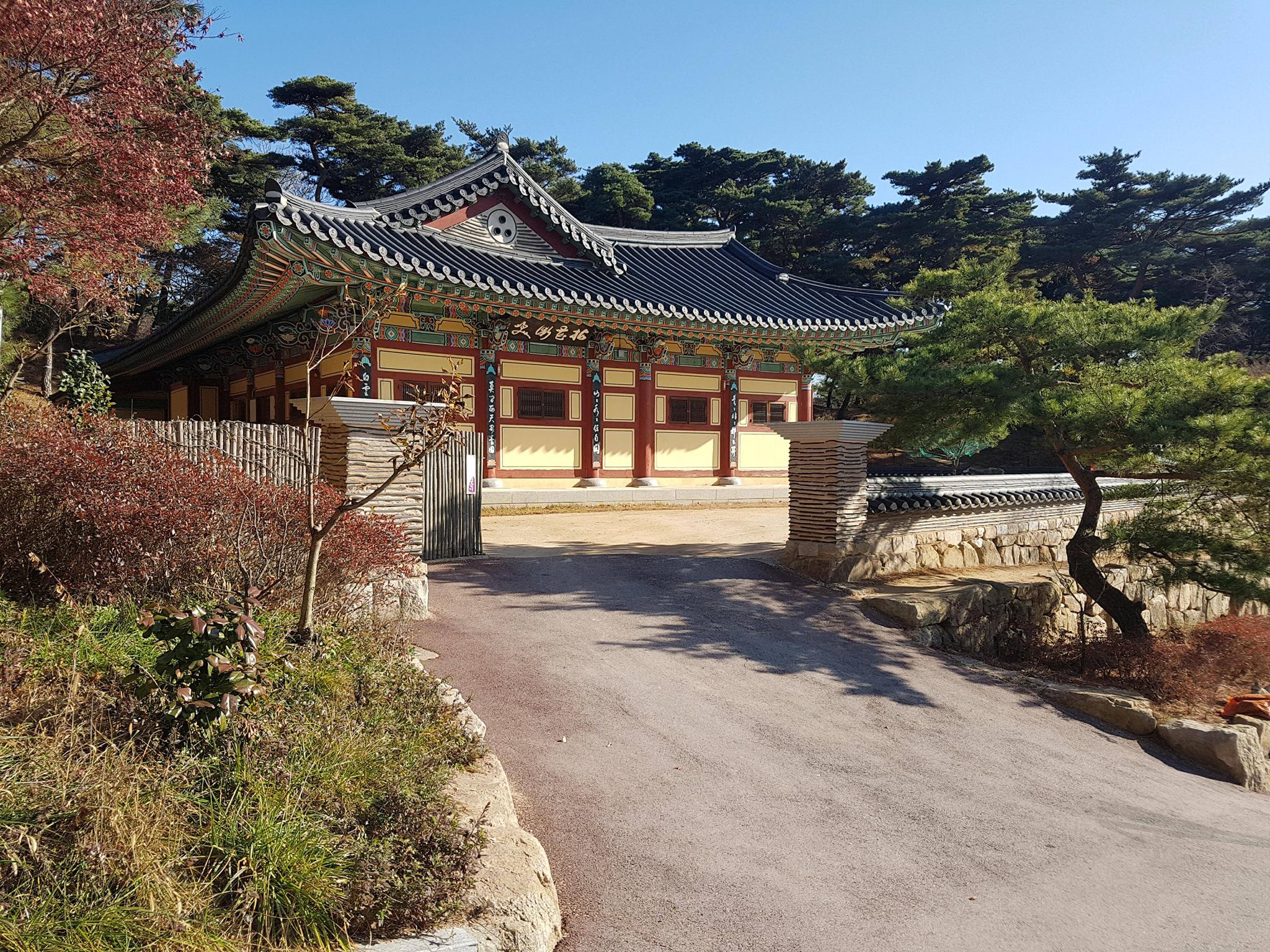
South Korea entered my consciousness through Hallyu – a term that when translated to English means Korean Wave. And yes, when that cultural wave reached our shores, South Korean dramas, movies, and music drowned the country’s airwaves. Local magazines and the entertainment sections of newspapers regularly featured K-pop artists and other Korean TV and movie personalities. Before long, other aspects of Korean culture – food, fashion, lifestyle, and what have you – started to deeply influence me and my countrymen.
Before the Korean Wave came, I knew not much about South Korea. I remember checking the encyclopedia for information about the Korean war when I took World History when I was a college student. It was only then that I found out that my country was one of those which sent troops to help this country to ward off the Communist invasion from north of its borders.
Just imagine how dreadful a picture of the war-torn Korean peninsula the things that I read created in my mind. It was horrible, to say the least. The death and destruction were too much to bear.
But before I graduated, I had another chance to check the encyclopedia for more information about South Korea when the country hosted the 1988 Summer Olympics. Because of the said sporting event, South Korea was all over the news. That triggered my curiosity thus I checked the encyclopedia to once again read something about the said nation.
I saw a country different from what those pages about the Korean war presented to me. I found out that the nation called “Land of the Morning Calm” rebounded from the horrors of the Korean war and eventually became very progressive. Then I wondered at that time and asked – “What did the South Koreans do that enabled them to, like the legendary Phoenix, rise from the ashes of a horrendous war at that time and even became only the second country in Asia to host the world’s biggest sporting event?”
As years passed, I learned more and more about South Korea, not only through traditional media but more from the Internet (which became more accessible than when I was in college). I got to see more and more Korean dramas. It made me, just like many of my countrymen, want to visit the country so bad. I wanted to visit the places in the country that I got to see only on TV programs and movies. I wanted to try soju and maekju and when the two are combined – somaek. I wanted to taste kimchi and eat Korean dishes prepared and served by Koreans. I wanted to try bibimbap, pyo haejangguk, and kalguksu served with plenty of banchan in a restaurant in South Korea, not in a Korean restaurant in my native land. I wanted to meet real Korean people. In short, I wanted to have an authentic Korean experience. I personally call that my “Korean dream.”
That urge became stronger when I enrolled in the program Teaching English to Speakers of Other Languages (TESOL). South Korea was mentioned by the program coordinator as one of the countries considered as premiere destination for ESL teachers. Thus, since teaching overseas is an option in the career path I set for myself, I thought that if I would teach abroad, why not in South Korea? My “Korea dream” suddenly expanded – I no longer just wanted to have an authentic Korean cultural experience but to live and work in this country.
Then I did what I had to do for that “Korean dream” to come true. I left no stone unturned.
My persistence and hard work eventually paid off. My wish was granted. I was given the opportunity to live that dream when a university hired me as a teacher. So, off to South Korea, I flew.
As soon as I exited Gimhae Airport, I started having that authentic Korean experience. The early spring weather giving me an icy cold welcome got it going.
As days and weeks passed, I gradually immersed myself into the country’s culture. I was no longer just watching the people of this land from the television set, the silver screen, and the World Wide Web. It’s no longer a Korean drama I was watching but it’s real Korean life I was experiencing… from reel to real. I got what I wanted.
Wellbeing of Filipinos in South Korea: A Needs Analysis

The coronavirus pandemic is an unfolding crisis whose extent of damage could be measured only when it finally ends. Suffice it to say that its economic ramifications are devastating. The global economy shrunk. More and more people are unemployed, hungry, and homeless.
But on top of the economic impact of the COVID-19 crisis, its socio-psychological implications should not be taken for granted. Remember that human beings have needs beyond foods, clothes, and shelter. These are only what Maslow classified as basic in the hierarchy of needs. People have higher needs – psychological and self-fulfillment needs – that must be satisfied.
The inevitable changes that took place because of the spread of this coronavirus have created different kinds of challenges and difficulties that left people with no choice but to contend with. They were confronted by circumstances different from what they were accustomed to.
The ongoing health crisis is testing how much a person could endure… how resilient are they. The current reality forged by the deadly pathogen has created different kinds of problems that may lead to uncertainties, grief, anxiety, fear, and loneliness. It would require resilience to overcome these negative emotions.
Resilience as defined by Luthar (2006), is “positive adaptation despite adversity.” It refers to the person’s ability to adjust to change and/or the capacity to recover from unfortunate events or misfortune. It is the capability to tolerate (and effectively cope with) experiences of change and adversity.
How resilient a person is depends on their level of wellbeing. In any study featuring these two constructs, a hypothesis of a direct positive correlation existing between them is very likely to be accepted. It means that the higher the level of a persons’ wellbeing the more resilient they are.
The Oxford dictionary defines wellbeing as the “state of being comfortable, healthy, or happy (Oxford, n.d.). This concept, as Purcell (2018) explained, embraces more than just physical health. It takes into account the entire person, both body and mind. It indicates not just the absence of illness but also the presence of positive mental states, emotions, and moods.”
“Species with useful adaptations to the environment are more likely to survive.” This is what Charles Darwin famously said. Given the current situation, to adapt is the only option people have. And the ability of a person to adapt to the kind of environment the ongoing pandemic created hinges on the level of their wellbeing.
Surviving the pandemic is the goal of adaptation. It is a personal responsibility. It’s not just a matter of steering away from the deadly path of the infectious disease but also coping with the situation that emerged from its trail of destruction and maintaining a strong resolve not to succumb to the challenges and difficulties that come along.
Overcoming the challenges and difficulties the deadly virus spawned requires all forms of toughness – physical, emotional, mental and spiritual. It demands a body and mind in tip-top shape, a holistic wellbeing.
The fear of possibly getting infected by the virus and losing job or working fewer hours (which means lesser pay too) are causing fear and uncertainty among many people. Losing loved ones to the deadly pathogen has left a lot of people grieving too. Coping to changes in lifestyle has caused so much stress as well. All these and other problems would really require toughness to overcome. And if a person is non-resilient, their inability to adapt or recover might lead to some other and worse problems.
Take into consideration also the directives to stay at home and strictly observe social distancing. Such orders from the authorities may seem inconsequential, but they are not. They do have debilitating effects. While social isolation may have saved a lot of people from getting infected by the virus, it exposed them to another kind of malady – loneliness.
Loneliness is a psychological condition that should not be taken for granted. Wilson et al. (2007) stated that “loneliness is often described as the state of being without any company or in isolation from the community or society. It is considered to be a dark and miserable feeling, a risk factor for many mental disorders like depression, anxiety, adjustment disorder, chronic stress, insomnia or even late-life dementia.”
“Prolonged isolation,” as Cacioppo and Hawkley (2003) argued, “can adversely affect physical and emotional health, altering sleep and nutritional rhythms, as well as reducing opportunities for movement.” Nardone & Speciani (2015) added that “isolation causes the natural channels of human expression and pleasure to become depressed negatively impacting mood and subjective well-being.”
So, social isolation, if not properly handled, may cause both physical and emotional problems. However, it is necessary. Most people would probably choose to bear the problems resulting from social isolation than the one caused by the deadly virus.
Staying at home and socially distancing may not be much of a problem, or not a problem at all, for those who are living with their families. But for people living alone, either by choice or circumstances, it could be. These people are the ones most vulnerable to problems that social isolation brings about.
One particular group that belongs to the category aforementioned expats or people living in foreign countries, mostly as workers or students.
Foreigners in a particular country, just like the citizens of that country, are caught in the same web of problems created by the coronavirus pandemic. They feel or face the same uncertainties, grief, anxiety, fear, and loneliness. But it’s very likely, that the foreigners, being away from their families, are more prone to the dangers of social isolation and other kinds of problems emanating from the ongoing health crisis. Thus, they need all kinds of assistance they could get from whatever support groups their own governments or from private organizations or individuals who are willing to help them.
Click on the link below to continue reading…
Then Came The “Layered Meat”
 Unabashedly that I made a confession in my article entitled “Love at First Bite” that I fell in love with kimchi. I have to admit though that with all the luscious Korean… DISHES, I wasn’t faithful to kimchi. I would later fall in love with other Korean foods.
Almost everyday that my new friends and colleagues would introduce me to a new local dish during my first few days here in South Korea. However, when I recalled what the doctor in the Philippines said during my medical examination before I flew here – that I need to lose weight – I slowed down a bit.
Then came the three-layered meat and the realization that losing weight is (and has always been) a “mission impossible.”
Before my first week in South Korea ended, we were given a treat by a fellow professor from the Philippines – Randy. He brought me and two other foreign professors (Deborah and Kenn) to a restaurant serving 삼겹살 (Samgyeobsal). That was after we claimed our Alien Registration Card (ARC) from the immigration office in Pusan to legitimize our stay in this country.
It isn’t enough to just say that I have tasted samgyeobsal that night. For me it was more than just eating pork belly. I don’t intend to sound dramatic but I guess it would be more appropriate for me to say that that night “I experienced samgyeopsal” instead of “I ate it.”
I consider the experience very special.
Why?
It’s a culture thing.
As we entered the restaurant, I saw Randy and the other professors remove their shoes. I did the same. We were escorted by an ahjussi (a middle-aged man) to a table and immediately left us after getting our order. There were no chairs, not like the set-up in that restaurant in the hotel where we had the orientation for our students. We sat on the floor. So, for the first time that I would experience eating while seated on the floor. I wasn’t comfortable sitting cross-legged but as soon as the ahjussi returned and placed on our table what sir Randy ordered, I forgot about my discomfort and started salivating.
Along with the slices of pork belly, we were given plenty of lettuce, perilla leaves, and enoki mushrooms. There were also raw onions, garlic and green chili peppers. We were also served with lots of small side dishes which the Koreans call 반찬 (banchan). Not to be missed among the dishes in the small plates is kimchi. There was a plethora of food in front of us. I promised not to eat much that night.
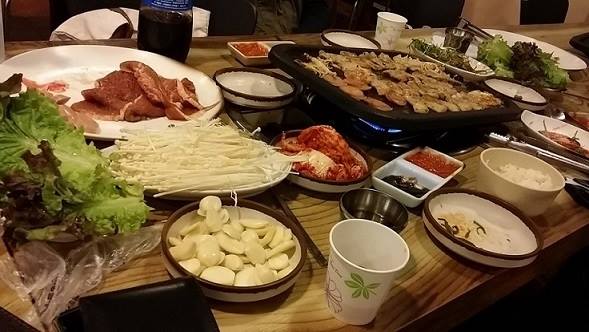
The ahjussi turned the portable gas griller on and the grilling began. As sir Randy held with a tong a slice of pork belly, like a teacher, he explained what samgyeopsal literally means: 삼- sam (three), 겹 – gyeop (layered), 살 – sal (flesh). His impromptu lecture did not end there. When the meat was cooked, he explained how to eat samgyeopsal the Korean way, that was after I excitedly picked up a piece of the cooked meat and had my first bite. He took a piece of meat, dipped it on a sauce then placed it on a leaf. Not done yet, he also added garlic and rice too. Then he rolled it up and stuffed it into his mouth.
“That’s the way the Koreans do it,” he said.
He made another roll and asked me to open my mouth. I hesitated at first because it was a little awkward. He explained that when dining Korean males usually do that and nobody would suspect them of “bromance.” So, I allowed him to stuff it in and returned the favor shortly after.
We learned quickly how to enjoy samgyeopsal . It was either sir Rhandy’s a good teacher or it was just our hunger. It didn’t take long before we had to order another round of pork belly.
There were two varieties of dipping sauces given to us by the ahjussi. Sir Randy told us that one is 쌈장 (ssamjang) and the other one 소금과 후추 기름 장 (sogeumgwa huchu gileum jang).
The kimchi served tasted differently from the one I first tried. There was no trace of sweetness. It was plain spicy.
While we were enjoying the “feast,” sir Randy who has been here in South Korea for a long time, recommended other Korean dishes that he said he was sure I would come to like.
The other customers in the restaurant were enjoying their samgyeobsal with 맥주 (maegju) and 소주 (soju). We wanted to also but we had class the following day.
We were one in saying that it was a sumptuous dinner.
For me, it was not a simple dinner. It was a wonderful cultural experience.
What about my promise not to eat much that night? Well, promises are meant to be broken.
Love At First Bite
I am a foodie. The extra pounds around my waist is a testament to that. So, when I came here (South Korea) I was excited to finally try the dishes which I saw only on television shows and in movies in my country.
The first food I ate here in South Korea was (drum roll, please)… biscuits from the Philippines. I wasn’t able to eat anything Korean immediately when I and sir Kenn (a fellow professor from the Philippines) arrived at the Busan International Airport. I was not thinking of food at that time. I was looking for at least a cup of coffee then, not because of hunger nor my usual craving for caffeine. I just wanted to feel something warm in my hands which started to go numb. It was freezing cold that morning and hunger was the least of my worries. The only thing I wanted was to reach our destination at Gyeoungju-si and wrapped myself up with the thickest of blanket I could find there.
My jacket wasn’t thick enough for my body to enjoy the early spring weather trying to give me an icy cold welcome. I didn’t have time to open my travelling bags because we had a bus to catch. It was my fault to believe what some friends back home told me that it’s not that cold here during spring. For a body used to either a hot or a VERY HOT weather, experiencing a negative two for the first time was literally a chilling experience.
As soon as I reached the apartment reserved for me by 경주 대학교 (Gyeoungju University), the first school where I worked here, I immediately unpacked and got myself another jacket. It was only when I was warm enough that I started to feel hungry and realized that I was actually a time zone away from my family. Back home, my wife would make sure that whenever hunger strikes there’s food I could grab from either the fridge or the table.
I waited for another day to officially get introduced to Korean dishes that I had the chance to see only on TV through the Korean dramas that Filipinos like me are so fond of watching. I found it amusing that aside from wishing me well for the Korean adventure I was about to embark on, my family and friends kept telling me that finally I would have a chance to try the legendary 김치 (kimchi).
Then finally the day came that something Korean would travel my digestive tract. I got that chance during the orientation for the university students held at the Concorde Hotel (Bomun Lake Resort, Bodeok-dong, Gyeongju-si, Gyeongsangbukdo). Of course, I was excited to meet my fellow professors from other countries and have my first encounter with Korean university students. But I was, I think, more excited to have my first dining experience in South Korea. What made it more exciting was the fact that after that night, the taste of kimchi would no longer be a mystery to me.
Right after the orientation, I joined the foreign professors and university officials and we all headed to the restaurant of the hotel. As we approached the dining hall, the ambrosial smell characteristic of hotel lobbies was replaced by a savory waft that was unlike any combination of aroma my sense of smell was used to. It made me hungrier and more excited.

There were four of us who shared one of the tables reserved. Already there (on the table) before we sat down were lots of 반찬 (banchan), or side dishes, mostly vegetables, including Korea’s “most-talked-about” kimchi.
I dived in. The first Korean food I tried was (drum roll again, please)… kimchi.
Despite my struggles with the chopsticks, I managed to pick a small chunk of this famous fermented cabbage. The smell, as I expected, was biting and pungent. Its tanginess was nothing new to me because in the Philippines there are items in our cuisine that I could say are perhaps more biting and more pungent than kimchi. What about the taste? It’s garlicky, salty and of course spicy. The first one I tried then had a combination of sweetness and spiciness. I was told that there are more than 100 known varieties of kimchi.
After my first bite, I immediately wanted more of it. Yes, I came to like kimchi. I don’t know why, let me just say that it was “love at first bite.” It is so hard to explain as to why I would consider meals incomplete without a serving of this side dish.

The main meal served was a kimchi-based dish called 김치 찌개 (kimchi-jjigae). Kimchi-jjigae is kind of stew where kimchi (preferably older or more fermented) is mixed with pork, seafood and diced tofu. I could handle spicy foods like this one. There are two problems though when I eat them. First, I sweat too much. Second and last, I probably would have up to two orders of extra rice. I was a little overweight when I came to South Korea. One of the things I set as goal when I came here was to get rid of the “belt bag.” With foods like kimchi-jjigae, I realized that night that losing weight is an impossible dream.
I completely abandoned my weight concerns when sir Randy, also a fellow professor from the Philippines, told me that the following day he would make me try 삼겹살 (samgyeobsal).
Kimchitized
There is a strong possibility that when we visit a country as tourists or stay there for a long time to work, we might experience culture shock. It happened to me here in South Korea. But mine is a culture shock unlike any other. It was like I was shocked, not to my dismay, but to my delight.
Which part of Korean culture did that?
It’s their FOOD!
That’s right! It’s the food. When I had my initial encounters with this element of Korean culture, I was shockingly delighted. I loved it.
I couldn’t find the right word to describe the experience. So, pardon me for coining a new word – KIMCHITIZE.
Am I the first one to use this word? (Please tell me if not.)
Anyway, KIMCHITIZE is a verb. It means “to cause a foreigner to like (or fall in love with) Korean dishes/foods.”
For the purpose of this essay, I need the past participle form of the verb – KIMCHITIZED.
The first Korean food that landed on my tongue was Korea’s fabled kimchi and the first Korean dish that traveled the full length of my digestive tract was kimchi-jjigae.
It was love at first bite. I was readily kimchitized!
It’s not much with the newness to me of the Korean cuisine. I have actually read a lot of literature about Korean dishes before. Even the Korean dramas we Filipinos are fond of watching in the Philippine give us a glimpse of what South Koreans cook and eat. What I consider, if I may say it again – “shockingly delighting” – are some things that I consider peculiar about the food part of Korean culture.
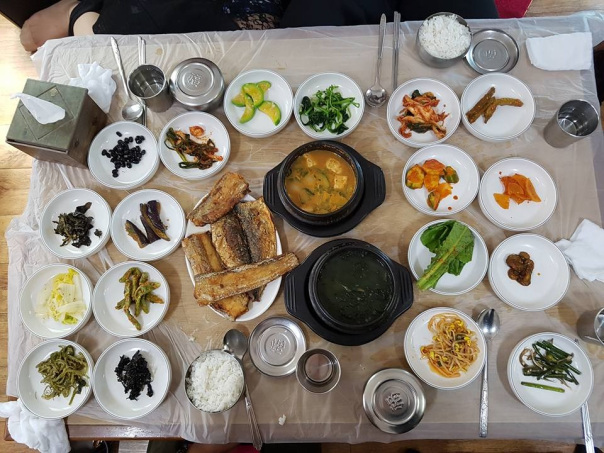
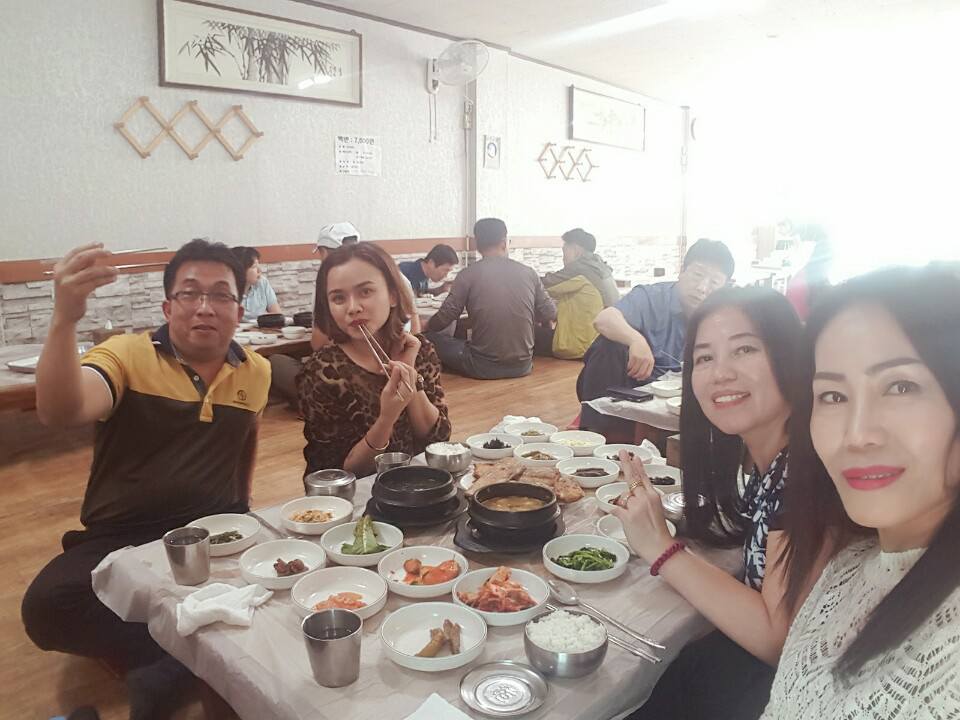
The first one I consider unusual are the side dishes (반찬 – banchan). No! Not the side dishes per se but the amount. Look at the photos and you’ll see what I mean. That’s a plethora of side items. The main dish is drowned in a sea of side dishes. It’s too many that you can easily say goodbye to weight loss once you see them scattered on a table. So inviting. It’s so hard not to pick one with your chopsticks, spoon or – fingers. You would promise “just this one” until that one becomes two – then three – then more.
The first time I experienced that shocking delight of having lots of side dishes was when for the first time I tried 삼겹살 (samgyeobsal). Aside from the leaves, there were plenty of side dishes like steamed eggplant, soybean sprouts, cucumber salad, and some more I could no longer recall.
Shockingly delighting also, for me, is the Koreans’ romance with green leaves. They love wrapping their meat with leaves, particularly lettuce and perilla. I got accustomed to just dipping grilled meat into a plate of salt or a bowl of soy sauce and vinegar combined then they’re ready to be eaten. For the Koreans, it’s different. They will get a leaf, spread it flatly on their palm then carefully pile there meat, grilled garlic, and a side dish or two. Then they carefully roll it making sure that it’s securely wrapped before stuffing it into their mouths.
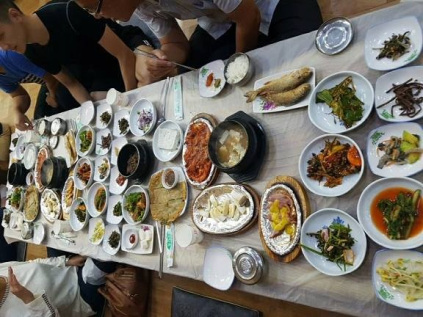
It surprised me also to see how my Korean friends would ordinarily munch green pepper and garlic as if it’s just another kind of fruit or vegetable. I am okay with the garlic, though I had to grill it first. I bravely tried the green pepper once my bravery was gone in just a few seconds. My friends laughed at how I perspired and my face turned so red that time. Since then I avoided it like a plague and would politely say no whenever offered.
They say that there are four phases of culture shock namely, honeymoon, frustration, adjustment and acceptance. In my case, it started with honeymoon and jumped right away to the final phase of acceptance. There were no frustrations at all. But wait! I remember that I passed through the adjustment period anyway.
And here’s what I did in the adjustment period – I needed to punch another hole on my belt because with all the mouth-watering Korean dishes/foods out there waiting to be discovered losing weight is going to be a mighty struggle.
__________
Below is a link to the articles about some of the Korean dishes/foods I have been enjoying here in South Korea.


 M.A.D. L I G A Y A