Blog Archives
HOLISTIC APPROACH TO SELF-IMPROVEMENT
My book, A PARADIM FOR SELF-IMPROVEMENT, will be retitled HOLISTIC APPROACH TO SELF-IMPROVEMENT for its second edition. The decision to change was informed by the fact that, after reviewing the contents, I found that the original title does not fully reflect the book’s scope and spirit. The original title focused on a conceptual framework, but the new title, Holistic Approach to Self-Improvement, better describes the book’s integrated view of personal growth and development. This view goes far beyond positive thinking to include ATTITUDES, BELIEFS, SKILLS, ABILITIES, PRACTICES, ACTIVITIES, and SELF-DISCIPLINE.
The change was made to ensure the title better fits the book’s content and its practical approach.
As I continue to fine-tune the contents, I have come to understand that the book is not merely about suggesting a framework; it is about embodying one. The word HOLISTIC describes that change. The word PARADIGM is too technical and creates the impression that this is just another research work, something to study. Replacing it with APPROACH tells readers that this is not a book meant only for academic purposes, but one that outlines the steps for those who intend to embrace personal growth and development.
Adding holistic indicates that growth doesn’t happen in separate parts; it happens when attitudes, beliefs, skills, abilities, practices, activities, and self-discipline come together. That’s the purpose of including PARADIGM in the original title: to show that SELF-IMPROVEMENT is a PROCESS that, when successfully carried out, would help an individual become their BEST SELF and attain FULFILLMENT.
In my book, I proposed the concepts of VALUE SYSTEM to comprise attitudes and values, COMPETENCE FRAMEWORK skills and abilities, and HABIT SCHEME practices and activities. The proposed concepts are viewed as DIMENSIONS of self-improvement.
The book, whether bearing the old or new title, encapsulates the interrelationships among these categories and self-discipline into a framework, illustrating how their synergy yields an effective process of self-improvement that leads to the attainment of one’s full potential.
The paradigm is divided into three sections: left, middle, and right. The middle section comprises three parts: the dimensions of self-improvement, the self-improvement process, and the concept of full potential, also known as the best self. The dimensions of self-improvement in this book are generally categorized as the attitudes & beliefs (value system), skills & abilities (competence framework), and practices & activities (habit scheme) that a person pursuing personal growth and development should acquire, possess, or develop. These elements come together through the self-improvement process, forming the second part of this section. This process aims
to help one become one’s best self, not as attaining perfection but as unlocking one’s full potential.
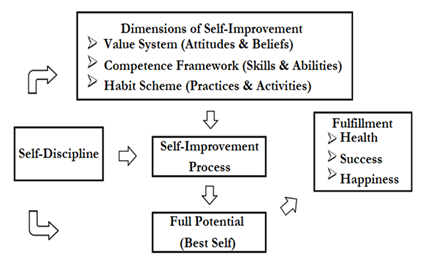
The left section of the paradigm highlights a crucial requirement for self-improvement: self-discipline. The paradigm illustrates how self-discipline continuously influences the process; even after one has achieved one’s full potential and become one’s best self, self-discipline remains essential. Self-discipline bolsters personal growth and development, forming the foundation for consistent progress and sustained fulfillment.
The right section of the paradigm illustrates the outcome of the self-improvement journey—fulfillment, characterized by becoming healthy, successful, and happy. This fulfillment represents not only the achievement of personal goals but also a deep sense of completeness and satisfaction that comes from living in alignment with one’s true potential. It is the reward for the dedication and discipline invested in becoming the best version of oneself.
Through self-improvement, individuals develop attitudes and beliefs, acquire skills and abilities, and engage in practices and activities to navigate life’s complexities confidently and purposefully. This transformation empowers them to achieve personal success, sustain a healthy state of being, and experience genuine happiness.
Those who achieve their full potential and become their best selves succeed in personal and professional endeavors. They become HEALTHY, SUCCESSFUL, and HAPPY.
If one intends to achieve their full potential and attain fulfillment, they must approach self-improvement holistically.
Foreword to My Book on Self-Improvement
Aside from the values of faith and self-belief my mother instilled in me, one key element of personal growth and development that was embedded in me long before I joined the self-improvement bandwagon was lifelong learning. My parents taught my siblings and me the value of education, the importance of learning new things and skills, and the need to always strive to be the best and strongest we could be to fulfill our dreams and ambitions.
I believed them to the point that when I had already acquired the degrees I wanted, I looked for a new jar of knowledge where I could dip my fingers. I pushed it further when I realized I had been doing much to improve my health and acquire new skills. I decided to focus on personal growth and development.
At first, my affair with self-improvement was just a fling. I thought it was enough that I read self-help books. However, I was not satisfied. I thought adding positive thinking to my faith, self-belief, and lifelong learning was enough. I was wrong. I wanted more.
Then, the unexpected happened. My romance with self-improvement took a serious turn after I watched a film entitled “The Secret.” I saw the movie’s DVD by accident. The store owner mixed it with other genres of film. When I bought it, I had no idea what it was. There was no synopsis or a brief note explaining anything about it. That was it. Everything was what the title suggests—SECRET.
I wondered whether it was a mystery-thriller or a sci-fi movie. When I played it, I discovered it was a “self-help” film—technically a documentary.
I must admit that I initially considered the ideas presented to be preposterous. Things
from the beginning of the film, what I saw and heard seemed lifted straight from the pages of a science fiction book, but they also tickled my curiosity, perhaps because I love science fiction.
I continued watching, tried to be open-minded, and considered the information in the film as tips for personality development. I have always considered anything that advocates positive change worth my time and effort. I watched it a second time and rewatched some interesting segments a few more. After that, I began applying the valuable tips I had learned from the movie. I even shared the ideas I discovered with my students whenever I saw a connection to the topic’s content.
Then I decided to do an Internet search for one of the speakers, the one who spoke first in the movie – Bob Proctor. That Internet search led me to his motivational videos on YouTube and links to information and videos of other motivational speakers such as Jim Rohn, Wayne Dyer, Les Brown, Joe Dispenza, John Assaraf, Brendon Burchard, Brian Tracy, Zig Ziglar, Tony Robbins, Simon Sinek, Tom Bilyeu, John Maxwell, Jordan Peterson, Jay Shetty, Andrew Huberman and Mel Robbins. I heard them mention Napoleon Hill, Earl Nightingale, and Earl Shoaff, which led me to find them online.
They were all my professors at VU (Virtual University). I religiously watched the videos they posted on their social media platforms, and they taught me well. I consider them my mentors in personal growth and development. Through them, I learned much about constructs related to self-improvement and Positive Psychology—goal-setting, planning, decision-making, time management, well-being, mindset, personal accountability, lifelong learning, good thinking, positive thinking, self-discipline, and more.
I consider them my mentors. They taught me valuable lessons I never learned in school. Thanks to them, I realized that in striving to be the best I can be, as my parents instructed, there are attitudes and beliefs I must pursue and possess, skills and abilities I must learn and acquire, and practices
and activities I must carry out and perform. I realized how essential they are for achieving one’s full potential and becoming the best.
Seeing how personal growth and development have benefited me personally and professionally, and recognizing that, as a teacher, I can help my students and influence my loved ones and dear friends to experience the same, I have embraced self-improvement as an act of advocacy. I am committed to promoting it. There may be those my mentors from VU could not reach, but whom I may be able to. I strive to do so in my humble ways.
To the best of my ability, I aim to plant seeds of motivation and inspiration in others, encouraging them to recognize their potential and embrace the transformative power of self-improvement. I believe that each interaction, no matter how small, has the potential to spark a profound change in someone’s life. Whether through teaching, writing, or engaging in meaningful conversations, I see every opportunity as a chance to leave a positive imprint on those I encounter.
In doing so, I am trying to carry forward the legacy of my mentors, whose wisdom and guidance have shaped my journey. Their influence reminds me that advocacy is not confined to grand gestures but is often reflected in our quiet, consistent efforts to uplift those around us.
My mission is to reach individuals who may feel unseen or undervalued and empower them to believe in their capacity to grow and succeed.
In my classes, I actively seek opportunities to instill the value of striving to improve. I do the same in informal discussions with friends, loved ones, and sometimes strangers. Whenever I have the chance to discuss self-improvement, I seize it without hesitation.
My approach is grounded in the belief that the desire to grow and evolve is universal, and all it often takes is a spark—a meaningful word, a shared experience, or a heartfelt conversation—to ignite that desire in someone.
It reminds me of how those simple compliments from a couple of teachers in high school inspired me to study harder.
I also write essays on personal growth and development, which I post on my websites and social media accounts. When I realized how much I had already written on the subject, the idea of writing a self-improvement book emerged. I decided to compile and interconnect everything I had written about personal growth and development into a book.
My motivation for writing this book is clear: I want to offer a guide that could help readers like you achieve their full potential, be the best and strongest version of themselves, and attain fulfillment by achieving what they desire. I also had my students in mind when I began working on this book. I hope they and other young people like them will read this book like you.
It is not luck or chance that gets you to the fulfillment of dreams and desires—it is learning the right strategies and applying the focus, determination, and passion you need to pursue your personal and professional endeavors. The future is yours to take.
My book is divided into three parts, each focusing on different aspects of self-improvement. In Part I, I discuss beliefs and attitudes; in Part II, I cover skills and abilities; and in Part III, I examine practices and activities.
I collectively refer to beliefs and attitudes as a value system, skills and abilities as a competence framework, and practices and activities as a habit scheme.
The world needs people willing to rise to their full potential, lead purposefully, and contribute to something greater. I believe you are one of those people.
As you read through the following pages, I hope you will find the encouragement, insight, and tools you need to take the next step in your journey. My goal is to inspire you to view your personal and professional goals not as impossible dreams, but as inevitable outcomes that await your dogged determination to succeed.
This book is both a reflection of my journey and an invitation to join me on the path to unlocking the greatness within you. I do not feel like I am already the best version of myself. Thus, my journey towards unlocking my full potential has not ended yet. If you have not started with yours, now is the time to begin.
—–
This foreword is only the beginning. If you wish to go deeper into the ideas shared here, my book on self-improvement is available on Amazon. May it serve as a companion in your own journey.
The Self-Improvement Paradigm
This video explains my proposed self-improvement paradigm. This conceptual model served as my guide in writing the book “A Paradigm For Self-Improvement.”
https://www.amazon.com/dp/B0DT4RGQ9H
BOOK: “A Paradigm For Self-Improvement”
My book, “A Paradigm For Self-Improvement: Unleashing Your Strongest Self,” is available at Amazon-KDP in paperback and e-book formats. If you have a Kindle account, you can read it for free.
This book offers a transformative personal growth and development framework, blending timeless wisdom with actionable strategies. This book helps unlock the attitudes, beliefs, skills, abilities, practices, and activities needed to unleash your full potential.
This comprehensive guide, which covers topics ranging from building self-belief and mastering time management to conquering self-doubt and cultivating lifelong learning, empowers you to take control of your journey. Each chapter is thoughtfully crafted to inspire reflection and action, helping you overcome challenges and achieve your goals. This book also includes a self-assessment designed to determine the extent of your adherence to self-improvement principles.
Whether seeking clarity in a chaotic world, resilience in the face of adversity, or the discipline to pursue your dreams and ambitions, this book provides the tools and insights to help you achieve success, health, and happiness.
Discover the paradigm shift that will unlock your strongest self and guide you toward the life you’ve always envisioned.
Take the first step toward unleashing your full potential—buy A Paradigm for Self-Improvement today and start your transformative journey toward success and fulfillment!
Why A Daily Routine Matters

“Win the morning, and you win the day.”
~ Aries Spears ~
Whether you believe it or not, the things you habitually do or do not do every day, consciously or unconsciously, will determine how healthy, successful, and happy you will be. That’s how powerful routines and habits are. It would help if you were mindful of the activities you engage with every day. Reflect and ask the following questions: “Are there things you’re supposed to do but have not done?” and “Are there things you did that should not have?” This discourse deals with the distinctions between routine and habit and how adhering to a consistent routine and good habits can unlock your full potential.
~~~~~~~~~~
A person who consciously sets routines can be likened to a pigeon with a keen homing instinct that can navigate its way back home no matter how far away from its loft you release it. Conversely, anyone who does not have specific daily routines and does things on autopilot is like driftwood floating in a river. Without intention or direction, the driftwood is subject to the forces around it, carried by the current without control over where it goes or when it stops.
You may pause for a while and reflect. With which could you be likened – to a pigeon or driftwood? Do you have specific daily routines that you perform religiously or start and end a day singing to the tune of “Que sera, sera”?
The word “routine” describes activities regularly performed. Routines can be personal or work-related and are done at the day’s beginning, during, and end. A routine may include behavior as typical as “waking up at the same time every morning” or as important as “going to work as scheduled.”
It can be argued that something you do repeatedly every day eventually becomes a habit, and thus, it ceases to be part of your routine.
At this juncture, clarifying the difference between routine and habit is necessary. The two are related but distinct concepts. Eyal (2014) argued that people want to turn everything into a habit without understanding the fundamental difference between a habit and a routine. He explained that habit is the impulse to do a behavior with little or no conscious thought, while routine is a series of behaviors frequently repeated [intentionally].
Eyal pointed out that most things people want to turn into habits will never become habits. Some routines can eventually become habits, but not every routine can become a habit.
The things you do daily can be deliberately set as parts of your daily routine or are habits you perform on autopilot. Those activities you intentionally or unknowingly do can benefit or harm your well-being. The ones you do routinely (and not habitually) are the ones that will move your SH2W needle.
Duncan (2022) explained that a daily routine is simply a collection of habits you do daily. He added that you likely have a series of daily routines you aren’t fully aware of—for example, things you do automatically when getting ready in the morning, starting your workday, or winding down in the evenings. He argues that making activities intentional means shutting off autopilot and consciously creating daily habits that increase productivity and generate happiness. Making routine intentional is also eliminating the habits that stand in our way.
A habit is an automatic behavior triggered by specific cues and usually performed without much conscious thought. Milkman (2021) explains that habits are like shortcuts—they’re things we can do quickly and without thinking because we’ve done them so often that they’ve become automatic. Routine, on the other hand, refers to a sequence of actions regularly followed, usually intentionally designed for specific times of the day. Routines are typically more deliberate and involve conscious planning.
As Milkman pointed out, a cue or trigger is often needed to remind us to start our habitual actions. For example, if you habitually brush your teeth after meals, you’ll likely do so automatically after finishing a meal. By contrast, a routine behavior is not connected to a specific cue. Following a routine, like going to the gym for a workout, requires conscious and deliberate effort—even discipline.
Habits form automatically over time, whether beneficial or detrimental, shaping your behavior often without conscious thought. There are good and bad habits. You must strive to retain positive habits and break negative ones. Self-awareness and discipline are crucial in helping you reinforce beneficial habits while working to eliminate harmful ones.
In contrast, a routine is generally designed to be beneficial, as it involves intentional planning and structure. People rarely, if not never, schedule activities that harm their well-being. You can incorporate positive habits into your routines to form a framework of beneficial behaviors that support pursuing your goals and overall quality of life.
As articulated in this discourse, a daily routine is a set of specific activities (including positive habits) scheduled at certain times of the day and performed in pursuit of one’s goals.
Your routines embody your goals and plans and are fueled by your whys. The things you do every day are supposedly tied to the goals you have set. Every move you make during your waking hours should be part of the plan you established to pursue those goals.
Setting routines indicates that you are controlling your destiny, unwilling to be dictated by the currents of fate—floating without a purpose, at the mercy of circumstances like driftwood. Establishing a daily routine is an effective way of managing time. It ensures that you do your daily activities as scheduled.
Organizing your activities sets clear intentions and indicates your seriousness about pursuing your dreams and ambitions. It is a hallmark of being purpose-driven. When we begin a day, we cannot afford to stay adrift, moving from task to task without any true purpose.
Routines are indeed driven by a purpose. We include an activity in our daily activities for specific reasons. We also add to our daily routine habits that we deem beneficial, which would contribute to attaining our goals.
Routines are beneficial in many ways. Csikszentmihalyi (2008) states, “When you establish a routine, your body and mind start to adapt, making it easier to slip into a deeply focused state known as ‘flow.’ Establishing a routine creates familiar cues that signal your brain to prepare for deep focus, enabling you to immerse yourself completely in an activity. Over time, this consistency allows you to transition smoothly into productivity without forcing it.
Choosing and sticking to your daily activities shapes your mood, shaping who you are (Murray et al., 2020). The activities you select each day influence your mood by setting the tone for how you feel and approach the world. Consistently engaging in positive, purposeful actions can foster a stable, uplifting mood, gradually shaping your habits, attitudes, and identity.
Daily routines also help you take control of your day and, subsequently, your life. They allow you to start your day, make better decisions, sleep better, enjoy quality time with loved ones, and have more time for activities you love (“Why Routines Are Good,” n.d.).
Having a daily routine will help you improve your focus and productivity. A list of specific activities at specific times of the day will allow you to concentrate on doing things one at a time and deliver the best possible results. Knowing what should be accomplished eliminates unwanted stress. Neuroscientists claim that when you set to do something, you are preparing your subconscious mind for the job, and doing it will no longer cause you to feel stressed.
The success, happiness, health, and wealth you want to achieve will not emerge from a stroke of luck or just sporadic bursts of effort. They will result from intentional daily routines—those small, often unnoticed actions that accumulate and compound over time. Take the example of daily reading in your field of expertise; it’s like a drop of water on a rock. Ovid once said, “Dripping water hollows out stone, not through force but through persistence.” The benefits of consistent reading—or any other habit you cultivate and include as activities in your daily routine—are impossible to predict now, but over time, they add up in ways you might never have imagined. Your daily routine shapes your life’s course when repeated with discipline and purpose.
Daily routines are usually divided into three parts – activities we do in the morning before performing our chosen profession/vocation, during the time that we perform that profession/vocation, and in the evening when we return home and before sleeping.
People have different morning rituals. Jim Kwik (2020) recommends his ideal morning routine – recall your dreams, make the bed, drink water and take supplements, breathe, meditate, move [exercise], take a cold shower, nourish your brain, journal, create a to-do list, a to-be-list, and a to-feel list, read, make a brain smoothie, do brain training, and start with your most difficult and most important task.
Which ones of Jim Kwik’s recommendation are you actually doing?
Bokhari (n.d.) argued that a healthy morning routine has four core components: physical, mental, emotional, and spiritual. He considers those four as the sources of energy that each of us is born with. You must unleash your physical energy and activate your body to prime it for a successful day. Learning something new or doing at least one thing each morning is essential to sharpen your mind. He suggests addressing your emotional and social needs by checking in with yourself, connecting with people you care about, and unleashing your spiritual energy by doing something that allows you to reconnect to your purpose, faith, or WHY.
During the day, your work or business takes a considerable chunk of your daily routine. A daily work routine is a set of behaviors aimed at achieving and accomplishing tasks most efficiently when practiced daily. A pattern of habits, activities, and behaviors governs how an individual plans a task schedule and decides which task should be done at what time (“Five Steps in Daily Work Routine,” n.d.)
Experts recommend taking breaks during work hours to boost productivity, maintain high levels of focus, and prevent burnout. The “Pomodoro Technique” is an effective way of doing this. The technique requires work intervals (e.g., 25 minutes of focused work followed by a 5-minute break).
The pursuit of your evening routine commences when you go home from work (or when you stop working). An ideal evening routine helps you wind down, reflect on the day, and prepare for the next one. The goal is to relax your body, declutter your mind, and prepare for a restful sleep.
Studies conducted on daily routine recommend the following to-do list for an evening routine: unplug and disconnect, reflect on the day and practice gratitude, plan and set intentions for tomorrow, engage in relaxing activities, practice personal hygiene and self-care, set up a sleep-friendly environment, and practice relaxation techniques or visualization.
Instead of spending long hours using gadgets, you might consider dedicating time to other activities, such as reading, journaling, or meditating.
A carefully planned daily routine is required to live a purposive life. It makes every action you take intentional and geared towards achieving your goals. Starting your day with morning rituals that will invigorate you the whole day ensures that you will work productively and get your desired results. Ending the days right is just as important. Thus, your evening rituals should not only be spent for further self-improvement but must allow you to recharge and get ready for the next day. Consciously choosing the activities for your daily routine is a manifestation of purposiveness. It indicates the desire not to live your life on autopilot. Establishing an organized set of activities is veering away from merely going through the motions of life.
__________
NOTE:
You can see the references in the following link…
The Pursuit of Well-Being (Part 2)

A holistic approach to well-being also requires embracing lifelong learning. The primary component of intellectual well-being is the desire to continuously learn and perpetually crave new ideas. Those strong in this dimension possess a sense of curiosity and the desire to develop their critical thinking and creative abilities.
On its website, dedicated to promoting well-being, the University of Virginia refers to intellectual well-being as the ability to open one’s mind to new ideas and experiences that can be applied to personal decisions, group interaction, and community betterment. It added that it also involves using one’s mental abilities meaningfully and feeling satisfied and proud of one’s educational and intellectual journey.
Awareness about how you learn and study best is vital to enhancing your intellectual well-being. You can foster this by challenging yourself and not allowing self-limiting beliefs. You will encounter setbacks and failures along the way, but treat them as opportunities for growth and development.
People with enhanced intellectual well-being are lifelong learners. Talerico (n.d.) states that they are interested in pursuing personal and professional development, such as picking up a hobby, studying a subject, learning a language, taking a vocational course, playing a sport, and joining a club. She also enumerated the benefits of lifelong learning: job security, career options, renewed motivation, stronger soft skills, better cognitive health, confidence, and networking opportunities.
__________
In addition to physical and mental well-being, the World Health Organization (WHO) considers social well-being an important dimension of overall health (Salehi et al., 2017). They identified five key domains of this dimension: social integration, social acceptance, social contribution, social actualization, and social coherence. Social wellness, or the lack of it, can significantly impact overall well-being.
Enhancing your social well-being requires building strong relationships and participating in community activities. You must cultivate positive and healthy relationships with family, friends, and colleagues. Volunteering in activities organized by your community is also an excellent way to establish new connections. Staying connected with the people in your life will help you enhance your health’s social and emotional aspects. Keep in mind that effective communication is essential in the process of establishing connections.
STRIDE (n.d.) explained that social wellness is achieved when one can create and maintain healthy, reciprocal relationships with the people around one. Positive social relationships can provide comfort and support in difficult times, increasing one’s resilience and ability to cope with life’s challenges.
It is not difficult to set a goal for social well-being. You can begin by regularly contacting friends, joining a group of people with whom you share common interests, or volunteering at community organizations that promote your advocacy.
__________
The quest for holistic well-being also involves engaging in activities that provide a feeling of purpose or productivity. At a certain point in your life, you will want a job or work where you can apply the knowledge and skills you acquired or developed. You may either apply for a job or be self-employed (or run an enterprise of your own) in your chosen field. When you finally settle into any kind of work, another dimension of your well-being is activated: your occupational well-being.
Occupational well-being is about pursuing a career that gives you a sense of purpose and fulfillment. It involves recognizing your talents and skills while seeking opportunities for personal satisfaction and growth through your work and pursuing a hobby or interest.
Sometimes, instead of contributing to overall health, having work becomes a source of stress. Instead of finding joy through it, work becomes a source of depression. Oakland University (n.d.) stressed that occupational well-being also involves achieving a healthy work-life balance, managing workplace stress, and building relationships with bosses and coworkers while integrating the commitment to your occupation into a satisfying and rewarding lifestyle. It may not be easy, but the only way to achieve occupational well-being is to learn the art of juggling your personal life and career.
__________
The occupational facet is directly tied to another dimension of well-being–financial well-being. Finding a job or pursuing a hobby or interest is done for self-fulfillment and financial stability. It can serve both purposes. The occupation that awaits you there will provide you the economic resources you must have for your basic needs and those beyond basic (healthcare, self-care, education, recreation, and what-have-you).
The CFPB (2015) defined financial well-being as a state of being wherein a person can fully meet current and ongoing financial problems, feel secure in their financial features, and make choices that allow enjoyment of life. The report added that the concept of financial well-being has four central elements: Having control over day-to-day and month-to-month finances, having the capacity to absorb a financial shock, being on track to meet your financial goals, and having the financial freedom to make the choices that allow you to enjoy life. For Kempson & Poppe (2017), this dimension of well-being refers to how individuals can comfortably meet their current commitments and needs and have financial resilience to maintain this ability.
Individual differences also affect how people determine the financial resources needed to cover necessities, settle obligations, handle emergency expenses, and fund recreational activities. A person’s level of materialism and practicality will influence the amount of money they require to achieve financial well-being.
__________
In the pursuit of overall well-being, we establish and nurture relationships with our fellow human beings, the social institutions we belong to, and our surroundings. You must preserve not only your personal relationships but also the environment. Your awareness of environmental issues, attitudes toward climate change, and willingness to adopt sustainable practices indicate your level of environmental well-being.
BU (n.d.) explains that environmental well-being involves valuing the relationship between ourselves, the spaces we live and work in, and the planet. It requires noticing and understanding how our surroundings impact our thoughts and feelings and how our actions affect the environment. This awareness enables us to make decisions promoting sustainability and respecting our community. According to STRIDE (n.d.), your sense of safety, comfort, and connection with your physical surroundings is called environmental well-being. It entails considering how your surroundings, community, and self interact.
While we may be at the top of the food chain due to our superior intelligence and the technology we have created, we must respect all of nature and the animals that inhabit it. This respect is the foundation of environmental well-being and fosters our environmental consciousness and conscientiousness. Such conscientiousness leads us to take on the role of a good steward of God’s creation rather than its destroyer.
__________
As previously articulated, Swarbrick maintains that all the dimensions of well-being are equally relevant and interdependent. However, if there’s one aspect that strongly affects all the others, it’s the spiritual dimension. While the journey toward overall wellness often begins with physical health, spiritual well-being provides a deeper sense of purpose and meaning, helping to sustain and balance the other dimensions.
The spiritual dimension is the foundation in your quest to achieve overall well-being. It will guide you through challenges and contribute to your emotional, mental, and social stability. Your spiritual inclinations will serve as the guiding force shaping your thoughts, behaviors, and attitudes in every dimension of well-being.
Najarkolaei et al. (2019) explained that spiritual well-being is a unique source that coordinates physical, mental, and social dimensions, and it is characterized by stability in life, peace, adjustment, and harmony, a sense of close relationship with oneself, God, society, and the environment.
Spirituality has a strong positive influence on the way people live. Those whose spiritual well-being is robust are better equipped to deal with difficulties and challenges in life. Faith in the existence of God gives hope when the chips are down, and assurance that helps is on the way. Puchalski (2001) mentioned that some studies indicate that spiritual people tend to have a more positive outlook and a better quality of life. This assertion was supported by the findings of the analysis performed by Casanova et al. (2023). They found a significant correlation between spiritual beliefs and hope/optimism, indicating the positive influence of spirituality on emotional well-being. Additionally, spirituality is positively associated with autonomy, highlighting its role in fostering independence in later life. They also explained that spirituality is both a coping mechanism and a source of purpose and meaning in life.
__________
With all the dimensions of well-being—physical, emotional, social, intellectual, occupational, financial, environmental, and spiritual—collectively contributing to holistic well-being, neglecting any one of them will adversely affect your journey toward living a balanced
 M.A.D. LIGAYA



 M.A.D. L I G A Y A