Category Archives: Self-Improvement
The Tree That You Are and The Fruits That You Bear
Water the fruit trees, and don’t water the thorns.”
– Rumi

“No good tree bears bad fruit, nor does a bad tree bear good fruit.”
That one was from St. Luke, and it’s only one of the many quotes where trees and fruits are used figuratively to bring beauty to an idea that a writer or speaker wishes to convey, emphasize, and clarify.
Obviously, the “tree” in that bible verse refers to you and me. And what about the fruits? They are our thoughts, words, and actions and their outcomes. Could there be other fruits? I believe there’s none. The things we think, say and do and their eventual consequences or results are the fruits of the tree that we are. There’s nothing else that would come from us through which we can be judged or valued as a person.
We think (consciously or subconsciously) first before we say or do something. I refer to it as the “think-say-do” process. After processing an idea or a situation (or any other kind of stimulus) in our minds, we decide what actions to take or words to say thereafter. That’s our response. You may call it a decision.
“Each tree is recognized by its own fruits.” Thus, you should be careful of what you think and the decision you make afterward. They are manifestations of the kind of person you are… and have consequences or results. I don’t know if there can be an argument against that assertion.
You have first-hand knowledge of how you think and decide. You are aware of the kind of fruits you produce. What about their outcomes? The fruits you bear result in the reputation you build for yourself in the community where you belong and among your colleagues, peers, friends, and loved ones. Imagine reputation as the basket where your fruits – the decisions you made in the past – are stored. What people say (and think) about you is your reputation. Your reputation is the consequence of your speech and actions.
Sometimes, even if you say and do good and always try your best to make the right decisions, some people will treat you negatively. Don’t mind them. Their reactions are boomerangs that would harm them, not you.
Whatever you have accomplished at this stage in your life are also consequences of your past decisions. Your resume is also a basket of the fruits you produced. If people would scrutinize your resume, what would they see? What they see are your fruits. Success is one big and ripe apple in the apple tree. It is the end goal of all our personal and professional pursuits.
But there’s a fruit sweeter than success – happiness. That’s what simple people with simple dreams who don’t have a curriculum vitae to show try to grow in their tree. You would even hear people with grand dreams say they aim for success because they want to be happy. Their success is the source of their happiness, while for the simple folks I mentioned earlier, the simplicity of their life and desires makes them happy.
Reputation, success, and happiness – the products of the decisions you make – are the fruits of the tree you become.
The kind of fruits you would bear depends on the kind of tree you grow into. Good fruits will spring out of your branches and twigs if you are a good tree.
Bear in mind that you have control of the process of becoming who you are. Yes, no one else is in control of it. We call that process self-improvement. The tree that would sprout from that transformation is your “best self.”
Only when you become your “best self” that you will start bearing the good fruits.
The journey into becoming your “best self” begins with one simple step – rejecting any excuse to not become the tree you wish to be and bear the fruit you desire.
Education comes next. We nourish the tree called “self” through education. And it’s going to be long and tedious. It’s actually lifelong. Remember what Aristotle said, “The roots of education are bitter, but the fruit is sweet.” But with education, I don’t mean just formal schooling. Schools are not the only place where learning can be had. Learning comes in many shapes and forms.
Learning makes you better than you were yesterday.
Sometimes we feel discouraged when all the efforts we put into self-improvement seemingly do not bear fruit. We need to be patient. Rousseau tells us that patience is bitter, but the fruit is sweet. Moliere added, “The trees that are slow to grow bear the best fruit.”
There’s one more fruit that your tree will eventually bear – wisdom. You know it’s there when you realize that growing the tree is more exciting than harvesting its fruits. What you will become – your best self – is beyond your reputation, more glittery than success, and more overwhelming than happiness.
MAD’S Workshop
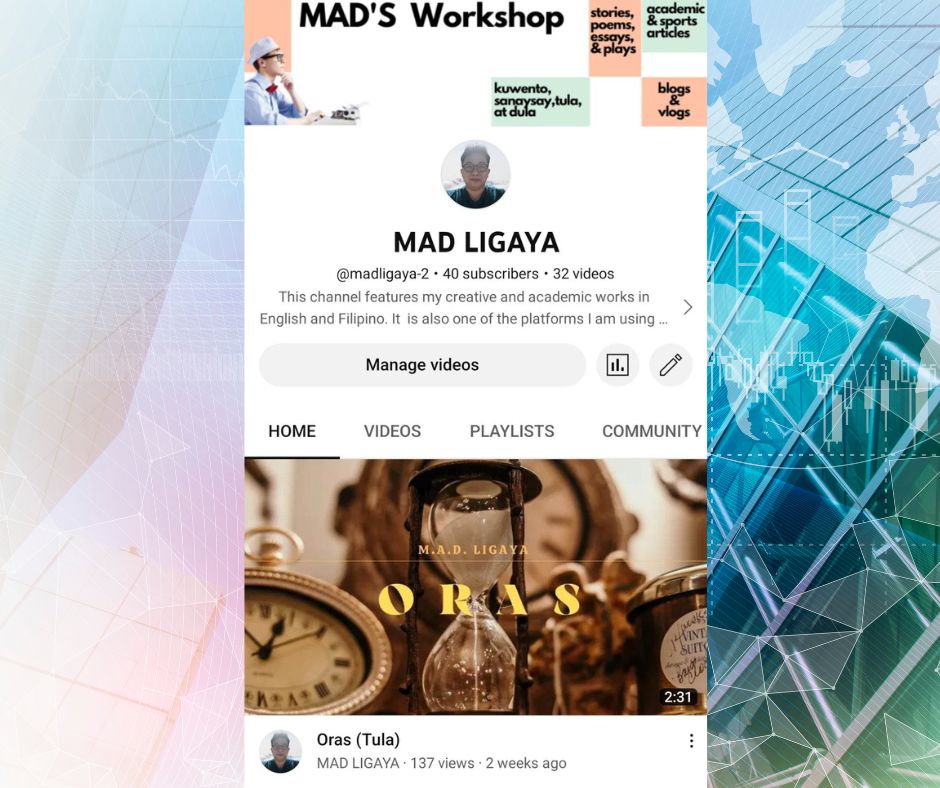
MAD’s Workshop is the new name of my other YouTube channel, the same name I adopted for my Facebook page, websites, and other social media platforms I am using. A workshop is a place where artists and artisans go to either create or hone their skills. My YouTube channels and websites are my workshops.
https://www.youtube.com/channel/UClipzKFSgZI-TwfR8gi88aA
This channel features my creative and academic works in English and Filipino. It is also one of the platforms I am using in sharing my expertise as a teacher as well as my experiences as an expat working and living in South Korea. I also post here videos of my lectures in subjects I teach and video recordings of my talks/speeches in seminars/conferences where I get invited as speaker/discussant/lecturer.
I have varied interests – language, literature, education, educational management, social sciences, research, and personal growth and development. I write stories, poems, essays, plays, academic and sports articles, movie reviews, and social commentaries. I also create videos for some of my written works in English and Filipino. They are the ones I publish on this channel. I also publish here the same videos I post on my other YouTube channel – “The Road to Self-improvement.”
THE ROAD TO SELF-IMPROVEMENT
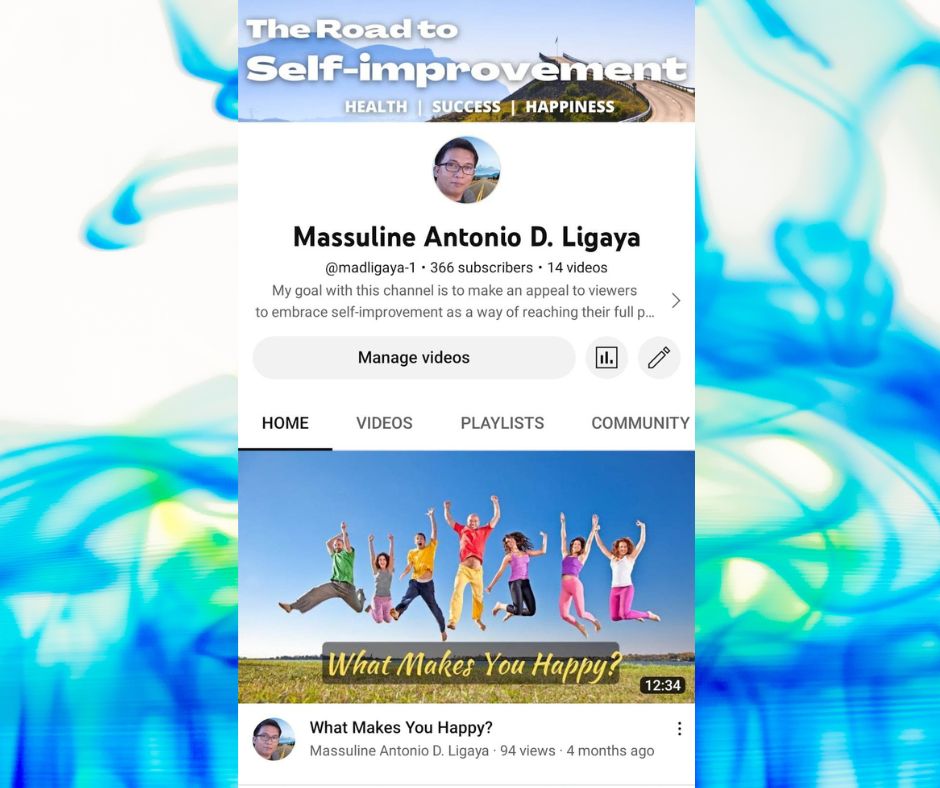
After 365 days, my first YouTube channel – “The Road to Self-improvement” – attracted 366 subscribers only.. I would love to have more but my goal for putting up the channel is not to have as many subscribers as possible but to advance one of my advocacies – SELF-IMPROVEMENT.
https://www.youtube.com/channel/UC2zzJ6T94fNnvPPwrA0OxAA
My goal with this channel is to make an appeal to viewers to embrace self-improvement as a way of reaching their full potential. I do believe that people will achieve success, have good overall health, and find happiness only when they become the best version of themselves. To strive to be the best one can be is a perfect duty toward oneself, family, and country.
I strongly believe that self-improvement is a prerequisite for national development. Only when citizens succeed in their personal undertakings and professional endeavors that they can contribute to the betterment of their country. The goal in the pursuit of personal undertakings is achieving good health, success, and happiness. For professional endeavors, it is to succeed in either work or business… or both. When people achieve their goals in both their personal undertakings and professional endeavors, there is no way for a country to go but be peaceful and progressive.
Some of my videos are delivered in Filipino because I intend to reach out to more of my countrymen and help raise among them an awareness of the importance of self-improvement.
Race To 100 (Longevity)
As I explore deeper into self-improvement, I came across a lot of literature written on longevity. I got so fascinated by the idea of people not just reaching their full potential as persons but living as long as they could.
Creating a paradigm to capture the relationship between the constructs “reaching one’s full potential” and “longevity” is a little bit tricky. Will the conceptual model show that the latter is an integral part (or the result) of the former? Which of the following questions should be answered – “Is living as long as a person could a part of reaching the maximum physical capability of their body?” or “Is longevity the result of being able to develop fully as a person?”
I think longevity should be viewed as a product of the efforts of people to reach their full potential. To say that living as long as people could is the result of them giving their physical bodies the maximum care only is tantamount to considering a person as a mere physical specimen. A person has, not just a body, but a mind and a spirit. In psychology, an individual is looked at as a physical, mental, emotional, social, and spiritual being. I believe that only when people are able to strike a perfect harmony among these different aspects of being that they could hope to have a shot at longevity.
The interest that longevity has been drawing from both the scientific community and the general public has seemingly created a new sport which I call “race to 100.” I signed up for the race. I want to celebrate my 100th birthday. It is my desire to be on my feet dancing and probably carrying one of my great-grandchildren (or would it be great great-grandchildren) when that happens. I don’t like to be in a wheelchair struggling to blow out those 100 candles.
Celebrating the 100th birthday is a milestone only a few were able to reach. Those who are lucky to live that long are called centenarians. The United Nation estimated that worldwide there are only more or less 600,000 centenarians. That’s less than 1% of the world’s total population of 8 billion people. Studies have shown that they live in certain locations in some countries which were designated as “blue zones.” Japan has the highest number of centenarians with more than 90,000.
When I told some of my friends about me wanting to be at least 100 years old, they said I am crazy to want to live that long. For them, they would be happy to live a few more years after their retirement. One of the reasons they would not want to go 80 and beyond is the possibility of them becoming weak and sickly and unable to fend for themselves. They are worried that their loved ones might just send them to nursing homes. One of them who happened to have visited an institution for elderly people lately told me that the pitiful physical, mental, and emotional condition of the old people she mingled with seemingly made her dread reaching advanced age.
That’s the most challenging part of the “race to 100” – getting there on your two feet and not aided by a wheelchair. Thus, it should be treated as a serious goal entailing careful planning and execution. It is definitely not a walk in the park. For those intending to join the race, it will help to know the life expectancy in the country where you live. In the whole world, it is currently pegged at 72.98 years. That’s the number of years an earthling can expect to live. Adding 20 or so more years is a tall order.
Genetics and environment play an important role in healthy aging and longevity. Thus, people aspiring to live way beyond their retirement age need to be aware of their family’s health histories for them to know if they have any genetic predisposition that should be addressed as early as possible. They need to ensure as well that they live in a conducive environment that would help them live healthier and longer.
The to-do list for people wanting to live as long as they could is as formidable as it could be. The list includes among other things slowing down aging, avoiding and curing diseases, staying healthy, striking a work-life balance, and keeping a robust wellbeing. All of the said undertakings are not easy to do.
There are procedures and treatments available to slow down aging. Most of them are skin-related. But it’s not only the skin cells that age. The tissues in our muscles, brain, heart, and other bodily organs succumb to the unforgiving hands of time as well. And available are natural and practical ways to slow down (if not reverse) it. What’s on top of the list is not surprising – proper nutrition and regular exercise. Eating the right kinds of foods and staying physically active help us stay healthy. Health experts claim that they contribute also to making us feel and look younger. Activities like getting enough sleep, meditation, and fasting intermittently or fully have been proven to contribute to longevity.
Additionally, it is also important to take a look at one’s lifestyle. Aside from genetics and the environment, how long people live is influenced also by their manner of living. Destructive habits like smoking should be avoided. How many times we have been told that smoking is known to cause illnesses that include heart disease and lung disorders. Scientists also found out that alcohol doesn’t only inflame the liver, it also infuses every cell causing damage to the genes. So, if drinking could not be completely avoided, at least it should be done moderately.
That’s how difficult the race to 100 is. As if those undertakings listed on the to-do list of people wanting to celebrate their 100th birthday are not already difficult, they must also observe self-discipline and sacrifice self-gratifying activities (of course only those that are classified as destructive). What makes joining this race a bit more challenging is the fact that it’s not just a matter of making sure that the physical, mental, emotional, social, and spiritual aspects of your being are in tip-top shape as you march toward the century mark. It also entails financial stability to ensure that at least your basic needs – food, shelter, clothes, medicine, and what-have-you – are met. Part of the planning in racing to 100 is calculating how much money you’ll need.
If you save more than enough to secure all that you need as you run the race to 100 and you have plenty to spare, consider traveling to places you have never been and enjoy life. Enjoy aging, don’t gripe about it. Age gracefully and gratefully. A study concluded that “those who view growing older positively lived seven years longer than those who griped about it.” So, instead of griping and worrying, just prepare for its coming.
What Makes You Happy?
A lot has already been written about happiness. Much has been said about how to achieve it and where to find it. It is my hope that the things I shared in this video would give you additional insights on the topic.
The Self-improvement Paradigm
According to Jim Rohn, “Success is not to be pursued, it is to be attracted by the person you become.” Imagine success as the fruit of a tree. A tree has to grow and mature. It will reach a certain stage of maturity that allows it to bear fruits. Imagine yourself as that tree. You have to grow and mature. The person you see at the end of the process of growing and maturing is what Jim Rohn refers to as the person you become. The fruits you bear or the success you achieve depends on the kind of tree you would turn into. And you have to become the best version of yourself. That’s the kind of tree you should be. You need to reach your full potential so you would bear the best fruits.
Self-improvement is the key to becoming the best version of yourself. If you succeed in getting to the end of the road to self-improvement, you reach your full potential.
But self-improvement is a complicated process. It is easier said than done. It requires the possession of certain beliefs, attitudes, and characteristics that will make up your value system. It requires also the acquisition of certain skills and abilities and the development of certain practices and habits.
The right beliefs, attitudes, characteristics, skills, abilities, practices, and habits, together, are the catalysts of self-improvement. However, having them is not enough. Something else is needed in order to make them work. Without it any attempt to reach one’s full potential is bound to fail. What is it? It’s self-discipline.
Self-improvement is not as simple as just being able to think positively. Positive thinking is but a tip of a huge iceberg called personal growth and development.
Self-improvement is a tedious process. Its ultimate goal is becoming the “best self” or achieving one’s full potential. As previously mentioned, certain beliefs, attitudes, characteristics, skills, abilities, practices, and habits are required. But possessing the said requirements is not enough. Consistency is needed in their pursuit. Thus, self-discipline is also needed.
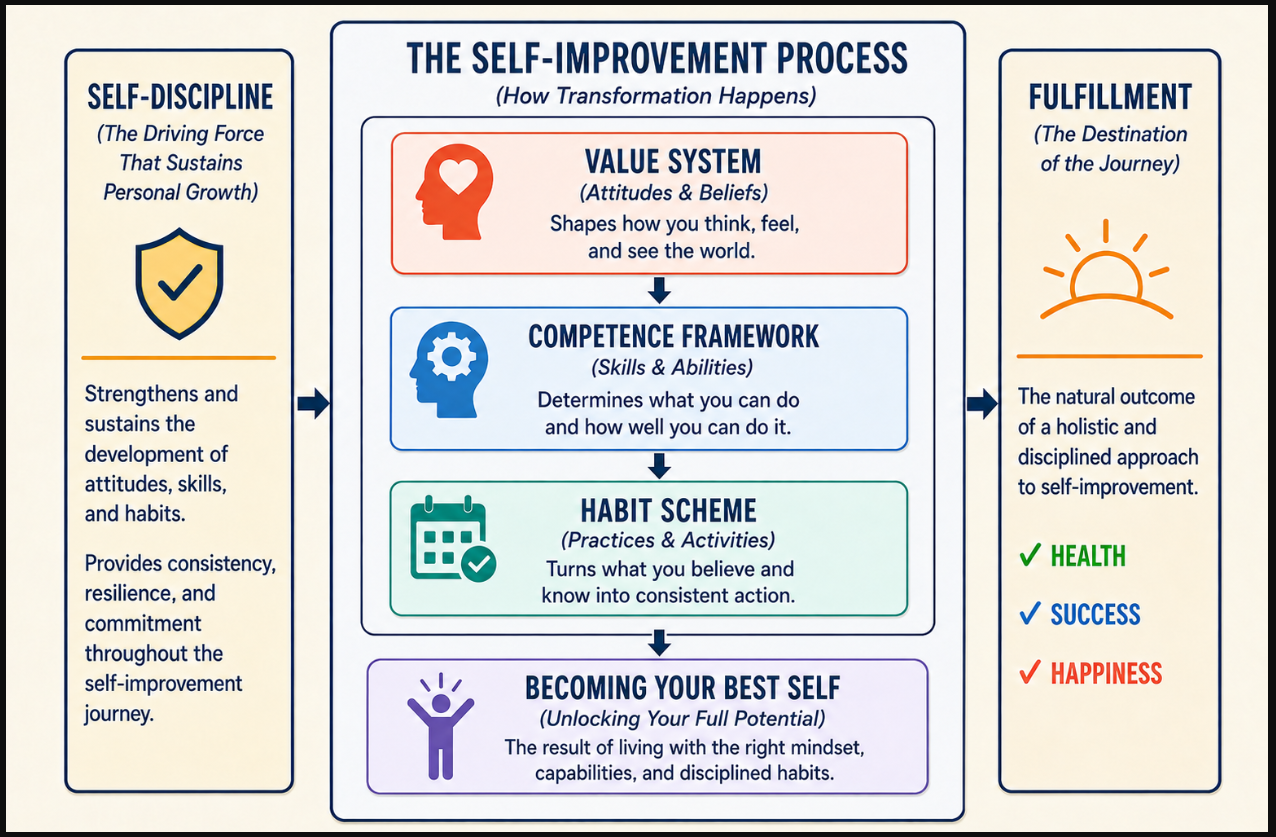
In thes book that I am currently working on (A Paradigm for Self-Imrovement), I will encapsulate the interrelationships among these categories and self-discipline into a paradigm, illustrating how their synergy yields an effective process of self-improvement that leads to the attainment of one’s full potential.
The paradigm is divided into three sections: left, middle, and right. The middle section comprises three parts: the dimensions of self-improvement, the self-improvement process, and the concept of full potential, also known as the best self. The dimensions of self-improvement in this book are generally categorized as the attitudes & beliefs (value system), skills & abilities (competence framework), and practices & activities (habit scheme) that a person pursuing personal growth and development should acquire, possess, or develop. These elements come together through the self-improvement process, forming the second part of this section. This process aims to help one become one’s best self—not as attaining perfection but as unlocking one’s full potential.
The left section of the paradigm highlights a crucial requirement for self-improvement: self-discipline. The paradigm illustrates how self-discipline continuously influences the process; even after one has achieved one’s full potential and become one’s best self, self-discipline remains essential. Self-discipline bolsters personal growth and development, forming the foundation for consistent progress and sustained fulfillment.
The right section of the paradigm illustrates the outcome of the self-improvement journey—fulfillment, marked by health, success, and happiness. This fulfillment represents not only the achievement of personal goals but also a deep sense of completeness and satisfaction that comes from living in alignment with one’s true potential. It is the reward for the dedication and discipline invested in becoming the best version of oneself.
Through self-improvement, individuals develop attitudes and beliefs, acquire skills and abilities, and engage in practices and activities to navigate life’s complexities with confidence and purpose. This transformation empowers them to achieve personal success, sustain a healthy state of being, and experience genuine happiness.
Those who achieve their full potential and become their best selves succeed in personal and professional endeavors. They become healthy, successful, and happy. Throughout this book, I refer to them interchangeably as winners, achievers, champions, high performers, and successful people.
I will divide the book into three major parts. In Part 1, I will explore the nature of dreams, ambitions, and potential; in Part 2, I will examine the foundations of holistic self-improvement; and in Part 3, I will delve into the connection between self-discipline and self-improvement and how their synergy leads to fulfillment.
Part 1 lays the groundwork by helping readers understand the importance of having dreams and ambitions, the deeper reasons that drive them, and the role of self-improvement in unlocking one’s full potential. This section encourages reflection on personal goals and provides the motivational foundation needed to begin the journey toward growth and fulfillment.
Among the three major parts of the book, Part 2 is the core of the holistic framework, presenting the key components that support lasting personal growth and development. Part 2 is subdivided into three sections—Value System, Competence Framework, and Habit Scheme.
The Value System section presents the attitudes and beliefs essential for personal growth. Topics such as the power of strong self-belief, the importance of seizing control over one’s life, and the role of personal accountability in staying grounded are discussed. You will also discover how maintaining the proper perspective, cultivating an adaptive mindset, thinking positively, and living with purpose can propel you forward.
The Competence Framework section focuses on the skills and abilities needed to succeed in one’s pursuits. From mastering time management and sharpening focus to practicing sound thinking, making purposeful decisions, and communicating effectively, this section equips readers with the tools to translate dreams into reality. It also addresses achieving work-life balance and overcoming self-doubt.
The Habit Scheme section emphasizes the practices and activities that transform self-improvement from a concept into a daily way of living. This part explores goal setting and planning, visualization, continuous learning, the pursuit of well-being and longevity, and the development of a consistent daily routine—elements that form the foundation of a fulfilling and productive life.
Part 3 brings the framework together by highlighting the vital role of self-discipline in sustaining self-improvement efforts and achieving fulfillment. It emphasizes that while knowledge and skills are essential, consistent action and commitment are what ultimately turn growth into lasting success.
For clarity, let me emphasize that being healthy, as articulated throughout this book, is a holistic state of well-being, encompassing not only physical, mental, and emotional well-being but also all dimensions of well-being.
If your current personal growth and development model is not helping you attain your desired self-improvement goals, you might need to make a paradigm shift. Try this one.
In this book, I will collectively refer to attitudes and beliefs, skills and abilities, practices and activities, and self-discipline as dimensions of self-improvement.
At the beginning of each chapter, I will include essential questions about the construct being discussed. These questions are designed to prompt reflection and prepare you for the discussion. Your answers will help you gauge your familiarity with the aspect of self-improvement being presented. May I suggest you keep a journal to record your answers and any other insights you gain from reading this book.
I will create and adopt action exercises (from related literature and studies) and put them at the end of each chapter. They are designed to encourage active participation in incorporating the discussed concepts into one’s daily routine.
The exercises are valuable for helping you turn ideas into behaviors that support your personal development. Spend time with each task, consider your answers, and incorporate the steps into your daily schedule. Remember, these activities are meant to help you feel comfortable going through them at your own speed and let them lead you on your path. There is no rush. Take as much time as you need.
There are empty areas at the end of the chapters that you can use for your notes.
I will also create and adapt questionnaires for each self-improvement construct comprising 10 items. Suppose the readers want to assess their understanding of the concepts discussed in personal growth and development. In that case, I will encourage readers to take a few moments to complete the relevant assessment before reading each chapter. It is also okay if they decide to answer them when you are finished reading the whole book. Either way works.
These questionnaires are intended as informal self-assessment tools rather than formal research instruments. Their purpose is to provide personal insight, encourage reflection, and guide you in identifying areas for improvement as you progress through the book.
This book will be more than just a guide—it is an invitation for the readers to take control of theirfuture, be their best and strongest selves by unlocking their full potential, pursue their dreams and ambitions, and live the life you they always envisioned.
This book will cover many concepts, not to mention the related essential questions, the action exercises, and the questionnaires. I hope none of these will overwhelm the readers. I needed to include all the constructs presented as the self-improvement paradigm, which I propose is inherently inclusive, seeking to provide a comprehensive framework that addresses the many dimensions of personal growth and development.
The Road To Self-improvement: The Road Not Taken
The road to self-improvement is either not taken or the one less traveled because it is easier, if not intuitive for people, to be complacent. Well, according to scientists, we should blame our brains for this. (And this is where we’re good at – putting the blame on someone or something else.) They (the scientists) say that we are naturally wired to prefer either lying on the couch or sleeping. We are naturally lazy. We hate getting out of our comfort zones. We want things to be given to us on a silver platter…