Self-Discipline
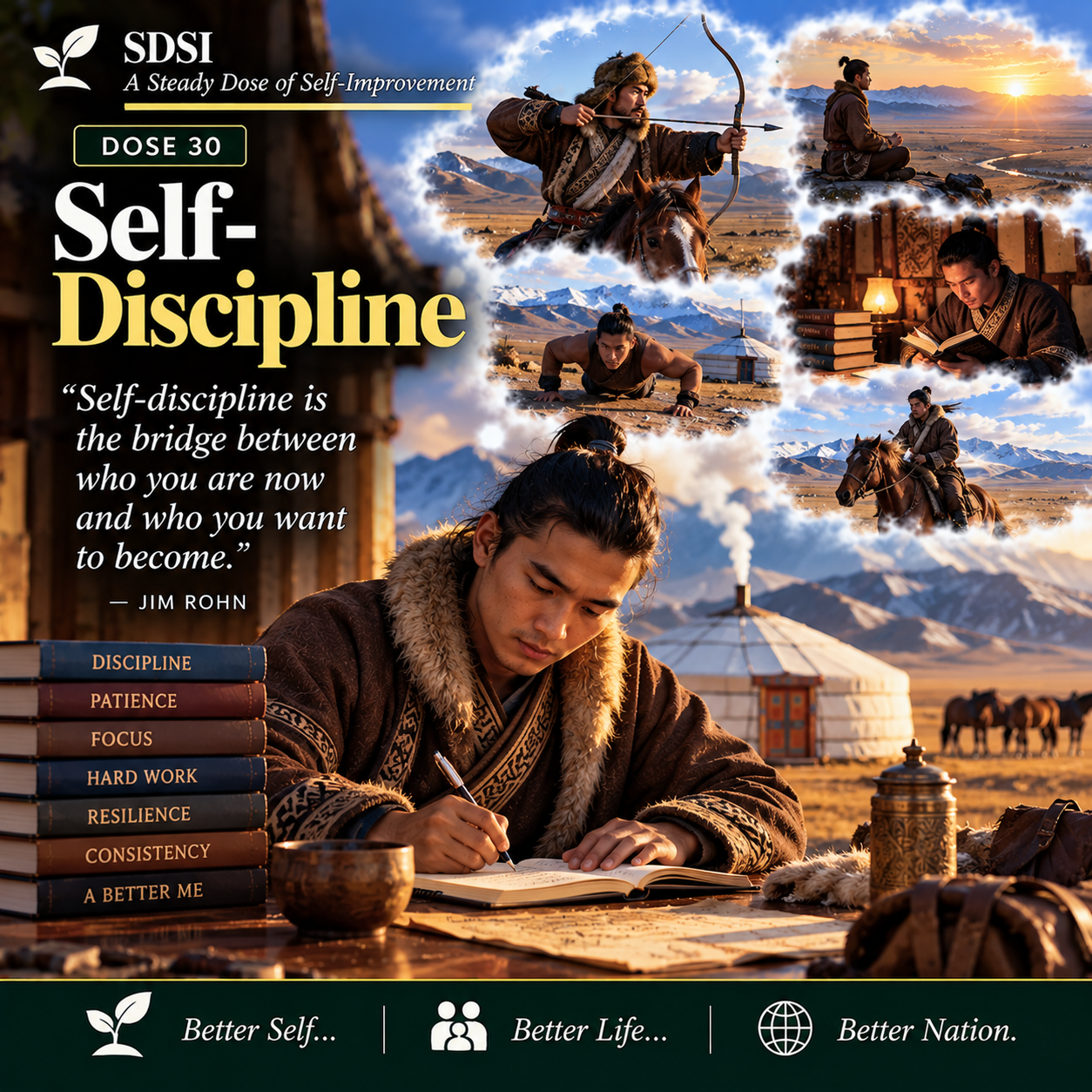
Self-discipline isn’t one more skill on the list—it’s the force that helps hold your beliefs, skills, goals,
and habits together when motivation fades.

Goals may tell you where to go. Self-discipline keeps you moving when the road stops being comfortable.
Self-discipline occupies a special place in self-improvement because it reaches across almost everything else. Strong beliefs are of little use if we do not act on them. Skills remain underdeveloped if we do not practice them. Goals remain plans on paper if we repeatedly abandon the work required to reach them. Self-discipline is what helps convert intention into sustained action.
Three words often accompany it: sacrifice, hard work, and focus. None is particularly comfortable. Sacrifice means saying no to something attractive now for something more important later. Hard work asks us to continue when ease is available. Focus requires us to protect our attention in a world designed to compete for it. Self-discipline does not eliminate discomfort; it teaches us that discomfort does not always deserve the final vote.
This is also why discipline should not be confused with punishment. Healthy self-discipline is not about treating yourself harshly. It is about governing yourself deliberately. Rest can be disciplined. Saying no can be disciplined. Stopping work when continued effort would damage your health can also be disciplined. The question is whether your choices serve your deeper values rather than your immediate impulses.
I learned this most tangibly after pursuing university teaching in South Korea. Opportunities for research, writing, conferences, and professional growth were available—but opportunity by itself produces nothing. Papers still had to be written. Revisions had to be completed. Books required page after page of work. The conditions helped, but conditions do not write books. Discipline does.
Over time, self-discipline strengthens the entire self-improvement process. It turns attitudes into behavior, competence into performance, and repeated practices into habits. Motivation may open the door. Discipline is what helps us keep walking through it.
Pause and Reflect
How disciplined are you when no one is watching, the excitement is gone, and the work has become ordinary?
One Step Forward
Identify one comfort or distraction you are willing to limit this week in service of a goal that genuinely matters to you. Write down what you are protecting—and why it is worth the sacrifice.
Explored in full in Part 3, Section I — Self-Discipline of A Holistic Approach to Self-Improvement.

Posted on October 4, 2026, in General. Bookmark the permalink. Leave a comment.



Leave a comment
Comments 0