THE DAY A FART BECAME A TEACHING AID
When Grammar, Chemistry, and Childhood Mischief Met in My Classroom
Nouns can be a very boring topic in grammar. After all, how much excitement can students possibly find in learning about the names of people, places, things, and ideas?
But the challenge for teachers like me is how to make even the simplest and seemingly most boring topics interesting, engaging, and, whenever possible, fun.
I once came across a saying suggesting that good teaching is one-fourth preparation and three-fourths pure theatre. I cannot remember its exact wording or who originally said it, but I have always appreciated the sentiment behind it.
Preparation provides the substance of a lesson. Theatre gives it life.
Of course, I do not enter my classroom intending to perform a comedy show. I prepare my lessons, identify my objectives, and think about how best to explain the concepts. Whatever theatrical elements emerge usually happen spontaneously.
Sometimes, even I am surprised by what comes out of my mouth.
And speaking of things coming out…
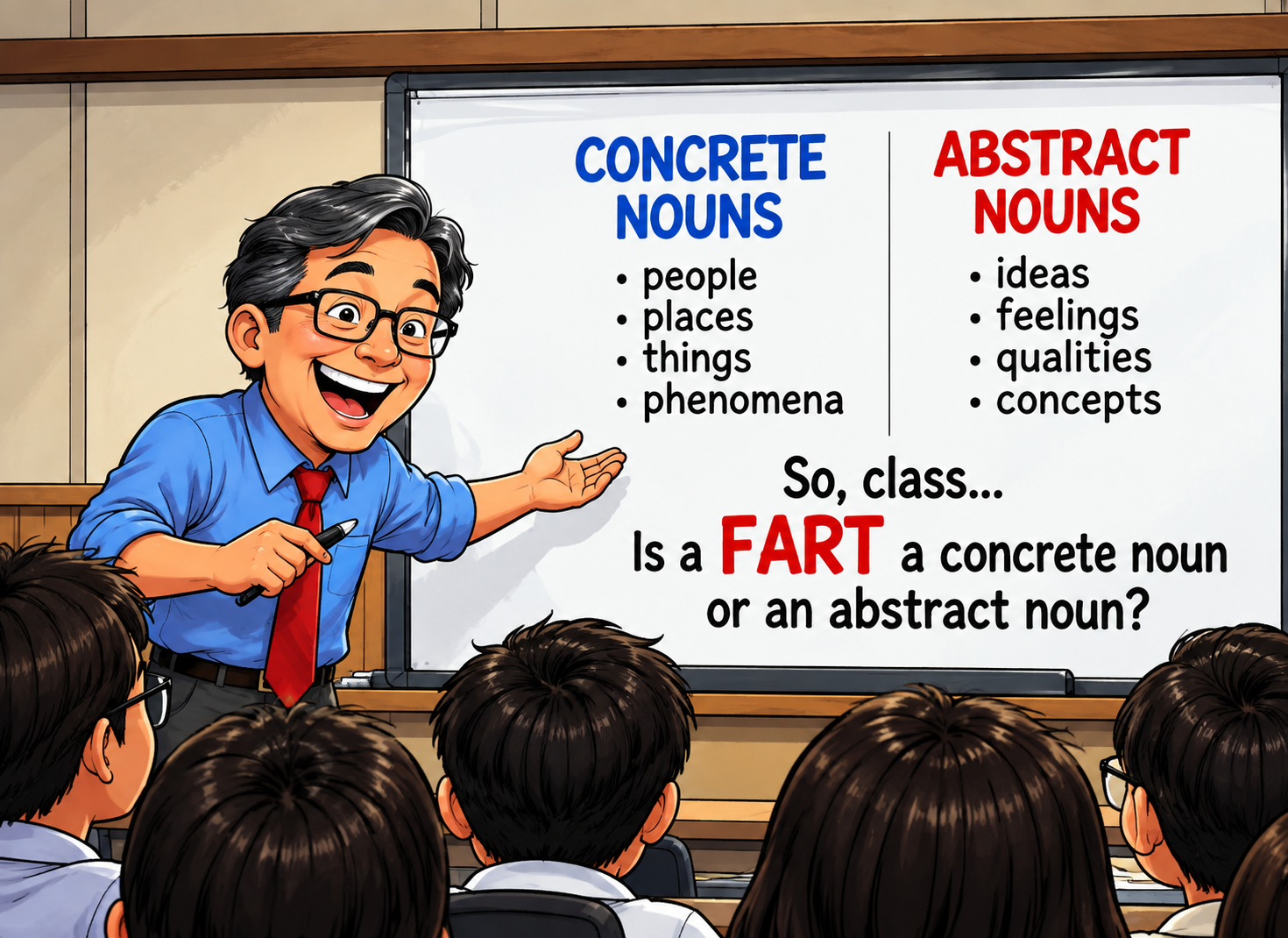
One day, while discussing nouns, I introduced the distinction between concrete and abstract nouns.
I explained that concrete nouns refer to physical things or occurrences you can perceive through the senses, whereas abstract nouns refer to concepts, qualities, feelings, and ideas.
After giving several conventional examples, I decided to test my students with a less conventional one.
“Class,” I asked, “is a FART a concrete noun or an abstract noun?”
There was a moment of hesitation.
Then came the answers.
“Abstract, sir!”
Practically everyone agreed.
I could understand their reasoning. A fart is generally invisible. You cannot put it on a table, examine its shape, or display it like a book or a chair.
But I had other ideas.
“No!” I declared. “A fart is a concrete noun!”
The students looked puzzled.
And so, our grammar lesson unexpectedly became a chemistry lesson.
I explained that a fart involves releasing intestinal gases. These gases have physical existence. They occupy space, consist of matter, and can be detected through our senses.
“Just because you cannot see something,” I explained, “does not mean it does not exist!”
I thought that would settle the matter.
But then I decided to go further.
“Besides,” I told them, “who says you cannot hold a fart?”
That was when I remembered something from my childhood.
When I was a little boy, I was playing with my younger sister. At some point, I passed gas. Being the mischievous little creature that I was, I quickly cupped my hand near my behind, pretending to catch what had just escaped.
Before the gas could completely disperse, I brought my cupped hand close to my sister’s nose.
Then I opened it.
My poor sister!
She cried and immediately ran to our mother to report the terrible injustice she had suffered.
Mama, apparently finding the whole incident amusing despite my sister’s distress, gave me a light smack with her slipper, partly to reprimand me and partly to appease the offended little girl.
I had received my punishment.
My sister had received her justice.
And neither of us could have imagined that decades later, the incident would become part of a university grammar lesson in South Korea.
By the time I finished telling the story, my students were in stitches.
What began as an ordinary discussion of concrete and abstract nouns wandered through chemistry, human biology, childhood mischief, and a mother’s slipper.
And somehow, we were still discussing grammar!
But the laughter wasn’t over
Having established that a fart was a concrete noun, I decided to challenge my students further.
“Now, class,” I asked, “is fart a count noun or a non-count noun?”
Immediately, two students began debating.
“It’s non-count, sir!” one insisted.
“No, it’s count!” the other argued.
One student tried to defend his position by referring to our earlier discussion.
“Sir just said it’s concrete! Like a smartphone is concrete. You can say, ‘I have one smartphone!'”
His classmate was unconvinced.
“Come on!” he protested. “You can’t say, ‘I have one fart!'”
The classroom erupted in laughter again.
I could hardly have asked for a more entertaining grammatical disagreement.
When the laughter subsided, I explained that fart is indeed a countable noun. We can say a fart, two farts, or several farts. The issue wasn’t its countability but the choice of expression. In ordinary conversation, we generally say someone lets out a fart rather than has one fart.
I also clarified that concrete and countable describe two different noun characteristics. A noun can be concrete and countable, like chair, or concrete and uncountable, like water.
By then, we had explored two grammatical classifications using one rather unconventional example.
But something else had happened.
My students were no longer merely listening to an explanation. They were arguing, reasoning, challenging one another, and defending their answers.
One student had attempted to apply an earlier grammatical concept to a new question. Although the reasoning wasn’t entirely correct, it gave us another chance to clarify the distinction between the two classifications.
And all of this happened because of a fart!
When Preparation Meets Theatre…
Looking back, I find the experience amusing not merely because of the laughter it produced, but because the lesson unfolded so naturally.
I had not planned to tell that childhood story. It wasn’t in my lesson plan. There was certainly no instruction in my teaching materials that said, “At this point, introduce a childhood fart incident.”
The story simply emerged from our discussion.
But beneath the humor was a genuine learning opportunity.
My students had initially associated concrete with things they could see or hold. The unusual example challenged that assumption and encouraged them to reconsider what physical existence means.
The chemistry explanation supplied the conceptual clarification. The childhood anecdote made the discussion memorable.
The subsequent debate about countability created another learning opportunity. It required students to examine their assumptions, explain their reasoning, and distinguish between two different grammatical concepts.
Did the laughter guarantee that every student understood the lesson? Of course not. Understanding still needs to be checked through questions, examples, and opportunities to apply what has been learned.
But the laughter helped turn an otherwise ordinary lesson into an experience we could share.
I have always believed that teaching should be a serious undertaking without necessarily becoming a solemn activity.
A teacher can be academically rigorous without being intimidating. A lesson can be intellectually demanding without being joyless. And sometimes, a little spontaneity can encourage students to participate in ways a carefully prepared explanation alone might not.
Perhaps that is what the expression about preparation and theatre really means to me.
Preparation ensures that I know what I am teaching, why I am teaching it, and what I want my students to learn.
Theatre, whether intentional or spontaneous, helps me bring the lesson to life.
And when the two come together, the classroom becomes more than a place where information is delivered. It becomes a place where ideas are explored, mistakes are examined, questions are encouraged, and learning can be accompanied by laughter.
I have often described my philosophy of teaching this way:
“The classroom is my playground, the students are my playmates, and the subject is our toy.”
That particular day, our toy happened to be a fart.
And somewhere in the Philippines, my younger sister probably has no idea that her childhood suffering has contributed to the grammatical education of university students in South Korea.
Sorry, little sister.
But thank you for your contribution to science—and English grammar!

Posted on October 4, 2026, in Educational Philosophy, Teacher-Student Communication, Teacher-Student Rapport, Teaching Style. Bookmark the permalink. Leave a comment.



Leave a comment
Comments 0