Blog Archives
The Sense of Fulfillment

Fulfillment isn’t a trophy waiting at the end of self-improvement. It grows from
becoming more fully the person you are capable of being.

Achievement asks, “What did I accomplish?” Fulfillment asks a deeper question: “Who did I become while accomplishing it?”
Fittingly, fulfillment stands at the far end of the self-improvement process presented in this book. But it should not be mistaken for a final destination where all striving stops. Fulfillment goes deeper than accomplishment. It is not merely reaching a goal; it is experiencing the meaning that comes from growing into the person capable of reaching it.
This is why external achievement alone can feel strangely incomplete. A promotion, publication, degree, business, award, or financial milestone can be deeply satisfying, but none automatically creates a fulfilling life. What matters is how those achievements relate to our values, health, relationships, purpose, and continuing development.
The Why–How–What structure helps clarify the relationship. The Why is the person you are trying to become and the potential you want to realize. The How is the self-improvement process—the attitudes, skills, habits, choices, and discipline through which growth occurs. The What is the life that emerges from that process: the concrete expressions of success, health, happiness, contribution, and meaning.
In my framework, fulfillment is strengthened when success, health, and happiness support rather than destroy one another. Success without health can become fragile. Health without purpose can feel incomplete. Happiness that depends entirely on circumstances can disappear as quickly as those circumstances change. Fulfillment becomes richer when these dimensions reinforce one another rather than compete for survival.
And because we continue changing, fulfillment must remain dynamic. Today’s best self is not necessarily tomorrow’s. New responsibilities, losses, discoveries, relationships, and possibilities reshape what a meaningful life requires from us. Fulfillment, then, is not the end of growth. It is one of the experiences that tells us our growth is moving in a direction that matters.
Pause and Reflect
If you stopped chasing fulfillment as an outcome and focused instead on becoming your best self, what would you do differently today?
One Step Forward
Write one sentence describing the person you are becoming—not what you hope to possess or achieve, but who you want to be in the process.
Explored in full in Part 3, Section II — Fulfillment of A Holistic Approach to Self-Improvement.
Pursuing Well-Being
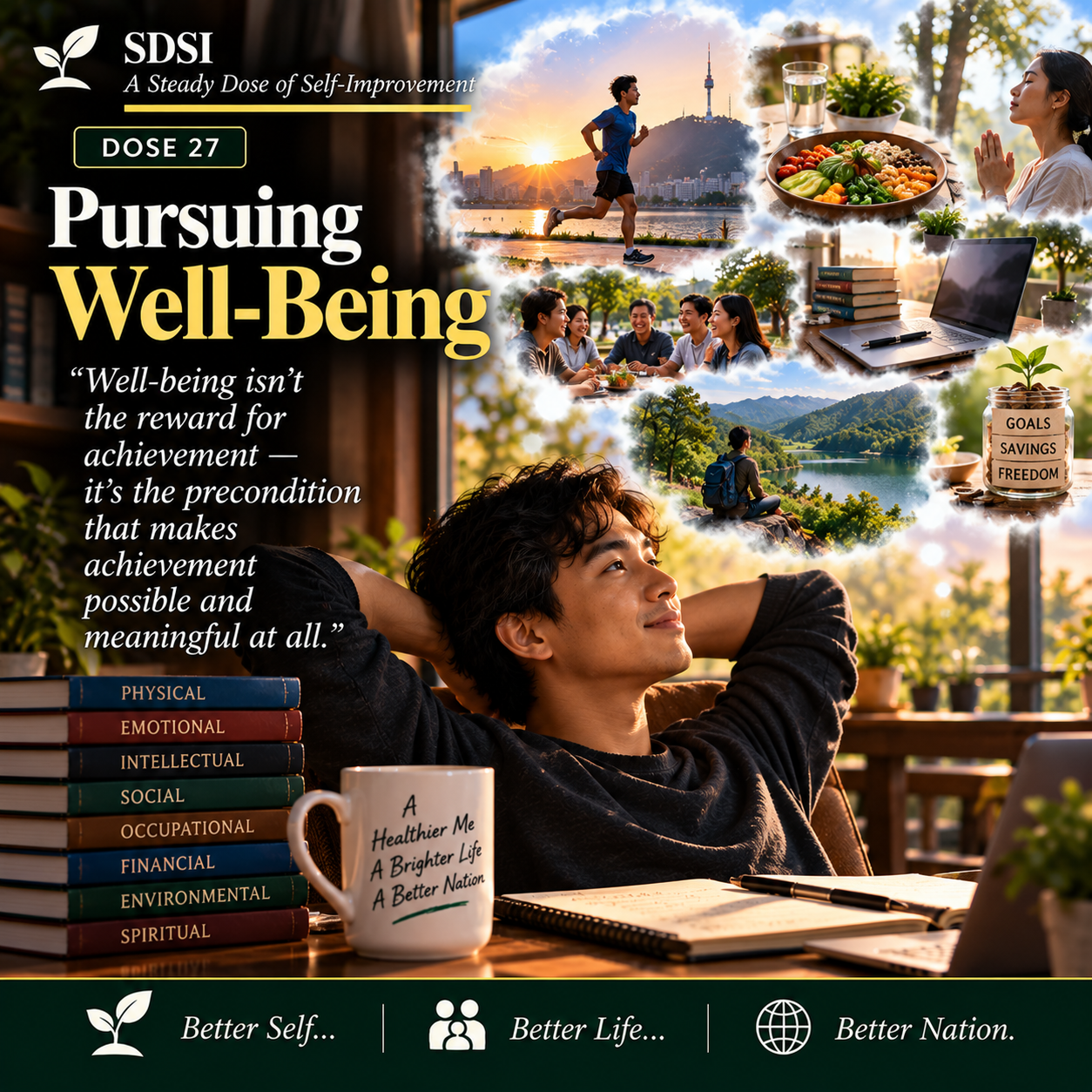
Well-being isn’t the reward for achievement — it’s the precondition that makes
achievement possible and meaningful at all.

Most people think of well-being as the absence of illness. It is far more than that.
Well-being is often reduced to physical health: no illness, no pain, a reasonably fit body. But genuine well-being reaches much further. It involves how we feel, how we function, how we relate to others, how secure and purposeful our lives feel, and whether the different parts of our lives support rather than constantly undermine one another.
One useful way of viewing well-being is through several interconnected dimensions: physical, emotional, intellectual, social, occupational, financial, environmental, and spiritual. The categories may overlap, but that is precisely the point. Human life is not divided into sealed compartments. Neglect one area long enough and the effects often spill into the others.
Research on exceptionally long-lived populations offers an interesting illustration. Communities studied for unusual longevity have often been associated with patterns such as regular movement, plant-rich diets, meaningful social connections, and a sense of purpose. Researchers continue to debate how broadly the popular “Blue Zones” framework should be applied, but the larger lesson remains useful: well-being is rarely the product of one habit. It is usually built from a pattern of living.
My own experience in South Korea has made that lesson personal. A manageable teaching schedule has given me room not only to work, but also to write, read, exercise, reflect, spend time with family, and pursue projects that matter to me. I have learned that having time outside work does not necessarily reduce productivity. Used deliberately, it can make productive work more creative, focused, and sustainable.
The goal, then, is not perfect balance every day. Life will sometimes demand more from one dimension than another. The goal is awareness: knowing when one part of yourself has been neglected for too long and having the courage to restore it before the deficit becomes a crisis.
Pause and Reflect
Which dimension of your well-being—physical, emotional, intellectual, social, occupational, financial, environmental, or spiritual—needs the most attention right now?
One Step Forward
Rate the eight dimensions from 1 to 10. Choose your lowest score and identify one small action you can take this week to strengthen it.
Explored in full in Chapter 18 — Pursuing Well-Being of A Holistic Approach to Self-Improvement.