Blog Archives
The Fabrics of Race (3)
(Third of Three Parts)

Why were the Nazis the only Whites who were made to account for the crimes they committed against humanity? There is also a need to consider past acts of slavery and the abuses, killings, and plunder committed by the White imperialist powers against the colonized people in countries they invaded as criminal acts. The Nazis committed their barbaric acts only for the duration of World War 2. Conversely, the White colonial powers perpetuated their brutality for centuries and yet got nothing, not even a slap on the hand.
The colonial powers and slave masters should acknowledge that they owe a debt to the descendants of the countries they colonized. There’s no way around it. It’s the only way that justice will be served. They must pay for the damages they caused. A way to quantify the debt for generations of exploitation, plunder, and enslavement must be devised. The colonizers must pay. More importantly, aside from financial restitution, they must also offer an apology.
However, convening in Geneva to establish statutes to retroactively determine the guilt of the practitioners of slavery and the White colonial masters is seemingly like Don Quixote fighting the windmills. Waiting for justice to be served, at least in terms of restitution and apology, is like Vladimir and Estragon waiting for Godot.
The victims of slavery and imperialism, like Don Quixote, are fighting against the insurmountable Caucasian forces hiding in their cocoon of denial and amnesia, and impervious to their pleas for justice. But unlike the delusional Don Quixote, the victims’ fight for justice is grounded in the harsh reality of the oppression they suffered at the hands of their colonial abusers. But the victims of slavery and imperialism could be like Vladimir and Estragon, endlessly awaiting the arrival of Godot, who never comes. The justice that should be given to them may never materialize.
Will the proud and mighty Caucasians of the world agree to indemnify and apologize to the victims of their colonial abuses? To hope that it will happen is more like waiting for Godot than believing that hope springs eternal. Those powerful white-dominated nations will never allow the passing of such measures if ever a convention for that purpose is held in Geneva or elsewhere in the world.
Instead of reparations for colonial crimes, the perpetrators justify their actions, asserting self-defense. They contend that they fought with and killed the native inhabitants of the countries they invaded because those people resisted. But why would they not? What else were they supposed to do when they were being enslaved, robbed, beaten, killed… and their daughters, sisters, and mothers raped? Would they be expected to say and do nothing? There are even arguments positing that colonial governments shouldn’t be condemned but rather compensated because they built roads, bridges, and schools for the people they colonized, as if that makes up for the crimes and abuses they committed. As if they didn’t exploit and force those same people to build those things and use those people’s own resources. As if they didn’t steal the natural resources of every land they took.
Colonizers claim that they brought prosperity to the countries they invaded. But what if it’s the opposite? What if, in reality, the resources the colonizers stole from their colonies through the violent subjugation of the Native peoples made their countries wealthy and progressive?
After a few years in the academe, a tertiary institution employed me as a school administrator. It necessitated my staying in an apartment away from my family during weekdays. I had no choice but to do the laundry myself. I decided to veer away from my grandmother’s strict orders to separate the white garments from the colored ones. I put them all together in the washing machine. When I did so for the first time, I recalled my grandmother’s stern warning, “You’ll be in big trouble with me if you do.”
That time was already the 21st century, and I thought that the world had become more aware of (and sensitive to) issues related to equality and racial discrimination. I thought that the world had embraced the doctrine of political correctness. I thought that people are trying to avoid language and actions that could be offensive to others, especially those relating to sex, gender, and race.
I was wrong.
I experienced firsthand how the monster called racial discrimination reared its ugly head. Such experience made me realize how deeply the injustice of colonialism and racial segregation had permeated societies, not just in America and Europe but all over the world.
That experience occurred when I applied as an English (ESL) teacher overseas and was unpleasantly surprised to discover that most universities in the countries where I hoped to work would hire only native speakers of English who were citizens of (guess what?) predominantly white countries. I had thought native speakerism was just gossip. How naïve of me not to believe what some of my friends said that preference is given to native speakers of English in the field of English language teaching overseas. Can I be faulted for thinking that the academe would be the last bastion of equality, justice, and meritocracy?
While the period of colonialism may have ended, neo-colonialism has taken its place. And I never thought that some universities have become their purveyors. Standing before the mirror at that moment, I was reminded that, yes, I am fully capable of teaching English, and I have the necessary educational qualifications, pedagogical training, and teaching experience. However, there is one thing I don’t have: fair skin. It made me think that even if I were a citizen of one of those countries predominantly populated by Caucasians, I might still not be hired by those universities because the unspoken standard is not citizenship—it’s the color of one’s skin.
What my grandmother repeatedly said when instructing the ones doing the laundry came back to mind: “Separate the whites from the colored fabrics.” Was I cursed because I did not follow her bidding? Should I have separated the white garments from the colored ones? Should I have treated the whites delicately? That’s essentially what those universities were doing. They were giving the Whites preferential treatment. It felt like a cruel reminder of the color of my skin… dark brown, almost black.
What hurts is the fact that the people in those universities who implement that discriminatory rule of hiring only native speakers of English to teach the language are Asians like me. Then I realized that the color of their skin is neither black nor brown. They belong to the yellow race, and their skin is almost white. White and yellow, both skins are fair. At that time, in my mind, neo-colonialism ceased to be just an abstract political term. I saw how alive it is in the structures that still marginalize people based on race and skin color.
The painful truth that many of the universities in those countries I hoped to work in would hire only native speakers of English from predominantly white nations, while overlooking my qualifications, is a stark reminder that colonial ideologies still shape opportunities and perceptions
*****
Just one more WHY?
When I was young, my mother told me that one day, when I grew older, I would understand why in America, colored people weren’t allowed to use the same toilets as White people. But here I am, a grown-up with graying hair that is supposed to symbolize wisdom, and still I do not understand.
Here’s my next why.
Why, after all these years, do we still see the same patterns of discrimination, hatred, and violence based on skin color?
What would I say to my children, or grandchildren, or any young person if they were to see the same images I saw before? Will I be able to sufficiently respond if they asked why people with dark skin couldn’t use the Whites’ drinking fountain?
What if, in the future, they see on social media the image of a person of color being mercilessly manhandled by a White person, like the photo of a White police officer (yes, a police officer) kneeling on the neck of a defenseless Black man, causing his death? Something that happened not centuries ago, when black slavery was at its worst, but one that occurred only a few years back. What will I say if they ask me why? Why do people like Derek Chauvin continue to exist, inflicting so much pain on the George Floyds of the world?
Maybe I’ll do as my mother did—nod, smile, and say, “Someday, my children, you will understand why.” But my fervent prayer to the Good Man above is that they never have to ask the same questions I did.” I hope they will live in a world where skin color no longer dictates one’s worth or opportunities.
Did America Save the Philippines From Spain?
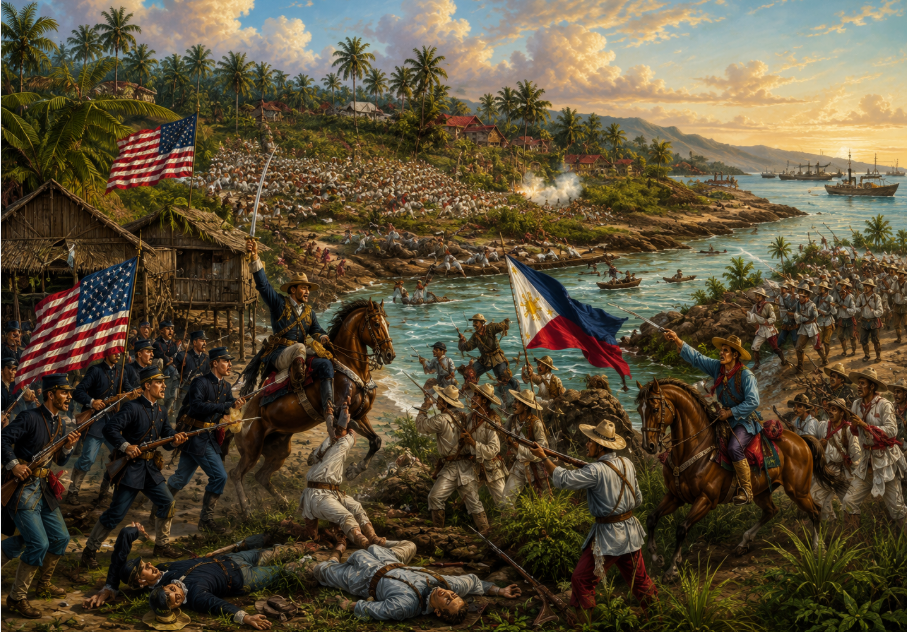
Not so long ago, in our university’s English lounge, I had a discussion with two colleagues about a comparative study on the effects of native and non-native English language teachers on students’ performance in English. When the discussion brought us to the three concentric circles of English, we tried to identify the countries colonized by England and America. Surprisingly, one said, “The Philippines (my country) was rescued by the Americans from the Spaniards.” I paused, looked at him, and said, “Are you sure you want us to discuss that topic?”
I was ready for a debate. I had the advantage — I am Filipino. I know my nation’s history, which he apparently knew little or nothing about. Philippine History was also one of the subjects I had taught, quite passionately, in my country, and I was ready to teach him a lesson. I was prepared to hit him with my historical whip. But when I asked that question, he only smiled and redirected the discussion back to the original topic.
I wanted to return to his statement — I needed to respond — but our time in the English lounge was over. We had to leave. The bell saved him.
That desire to respond stayed with me. It tortured my Filipino soul. The Filipino in me could not stand down. I did not stand down, either, when another colleague made some unsavory remarks about Filipinos in his own country. I still recall how irate he became at what I had to say in response. He was so vexed by the way I refuted his statements that, one time when he got drunk, he gave me a mouthful and had to be restrained by his friends.
To that fit of rage from a drunk man, I did not respond violently. Why would I? I simply retorted wittily, which I think inflamed his bruised ego all the more. And to that earlier statement — that “my country was saved by Uncle Sam from the bullies from the Iberian peninsula” — I also had to do something. The only way to regain my peace was to respond in some way. So I decided to write this article, hoping that one day, that colleague who wrongly believed the Americans were the Filipinos’ knights in shining armor during the colonial period would read it.
Now, let me answer the question: Did the Americans save the Filipinos from the Spaniards?
HELL NO!
The Americans extinguished the flames of Filipino nationalism just as they were beginning to flicker, depriving the Filipinos of the chance to chart their own destiny as a nation. That’s what they did. And it shouldn’t have surprised anyone — if they treated African Americans in their own backyard the way they did during those times, why would they be any kinder to Filipinos in a foreign land?
Let me share some excerpts from my ongoing study, “How Colonialism Shaped the Filipino Character.”
* * * * * * * * * *
In 1896, the Filipinos staged the biggest and most organized revolt against Spain. Their previous attempts to overthrow their invaders from the Iberian peninsula had all been quelled. Historians say those earlier uprisings failed because they were driven by localized issues confined to limited geographical scales and lacked a truly national character. The 1896 revolution was different. It started in the capital, Manila, then spread to surrounding provinces and eventually became national in scope, driven mainly by the rise of Filipino nationalism.
The Spaniards had their hands full, and it was only a matter of time before their more than three centuries of rule would have ended. Even if the Americans had not come, the Filipinos could have succeeded in ending Spanish rule on their own.
The Americans duped Emilio Aguinaldo, leader of the revolt against Spain, into believing they had come to help the Filipinos establish a republic and had no designs on a colony of their own.
Then the Filipinos watched helplessly as the Spaniards — too proud to accept defeat at the hands of the Indios they had enslaved for centuries — surrendered to the Americans instead, and were paid $20,000,000 for the improvements they had made to the Philippine islands during their colonial rule. That was one of the conditions set in the Treaty of Paris of 1898, which the two countries concluded without securing the consent of the Filipino people.
Would the Americans really pay the Spaniards that huge sum — worth more than $800 million today — and get nothing in return?
HELL NO!
America, then an emerging world power, needed to flex its muscles in the Pacific, and the Philippines was the ideal place to do it. Its military strategists likely believed America needed a presence in Asia to counter the growing might of imperial Japan.
So, contrary to the promise Aguinaldo said he had naively believed, the Americans declared the Philippines a territory ceded to them by Spain.
It was a painful experience for the Filipinos. After centuries of struggle against Spain, they finally had a chance to chart their own destiny as a nation. But the Americans stood in their way, and the Filipinos had to continue their search for that elusive freedom.
So the Philippines changed hands — from one colonial master to another, from the Spanish yoke to the American one.
What if the Americans had observed the principle that “governments derive their just powers from the consent of the governed,” and decided not to stay in 1898, allowing the Filipinos to govern themselves? The Americans should have known better — that very principle drove their own Declaration of Independence in 1776. It is touted as the model for the right to self-determination, the very right they denied the Filipinos when they colonized the Philippines. The Americans justified their occupation by claiming the Filipinos were not ready for self-governance. But how sure were they? Even then, the Filipinos would certainly have preferred to chart their own destiny as a nation, no matter the consequences. The world will never know what would have happened had the Americans given them the reins of their own government. While it isn’t certain the Filipinos would have succeeded, one thing is clear: the Philippines didn’t become a better nation simply because the Americans occupied it, either.
And let us not pretend that whatever roads, schools, or railways the Americans built were gifts paid for with American dollars. They were not. The colonial government operated under what was called a “self-supporting” budgetary system — every peso spent on Philippine infrastructure came from Philippine taxes, Philippine tariffs, and Philippine export revenue. Filipinos paid for their own colonization, administered by American hands. And what did those hands take in return? In 1899, American goods made up a mere 7 percent of what Filipinos imported; by 1934, that figure had ballooned to 66 percent. In that same span, the share of Philippine exports flowing to the United States rose from 26 percent to 84 percent — sugar, coconut, tobacco, abaca, and the gold and chromite pulled from Baguio and Surigao. The 1909 Payne-Aldrich Tariff dressed this up as “free trade,” but free trade between an industrial power and its colony is never quite free — one side sends raw material, the other sends finished goods, and profit finds its way to the side that already has the factories. Add to this the naval and military foothold the Americans secured in the Pacific — a strategic prize never once listed on any balance sheet — and the picture becomes clear: whatever the Americans built in the Philippines, the Filipinos had already paid for it twice over, once in tax pesos and once in raw resources shipped abroad.
It would have been a significant boost to Filipino pride had they been allowed to continue their war with Spain, which they were winning at the time. Instead, Spanish and American strategists connived to stage what later became known as the “Mock Battle of Manila Bay,” which the Americans purportedly won. That plan was concocted to prevent Manila, the nation’s capital, from falling into the hands of Filipino revolutionaries. Just imagine how a genuine victory like that would have affected the Filipino psyche — the nation’s character would have evolved in a much different direction. But it was not meant to be.
The last quarter of the 19th century was perhaps the most significant stage in the Philippines’ development. It was when nationalism began to flourish. It had taken centuries for the natives to put up a united front against their colonizers, but like the sun rising in the east, spreading its golden rays to signal a new day, an emerging solidarity among the natives became a portent of greater things to come — things that never came.
The most essential ingredient for national development was finally manifesting among Filipinos: the seeds of nationalism had begun to sprout. The influx of liberal ideas from Europe, the rise of the middle class, and the martyrdom of Fathers Gomez, Burgos, and Zamora (GomBurZa) were among the factors believed to have fanned the flames of national unity.
It was a long and arduous journey toward national solidarity, made difficult by a combination of factors: the island nation’s geographical fragmentation, its people’s many dialects, and the Spaniards’ deliberate employment of divide-and-conquer tactics.
The Spaniards succeeded tremendously at this tactic — so much so that they reigned supreme for more than 300 years. But once the Filipinos began to develop a cohesive spirit that closed their geographical gaps and dismantled their language barriers with a deafening cry for freedom, the days of the Hispanic colonizers became numbered. The colonial masters suffered humiliating defeats at the hands of the very people they had held by the neck for so long, and were forced to retreat to the walled city of Intramuros.
However, the next chapter of the Philippine drama unfolded not as the Filipinos had written the script, but as the directors from Hollywood penned it. Just as the Filipinos were ready to hammer the last nail into the coffin of Spanish tyranny, the Americans said, “CUUUTTTT!”
With near certainty, the revolution the Filipinos started in 1896 would have finally ended Spanish rule. The natives had them figured out. All they needed was to march together, hands bound by the bond of patriotism. The Filipinos were ready to storm Intramuros, the last bastion of Spanish rule, but were stopped in their tracks by the Americans — whom they wrongly perceived as an ally in their quest for freedom. The Filipinos naively believed that the Americans, who were also waging war against Spain in Cuba, had come as friends, not foes.
To cut the story short: the Americans occupied the Philippines once the Spaniards left, and the Filipinos were forced to wage war against a military far more powerful and advanced than their former colonizers.
The natives eventually lost that war, and the sprouts that had grown from the seeds of nationalism sown by the forebears of the Filipino race were never allowed to bloom. They were forcibly uprooted and trampled by the Americans. Historians explain that the new colonial masters extinguished the flames of Filipino nationalism through laws like the Sedition Law (1901), which imposed the death penalty or lengthy imprisonment on anyone advocating independence from the United States — even by peaceful means — and the Flag Law (1907), which prohibited the display of the Philippine flag anywhere.
Filipino nationalism was nipped in the bud. That period in Filipino history came to be called the “Era of Suppressed Nationalism.” While the natives were still licking the wounds inflicted by their former Spanish masters, the Americans began opening the very same wounds of subjugation.
As everybody knows, the justification offered by the Filipinos’ new colonial masters was that the natives were not ready for self-governance, and that leaving them to fend for themselves would have been chaotic.
They could have been right. But if they were wrong, we will never know now, will we? What critical-thinking Filipinos today do know is that the Americans had no right to deprive them of the chance to determine their own fate as a people at that time. The natives could have been left to face the consequences of standing on their own feet. No one had the right to deny the Filipinos the opportunity to claim their own victory against Spain. It would have meant so much had the colonizer surrendered to the colonized — that would have been a huge moral and psychological victory for a people enslaved and deprived of their fundamental rights and freedoms for so long. But instead of a boost to their spirit, the Americans’ actions wounded Filipino pride and stunted the growth of a stronger national character.
The Americans should have taken a page from their own history to understand how the Filipinos felt. According to historians, the American colonists fought for independence against Britain in the 1700s largely because they believed in the individual’s inalienable rights, and being taxed by the British Parliament without representation violated those rights. They believed no government could act without the consent of the governed. The Filipinos, likewise, did not want another foreign power ruling them — they had already had enough of the Spaniards. The Americans never had the Filipinos’ consent to stay in the country and govern them.
But the Filipinos could do nothing; no other country could come to their aid at the time. The Americans had had France to support their own bid for independence from Britain, and perhaps the Filipinos hoped America would “do a France” for them when it arrived. It was wishful thinking.
The Filipinos were on their own, and the world then was a vast jungle where colonial powers were the predators and weaker nations the helpless prey.
The Filipinos, then, could not even invoke any law to contest the legality of the American occupation. Imperialism makes its own rules and enforces them with brute force; because of its armed strength, imperial law simply supersedes international law. As one historian put it, the legality of imperial activity rests largely on the imperial state’s own judicial system and its own legal experts — a convenient arrangement, given that Americans, who championed liberalism, should have known that natural rights are not contingent on any particular culture, government, or custom, but are universal and inalienable.
* * * * * * * * * *
So, did America save the Philippines from Spain?
Let me answer it one more time…
HELL NO!
How could it, when historians have described the Philippines as America’s “first Vietnam” — a conflict in which U.S. troops first used tactics like strategic hamlets and scorched-earth policies to “pacify” the revolting Filipinos? The image below shows how that strategy played out.
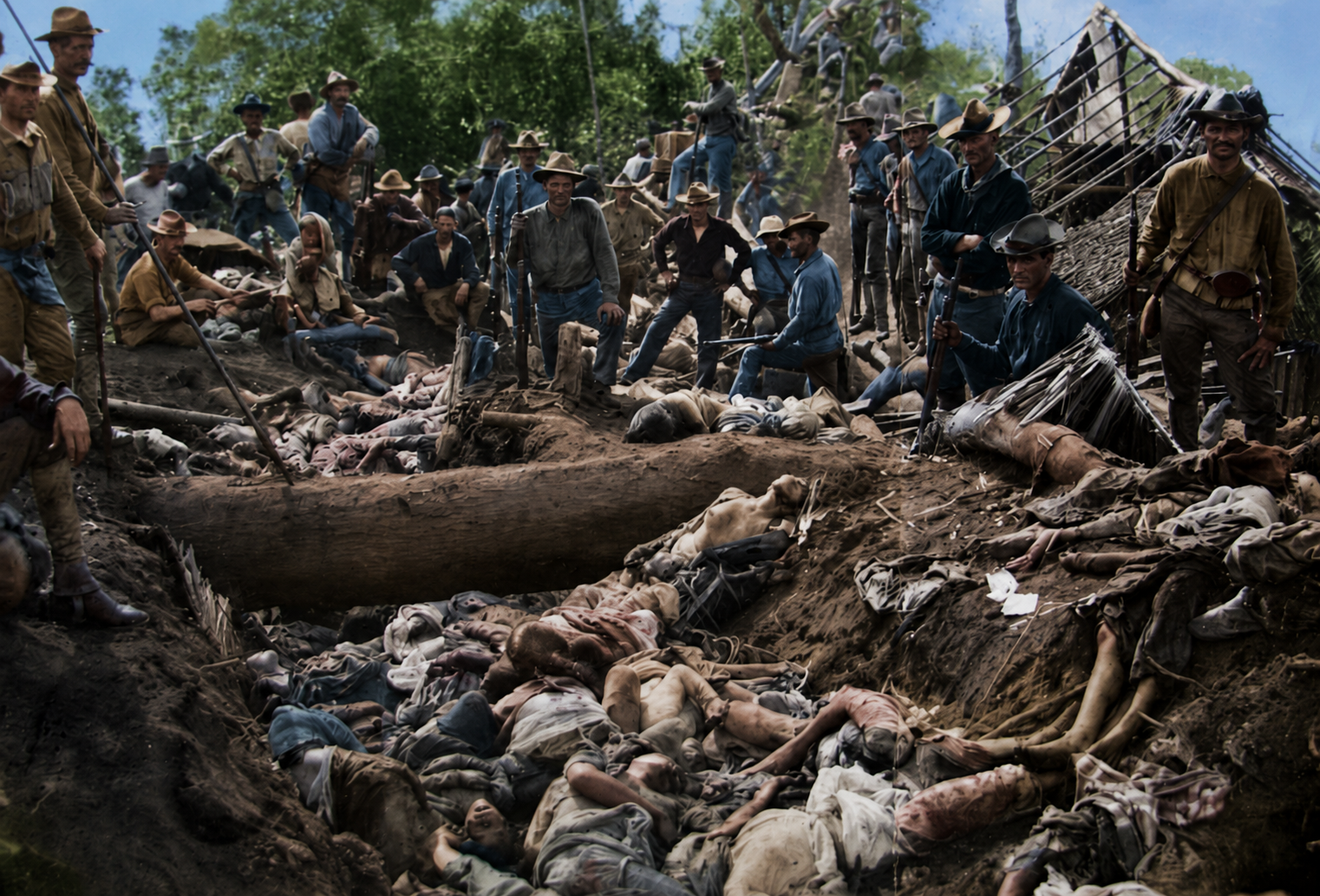
No — those are not Nazi soldiers posing proudly after killing Jewish people. These are American soldiers posing with dead Filipino Muslims after the Bud Dajo massacre in 1906. The Americans called it the “Battle of Bud Dajo.” It wasn’t a battle. Mark Twain — the famous American author, born Samuel Langhorne Clemens — condemned it from home as a member of the Anti-Imperialist League, writing: “In what way was it a battle? It has no resemblance to a battle… We cleaned up our four days’ work and made it complete by butchering these helpless people.”
Let me close with an excerpt from a speech by Manuel L. Quezon, president of the Philippines from 1935 to 1944:
“It is true, and I am proud of it, that I once said, ‘I would rather have a government run like hell by Filipinos than a government run like heaven by Americans.’ I want to tell you that I have, in my life, made no other remark that went around the world like that one. There was no paper in the United States, including the smallest village paper, that did not print that statement, and I have seen it printed in many newspapers across Europe as well. I would rather have a government run like hell by Filipinos than a government run like heaven by any foreigner. I said that once; I say it again, and I will always say it as long as I live.
But that is not an admission that a government run by Filipinos will be a government run like hell — much less an admission that a government run by Americans, or by the people of any other foreign country, could ever be a government run like heaven.”
How Colonialism Shaped the Filipino Character (Last of 4 parts)

The last quarter of the 19th century was perhaps the most significant stage in the development of the Philippines as a nation — the moment nationalism began to flourish. It took centuries for the natives to finally unite against their colonizers. Like the sun rising in the east, spreading its golden light to signal a new day, this emerging solidarity became a portent of greater things to come — things that, in the end, never came.
The essential ingredient for national development was finally taking shape among Filipinos. The seeds of nationalism began to sprout, nourished by the influx of liberal ideas from Europe, the rise of the middle class, and the martyrdom of Fathers Gomez, Burgos, and Zamora (GomBurZa) — events widely credited with fanning the flames of national unity.
It was a long and difficult road to national solidarity, made harder by a combination of factors: a geographically fragmented island nation, a people divided by dialect, and the Spaniards’ relentless use of “divide and conquer” tactics.
The Spaniards employed that tactic so effectively that they reigned for more than three hundred years. But once Filipinos began to forge a cohesive spirit that bridged their geographic divides, once they tore down the language barriers with a unified cry for freedom, the days of Spanish rule became numbered. The colonizers suffered humiliating defeats at the hands of the very people they had held by the neck for so long, and were forced to retreat behind the walls of Intramuros.
But the next chapter of the Philippine story did not unfold according to the script the Filipinos had written. It unfolded the way Hollywood might have written it instead. And just as the Filipinos were ready to drive the final nail into the coffin of Spanish tyranny, the Americans called, “Cut.”
There is little doubt the revolution begun in 1896 would have finally ended Spanish rule — the Filipinos were ready to storm Intramuros, the last Spanish stronghold, needing only to march together as one. But the Americans, whom they wrongly mistook for allies in their fight for freedom, stopped them just short of the finish line.
To cut the story short: the Americans occupied the Philippines once the Spaniards withdrew, and the Filipinos were forced to fight a war against a military far more powerful and far better armed than their former colonizers had ever been.
The natives lost, and the seeds of nationalism sown by earlier generations of Filipinos were never allowed to bloom. They were forcibly uprooted and trampled by an occupying power determined not to let them take root again.
Filipino nationalism was nipped in the bud. Historians call this period the “Era of Suppressed Nationalism.” While the natives were still nursing the wounds inflicted by their former Spanish masters, the Americans began inflicting new ones.
As is well known, the justification the new colonizers offered was that the Filipinos were not yet ready for self-governance, and that leaving them to their own devices would have led to chaos.
They may have been right. Or they may have been wrong. No one will ever know for certain. But what any critical-thinking Filipino today understands is that the Americans had no right to deny the Filipinos the opportunity to determine their own fate. The natives should have been allowed to face the consequences of standing on their own feet — to raise their arms in victory against Spain, however that victory might have unfolded. It would have meant so much for the colonizer to surrender to the colonized. That would have been a profound moral victory for a people who had been enslaved and deprived of their basic rights and freedoms for so long — a genuine boost to Filipino morale. Instead, American intervention wounded Filipino pride and stunted the growth of a stronger national character.
The Americans might have looked to their own history to understand how the Filipinos felt. The American colonists themselves fought for independence from Britain in the 1700s because they believed in the inalienable rights of the individual, and that taxation by Parliament without representation violated those rights [12]. They believed that a government’s power must rest on the consent of the governed. The Filipinos, too, wanted no part of another foreign power ruling over them — they had already had enough of the Spaniards. And the Americans never had the Filipinos’ consent to remain and govern.
But there was nothing the Filipinos could do; no country stood ready to come to their aid. The Americans had France’s support in their fight for independence from Britain, and perhaps the Filipinos hoped America might do the same for them. It was wishful thinking.
The Filipinos stood alone, in a world that, at the time, functioned like a jungle — where colonial powers were the predators and weaker nations the helpless prey.
The Filipinos could not even invoke any law to challenge the legality of the American occupation. Imperialism operates by its own laws, backed by brute force; armed power allows imperial law to override international law, since the legality of imperial activity rests largely on the imperial state’s judicial system and legal experts [13]. Yet wasn’t America supposed to champion liberalism — the belief that natural rights exist independent of any culture, custom, or government, and are therefore universal and inalienable [14]?
Two faces of the same Filipino emerged from those centuries of subjugation, and both carry the fingerprints of the colonizer.
On one face: a people famous for their warmth, resilience, and instinct to hold family and neighbor close through every storm. The hospitality that welcomed strangers ashore, the bayanihan spirit that still carries a neighbor’s house on bamboo poles, the family ties that never loosened even when everything else was taken — none of this vanished under three centuries of foreign rule. If anything, colonization tempered these traits the way fire tempers steel. A people stripped of land, labor, and self-governance had little left to hold onto but each other, and so they held on tighter.
On the other face: a people who, more often than history should allow, still doubt themselves before a foreigner even speaks — who shrug at misfortune and call it destiny, who eye a neighbor from the next province with more suspicion than they ever directed at the men who colonized them both. Fatalism, regionalism, colonial mentality — these were not accidents. They were cultivated by rulers who profited from a people too divided to unite, too resigned to resist, too eager to please to ever ask why. That same regionalism, inherited rather than chosen, still makes it difficult to think and act as one nation; it resurfaces today less as province against province than as camp against camp, with loyalty to a politician often commanding more devotion than loyalty to a shared and rightful cause.
Here, then, is the uncomfortable truth this series has been circling: colonialism did not simply wound the Filipino, nor did it simply fail to break him. It did both, to the very same people, across the very same three hundred years — and the strength and the wound came from the identical source. That is the paradox at the center of Filipino character: a resilience the world admires, built atop a self-doubt the Filipino rarely admits to himself.
The history itself, painful as it is, is water under the bridge now — the Spaniards and the Americans are both long gone. What remains, and what every Filipino still carries, is the paradox laid bare above. Revisiting the hallowed pages of that history is not about relitigating old wrongs; it is about understanding what they made of us, and why we still think and act the way we do.
Filipinos need to do some rewiring. They must remove the faulty code their colonizers left behind in their system — the lines that cause them to malfunction — replace it with something better, and reboot.
___________________________
How Colonialism Shaped the Filipino Character (3rd of 4 parts)

Filipinos are not perfect — far from it. But is there any race or group of people anywhere in the world who could claim to be? No race is without blemish. All people, from every nation, carry negative tendencies alongside their virtues — some, perhaps, worse than those of Filipinos. There is no shame in admitting that one’s race is imperfect, and no reason to deny or hide the shortcomings of a nation and its people.
When something goes wrong, it isn’t accurate to say “only in the Philippines,” because far worse happens elsewhere in the world.
Filipinos, almost by habit, tend to stress their own shortcomings and find fault in their behavior. Some even compare themselves unfavorably to Westerners, judging themselves by Western standards [7]. Perhaps, somewhere in their subconscious, they have not fully shaken off the legacy of having once been dominated by fair-skinned colonizers.
These Southeast Asian people are well aware of the negative traits they carry. They do not sweep their imperfections under the rug. Some of these traits are minor, even petty, but others are serious enough to be considered harmful to national development — and may help explain why the country continues to lag in socio-economic performance.
What people unfamiliar with Filipino history often fail to understand is that many, if not most, of these negative traits developed as a direct result of the painful experiences endured during the colonial period.
Self-deprecation, fatalism, regionalism, colonial mentality — on the surface, these look like four unrelated tendencies. They are not. Each is a different face of the same wound: centuries of being told, in ways both subtle and violent, that another people’s judgment mattered more than one’s own. Trace any of them far enough back, and they lead to the same place.
A fair skeptic might object here: are these truly colonial wounds, or simply the ordinary texture of agrarian, deeply religious societies anywhere in Southeast Asia — traits one might find in Thailand or Vietnam, nations Spain and America never touched? The objection deserves an answer, not a dismissal. Some of what looks colonial may well be regional or agrarian in origin rather than colonial at all. But regionalism of this particular kind — this specific, engineered mistrust between Filipinos of different provinces — has a documented cause with a name and a date, not a vague cultural explanation. Colonial mentality, too, cannot exist without a colonizer to measure oneself against by definition. Where a trait has a specific colonial mechanism behind it, as with these two, the case is strong. Where it does not, honesty requires admitting that colonization may be only one thread among several, not the whole of the explanation.
Filipinos are fatalistic. They believe that whatever happens, happens because of fate — that events unfold inevitably, set in motion from the beginning of time, following a course from which there is no deviation.
Having been Christianized by the Spaniards, Filipinos developed a strong faith in God — a positive trait in itself. But they also absorbed, almost uncritically, the doctrine of predestination: the belief that God exercises total control over the world and has freely and unchangeably ordained everything that comes to pass [8]. For many Filipinos, whatever happens is simply God’s will. If a person is destined to succeed, they believe, the stars will align and he will become exactly what the Supreme Being intended.
This belief sometimes leads Filipinos to work only half-heartedly, reasoning that no amount of effort will matter unless success is already written in the stars — what they call “guhit ng palad,” or destiny. When something good happens, they credit luck (“swerte”); when misfortune strikes, they blame bad luck (“malas”), shrug, and accept it as fate. It is God’s will, they say, that allows both good and bad to happen.
Their experiences under colonization deepened this fatalism. During the Spanish and American periods, Filipinos learned that no matter how hard they worked, they could go only as far as their colonizers allowed, and could keep only what their conquerors permitted — and more often than not, the fruits of their labor were simply taken from them. Out of this grew the attitude of “bahala na” — come what may. They learned to plunge into uncertain endeavors, fingers crossed, trusting that “God will see them through” (“May awa ang Diyos”).
And why is regionalism so strong among Filipinos? Why this fierce loyalty to one’s home region? Why, even abroad, do they gravitate toward others who speak their language and eat their food? Why the lingering distrust between people from different parts of the country?
Two commonly cited reasons are the Philippines’ fragmented geography — a nation of scattered islands — and its many distinct languages. Both may be true, but there is a more compelling explanation for why regionalism became embedded in the Filipino character.
Both the Spaniards and the Americans needed policies that would guarantee the longevity of their rule. The colonizers had to find ways to contain the colonized, keep them at bay, and prevent them from uniting to drive out their rulers.
Because the Philippines is a fragmented archipelago of thousands of islands, the Spaniards used this geography to their advantage, tightening their grip on the natives. It made their “divide and rule” tactics far easier to execute. They restricted movement between provinces and regions specifically to prevent unity from taking root.
This control was not exercised through a single travel-ban law, but through an interlocking system anchored in the cédula personal [9] — a residence tax certificate that every native had to carry and that functioned as a de facto internal passport; without it, a person could be flagged as indocumentado and penalized. This was reinforced by the earlier reducción policy, which resettled scattered communities into centralized pueblos clustered around a church, a condition known as living bajo la campana, or “under the bell,” making the population easier to monitor. On-the-ground enforcement fell to local intermediaries such as the cabeza de barangay and the principalía, who tracked residents for tribute and forced labor under the polo y servicio system. Together, these mechanisms formed the true instrument of movement control — less a single law than a web of taxation, resettlement, and local surveillance designed to keep the population fragmented.
This explains much of the animosity and mistrust that still lingers between Filipinos from different regions. By preventing natives from moving freely and forming strong ties across regions, while simultaneously turning them against one another, the Spaniards ensured that any threat to their rule would collapse from within.
When uprisings broke out in one province or region, Spanish authorities often enlisted soldiers from other regions to help crush the rebellion — effectively making natives fight one another while the colonizers watched safely from a distance, like Romans enjoying the spectacle of gladiators cutting each other down.
This engineered fragmentation outlived Spanish rule. Where the colonizer once directed native loyalty toward local proxies rather than a shared identity, that same instinct — attaching loyalty to a person rather than a nation — still shapes how many Filipinos relate to their leaders today. Support for a politician often hardens into identity rather than policy preference, with rival camps treated less as fellow citizens who disagree and more as enemies to be defeated. The lines have moved from region against region to camp against camp, but the underlying pattern remains the same: identity built through opposition, and loyalty measured by hostility toward those who follow someone else.
Politicians have learned to work within this inherited pattern rather than against it. Just as the Spaniards found a divided population easier to govern than a unified one, political leaders often find it more effective to cultivate personal loyalty than to build coalitions around shared principles. The result is a citizenry no longer separated by seas and mountains, but by invisible borders of allegiance — serving the same old purpose of
Having been colonized by both Spain and America, it was almost inevitable that Filipinos would develop what the historian Renato Constantino famously called a “colonial mentality” — the tendency of a colonized people to see themselves, their culture, and their capabilities through the eyes of their colonizer, and to come away finding themselves lacking by comparison [10]. They resisted, staging uprisings again and again, but eventually succumbed to the superior force of the Westerners. With no real choice, they accepted their colonizers and absorbed their cultures — grudgingly following everything imposed on them, from ideas to manners to food. In trying either to impress their colonial masters or avoid their wrath, the Filipino began to copy their ways, think their thoughts, eat their food, and wear their clothes. This is how the enduring Filipino colonial mentality took root. Over the years, natives came to prefer what the colonizers produced over their own — a pattern still visible today.
That preference shows up in ways both plain and painful. It is there on the shelves of skin-whitening products marketed to a people already brown by nature and by sun. It is there in the quiet assumption that a foreign brand, a foreign degree, or a foreign accent must be better than a local one, simply for being foreign. It is there, too, in the shame some Filipinos feel toward their own regional accent or provincial roots when standing before someone speaking polished English. None of this happened by accident. It was cultivated, generation after generation, until the natives began to police themselves — no longer needing a colonizer standing over them to feel smaller than they were.
Yet those years under Spanish and American rule produced two extremes: fondness for the colonizers on one hand, and deep-seated resentment on the other.
The primary objective of colonization is the subjugation of both a people and their land — achieved either through the colonizers’ physical force (raids, seizure of labor and resources, imprisonment, targeted killing) or through the dismantling of the native population’s cultural patterns [11]. The colonizers of the Philippines did exactly this to its people and its land.
Are these reasons enough to explain why many Filipinos resent their former colonizers? Those who truly know their history carry no trace of colonial mentality. They understand that the Filipino people deserved the right to determine their own fate as a nation and to chart their own destiny.
___________________________
[7] http://www.crvp.org/book/series03/iii-7/chapter_v.htm
[8] https://en.wikipedia.org/wiki/Predestination_(Calvinism)
[9] Constantino, R., & Constantino, L. R. (1998). The Philippines: A past revisited. Renato Constantino.
[10] Renato Constantino, “The Miseducation of the Filipino” (1966)
[11] http://theanarchistlibrary.org
How Colonialism Shaped the Filipino Character (last of 4 parts)



 M.A.D. L I G A Y A