Category Archives: Value System
WORK-LIFE SYNERGY: When Work Becomes Play
(A PERSONAL ESSAY)

People often talk about work-life balance. In fact, striking that balance is something I advocate in my book: A Holistic Approach to Self-Improvement. As we pursue professional growth, success, and financial security, we should not allow work to consume the other parts of life that make it worth living—our family, relationships, health, and time for ourselves. But lately, I have found myself wondering about another possibility. What happens when the line between work and life becomes blurred, not because work has invaded life, but because the work itself has become part of a life one genuinely enjoys? What happens when the two no longer seem to compete for time and attention, but instead become integrated—each enriching the other, with neither necessarily being sacrificed? Perhaps, in such a life, the challenge is no longer simply to maintain work-life balance, but to discover something beyond it: work-life synergy.
PART 1
PART 2
PART 3
Pursuing Continuous Learning
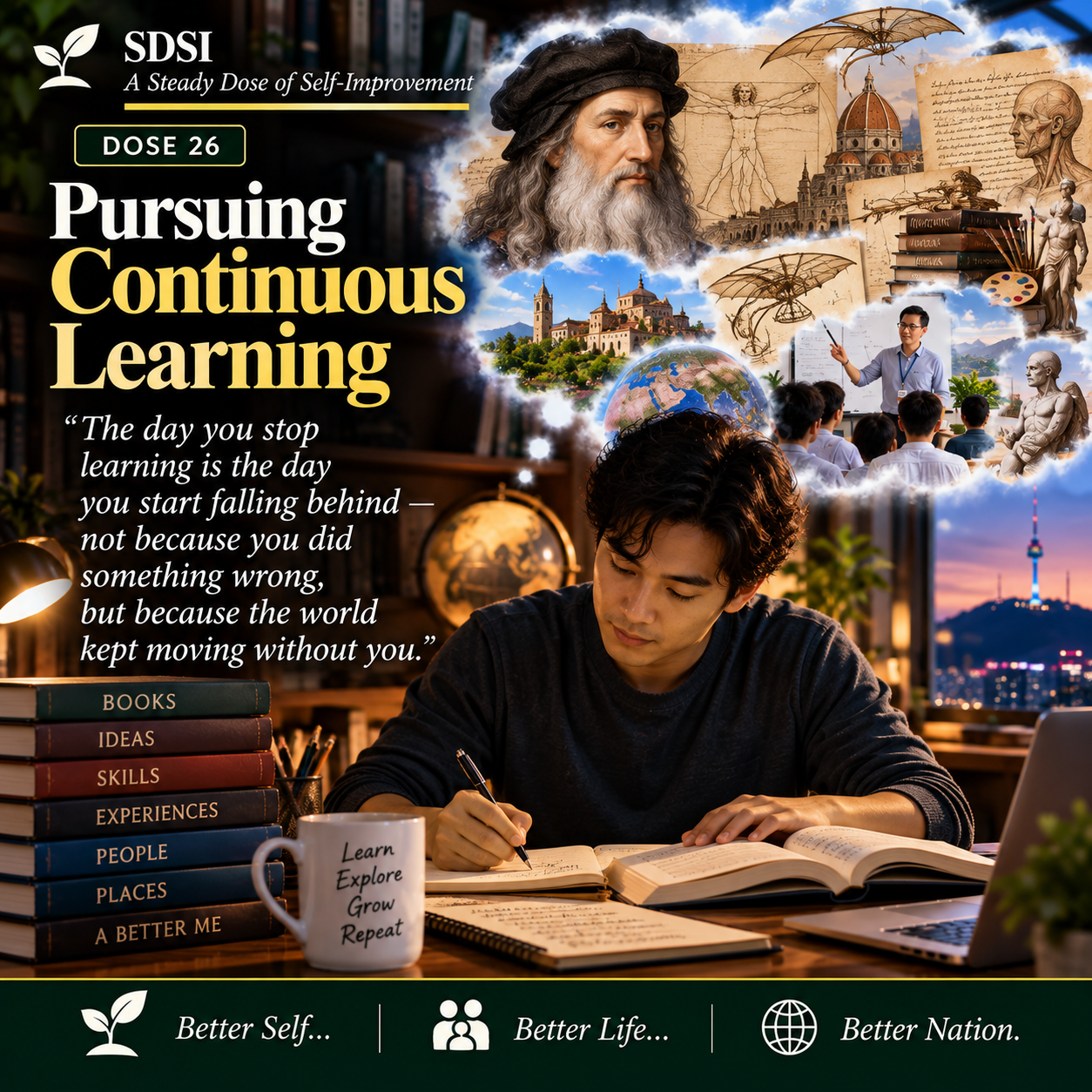
The day you stop learning is the day you start falling behind — not because you did something wrong,
but because the world kept moving without you.

Leonardo da Vinci moved freely among art, anatomy, engineering, mathematics, music, and the natural sciences.
Continuous learning is the ongoing pursuit of knowledge, skills, and experiences throughout life. It is not confined to classrooms, degrees, or certificates. It begins with a simple recognition: the world does not stop changing when our formal education ends. If we want to keep growing, adapting, and contributing, learning must remain part of the way we live.
Leonardo da Vinci remains one of history’s most striking examples of this spirit. Painter, sculptor, engineer, anatomist, inventor, musician, and observer of nature, he refused to confine his curiosity to a single field. His notebooks reveal a mind constantly asking questions, making connections, and investigating how things worked. He learned not merely for credentials or recognition, but because curiosity had become a way of life.
Warren Buffett offers a modern example from a very different field. He has repeatedly emphasized the importance of reading and thinking, and once advised students to read hundreds of pages a day, comparing the accumulation of knowledge to compound interest. The number itself is less important than the principle: what we deliberately learn today expands what we are capable of seeing and doing tomorrow.
Coming to South Korea opened a learning journey I had not fully anticipated. University teaching, advising students, presenting at international conferences, conducting research, and publishing scholarly work were not all part of my original plan. Many of those opportunities became possible because I kept learning. Each new competency revealed a door I could not have seen from where I started.
Continuous learning does not require us to return to school every year. It requires something both simpler and more demanding: remaining teachable. Read. Ask. Listen. Experiment. Learn from people younger and older than you. Learn from mistakes. Learn from unfamiliar places. The moment we decide we already know enough, we place a ceiling over the person we can still become.
Pause and Reflect
When did you last learn something significant outside a formal school setting—and how did it change what you could do or understand?
One Step Forward
Dedicate 20 minutes today to deliberate learning: read a chapter, listen to a thoughtful lecture or podcast, or practice a new skill. At the end, write down one thing you learned.
Explored in full in Chapter 17 — Pursuing Continuous Learning of A Holistic Approach to Self-Improvement.
Visualization
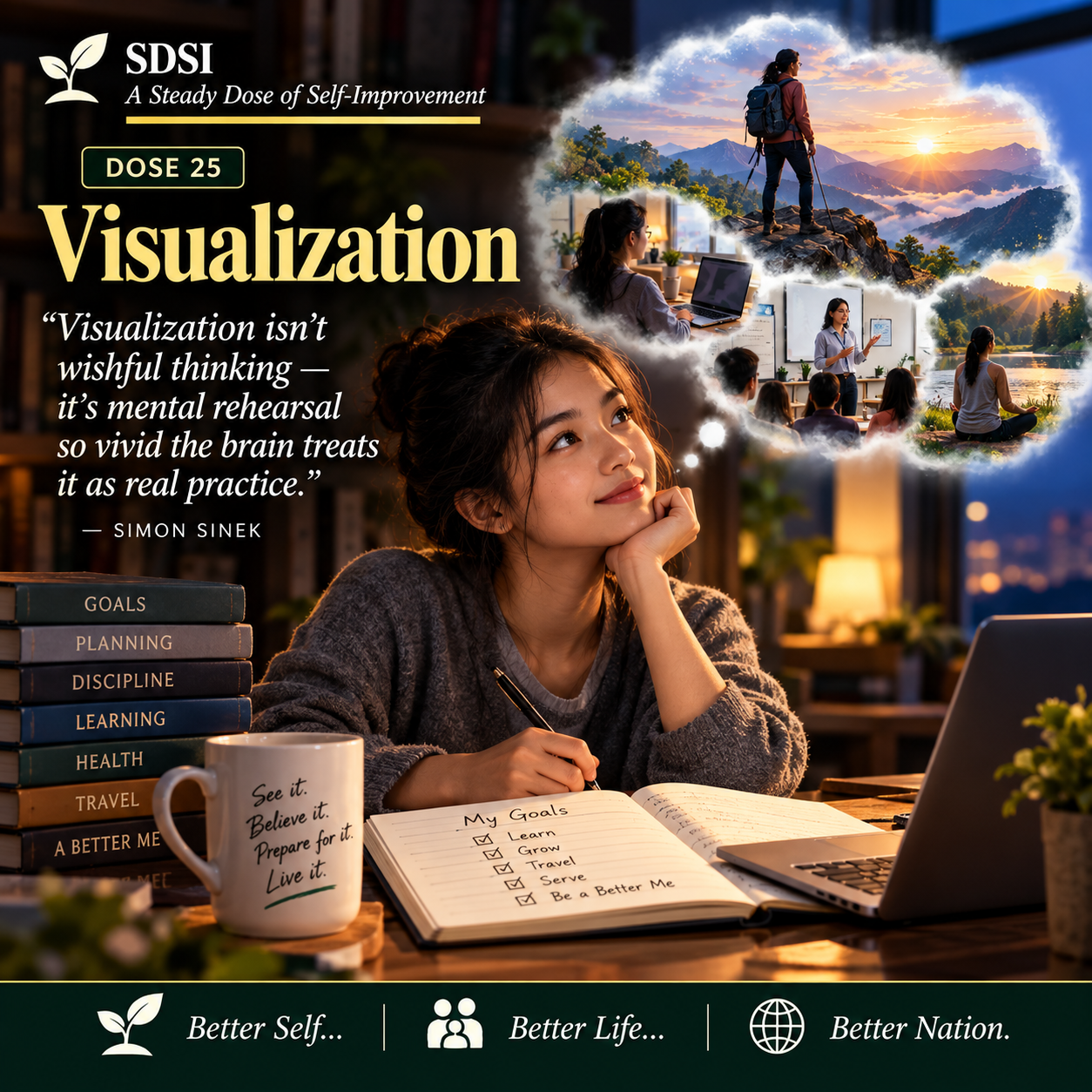
Visualization isn’t wishful thinking — it’s mental rehearsal. By vividly rehearsing an action or experience
in the mind, we can prepare ourselves for performing it in the real world.

At the 2008 Beijing Olympics, Michael Phelps’s goggles filled with water mid-race, leaving him unable to see clearly.
Visualization is one of the most powerful—and perhaps most underestimated—tools in the self-imprOvement toolkit. Like positive thinking, it is sometimes dismissed as little more than imagining success instead of working for it. But effective visualization is not a substitute for action. It is preparation for action.
Visualization involves creating vivid and detailed mental representations of an action, process, or desired outcome. Rather than merely seeing an image in the mind, effective visualization can engage multiple senses: what you see, hear, feel, and even how your body moves. Research on mental imagery suggests that imagined and actual actions can engage overlapping neural processes, helping explain why mental rehearsal has long been used in sports and other performance settings.
At the 2008 Beijing Olympics, Michael Phelps faced exactly the kind of situation he had mentally prepared for. During the 200-meter butterfly final, his goggles filled with water, severely limiting his vision. Yet he continued swimming, relying partly on his practiced stroke count and preparation, and won the race in world-record time. His longtime coach, Bob Bowman, had taught him to mentally rehearse races—to “watch the videotape” in his mind, including situations in which things did not go perfectly.
That detail matters.
Effective visualization is not simply seeing yourself standing triumphantly at the finish line. It is rehearsing how you will get there—and how you will respond when something goes wrong.
Research by Pham and Taylor similarly highlighted an important distinction between visualizing an outcome and visualizing the process required to achieve it. Imagining yourself receiving the diploma, losing the weight, publishing the book, or crossing the finish line may inspire you. But mentally rehearsing the studying, training, writing, decision-making, and persistence required to get there can better connect the vision with action.
Before deciding to pursue ESL teaching in South Korea, I spent considerable time imagining what that life might look like: the classroom, the students, the research opportunities, and the life I hoped to build. That mental picture did not magically bring me to South Korea.
Visualization did not get me here. But it helped make the destination real enough for me to move toward it.
And perhaps that is visualization’s greatest value. It allows us to visit a possible future before we arrive there—not so that we can escape into it, but so that we can return to the present knowing more clearly what we need to do next.
Pause and Reflect
What future have you repeatedly imagined for yourself—and what would you need to start doing today to move closer to it?
One Step Forward
Set aside 10 minutes today. Close your eyes and visualize not only achieving one of your important goals, but taking the next concrete steps toward it. See the environment. Hear the sounds. Feel yourself doing the work. Then open your eyes—and take one of those steps.
Explored in full in Chapter 16 — Visualization of A Holistic Approach to Self-Improvement.
Habit Scheme: Practices and Activities
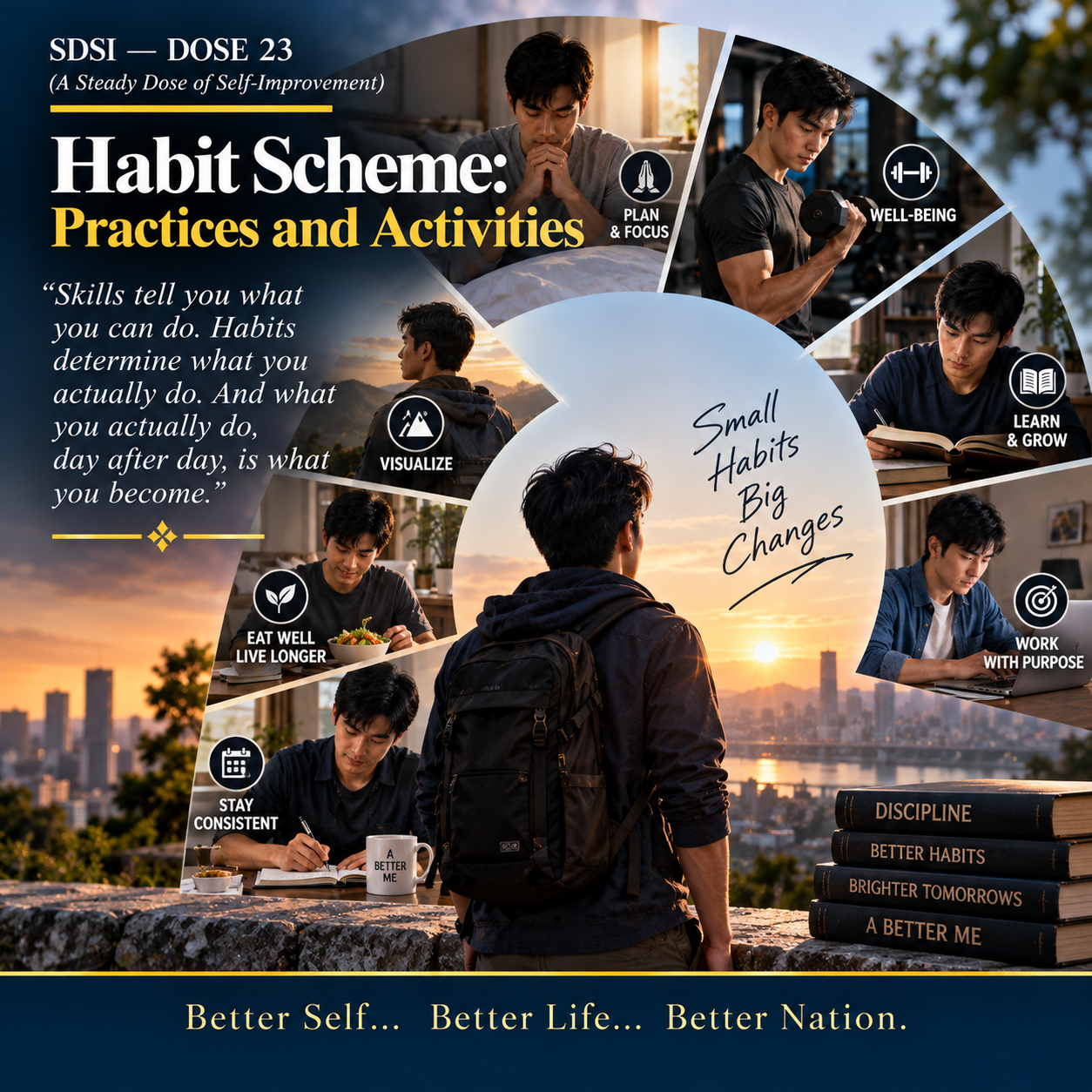
Skills tell you what you can do. Habits determine what you actually do. And what
you actually do, day after day, is what you become.

Knowing what to do means little if you rarely do it.
The Value System gives self-improvement its foundation. The Competence Framework develops the skills and abilities needed to act on it. But neither beliefs nor abilities, powerful as they are, complete the process. Knowledge and capability must be translated into consistent action before they can produce lasting results.
That is where the Habit Scheme comes in.
There is a profound difference between knowing what to do and actually doing it—especially on the days when you do not feel like doing it. That difference is often habit.
More than two thousand years ago, Aristotle argued that character and excellence are cultivated through repeated action and habituation. Centuries later, Will Durant captured that idea memorably while explaining Aristotle: “We are what we repeatedly do. Excellence, then, is not an act but a habit.”
Excellence, then, is rarely the product of one dramatic act. More often, it is the accumulated result of small, intentional actions repeated consistently over time.
This is why motivation alone is unreliable. Motivation can provide the initial spark, but it rises and falls. Habits reduce our dependence on feeling motivated every time action is required. We build routines, systems, and environments that make productive behavior easier to repeat.
The important question, therefore, is not whether you have habits. You do. The question is whether your habits are carrying you toward the person you want to become—or quietly pulling you away from that person.
Six practices comprise the Habit Scheme: goal setting and planning, visualization, continuous learning, well-being, longevity, and a consistent daily routine—all held together by self-discipline.
I learned the power of the Habit Scheme most clearly by living it. The attitudes and beliefs I developed gave me the foundation to make the leap to South Korea. The skills I had acquired enabled me to perform once I arrived. But it was what I repeatedly did—reading, writing, researching, exercising, reflecting, and continuing to learn—that ultimately determined the quality of what I produced.
Without those habits, my beliefs and abilities might have remained little more than potential.
Beliefs provide the foundation. Skills provide the capability. Habits turn both into a way of life.
Pause and Reflect
Which of your daily habits, if you are completely honest with yourself, is quietly working against a goal you say matters to you?
One Step Forward
Identify one automatic habit that is no longer serving you. Then choose one small behavior to replace it with this week. Do not try to transform your entire routine. Change one repeated action.
Explored in full in Part 2 — Foundations of Holistic Self-Improvement, Section III: Habit Scheme (Practices & Activities) of A Holistic Approach to Self-Improvement.
Better Self… Better Life… Better Nation.
Conquering Self-Doubt
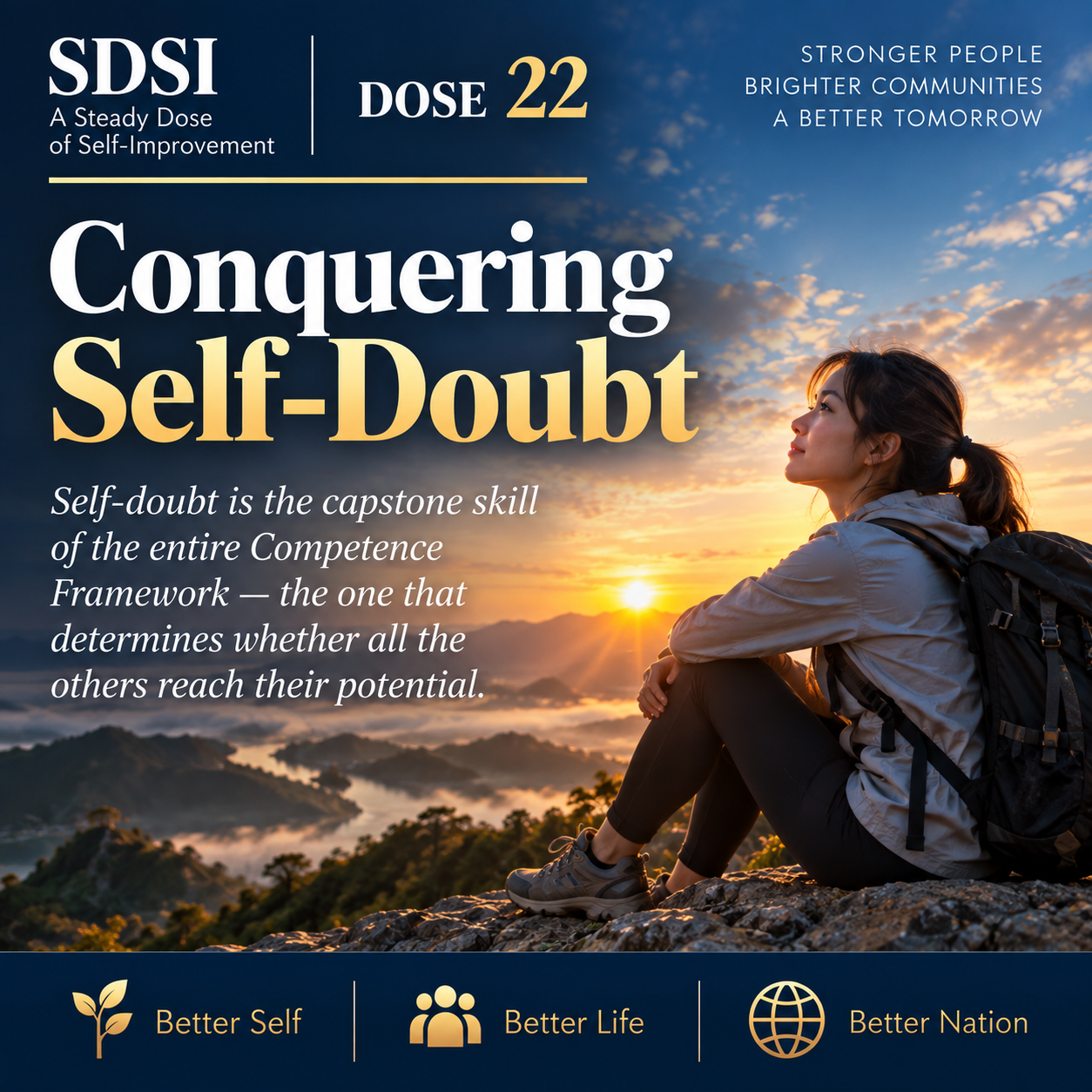
Self-doubt is the capstone challenge of the Competence Framework—the one that determines whether
all our other abilities are ever fully used.

What if self-doubt belongs on the list of deadly sins?
Perhaps that question goes too far. Ordinary self-dOubt is neither evil nor necessarily harmful. Sometimes it protects us from arrogance. It makes us examine our preparation, recognize our limitations, and seek the help or training we genuinely need.
But self-doubt becomes destructive when it continues speaking even after the evidence has answered it.
It whispers that you are not intelligent enough, capable enough, or worthy enough to succeed. It dismisses every accomplishment as luck, every compliment as politeness, and every opportunity as something intended for somebody better. Given enough authority, it does more than make you uncomfortable—it prevents you from using the abilities you already possess.
I know that voice.
It has asked me who I thought I was to teach abroad, present research, write books, and advocate self-improvement. It did not disappear when I earned another degree, accumulated years of teaching experience, published my work, or stood before international students. Whenever I attempted something larger, the same question returned in a different form:
Who do you think you are?
Eventually, I learned to answer it with evidence.
I am someone who has faced unfamiliar situations and learned. I am someone who has been rejected and continued. I am someone who has completed difficult work before. None of this guarantees that everything I attempt will succeed. It simply proves that self-doubt is not qualified to declare what I cannot do.
Conquering self-doubt does not mean silencing it forever. Even accomplished people occasionally question themselves. The goal is not to become so confident that we ignore our weaknesses or assume that we cannot fail. That is not confidence; it is carelessness.
The goal is to place self-doubt in its proper position. Let it ask questions, but do not let it deliver the final judgment. Examine what it says. If it identifies a real deficiency, improve. If it merely repeats an old fear that contradicts the evidence, proceed despite it.
This is why conquering self-doubt completes the Competence Framework. You may manage your time efficiently, remain focused, think before acting, make purposeful decisions, communicate effectively, and maintain balance. But if you continually doubt your right or ability to use those skills, much of your potential will remain untouched.
You do not need absolute certainty before taking the next step. You need sufficient preparation, honest evidence, and the courage to act while a little uncertainty remains.
Self-doubt may accompany you.
It simply must not lead you.
Pause and Reflect
What opportunity have you avoided because you doubted yourself?
What evidence from your own life challenges that doubt?
One Step Forward
Write one sentence naming a capability you genuinely possess. Beneath it, list three experiences or accomplishments that provide concrete evidence for it.
Explored more fully in Chapter 14 — “Conquering Self-Doubt” of A Holistic Approach to Self-Improvement.
Better Self… Better Life… Better Nation.
Striking Work-Life Balance
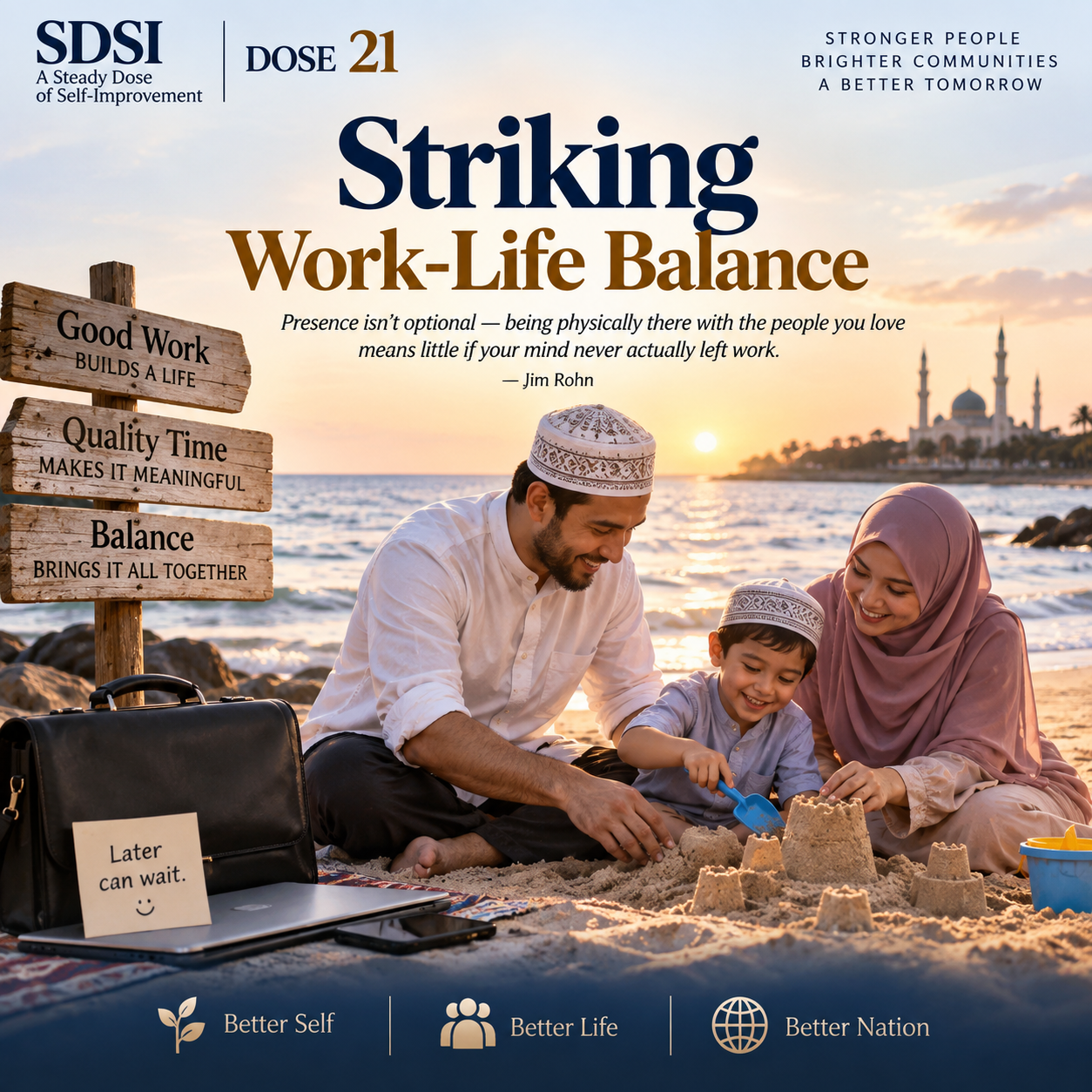
Presence isn’t optional — being physically there with the people you love means little
if your mind never actually left work.
Jim Rohn once took his family to the beach. He brought his briefcase.
Striking a balance between personal undertakings and professional endeavors is easier said than done. Yet few things matter more to the quality of our lives than getting this balance right. A life tilted too far toward work may make us productive while leaving us personally impoverished. But neglecting meaningful work and responsibility can also deprive us of the sense of purpose and accomplishment they provide.
Work-life balance is not simply a matter of dividing our hours equally between work and home. It depends not only on the time we spend physically at work, but also on the energy, focus, and attention that work continues to demand after we leave.
You can leave the office and still be psychologically at work — replaying problems, answering messages, planning tomorrow, or worrying about what remains unfinished. True balance therefore requires something more difficult than simply going home: learning to mentally disengage from work when work is done.
Jim Rohn illustrated this lesson with a simple story. He recalled taking his family to the beach while bringing his briefcase along. His family was not pleased. The lesson was unmistakable: being physically present with the people you love is not enough if your attention remains somewhere else.
Presence isn’t optional.
When you’re with your family, be with your family. When you’re resting, allow yourself to rest. When you’re working, give your work the attention it deserves. Balance comes not from giving everything equal time, but from giving each part of life the attention it deserves when its time comes.
Arianna Huffington learned a similar lesson far more painfully. After collapsing from exhaustion and injuring herself, she began questioning conventional definitions of success built primarily around money and power. Her experience eventually helped shape her advocacy for a broader measure of success—one that includes well-being, wisdom, wonder, and our capacity to live fully.
My own experience teaching at a university in South Korea has given me something I have learned not to take for granted: protected time outside work. My teaching schedule and semester breaks have allowed me time to write, connect with family, pursue personal projects, and simply rest.
That experience has taught me that time away from work is not necessarily time taken from productivity. Properly used, it can replenish the very energy, creativity, and perspective that make productive work possible.
Work is an important part of life.
But work is not life itself.
The goal is not to work less simply for the sake of working less. Nor is it to divide every day neatly into equal portions. The goal is to build a life in which professional accomplishment does not require sacrificing the people, experiences, health, and moments that make accomplishment worth having.
Pause and Reflect
When you’re with the people you love, are you truly present — or is work still occupying your mind?
One Step Forward
Choose a specific time after which you won’t check work messages tonight. Hold that line, even if it feels uncomfortable.
Explored in full in Chapter 13 — Work-Life Balance of A Holistic Approach to Self-Improvement.
Better Self… Better Life… Better Nation.
Effective Communication
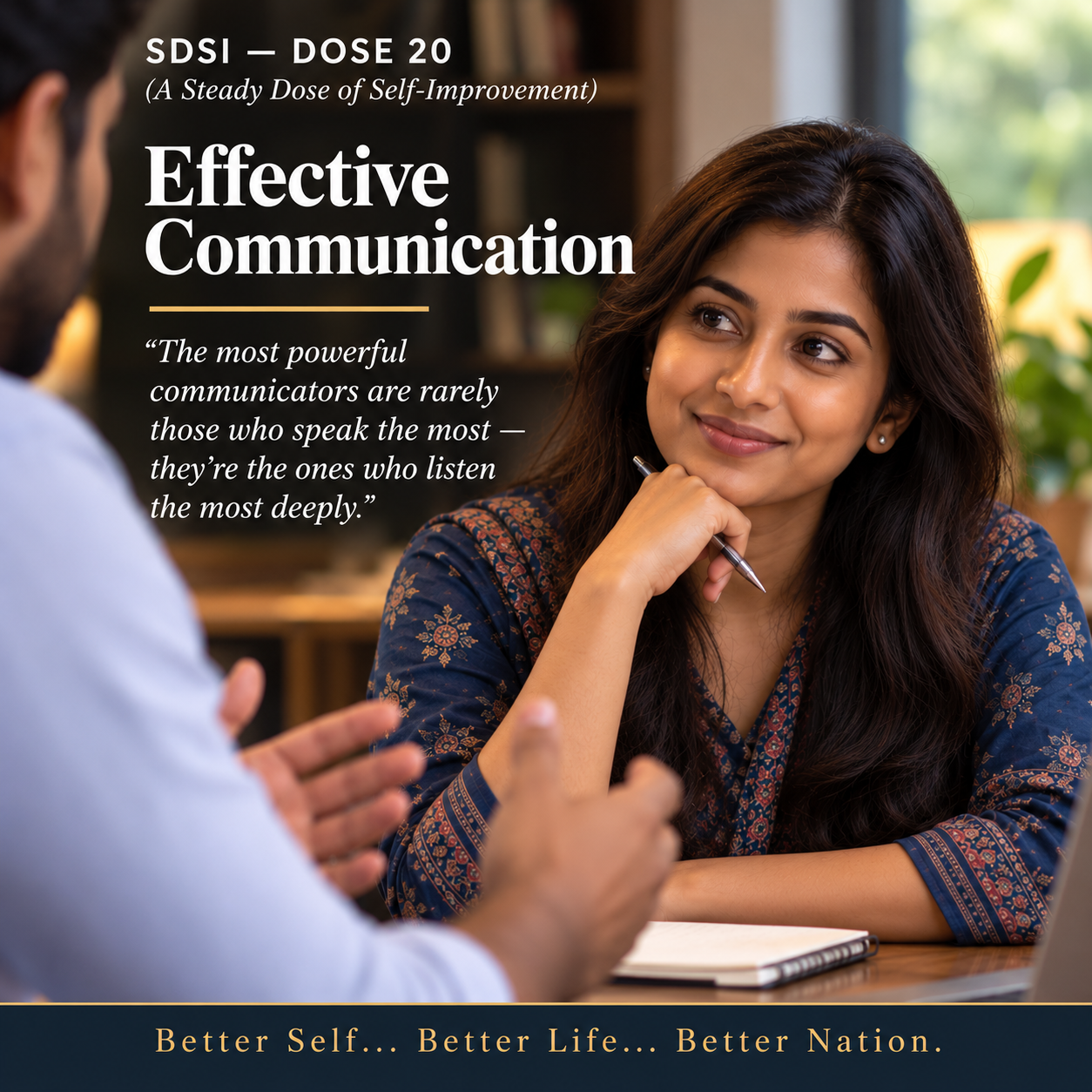
The most powerful communicators are rarely those who speak the most — they’re the ones who listen the most deeply.
Nelson Mandela’s greatest communication skill wasn’t his speeches. It was his listening.
Of all the skills in the Competence Framework, effective communication may be the most universally required. Every relationship you build, every idea you want to share, every conflict you hope to resolve depends on your ability to communicate clearly, honestly, and with genuine attention to the person on the other side of the conversation.
At its simplest, communication is the exchange of information. But effective communication is more specific: it’s communication that achieves its intended purpose — the message sent is the message received, understood, and responded to appropriately. That requires five elements working together: sender, message, channel, receiver, and feedback, all shaped by context and threatened by noise.
Nelson Mandela, who appears in several chapters of this book for good reason, was one of the most powerful communicators of the 20th century. What made him extraordinary wasn’t rhetorical brilliance alone, but the quality of his listening. He studied his opponents carefully, understood their perspectives before engaging them, and found language that could reach across divides rather than deepen them.
Oprah Winfrey built one of the most successful media empires in history largely on her capacity for active listening. In her interviews, she was famous for making her subjects feel genuinely heard, which led them to share more openly and authentically than they had with almost anyone else. She understood that the most powerful communicators are often not those who speak the most, but those who listen the most deeply.
Active listening means giving the speaker your full, undivided attention: no phone, no mental composing of your response while they’re still talking. After someone speaks, reflect back what you heard: ‘So what I’m hearing is…’ This simple practice dramatically reduces misunderstandings and signals that the other person has genuinely been heard — the precondition for any productive exchange.
Pause and Reflect
What is the biggest barrier to effective communication in your own life — and what would change if you removed it?
One Step Forward
In your next conversation, practice reflecting back what you heard before responding. Notice how it changes the exchange.
Explored in full in Chapter x — Effective Communication of A Holistic Approach to Self-Improvement.