Category Archives: Philippines
On the 2016 Elections (4th of a series)
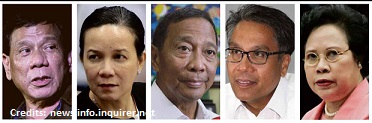
Down to 5 presidential aspirants (in alphabetical order, not the writer’s order of preference)… Binay, Duterte, Poe, Roxas, and Santiago. With only three months left before the elections, the presidential race is beginning to heat up. Things will get more exciting once the official campaign period kicks off.
The bets for the presidency have already bared their platforms of government for the scrutiny of the voting populace. They, even if the official campaign period is yet to begin, have been posting and airing their respective campaign ads in print, broadcast and social media with each of them attempting to convince the electorate that he/she is the best and most qualified to lead the country in the next six years. They are taking turns in courting the voters promising, as usual, the moon and the stars should they get elected. They and their legion of supporters have been making rounds in the provinces holding meetings and performing activities intended to increase their chances of winning. Their respective “dirty tricks departments” have been doing their best as well to open their opponents’ cans of worms to tarnish their reputation and make them less competitive.
Analyses and results of pre-election surveys show how fickle-minded are the voters. Different candidates ended at the top of voting preference at different period of times.
Had elections been held a couple of years ago Binay would have won. However, his popularity bubble burst when pricked by accusations of corruption hurled against him and his family. His place as the most preferred presidential aspirant was taken over by Poe whose ascension to the Senate was undoubtedly aided by the popularity of her father, the late Fernando Poe, Jr., the action king of Philippine cinema. It is also the FPJ factor that may catapult her to the most powerful seat in Malacañang.
But the voter preference meter for the 2016 elections suffered another fluctuation when Poe was said to have actually renounced her Filipino citizenship some years back to become an American thereby making her technically not qualified to seek the highest position in the land. When COMELEC barred Poe from running for President for the aforementioned, down went her numbers in the surveys.
It was at that juncture that Duterte’s popularity started to gain ground. The Filipinos who are tired of decades of cronyism, patronage and political compromises saw a glimmer of hope in the feisty mayor of Davao city. Duterte saw his steady climb in the surveys which made him finally decide to throw his hat into the presidential derby after dillydallying for sometime.
However, he committed a serious blunder that may have permanently damaged his quest for the presidency. In one of his trademark verbal outbursts, he was construed to have cursed Pope Francis. It did not sit well with the Filipinos, most of whom are devout Catholics. As to whether Duterte’s candidacy recovers from that miscue or not will be made known after the 2016 presidential joust.
The other candidate known for feistiness is Santiago. She continues to occupy the bottom of election surveys and it is believed that it may take a miracle for her to say that “the third time’s the charm.” Santiago is seeking the presidency for the third time.
Quietly lurking on the shadows of the leaders in the surveys is the administration’s bet, Roxas. He has yet to occupy the top of the voters’ preference but make no mistake about it, he is seriously contending for the presidency. He has no less than the backing of the government ran by the members of the political party where he belongs and the endorsement of the incumbent President. However, such endorsement from a President who has been making some unpopular decisions as of late may be seen more as a kiss of death rather than a shot in Roxas’ arms. But who knows if the Cory factor still weaves a political magic. The yellow army of Cory Aquino may have not forgotten yet how he unselfishly gave way to Noynoy during the 2010 elections.
Santiago and Poe know too well how is it to run against an administration bet. The former lost to Fidel V. Ramos in the 1992 elections and the latter’s father, FPJ, failed in his presidential bid against Gloria Macapagal-Arroyo in the 2004 polls. Both Santiago and FPJ led the pre-election surveys. Even early election results then showed them leading comfortably. But they both ended up runner-ups to the eventual winners. They cried foul to high heavens but to no avail.
The most recent (January-2016) Pulse Asia survey shows Poe on top again. This came on the heels of the Supreme Court’s decision declaring that the COMELEC can’t cancel Poe’s candidacy (yet). Surpisingly, Roxas, statistically tied Binay, and Duterte at 2nd place. While Roxas was up 3 points from his 17 percent rating in December, 2015, Binay and Duterte suffered a decline of 10 points and 3 points, respectively. Poe’s ratings jumped by nine points from 21 percent raising speculations (and fears) that she might win come May 9.
So, will there finally be a “Poe” in Malacañang in 2016? Not if the other contenders can help it. Binay and Duterte, however, must seriously do some damage control for the issues bedevilling them at the moment. Roxas on his part is uncertain whether being identified with an administration whose gains in the economic front were stained by the blood of 44 members of the Special Action Force who got killed in the Mamasapano encounter and cursed by the country’s senior citizens whose hopes of getting an additional P2,000 monthly pension was vetoed by the very President who endorsed his candidacy. Santiago, on the other hand, need to dish out a magical performance out of her bag of political theatrics in order to convince the voters that she’s got what it takes to be a President of the Philippine Republic.
As it is, those leading in the pre-election surveys may have the edge yet nobody knows for sure who will win. But one thing certain and inevitable, just three more months and Noynoy will relinquish the presidency to whoever wins the 2016 Elections.
On the 2016 Elections (3rd of a series)

How many of the registered voters in past elections can proudly claim that not even once that they sold their votes? Hard to say so it is difficult to choose which quantifier to use at the beginning of the next paragraph. Should it be all, many, some, several or a few? Just feel free to fill-out the blank.
_____ voters expect to be paid before they go to the precincts to cast their votes. Normally, midnight before the actual election day (or the wee hours of the morning of that day).
Had this writer used all or many he may be accused of committing the fallacy of hasty generalization. Perhaps the safest to fill-out the blank with would have been some.
This is the other side of the coin. Politicians buy their way to victory because the voters are selling their votes. There’s a causality dilemma involved…the politicians are buying votes because the voters offered to sell them or the voters are selling their votes because the politicians offered to buy them. Either way, “it takes two to tango.”
This is the sad reality in the country’s electoral process. Vote buying is rampant. It usually happens in the few days leading to the election day.
Let’s paint a scenario. Say there are 3 candidates for a mayoralty race in a town or city. All of them would offer a certain amount for each voter. The highest bidder will get the vote. The first candidate may be offering the usual P500 per vote but the second candidate who may promise P1000 would be preferred of course. However, if the third candidate would be willing to give P1,500 then he gets the nod of the voters, unless on the 11th hour one of the two other candidates will offer more than what the 3rd one promised.
The voter writes in the ballot the name of the candidate who gives him more money but gets to pocket as well all the amount promised by the other candidates. The total earnings of each voter would be the sum of the amount all the candidates promised. That’s only from the mayoralty bets. What about the money coming from candidates for other positions, national and local? Just do the Math. There’s indeed much money that circulate during elections.
Usually, the campaign leaders and trusted assistants of candidates are the ones going around to distribute the payroll. Supposedly, the wheeling and dealing are done discretely. Of course, none of the incumbent local and national officials will admit that they used their millions to secure their victory in the polls. They will deny it to death but only those who were born yesterday would say that stories about vote buying are not true.
The voters selling their votes thought that they have nothing to lose but instead they have a few thousand bucks to earn from what they’re doing not realizing that governance is a serious matter that should be put in the hands of the most qualified leaders and not in the dirty fingers of the ones using money for them to ensure victory during elections. Or probably they know… they just don’t care. The few bucks they would get is all that matter.
The voters selling their votes need to realize that they indirectly contribute to corruption in the government. The scheming politicians are just more than willing to spend millions during elections but they make sure they recoup the millions they spent for paying the voters and much more by getting involved in kickbacks and shady deals while in power and by dipping their hands into the coffers of the government. Only a few of them get caught in the process because they know how to work their way around existing laws and regulations.
More often than not that voters complain about the performance of local and national leaders. They forget the maxim that says “You deserve the leaders you elect.” The electorate must always remember what Thomas Jefferson once said, “The government you elect is the government you deserve.”
ON THE 2016 ELECTION (1st of a Series)
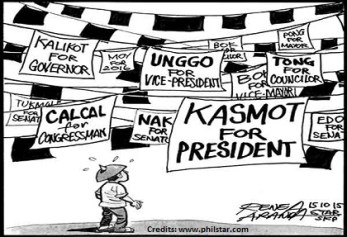
Something tells me that whoever wins the 2016 presidential elections, the Filipino dream for a better nation will remain as it is… a dream.
Call it a bleak forecast but there is no reason to be optimistic. As the country inches closer to the next political derby there’s nothing that could be gleaned from the electoral process ongoing that would indicate that something new and better is about to come or happen. There’s nothing new… nothing better. In fact, everything we’re hearing and witnessing are “restored from the recycle bin.”
We have the same familiar faces dotting the nation’s political landscape…the same personalities who had slugged it out for national and local positions in the past are the same people who would lock horns in the 2016 elections. They have been the ones in whose hands the reins of government changed producing the same ABYSMAL socio-economic and political performance for the nation.
In case nobody has noticed these personalities come mostly from the same clans who have been lording it over in the political arena for decades now. Most of them are scions of powerful and wealthy Spanish mestizos. Their Spanish grand parents (or great grand parents), as anyone familiar with Philippine history knows, happened to be the former colonial masters of the Filipinos. Some were former associates of the then powers-that-be who became rich and powerful after getting their shares from the spoils of struggles for power which they joined and won. There were also celebrities (movie and TV stars, singers, athletes, etc.) who took advantage of their popularity or that of their parents or siblings.
But there are also honest-to-goodness leaders who chiseled their political fame with hard work and the genuine desire to serve the people. They are few and far between though and much as politics is also a numbers game their call for change and reforms is like a voice in the wilderness.
It’s a tug-of-war among the personalities aforementioned, and whoever wins among them may just (if I may use this phrase again) “restore from the recycle bin” the same kind of leadership that has repeatedly failed to steer this nation to greatness. But in case the STUBBORN electorate will again make do of them, let them be given the benefit of the doubt (for the nth time).
These politicians who failed to lead the Philippines to a better standing in the community of nations keep seeking reelection. Unfortunately, notwithstanding their dismal performance as public servants they keep winning.
They keep winning because they have the M’s…manpower, machinery and MONEY. Money can buy anything, including VOTES.
How Colonialism Shaped the Filipino Character (Last of 4 parts)

The last quarter of the 19th century was perhaps the most significant stage in the development of the Philippines as a nation — the moment nationalism began to flourish. It took centuries for the natives to finally unite against their colonizers. Like the sun rising in the east, spreading its golden light to signal a new day, this emerging solidarity became a portent of greater things to come — things that, in the end, never came.
The essential ingredient for national development was finally taking shape among Filipinos. The seeds of nationalism began to sprout, nourished by the influx of liberal ideas from Europe, the rise of the middle class, and the martyrdom of Fathers Gomez, Burgos, and Zamora (GomBurZa) — events widely credited with fanning the flames of national unity.
It was a long and difficult road to national solidarity, made harder by a combination of factors: a geographically fragmented island nation, a people divided by dialect, and the Spaniards’ relentless use of “divide and conquer” tactics.
The Spaniards employed that tactic so effectively that they reigned for more than three hundred years. But once Filipinos began to forge a cohesive spirit that bridged their geographic divides, once they tore down the language barriers with a unified cry for freedom, the days of Spanish rule became numbered. The colonizers suffered humiliating defeats at the hands of the very people they had held by the neck for so long, and were forced to retreat behind the walls of Intramuros.
But the next chapter of the Philippine story did not unfold according to the script the Filipinos had written. It unfolded the way Hollywood might have written it instead. And just as the Filipinos were ready to drive the final nail into the coffin of Spanish tyranny, the Americans called, “Cut.”
There is little doubt the revolution begun in 1896 would have finally ended Spanish rule — the Filipinos were ready to storm Intramuros, the last Spanish stronghold, needing only to march together as one. But the Americans, whom they wrongly mistook for allies in their fight for freedom, stopped them just short of the finish line.
To cut the story short: the Americans occupied the Philippines once the Spaniards withdrew, and the Filipinos were forced to fight a war against a military far more powerful and far better armed than their former colonizers had ever been.
The natives lost, and the seeds of nationalism sown by earlier generations of Filipinos were never allowed to bloom. They were forcibly uprooted and trampled by an occupying power determined not to let them take root again.
Filipino nationalism was nipped in the bud. Historians call this period the “Era of Suppressed Nationalism.” While the natives were still nursing the wounds inflicted by their former Spanish masters, the Americans began inflicting new ones.
As is well known, the justification the new colonizers offered was that the Filipinos were not yet ready for self-governance, and that leaving them to their own devices would have led to chaos.
They may have been right. Or they may have been wrong. No one will ever know for certain. But what any critical-thinking Filipino today understands is that the Americans had no right to deny the Filipinos the opportunity to determine their own fate. The natives should have been allowed to face the consequences of standing on their own feet — to raise their arms in victory against Spain, however that victory might have unfolded. It would have meant so much for the colonizer to surrender to the colonized. That would have been a profound moral victory for a people who had been enslaved and deprived of their basic rights and freedoms for so long — a genuine boost to Filipino morale. Instead, American intervention wounded Filipino pride and stunted the growth of a stronger national character.
The Americans might have looked to their own history to understand how the Filipinos felt. The American colonists themselves fought for independence from Britain in the 1700s because they believed in the inalienable rights of the individual, and that taxation by Parliament without representation violated those rights [12]. They believed that a government’s power must rest on the consent of the governed. The Filipinos, too, wanted no part of another foreign power ruling over them — they had already had enough of the Spaniards. And the Americans never had the Filipinos’ consent to remain and govern.
But there was nothing the Filipinos could do; no country stood ready to come to their aid. The Americans had France’s support in their fight for independence from Britain, and perhaps the Filipinos hoped America might do the same for them. It was wishful thinking.
The Filipinos stood alone, in a world that, at the time, functioned like a jungle — where colonial powers were the predators and weaker nations the helpless prey.
The Filipinos could not even invoke any law to challenge the legality of the American occupation. Imperialism operates by its own laws, backed by brute force; armed power allows imperial law to override international law, since the legality of imperial activity rests largely on the imperial state’s judicial system and legal experts [13]. Yet wasn’t America supposed to champion liberalism — the belief that natural rights exist independent of any culture, custom, or government, and are therefore universal and inalienable [14]?
Two faces of the same Filipino emerged from those centuries of subjugation, and both carry the fingerprints of the colonizer.
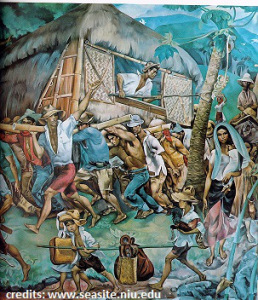
On one face: a people famous for their warmth, resilience, and instinct to hold family and neighbor close through every storm. The hospitality that welcomed strangers ashore, the bayanihan spirit that still carries a neighbor’s house on bamboo poles, the family ties that never loosened even when everything else was taken — none of this vanished under three centuries of foreign rule. If anything, colonization tempered these traits the way fire tempers steel. A people stripped of land, labor, and self-governance had little left to hold onto but each other, and so they held on tighter.
On the other face: a people who, more often than history should allow, still doubt themselves before a foreigner even speaks — who shrug at misfortune and call it destiny, who eye a neighbor from the next province with more suspicion than they ever directed at the men who colonized them both. Fatalism, regionalism, colonial mentality — these were not accidents. They were cultivated by rulers who profited from a people too divided to unite, too resigned to resist, too eager to please to ever ask why. That same regionalism, inherited rather than chosen, still makes it difficult to think and act as one nation; it resurfaces today less as province against province than as camp against camp, with loyalty to a politician often commanding more devotion than loyalty to a shared and rightful cause.
Here, then, is the uncomfortable truth this series has been circling: colonialism did not simply wound the Filipino, nor did it simply fail to break him. It did both, to the very same people, across the very same three hundred years — and the strength and the wound came from the identical source. That is the paradox at the center of Filipino character: a resilience the world admires, built atop a self-doubt the Filipino rarely admits to himself.
The history itself, painful as it is, is water under the bridge now — the Spaniards and the Americans are both long gone. What remains, and what every Filipino still carries, is the paradox laid bare above. Revisiting the hallowed pages of that history is not about relitigating old wrongs; it is about understanding what they made of us, and why we still think and act the way we do.
Filipinos need to do some rewiring. They must remove the faulty code their colonizers left behind in their system — the lines that cause them to malfunction — replace it with something better, and reboot.
___________________________

 M.A.D. LIGAYA



 M.A.D. L I G A Y A