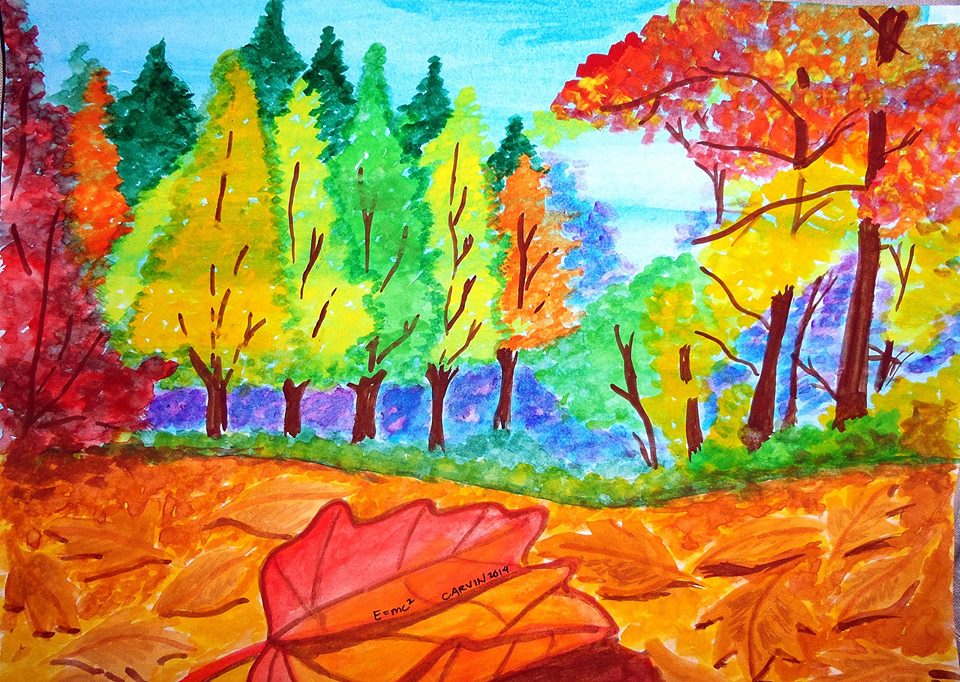
Ilang ikot pa ng tangkay ng orasan Kalendaryong gamit muling papalitan Mga paghahanda’y kaliwa’t kanan Paligid tiyak dadagundong nanaman Tiyak na paligid nga ay dadagundong Sa nanalapit nanamang bagon taon Kasi gawi na kapag ito’y sinalubong Paputok dapat bahagi ng selebrasyon Ang paniniwala kasing nakagisnan Ingay at paputok kinatatakutan Ng mga espiritung dala’y kamalasan Kaya’t sa bagong taon ay pa-ingayan Ngunit wika ni Brod Pete may nasusulat Ang paputok daw pala dala ay malas Espiritung nasa labas kapag nagulat Sa bahay, nang taguan, ay hahagilap Dagdag niya kung gusto raw makatiyak Ito’y kanyang binasa sa nasusulat Nang ‘di papasok itinataboy na malas Magpaputok sa loob ‘wag lang sa labas Meron pang uso bukod sa mga paputok T’wing bagong taon malapit nang pumasok Ang natura’y prutas na korteng bilog Ubod nang dami kung sa mesa’y ihandog Bilog, kasi, ang kasinghugis ay pera Kaya’t sa bagong taon swerte daw ang dala Sa bilog na prutas yayaman, giginhawa Hindi ang bumibili kundi ang tindera Iba’t-iba ang ating mga pamahiin T’wing ang bagong taon ay sasalubungin May pagkaing dapat at di-dapat ihain May kulay ang damit na dapat suotin Dapat may lucky charm sa ding-ding nakadikit Dili kaya’y sa damit ito’y nakakabit Dapat kulay pula ang isuot na damit At may mga bilog dito’y nakatitik Malas di maitataboy ng paputok Swerte’y di dadalhin ng prutas na bilog Kung sa pamahiin hindi huhulagpos Masaganang buhay hindi maaabot Kung tagumpay ay nais makamtan Mga pamahiin atin nang talikuran Sa bagong taon ang ating asahan Awa ng DIYOS at sariling kagalingan
Category Archives: Literature
Bagong Taon Nanaman
Why Do I Write?

Why do I write?
Is it to impress?
I don’t write to impress. I’m well aware of the fact that my writing skill is nowhere near excellent. It seems to me that I am not even halfway my journey to excellence in writing. But I am sure I’ll get there before I breathe my last. Right now, I am still inside the “room for improvement.”
Let me go back to the question – Why do I write?
Do I write in the hope that I earn money and become famous?
Not even!
Becoming famous and earning money are not my primary reasons for writing. Of course I need money. It’s hypocritical to say that I don’t like to have additional numbers to the farthest north of the first digit in my bank account.
But can writing earn you money?
Writing is very financially rewarding specially if you are a script writer of one of the popular TV networks or movie outfits in your own country or a novelist who belongs in the league of the likes of J.K. Rowling, Dan Brown, and Stephen King.
Yes, I am also earning from writing. It’s actually my secondary source of income. I got paid for some of the articles/papers I have written. When I began writing when I was young, I did not expect that someday it would be an additional source of income. I used to think that “there’s no money in writing.”
The university where I am currently employed offer cash incentives to professors for research works published in international (indexed) journals. Professors can also opt to apply for research grants We can get research funds in the process and just ensure to have the paper published within 2 to 3 years. They also give honorarium for articles contributed to the school’s publication in English.
I wouldn’t pass up the opportunity to hone my skills as a writer and researcher, to possibly add to the sum of existing knowledge, to have my works read, and to even get paid in the process. So, I have been publishing papers in international journals and contributing articles to our university publication. In addition, I have been doing it (the publication of research papers) because university professors are supposed to publish. Our university is not requiring us but I consider publishing as a “professional obligation.”
Once in a while, some individuals would also commission me for writing jobs. There were times I did it for free. There were also times that I was promised remunerations for what I wrote but didn’t get any. I was also duped once by an online news organization who did not pay me a single cent for the articles I wrote for them.
I consider the cash incentives as my reward for doing what I love doing – WRITE. But it’s not all about the money. The money is not the reason I write.
The rewards that writing gives, for me, are hard to quantify. Such rewards are transcendental. That’s not me trying to sound philosophical. That’s just the way I feel about it.
What about fame? What about the accolades? Are those the the things that inspire me to write?
NOPE!
As a matter of fact, when I write and allow people to read my works I am unnecessarily putting myself under the microscope. I am putting myself in the line of fire if among my readers there are unforgiving members of the grammar police who wouldn’t hesitate to shoot on sight anyone whose spoken and written English are perforated with errors in grammar. When they start firing you can not hide. My missing the comma between the words “firing” and “you” in the previous sentence is something they could not miss.
So, instead of accolades I may get negative comments. This is the reason, a friend said, that he would never write for any publication or post any of his writings on any of the social networking sites. He is afraid he may not be able to take negative comments. He added he fears committing errors in grammar. He considers it embarrassing to be corrected for such mistakes.
In my case, criticisms and corrections are welcome. I won’t die if criticized and corrected. As a matter of fact, I have already received a lot of those and here I am – still alive and kicking. I don’t mind if somebody calls my attention for mistakes I committed. Just break it to me gently and constructively.
The reason erasers were invented and keyboards of computers have backspace and delete keys is… nobody’s perfect.
I keep rereading my stuffs in this website to correct possible errors and to improve them.
People may read or disregard what I write. If they do read, a million thanks. If not – no hard feelings. And for having reached this far into my essay, I want to say thanks to you.
I may have received some good comments from my friends for some of my writings in the past. But of course, those comments may have been either meritorious or simply generous. Sometimes there are people who give positive and encouraging compliments. Thanks to them.
But aside from good comments some of my works have also angered some individuals who were offended thinking that what I wrote pertained to them. Writing sometimes is a magnet for trouble. I remember quite well when I wrote a satirical poem in Filipino (about a wolf in sheep’s clothing) when I was working in a Catholic college. The parish priest who felt alluded to (and I was really alluding to him) reportedly asked the Sister-President of the college, my superior, to summon me to the latter’s office so he could talk to me about what I wrote. However he was dissuaded from pursuing his request. But even if he was able to convince the President and the College Dean then, I wouldn’t see him. Why? That poem I wrote and my act of writing it had nothing to do with my employment. My being a writer has no personality and office that could be connected to any of the lines that run vertical and horizontal in our organizational chart. In short, the priest had no authority over me. The priest never bugged me again but I wrote another poem for him (Habit and Habit).
My quatrains (in Filipino) are the ones that brought me some colorful moments. I have lost a friend or two (or is it three… perhaps more) for the quatrains I have posted in a social networking site. I once wrote a quatrain and a friend liked it. Almost a year later, I re-posted the same quatrain and surprisingly the same person who previously liked it was angered and gave me a mouthful. We’re very good friends so we talked about it. He understood, apologized, and we both forgot about it since then.
Also, my writings where my political beliefs are in full display had me losing very dear friends.
So, why do I write then?
Is it for the “likes,” “reactions,” and compliments I get when I have those poems, stories, and essays posted in my social networking accounts or in this website?
Not also.
Of course those things make me happy and I am so thankful for those friends who take time to read my works then reacted and commented on them.
Then, why? Why do I write?
It’s hard to explain. It’s something like a combination of the answers to the following questions: Why do people need to eat when they are hungry? Why do they need to drink when they are thirsty? Why do they need to take medicine when they are sick? Why do they laugh? Why do they cry?
There is a kind of hunger within me that only writing can satisfy. There’s an insatiable thirst in my soul that would go away only when I read what I write. I suffer from a very mysterious illness that goes away only when I write in sentences or verses the equivalent words of the thoughts and feelings that drown me during quiet moments in my life.
Writing is my endorphin.
I must release my pain, anger and disagreement by writing about them or else they will haunt me endlessly. When I feel wronged I have to respond, not by violent means. I respond in a creative manner – through poems – sometimes satirical. I do it usually using anthropomorphism.
If the spirits of William Shakespeare and Elizabeth Browning I could not summon through the glass to inspire me to express in poetry whatever I wish to say then I turn to Francis Bacon and Michel de Montaigne’s way of capturing into words – essays – whatever it is that I wish to convey. If I don’t wish to be so direct with my points and would like to hide my feelings and thoughts between lines and behind symbolism then I walked the path that Edgar Allan Poe and Guy de Maupassant paved. I write stories.
I just don’t keep quiet when I notice human follies displayed by my loved one, friends, and other people around me. Again I resort to anthropomorphism. I use animals to represent their irrationality. It may hurt them and make them angry but the truth may be bitter but sweeter than the sweetest lie. VERO NIHIL VERIUS. Nothing is truer than the truth.
This is not saying that I am a perfect human being. I am as imperfect as anyone else and may have, perhaps, done more terrible things. Thus, the satires I wrote are like boomerangs. They sometimes hit me also.
Pain is like a prison cell. It is by writing that I break free from that hell. As my heart churns out the words, I go through the pain, feel it, not escape from it. And as I write the final sentence or verse, as I put the final punctuation mark, the pain vanishes.
Even my happiness and satisfaction wouldn’t be complete if I do not write about them. I need to capture in either prose or poetry those moments so I can feel more deeply the joy they bring. I do write about them so I can relive those moments any time I wish to.
I need neither material rewards nor accolades for what I have written (and will be writing.) The essays, plays, poems, research works, and stories I create are themselves the rewards. I love and treasure them.
I write not to impress but rather to express my thoughts, feelings and ideals. Writing is my freedom, my happiness.
SCRIBO, ERGO SUM. I write, therefore I am.
PAIN’S BUT A MYTH
Venomous pain the Algea injected
In anguish and torment my soul screamed
“Journey to dreamland” Hypnos muttered
“Drown misery in my lake of dreams”
But Dionysus countered “Visit my vines
Feast upon my sweet magical grape
Submerge anguish in the lake of wine
Dream not in languor but while awake”
Aphrodite said “I’ll bring Helen
She can kiss your anxieties away
Frolic with her in Dionysus’ haven
While I hold Menelaus at bay”
When Thanatos arrived he whispered
“Down there anxieties have no domain
Hold tight my hands waiting is Hades
Let death vanquish distress and pain”
Rhea came last took my hand and smiled
Her turret crown beamed comfort and ease
On her laps I cuddled like a child
Then she told me “Pain’s but a myth”
———–
Image source: http://www.flickr.com
ON BEING A POET

It’s never easy.
The literary genre most difficult to produce is the poem. Imagine putting together the elements of rhythm, rhyme, sound and imagery, not to mention the need to have a formidable vocabulary.
Writing stories may also have maze-like intricacies because mixing in bowl the elements of fiction within the bounds of the plot is not a walk in the park. But fiction writers have the luxury of using a lot of pages to serve their purpose. Leo Tolstoy needed more than half a million words for his novel “War and Peace.”
Conversely, a poet has a single page, sometimes not even the whole of it, to capture vivaciously and vividly the emotions and thoughts pervading within or around him. The Japanese, through their Haiku, would do it in a single-stanza poem with three lines consisting of a total of 17 syllables.
What adds difficulty when poets thread the rhyme zone is that they can not walk the path of sadness while wearing a smile. Neither can they frolic in the lake of happiness while riding the canoe of sadness.
Pain begets pain, joy engenders joy. This is seemingly the prevailing mood in the realm of poetry. Rare are the crying clowns who can masterfully inject sadness into the veins of their poems while they are cracking a joke.
The melancholic lyre sounds best when played by a poet who in one way or another licked some emotional wounds sometime ago in a desolate room. On the other hand, the trumpet of merriment can best be blown by a poet who has journeyed the clouds of ecstasy.
But life is a masterful musician who teaches poets to play both the melancholic lyre and the trumpet of merriment. Life enables a poet to play any of the said instruments at a given time.
If a poet intends to paint his canvass with gloom then he can easily prick an old emotional wound until it bleeds sadness. He can walk down memory lane and revive the pains inflicted by either a person or an event he would rather forget. That’s not masochism but rather a form of sacrifice, the poet ought to feel what he intends to write.
If it is the rainbow needed in his canvass then exactly the opposite of the foregoing he must be doing.
That‘s the beauty of being a poet. Poets can switch with ease to any emotions that they desire. Like an actor in a theater, crying one moment then in a jiffy burst into laughter.
Sometimes poets get misconstrued. When a poem tackles sadness and regret for losing someone the readers would think that the poet still loves and wants that someone back. Worse, the person who felt alluded to may either be excited or feel vindicated.
Lest we forget that poets are men of arts who write for art’s sake. Undoubtedly, they draw inspiration from someone or something. They need a motivation in pursuance of their art. But as it is, the end is the art and the motivation is but the means to achieve the end.
And what is the reward the poet receives for writing a poem? The reward is the poem itself. No reward can be sweeter than the poem itself which the poet chiseled with his pains and joys.
As to whether or not a poet who writes a poem of gloom and bewail is sad and regretful, only he knows.