Category Archives: Faitfulness
It Has Always Been You
(Were We Ever Meant to Be – Part 5)
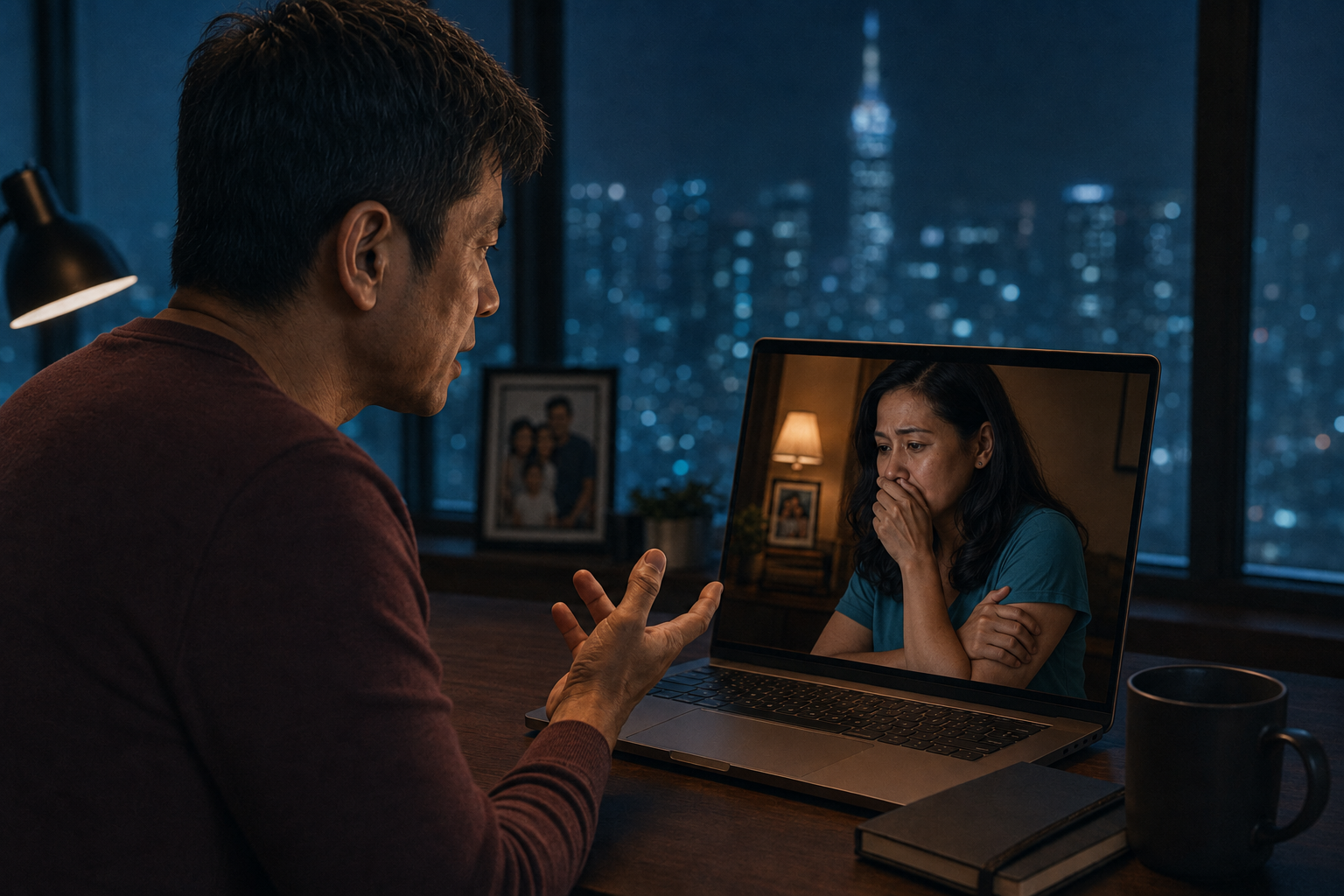
“It’s you, Kath. It has always been you.”
“Stop, Marco.”
“I should have waited. I should never have rushed into marriage with Anna. I should not have listened to my mother. I should have taken you to Cebu.”
“I said stop.”
“I stayed with Anna because there was nowhere else to go. There was no Kath waiting for me. If I ever love someone again, it can only be you. I never stopped loving you.”
Kath stood and moved away from the laptop. When she returned, she looked shaken.
“Do you know what you are doing?”
“I’m being honest.”
“No. You are disturbing my peaceful life. You did it before, and you are doing it again.”
She ended the call.
For a moment, clarity pierced my certainty. She had entered my office years ago wanting nothing more than to begin a career. I had allowed her feelings to deepen while knowing I was married and held authority over her future. Now, after she had built a family and repaired her marriage, I had returned carrying the same disruption.
Kath had not been innocent, but neither was she merely an equal reflection of me. I sent the birthday greeting, insisted on the first video call, revived the old questions, and pushed every answer toward the conclusion I wanted. Each time she said friendship, I searched for a way to make the word contain romance. Each time she asked me to stop, I treated the request as fear to overcome rather than a decision to honor.
Yet even as I recognized the harm, part of me wondered only whether I had moved too quickly. Perhaps I should have revealed my feelings gradually. Perhaps I had frightened her by forcing the issue.
Near midnight, I sent an apology. I promised that I would never call again.
Kath called.
For a long time, neither of us spoke.
“I’m sorry,” I said. “I never intended to disturb your life.”
“But you did. You disturbed my mind.”
I wanted to ask why, but I believed I already knew.
“All I wanted was to reconnect,” I said. “To talk to you again.”
“Can’t you talk to Anna?”
“I can. But I don’t merely want conversation from you. I long for your presence. I want to see you.”
She shook her head. “Why can’t you leave me alone? Forget me.”
“I tried. God knows I tried. I failed.”
“I cannot control what you feel. But expect nothing from me. We are married. We have children. What we can have is friendship.”
“Then let me call once a week.”
She sighed. “Once a week.”
“Thank you. I love you.”
“We are friends, Marco.”
“Friends can say ‘I love you.’”
“Always a loophole.”
“Say it.”
She looked into the camera. “I love you too, my friend.”
The word friend should have ended the matter. Instead, it became permission.
Over the next two weeks, our weekly call became twice a week, sometimes three times. We told each other what had happened during the eight years apart. Kath spoke about her Christian community and the worship services she attended with Jay whenever he was home. I told her that I had begun taking my writing seriously and had created a website.
We also spoke about ordinary things—the children’s classes, groceries, weather, books, films, and the inconveniences of pandemic life. Those conversations were perhaps more dangerous than the declarations. They allowed us to rehearse companionship. We began imagining not only kisses and escape but breakfast, errands, shared jokes, and growing old within reach of each other. Desire entered through nostalgia; domestic fantasy persuaded it to stay.
“I know,” she admitted. “I read your stories and poems.”
“Then you know some are about you.”
“I didn’t want to assume.”
“Whenever I need to write love, joy, longing, or pain, I think of our memories. I think of the us that never happened.”
She asked about the white rose in one of my poems.
“You,” I said. “Obviously.”
“You must have prepared that speech to make me fall in love with you again.”
“Again? Are you saying you aren’t in love now?”
“Friends, Marco. Nothing more, nothing less.”
But soon she began calling me during the day. She knew the hour of my coffee break and the days I left work early. Once, when she noticed a woman behind me in a café, jealousy sharpened her voice.
At home, Kath waited until her children had gone to their rooms before answering my calls. Sometimes one of them knocked, and her entire expression changed as she turned away from the screen and became their mother. Those brief interruptions should have restored perspective. Instead, I waited impatiently for her to return, as though her family were intruding upon time that belonged to me.
“Make sure she isn’t with you.”
“No, baby. I don’t even know her.”
“Baby?”
“May I call you that?”
“Do whatever you want.”
I treated her refusal to refuse as consent.
That night, however, she did not answer my messages. At midnight, I called.
“Are you all right?”
She shook her head. “We have to stop this.”
“Why?”
“The pastor’s sermon struck me hard tonight. I realized that I long for your presence more than I long for Jay’s. I used to talk to him almost every night. Now I would rather talk to you.”
Jay was somewhere at sea, trusting the wife who had told him years earlier about me and had chosen to rebuild their marriage. I knew that history, yet I regarded his absence as an opening. Because Kath and I shared language, humor, and emotional intimacy, I treated compatibility as a superior claim. I rarely asked what promises Jay had kept during the years when I had been absent from her life.
Her confession filled me with joy even as I watched it frighten her.
“Why are you doing this to me again?” she cried. “I had become peaceful. I could have ended our first conversation, but I stayed. I answered your calls. When it comes to you, I am so weak.”
“I love you, baby.”
She looked directly into the camera.
“I love you too, Marco. May God forgive me, but I love you.”
PART 6 – Beyond the Screen
Helen Or Penelope?

When Troy was released in 2004, I watched it. The literature teacher in me could not bear the thought of missing it.
Afterward, I anticipated that one of Hollywood’s major studios would eventually give The Odyssey the same grand cinematic treatment. I imagined vast seas, legendary creatures, powerful gods, and the long, perilous journey of Odysseus brought spectacularly to the screen. But year after year, that film did not come. Several screen productions drew inspiration from Homer’s epic, but none matched the scale I had envisioned.
Finally, twenty-two years later—a wait two years longer than Odysseus’s total twenty-year absence from Ithaca—a big-budget, star-studded film based on Homer’s Odyssey arrived.
And once again, the literature teacher in me could not bear to miss it.
Like many literary classics adapted for the screen, I did not expect either Troy or The Odyssey to reproduce Homer’s epic poems faithfully and completely. Modern English translations of each work run to hundreds of pages. In bringing them to the screen, filmmakers must condense events, combine characters, and reshape parts of the story according to the demands of modern cinema.
Nevertheless, I still wish the scriptwriters of Troy had not killed Agamemnon and Menelaus on Trojan soil. In Homer’s story, both survived the war. Agamemnon was killed only after returning home, while Menelaus eventually returned to Sparta with Helen. As a teacher of Greek mythology, I could understand the filmmakers’ need for dramatic changes, but the literature teacher in me could not help protesting quietly.
When Queen Penelope first appeared on the screen in The Odyssey, I was reminded of one of my favorite questions for students attending my Greek Mythology class:
Who would you rather have as a girlfriend or wife—Helen of Troy or Queen Penelope? Why?
If I were answering my own question today, I would choose Penelope.
I would not choose Penelope merely to condemn Helen, but neither would I remove all personal responsibility from her. In versions in which she willingly left Sparta with Paris, Helen was an adult capable of exercising free will. She made a choice—to leave her husband, child, and homeland—and choices carry consequences. The influence of Paris and the intervention of Aphrodite may help explain her decision, but they do not necessarily erase her agency.
At the same time, personal responsibility should not be confused with sole responsibility. Helen did not command the armies or decide that powerful kings and warriors would continue fighting for ten years. Paris, the Greek and Trojan leaders, the warriors, and even the gods all played their parts. Helen may bear responsibility for her own decision, but she cannot carry the moral burden of every death that followed.
My choice of Penelope, therefore, rests not merely on what Helen did but, more importantly, on what Penelope consistently chose to do. Physical beauty has value, but a life partner must possess qualities far more enduring than beauty.
Penelope was faithful, certainly, but she was also intelligent, patient, resilient, and discerning. She did not merely sit and wait helplessly for Odysseus. She protected her household through her ingenuity, weaving during the day and secretly undoing her work at night to delay the suitors. Even when Odysseus finally returned, she did not allow emotion to overpower her judgment. She tested him through the secret of their marriage bed before accepting that the stranger standing before her was truly her husband.
Her love was steadfast, but it was never foolish.
More importantly, Penelope was Odysseus’s intellectual equal. Both possessed metis—the cunning, strategic intelligence that enables a person to survive through wisdom rather than physical strength alone. Odysseus used his metis to overcome the dangers he encountered during his journey. Penelope used the same quality to preserve their household, protect their family, and resist the men who sought to take Odysseus’s place.
While Odysseus was fighting his way home across hostile seas, Penelope was fighting a quieter battle within the walls of Ithaca. His struggle was outward and physical; hers was inward, domestic, and political. Yet both endured through patience, restraint, and intelligence. Even her final test involving their marriage bed was an encounter between two perceptive minds: a question that only the real Odysseus could answer and a secret that only the two of them shared. Penelope was therefore not simply the woman waiting for the hero. She was his true partner—someone capable of meeting him as an equal.
Perhaps when we are young, we are more easily captivated by Helen—her extraordinary beauty, the admiration she inspired, and the drama surrounding her. As we grow older, however, we begin to recognize Penelope’s quieter greatness: not the power to attract countless men, but the strength to remain true during twenty years of uncertainty; not beauty that begins a story, but character that keeps it from ending.
So, my answer is Penelope.
Yet perhaps the better question is not simply, “Which woman would I choose?” The question must also turn toward me:
“Am I becoming the kind of man who would be worthy of a Penelope?”
It is easy to desire beauty, loyalty, intelligence, patience, and strength in another person. The harder and more honest task is to cultivate those same qualities within ourselves. We should not merely look for someone worth coming home to; we must also become someone worth waiting for—and someone worthy of being welcomed home.