That Space Between Stimulus and Response
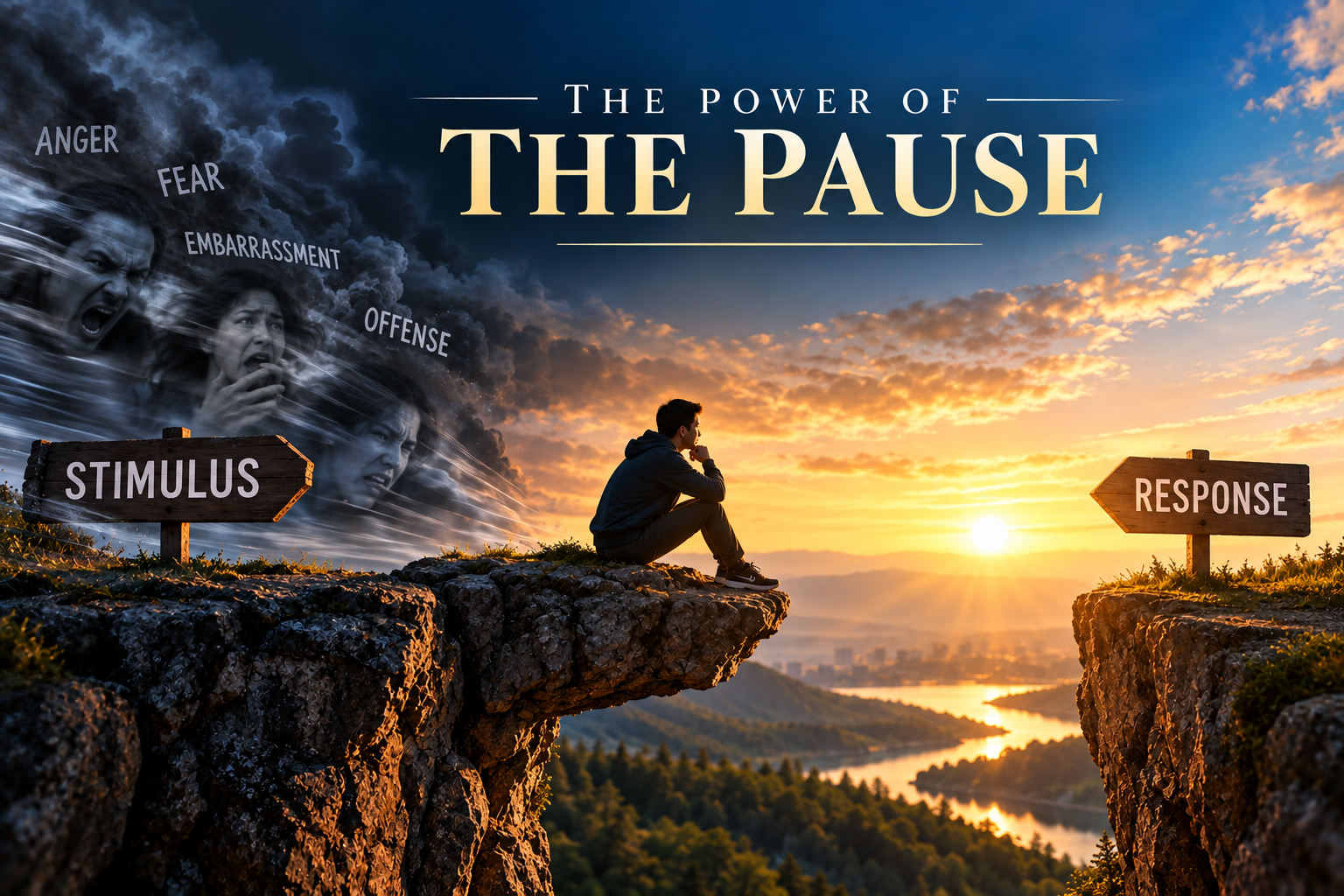
Had I known earlier that there is a space between stimulus and response, I might have saved my younger self a great deal of pain and trouble.
Think of that space as a stopover—a brief opportunity to collect ourselves before deciding how to respond to something that happens to us. It offers us the luxury of stopping, even for a split second, before allowing our emotions to take the driver’s seat.
But then again, can we really call a split second a luxury? How much thinking can we possibly do in such a fleeting moment? Unless, of course, we happen to be Flash, the comic-book superhero who can accomplish extraordinary things in the blink of an eye. Unfortunately, most of us do not possess his superhuman speed. ^^
That space has a name: the pause.
It has always been there, quietly waiting to be recognized and used. Yet many of us go through life without realizing its significance.
When something makes us angry, frightened, embarrassed, or offended, our emotions can rise faster than our thoughts. Before we fully understand what has happened, harsh words may have already escaped our lips, and regrettable actions may have already been committed. Words we would never utter and actions we would never consider when we are at our best suddenly become part of a moment we wish we could undo.
And yes, how we wish we could be Flash, if only to give ourselves enough time to think before our tongues get us into trouble or our actions leave us with consequences we must live with.
But perhaps we do not need superhuman powers after all.
As I articulated in a related article, Thinking First, we are not helpless victims of our emotions. Emotional reactions may arise almost instantly, but they do not necessarily have to dictate what happens next. We can learn to recognize our feelings without immediately acting on them. We can develop the habit of pausing, however briefly, to allow reason to catch up with emotion.
A statement often associated with Viktor Frankl describes the space between stimulus and response as the place where our freedom to choose resides. Although the exact wording cannot be reliably attributed to Frankl, the underlying principle reflects one of his central teachings: circumstances may influence us, but we retain some freedom in choosing how we respond to them.
And therein lies the power of the pause.
It may not always be long enough for deep reflection, but it can be enough to stop an angry word, reconsider an impulsive decision, or prevent an action we might later regret. With practice, that seemingly insignificant moment can become a powerful instrument of self-control.
We cannot always control what happens to us. We cannot always prevent emotions from arising. But we can learn to exercise greater control over what we do with those emotions.
Perhaps growing wiser is not simply about learning what to say or do. Sometimes, it is about learning when not to say or do anything at all.
Remember this:
Every word you have regretted saying and every action you have wished you could take back probably began the same way: you reacted before you thought.
And perhaps, between the next stimulus and your response, you will find that little space where a better choice is waiting to be made.

Posted on October 11, 2026, in General and tagged dailyprompt, dailyprompt-2911. Bookmark the permalink. Leave a comment.



Leave a comment
Comments 0