Beyond the Screen
(Were We Ever Meant to Be – Part 6)
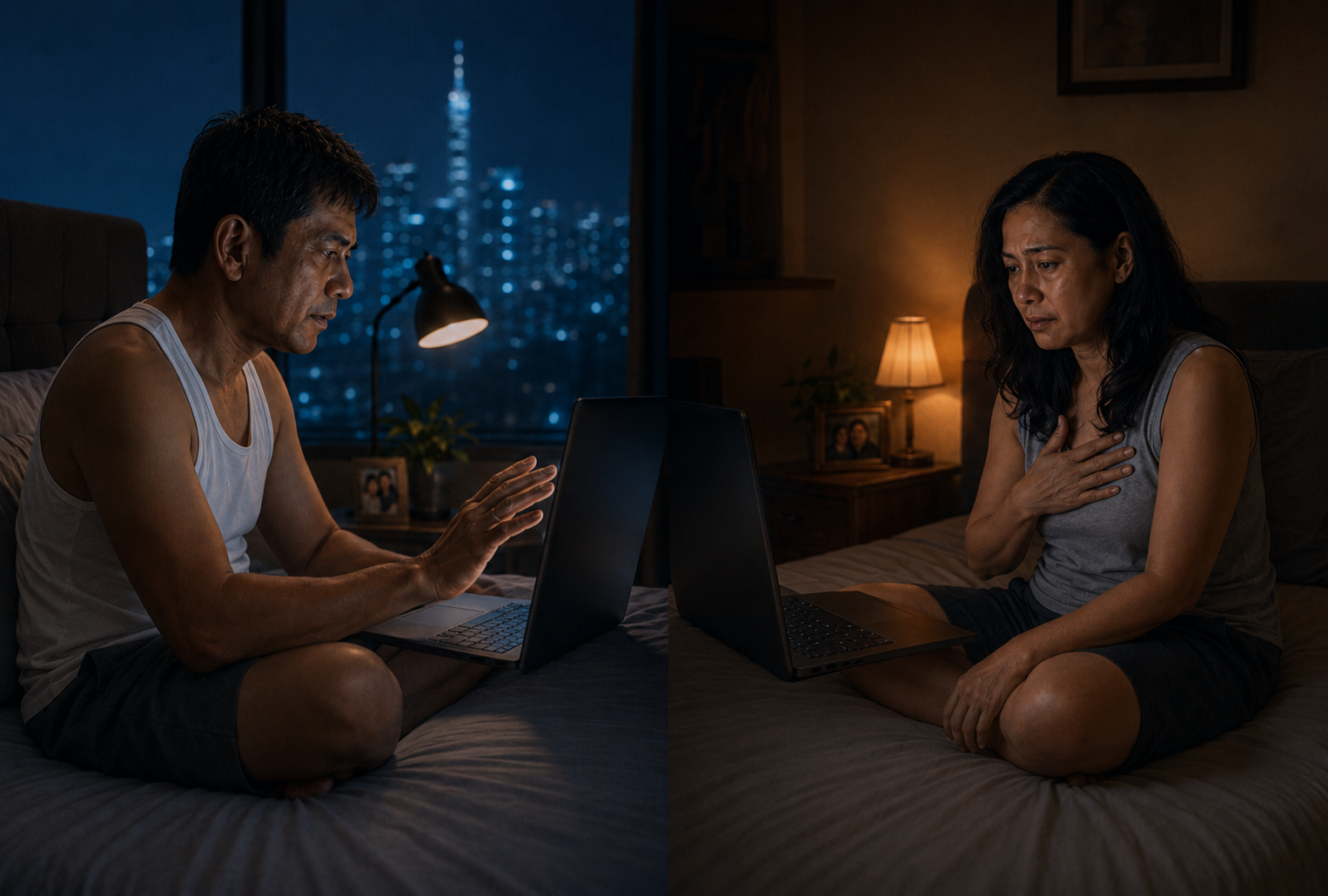
After that, we spoke almost every night. If our affair were a voyage, we had sailed so far from shore that neither of us could see where we had begun—or decide whether we still wanted to return.
Our conversations developed rituals. I messaged first to ask whether the children were asleep. She checked whether Anna might call. We used earphones, lowered our voices, and deleted exchanges that could expose us. Secrecy itself became intimacy: every precaution reminded us that there was an us important enough to hide.
One evening, Kath returned to the claim she had never completely believed.
“You still expect me to believe that you lived without sex for eight years?”
“I already told you. I never paid anyone, and I never found a girlfriend.”
“Not even once?”
“Not even once.”
“Then how did you manage?”
“A selfie,” I said, making her laugh. “Twice a week. I tell myself regular release is good for a man’s health.”
“Do you need stimulation?”
I admitted to visiting adult websites.
“Disgusting,” she said, although she was still laughing.
“They would become unnecessary if I had something better to look at.”
Her laughter disappeared. “Don’t start, Marco.”
“I haven’t started anything.”
“Your voice changes whenever you want something.”
“And you recognize it.”
“Unfortunately.”
Then I asked whether she ever touched herself.
“No. Jay and I once tried doing something online when he first returned to sea, but it didn’t work for me. We never tried again.”
“Perhaps it wasn’t the distance.”
“What do you mean?”
“Perhaps it was the person on the other side of the screen.”
She stared at me without answering.
The conversation changed the air between us. Her teasing smile faded, but she did not look away. I heard her breathing through my earphones, each quiet breath making the thousands of kilometers between us seem less real.
“What’s wrong?” she asked.
“Nothing.”
“Tell me.”
“I feel like taking a selfie.”
She understood. “Then take one.”
“I need inspiration.”
“Visit one of your disgusting websites.”
“I would rather look at you.”
Silence.
I removed my shirt first. Beneath it, I was wearing a white undershirt. Kath shook her head, but the faint smile at the corner of her mouth betrayed her.
“You are shameless.”
“Your turn.”
“No.”
“Then why haven’t you ended the call?”
She could have. Her finger hovered near the touchpad, and for several seconds I believed she would make the choice neither of us had been strong enough to make. Instead, she leaned back.
Her hand moved slowly over her chest, almost unconsciously at first, then stopped when she realized I was watching.
“Marco, what is happening to me?”
“Nothing you don’t want.”
“Don’t pretend you know what I want.”
“Then tell me to stop.”
“I have been telling you that from the beginning.”
The answer should have ended everything. Instead, neither of us moved.
“Please,” I whispered.
Kath closed her eyes. When she opened them again, fear and desire occupied the same expression.
“Why are you so difficult to resist?”
She carried the laptop to her bed. I did the same. Before setting it down, she changed into a thin undershirt and returned beneath the sheet.
“This is all you are going to see,” she warned.
“For now.”
“Don’t push me.”
But she remained.
The two rooms, thousands of kilometers apart, became one private space of restrained movements, uneven breathing, exposed shoulders, and whispered names. We watched each other without touching, yet every movement seemed answered by another on the opposite side of the screen.
Kath hesitated several times. Each pause gave us an opportunity to stop; each time, I asked her whether she wanted to continue. Sometimes she said no while remaining in front of the camera. Once she covered herself completely, and I thought the moment had ended. Then her face reappeared.
When she finally chose to continue, the surrender was mutual, but it was not free of pressure, guilt, or fear. The screen protected us from physical touch while permitting us to pretend that what happened through it was somehow less real.
That night, we crossed the boundary Kath had refused to cross eight years earlier.
It was not the last time. Soon, many of our late-night calls ended the same way. We began our conversations sitting at desks and finished them in bed. What we called friendship had become impossible to defend, even to ourselves.
Afterward, Kath sometimes covered herself quickly and avoided my eyes. At other times she laughed with the shy happiness of the younger woman I remembered. I preferred those moments. Her guilt threatened the future I was constructing, so I answered it with assurances: no one had forced us, our marriages were already incomplete, and love could not be evil simply because it arrived at the wrong time. The arguments comforted me because they began with the conclusion I wanted.
Yet the more we possessed of one another through our screens, the less sufficient the screen became. I wanted to return to the Philippines. I wanted to hold her without glass, pixels, or distance between us.
One night, Kath asked, “What exactly do you intend to do about us?”
I had waited for that question.
“First, answer something. Whom do you love more—Jay or me?”
“That is a ridiculous question.”
“Why?”
“Do you remember the crisis Jay and I went through before you left for Korea?”
I nodded.
“You were the reason. I told him everything about us. He asked whom I loved more, and I answered honestly: you. He threatened to leave me. That was why I came to you that day. I expected warmth, some sign that you still wanted me. Instead, you advised me to reconcile with him. You pushed me back into his arms.”
Her revelation rearranged eight years of memory. I had believed Kath chose Jay because she loved him more or because what existed between us had been insignificant to her. Now I learned that she had once approached me on the edge of choosing—and I, absorbed by my own crisis, had failed to recognize it. The lost possibility became more intoxicating than any future we could realistically build.
Had I known, I thought, I might never have boarded the plane to Korea.
“When Jay apologized and promised to help me forget you, I accepted. But did he erase you? Look at me, Marco. I talk to you instead of him. I want to see you all the time. You ask whom I love more?”
“I understand.”
“No. Say it.”
“You love me more.”
“You fool. You are the only man I love. I needed Jay because you were not there. I was learning to love him. Then you returned.”
She began to cry.
“Perhaps we decide whether we are meant to be,” I said. “Leave Jay. I will leave Anna. Come with me.”
Kath lifted her tear-streaked face.
“And my children?”
“I will accept them as my own.”
We discussed separation, secrecy, scandal, custody, and sacrifice. She had far more to lose than I did, but I was confident she would choose me.
I proposed that we keep our relationship hidden even after separating from our spouses. If Jay discovered that I was the reason Kath left, he might fight for custody or prevent the children from seeing her. Anna would have to face another betrayal, Kenneth would have to understand why his parents’ marriage ended, and both families would endure gossip and anger. I spoke of these consequences as obstacles we could manage, not wounds other people would suffer.
Kath listened, but the practical future made her quieter than the romantic one. It was easy to say she would leave everything for love while we were safely separated by thousands of kilometers. It was harder to imagine telling her children that the man on her laptop would replace the father they knew.
“Give me time,” she said. “I love you, but I don’t know what to do.”
I heard only the words I wanted to hear: I love you. I treated everything that followed as uncertainty time would eventually overcome.
PART 7 – The Hardest Choice

Posted on September 4, 2026, in Creative Writing, Fiction, Infidelity, Literature, Marriage, Moral Choice, Prose and Poetry, Romantic Novelette, Unfaithful and tagged Creative writing, Fiction, Infidelity, Literatrue, Marriage, Prose and Poetry, Romantic Novelette, Unfaithful. Bookmark the permalink. Leave a comment.



Leave a comment
Comments 0