Category Archives: Enhanced Performance
Power of Visualization: Achieving Goals and Enhancing Performance

“Formulate and stamp indelibly on your mind a mental picture of yourself as succeeding.
Hold this picture tenaciously and never permit it to fade. Your
mind will seek to develop this picture.”
– Norman Vincent Peale
The desire to become the best version of oneself is a powerful driving force for those committed to self-improvement. This desire propels individuals on a quest to reach their full potential, both personally and professionally. If you aspire to improve continuously, you must embrace this journey. Striving for excellence and optimizing your performance in all areas of life should be an ongoing pursuit.
Achieving your best self does not come through shortcuts or magic solutions. The path to self-improvement is challenging, but it is far from impossible. Success in reaching your dreams and goals is attainable, but how can you get there?
Various methods and techniques can help you succeed in your endeavors. In the previous chapter, we discussed the initial steps in achieving your goals: setting clear objectives and creating actionable plans. Experts in Positive Psychology also emphasize the importance of cultivating the right mindset, executing your plans, maintaining work-life balance, adapting to change, finding a mentor, and visualizing success.
This discussion will focus on one particularly powerful technique: visualizing success.
Visualization involves creating vivid and detailed images or scenarios in your mind to help you achieve your dreams and goals (Hook, 2024). Roychowdhury (2023) defines visualization as the “creation of detailed mental images that mimic real-life experiences. It involves engaging multiple senses, such as visual, auditory, and kinesthetic, to create a comprehensive mental representation.”
This mental technique taps into the power of imagination to mentally rehearse success, influencing your mindset and behavior. Visualization is closely related to mental imagery, explicitly focusing on creating or recalling visual images. According to Roychowdhury, the critical components of visualization include imagery control (the ability to manipulate images), imagery vividness (the clarity and detail of the images), and imagery duration (the ability to sustain the images over time).
Visualization is used in sports, therapy, and personal development to rehearse scenarios and achieve desired results. An anonymously written article explains that “visualization goes beyond mere daydreaming; it’s a focused and purposeful exercise that prepares the mind, much like physical practice prepares the body.” The article also reveals that brain studies show the same neural pathways are activated when a weightlifter lifts heavy weights and when they only imagine lifting.
An AI model explains that “visualization is a powerful tool for achieving your dreams. By mentally rehearsing success, you prepare your mind and body to perform at their best, increase your confidence, and stay focused on your goals. When combined with consistent action, visualization can be a key factor in turning your dreams into reality” (OpenAI, 2024).
Skepticism often surrounds visualization, as it may seem implausible that merely imagining success can lead to actual achievement. However, visualization is supported by scientific research, which validates its effectiveness. Hook (2024) identified Neuroscience, Epigenetics, and Psychology as the scientific foundations of this technique. Neuroscientific studies have shown that visualization activates the same brain regions as actual physical performance, affirming the claims mentioned in the earlier article. Additionally, research in epigenetics indicates that positive mental practices, like visualization, can influence gene expressions related to stress, resilience, and overall well-being. In cognitive psychology, techniques like guided imagery and mental rehearsal have been used to treat anxiety and improve self-confidence.
The notion that visualization or mental imagery can enhance an athlete’s focus, reduce anxiety, and improve cognitive performance is not just anecdotal. Scientific studies support these claims. For example, Predoiu et al. (2020) explained that visualization techniques can improve motor skills, increase muscle strength, boost self-confidence, enhance concentration, and reduce anxiety. They also noted that imagery can aid in pain management, endurance, performance motivation, and physical performance in athletes. Markova et al. (2024) found that visualization is also effective in overcoming anxiety and nervous tension, as well as reducing symptoms of depression and stress. Their research showed that adaptive coping strategies are closely linked to self-knowledge, revaluation of values, positive self-attitude, and visualization.
Visualization can also enhance learning and memory. Kosslyn et al. (2001) reviewed various findings on how mental imagery activates neural pathways similar to real perception. They concluded that visualization could be a powerful tool for enhancing memory retention and learning, especially when combined with actual practice. Fishback et al. (2003) examined whether students who visualized themselves performing well on exams were more likely to achieve their academic goals. They found that students who visualized themselves successfully completing specific tasks (e.g., studying for an exam) were likelier to engage in behaviors that led to academic success.
The literature clearly presents the variety of benefits that visualization brings. At the top of the list is enhanced performance. Athletes often turn to visualization to achieve better results in competitions. Practicing this mental technique not only improves competence but also boosts confidence. As mentioned earlier, even cognitive functions benefit from visualization. Both your body and mind perform better when you embrace this method. So, why not give it a try?
The benefits of visualization extend beyond physical and mental improvements. This mental practice can also provide emotional relief, particularly for those suffering from anxiety and depression.
The great things you will gain from visualization are not just physical and mental. You can get emotional relief from this mind practice as well if you are suffering from problems like anxiety and depression.
Moreover, visualization can significantly enhance goal setting. Several studies have explored the connection between these two constructs. For instance, Pham & Taylor (1999) compared the effects of two visualization types—outcome visualization and process visualization—on goal attainment. Outcome visualization involves picturing the successful outcome, while process visualization focuses on the steps required to achieve the goal. Their study revealed that process-oriented visualization was more effective in helping participants achieve their goals. The researchers explained that those who visualized the process were likelier to succeed than those who only visualized the outcome. Scheier & Carver (1985) found that “individuals who engaged in positive visualization were more likely to set challenging goals and persist in achieving them.” Positive visualization enhances self-efficacy and increases the likelihood of achieving challenging goals by fostering a proactive mindset and a belief in one’s ability to succeed.
The process of visualization enhances goal setting and what comes next: planning. This mental activity clarifies your vision, builds your confidence, and heightens your motivation. When setting goals, part of the process involves preparing a plan that outlines the techniques and strategies needed to pursue them. Visualization plays a role in anticipating potential challenges and responses, helping you develop the confidence to face obstacles and stay motivated in your pursuit.
Visualization is also linked to effective planning, as established by several studies. These studies have shown how visualization improves problem-solving, decision-making, and strategic thinking—key aspects of planning. Dela Sala et al. (2010) studied how individuals use mental imagery to simulate future scenarios and plan accordingly. They found that individuals who frequently engage in visualization are better at planning and decision-making because they can mentally simulate different scenarios and outcomes, leading to more informed and strategic choices. Klein (1998) observed that “visualization is crucial in planning, especially under conditions of uncertainty, as it helps individuals mentally test and refine their strategies before implementation.” This finding was based on real-world observations of decision-makers who experienced how visualization aids in developing more effective and adaptive strategies. Sheehan & McConkey (1982) concluded that this mental process enhances the ability to organize and execute complex plans by providing a mental rehearsal space where details can be worked out before action.
The following table shows some of the visualization techniques that are being used.
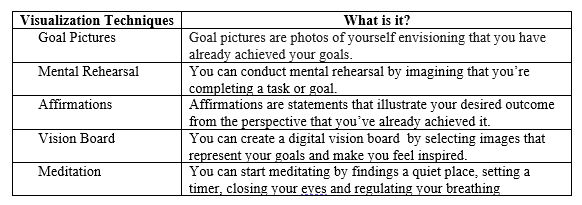
Predoui et al. (2020) suggested that visualization techniques include the five major senses (touch, hearing, sight, smell, and taste) to achieve the best results.
In conclusion, visualization is a powerful and scientifically supported technique crucial to personal and professional development. By engaging in vivid mental imagery, individuals can enhance their performance, boost their confidence, and achieve their goals more effectively. Visualization is not merely a passive daydream but a purposeful exercise that prepares the mind and body for success. Whether it’s improving athletic performance, managing anxiety, enhancing learning, or strengthening goal-setting and planning, the benefits of visualization are vast and varied.
This mental practice, grounded in neuroscience, psychology, and epigenetics, proves that the mind can be trained to influence real-world outcomes. By incorporating visualization into your daily routine, you can cultivate a mindset of resilience, focus, and determination, ultimately transforming your aspirations into reality. As the evidence shows, those who visualize see their goals more clearly and find the motivation and strategies necessary to reach them. Therefore, embracing visualization is an option and a valuable tool for anyone committed to self-improvement and achieving their fullest potential.
 M.A.D. LIGAYA



 M.A.D. L I G A Y A