Blog Archives
On Evaluating Teachers’ Performance

Evaluating teacher’s performance is part and parcel of the educational process. Teaching and learning are the two major interdependent operations of that process that also involve two interdependent players – the teacher and the student. The evaluation of the performance of teachers is intended to ensure that teaching is performed effectively, resulting in the achievement of the goals of learning.
Evaluation of teacher’s performance can either be formative or summative. While both are performed for the purpose of improving the teaching-learning process, they are different in terms of objectives.
Formative evaluations are intended to give teachers information or feedback to help them improve their pedagogical skills. It can be done at any time throughout a school term to monitor what teachers do in the classroom in order to identify where they are good at and where they need improvement.
Conversely, summative evaluations are done to appraise teacher’s performance, not for the purpose of giving them feedback to improve their delivery of instruction but for measuring the effectiveness of their teaching methods and strategies. The main objective is to determine if the teacher’s pedagogical skills measure up with the institution’s standards.
While formative evaluation is used by academic institutions to monitor (and promote) the progress or growth of the teacher, summative evaluation is carried out by school administrators in order to have a basis for employment-related decisions like promotion and continuation of employment.
Results of the summative evaluation of the performance of teachers determine whether they get promoted, given tenure, or allowed to continue to work in the academic institutions that employ them.
In the university where I am currently working, topnotchers in teachers’ evaluations are even given cash incentives. Unfortunately, failure to get the required passing scores in the annual evaluation of teachers’ performance would mean not being given a contract extension for the following school year. That is for non-tenure foreign professors like me.
Because the results of summative evaluation affect the employment status of teachers, it is important that heads of schools ensure that this analysis of teachers’ performance is valid and reliable. The evaluation instruments created should be able to measure what they intend to measure. The items/criteria included in the instrument need to be authentic measures of the pedagogical skills of teachers and their professionalism.
The appraisal of the performance of teachers is usually done through actual class observation. Additionally, checklists are used to determine teachers’ compliance with administrative requirements.
It is important that people designated to carry out the evaluation should be competent and trained to appraise teachers’ performance. This assertion brings to the fore the question of including results of students’ appraisal of their teachers’ performance in summative evaluation.
I think including the scores of students’ evaluations makes the results of summative evaluations less valid and reliable. Why? Students are not expected to be as objective as they ought to be when appraising the performance of their teachers. Even if teachers are pedagogically sound and professional in handling their jobs, if students don’t like their styles, they will get low scores. There exists a possibility that some students, when they perceive their teachers to be strict and unfriendly, they will use teachers’ evaluation as a means to get even. It is even likely that students won’t take seriously the evaluation not bothering to carefully read the items in the instrument.
Students have no training in pedagogy for them to understand what things to consider when evaluating the performance of their teachers. Therefore, their performance appraisal should be treated only as a formative evaluation intended to give teachers feedback or information that will guide them in improving their craft. Excluding their scores from the summative evaluation eliminates any bias that could potentially impact the employment-related decisions that school administrators make at the end of a school term.
In a tertiary institution where I used to teach, class observations are done 5 times in a semester. Three of those are called pop-in visits (unannounced), where the evaluator stays for a few minutes, targeting only a specific area of the lesson plan. The other two are formal visits where the one doing the appraisal of the teacher’s performance stays from the beginning up to the end of the class. One of those formal visits is “announced,” and the other is “unannounced.” The teachers are informed at the beginning of a school term that those pop-in visits and formal class observations will be done at any time.
I believe that the results of class observations are more valid and reliable if they are done “unannounced.” School administrators get to see the “real performance” of teachers when the latter have no inkling as to when they are going to be observed in their classes.
When Students Don’t Learn

One morning, I witnessed how an English teacher masterfully discussed the intricacies of the English language. It would take me a paragraph or two to explain in detail the things he talked about. Let me just say that he is every inch a native English speaker. His knowledge of the phonemes, morphemes, lexemes, syntax, and context is impeccable. He dissected the language so skillfully, and the way he did it almost made me envious. I was reduced to being a listener, uncertain whether I just wanted to make sure not to miss anything new (something I don’t know yet) from what he was saying or I had nothing more to share because he had everything covered about what he was discussing. I wasn’t really sure what prevented me from saying anything. Maybe I was intimidated by his mastery of grammar, semantics, and pragmatics, or I did not like to gatecrash into his moment to showcase his brilliance. Stealing someone’s thunder is not my cup of tea.
That teacher held court in his impromptu lecture. He had the attention of everybody present. It was difficult to judge the intentions of my colleagues whenever they (unsolicitedly) shared their expertise like that. Was it to impress upon us (their co-teachers) that they know that much, or they simply would (good-naturedly) like to help us learn more about the subject (English) we’re teaching.
Later that day, I changed upon a student who had attended my English class in a previous semester. That student was one of the best in my class. Like me, he was heading out of the campus. After the exchange of greetings, I asked, “Who’s your English teacher this semester?” The student had already started responding before I recalled that I had previously made a promise to myself never to ask any of my former students that question for the reason that a few of my previous attempts led to the opening of “a can of worms.”
But it already happened – I asked that stupid question again.
The student named the teacher – he was the one I heard deliver an impromptu lecture about the English language earlier that day. After that, the student heaved a sigh and said, “We could hardly understand what he was teaching.”
I looked at him seriously, and all I could say was, “Really!?”.
He nodded and said, “He is also very serious.”
Before he could open that “can of worms,” I told my former student to give that teacher more time to adjust since the semester is still a long way to go. Then, I quickly redirected our conversation to another topic after that.
What’s amazing is the occurrence – of one day hearing a colleague deliver a brilliant impromptu lecture, but later that same day (or within the week), I would meet one of his students (who used to be my student also) claiming that they, in the class, could hardly understand what he is teaching – did not happen only once. If my memory serves me right, that’s the fourth time.
It finally made me reflect. That’s the reason I wrote something about it.
It made me wonder (again) how my former students rate my performance as a teacher. What do they think (and how they feel) about me as their teacher? What would they say to a colleague or fellow students when asked about me?
Students evaluate the performance of their teachers every semester. It’s hard to tell how reliable and valid the results of such evaluation are. Whether or not the results are a reflection of the true professional and personal qualities of the teachers is a matter of debate.
But valid or not, reliable or otherwise, it’s hard to ignore what students say about the performance and behavior of their teachers. Teachers get to read what students write in their evaluations. They could either agree or disagree with the results of their evaluation. But what the teachers would not know is what students say about them in informal discussions. Only the most naïve among teachers don’t know that students talk about their teachers.
In gatherings, teachers talk (or should I say gossip) about their students – their performance and behavior in the class. Conversely, students do the same. They talk (or gossip) about their teachers. There are only two possibilities – they either praise or curse their teachers.
One of the most unacceptable things that students could say about a teacher is that they do not (or they could hardly understand) what he/she is teaching.
Witnessing firsthand an English teacher discuss with ease the complexities of the English language and hearing a student claim that he and his classmates could hardly understand what that teacher was teaching is quite paradoxical.
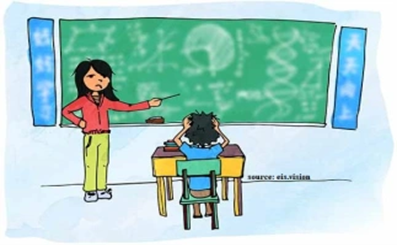
So I asked myself this question that night – Which is true… my impressions about that English teacher or that of his students?
What could have gone wrong?
My former student said that their current English teacher is very serious. Is that the problem – good rapport does not exist between him and the students? It is no secret that a teacher’s personality is correlated to students’ academic performance.
I tried to think of other reasons.
Then I recalled my teaching demonstration when I was applying for a job right after my graduation. When the high school principal called me to her office to discuss the results, she told me I did great. But she said there was a problem – I explained things in a way that only students enrolled in a graduate program could understand.
Could that be the reason?
If that teacher carried out discussions in the class in the same way he explained the grammar topic to us in that gathering earlier that day then that exactly is the problem. You cannot discuss a grammar point with students trying to learn the language the way you would with teachers teaching that language. I think that is not rocket science.
There are two things I learned before I officially began my teaching career – adapt my strategies and materials to students’ levels and simplify my language.
The problem is there are teachers who have a “one-size-fits-all” mentality, thinking that educational processes and approaches to teaching and learning are standard and cannot be tailored to meet individual needs. They wouldn’t buy into the idea of differentiated learning and teaching.
They will never accept responsibility when their students don’t learn.
Their standards are as immovable and high as Mt. Everest. The students have no choice but to climb that “Mt. Everest.”
For them, it’s the fault of the students when they fail.
How I Conduct My First Class

Each meeting with my students, either online or face-to-face, is important. But it’s the first day that I consider very special – the most strategically important. It’s the day that I would attempt to accomplish one of the hardest things to do in education – to shatter the students’ image of the classroom as a prison cell, with them as prisoners and the teachers as nasty prison guards. It’s the day when I begin to lay the foundations of what every teacher should endeavor to forge between them and their students – a good rapport. The entire semester is a long haul and I know that winning their hearts – making them comfortable – would make our journey together as enjoyable and productive as it could be. If I succeed in making them trust me, especially since I am not the native speaker of English they were expecting as an ESL teacher, half of the battle is already won.
There’s nothing very special about the way I conduct my first meeting with my new students. It’s just a bit unconventional.
My introduction would always include telling my students the nickname which I adopted with the intention of eliciting laughter whenever I deliver a talk – Tonitonipoponibananananapoponinomimayfofoni. (That’s inspired by the song “Name Game.”) Amazingly, when I tell my students that and jokingly threaten them to memorize it if not they would fail in my subject, they would try very hard to repeat it after me and laugh at themselves if they wouldn’t be able to say it.
Then I would add, “Whoever could say my nickname correctly will get an A+.” I was just kidding of course. Luckily, up until this time, no one among those who tried succeeded. It was me who would always succeed – in getting their attention.
From there, I would give them the necessary information about me as their teacher. The most significant of those information (as far as I am concerned) is the number of years I have been teaching. I won’t say it directly. Just do the math and… a little bit of research. I sarted teaching the year the summer olympics was held here in South Korea. The point I wish to drive home for highlighting to my students how long I have been teaching is – I wouldn’t stay this long in the academe if I don’t love my job.
The next part of my first-day-of-class script would touch the boundaries of philosophy.
I would be delivering something like an “eve-of-battle” speech. The way they do it in movies.
I would ask my first question: “Why am I teacher?”
Puzzled, the students would grope for an answer.
I would give follow-up questions after that – Would you call a woman a mother without a son or a daughter? Are your mothers and fathers mothers and fathers without you as their children?
Amid their “aahs” and nods I would then say, “I am a teacher because of the students. My reason for being a teacher is each of you. Without you I am not a teacher.” In the same manner that a woman wouldn’t be called a mother if she has no son or daughter, biological or adopted.
That’s my way of telling my students that the most important stakeholder in a school are them. Schools exist because of them. School administrators and teachers have work because of them.
That’s my way of telling them that I exist (as a teacher) to serve their interest.
I would end that part with the following statement: “Thank you for having me as your teacher.”
After that I would show them a videoclip from the movie “Collateral Beauty” – that part where Howard Inlet, a character played by Will Smith, delivered a speech in a gathering of his employees at the beginning of the movie.
He said “What is your why? Why did you even get out of the bed this morning? Why did you eat what you ate? Why did you wear what you wore? Why did you come here?”
I would pause the video clip after each question and would ask them to give an answer.
Then I would ask them follow-up questions. (These were the only questions I asked when I was not yet using that movie clip.)
Why are you here in school?
Why do you want to finish your studies?
The last question I would ask – Why did you enroll in this class?
I never failed to ask the said questions because I want my students to understand that for them to succeed not only in their studies but in all their present and future endeavors, they need to set goals. They ought to know their whys. They must know the reasons why they do what they do, say what they say, and think what they think.
I would tell them also that the worst “why” to have for studying is to get A+ – that grades are not the be-all and end-all of schooling.
All of the foregoing would be finished in twenty to thirty minutes.
I would then ask the student to introduce themselves.
After all of the foregoing , that’s the only time that I would present the course syllabus – explain the course objectives, give the topics to be discussed weekly, and tell them what activities will be done in the class and how they are going to be graded.
It’s not surprising to see the students frown when they see the course requirements on the last page of the syllabus. That’s the time that I would deliver the last part of my “eve-of-battle” speech.
I would ask – “Is learning fun?”
As expected, majority would say “no.”
My next question would be – “Is work fun?”
Of course the students would say “no” again. And every time I would ask that, one or two would say “My father always complains about his job.”
Then I would go on and tell them the following:
“Nothing is to be given to you in a silver platter. You need to work hard to achieve your dreams. Studying and working would require effort – you have to exert mentally, emotionally and physically. But something could make studying and working fun – your attitude. Your attitude towards studying will be dictated by your whys. Your whys put together is your philosophy.”
I would spend another minute or two to explain something about “personal philosophy.” At the end I would tell them that each teacher has a personal teaching philosophy and mine is as follows:
“The classroom is my playground. The students are my playmates. The subject is our toy.”
How surprised they would be whenever I say that when I come to class I don’t work, I play. Work is hard. Play is fun.
And that’s how I found joy in teaching – to not consider it as just another job. It works for me.
After all the aforementioned, when I know that I communicated already what I wanted to, that’s the only time that I would present the course syllabus.
As we end the first meeting I would tell them, “Come back next week and let’s play.”
Just imagine – I play and get paid handsomely for doing so. The remuneration is just the icing on the cake. Which one is the cake? It’s the happiness; the happiness that I derive from doing what I love doing – teaching.
Professionalism Among Teachers

The complexities involving the teaching profession and the importance of the role of teachers in the holistic development of learners require strict adherence to the tenets of professionalism. There are expectations that teachers need to meet and there are qualities that they are expected to possess. These expectations and qualities are the ones that should inform the decision to hire somebody applying for a teaching position.
All the qualities teachers ought to have and what are expected of them can be summed up in one concept – “teacher professionalism.”
“Teacher professionalism” is an idea that can be defined differently based on multiple perspectives and its merits scrutinized according to various arguments. It is considered a broad concept consisting of several dimensions. However, for delimitation purposes, the discussion on the subject in this article is anchored only on the definitions of the term “professionalism” given in the next two (2) paragraphs.
Evans pointed out that “professionalism means different things to different people.”1 The Oxford dictionary simply defines the term as “the competence or skills expected of a professional.”2 It is the level of excellence or competence that professionals should manifest in their chosen fields of specialization.
Tichenor3 explains that professionalism are the expected behaviors of individuals in a specific occupation. Professionals need to conduct themselves in accordance to set standards.
Boyt, Lusch and Naylor4 combined the said views about professionalism when they describe it as a multi-dimensional structure consisting of one’s attitudes and behaviors towards his/her job and the achievement of high level of standards. Similarly, Hargreaves5 defines professionalism as the conduct, demeanor and standards which guide the work of professionals.
The terms associated to professionalism as seen from the definitions and explanations given are as follows: competence, skills, behaviors, conduct, demeanor, and standards. Competence and skills are synonymous and so are behaviors, conduct, and demeanor. Standards refer to the quality or accepted norms for competence and behaviors.
Skills are not the only components that make up teacher’s competence. Knowledge is, of course, an integral part of it.
Skills and knowledge are very broad attributions to a teacher’s competence. What specifically are the skills and knowledge that would make a teacher competent?
As Baggini puts it, “To be a professional or a professor was to profess in some skill or field of knowledge.”6 It’s a given that teachers should have knowledge of the subject matter or expertise in a particular skill. Teachers are expected to know not a little but much about what they are teaching.
What adds challenge to being a teacher is the ability to dig (whenever applicable) into the scientific, philosophical, legal, sociological, and psychological foundations of what is being taught. It is important that teachers are able to relate whatever they are discussing to other fields. Such an ability would enable teachers to enrich the discussion.
But teaching and learning are complex processes that involve a lot more… not just knowing what to teach and being able to connect a topic to other disciplines. What would make teachers truly competent are the corresponding skills that enable them to effectively teach what they know and make the students learn. Such skills are acquired through training in pedagogy.
Pedagogy is commonly defined as “the art, science, or profession of teaching.” Pedagogy informs teaching strategies, teacher actions, and teacher judgments and decisions by taking into consideration theories of learning, understandings of students and their needs, and the backgrounds and interests of individual students.7
Pedagogy, in a nutshell, tells how best to teach and how best the students learn.
Knowledge and expertise in a field would not make one a teacher. Pedagogical skills are needed. Competent teachers SHOULD know, not just the subject matter, but how to set learning objectives, motivate students, design learning activities, facilitate learning, construct assessment, and assess learning.
In addition, another skill through which the competence of 21st-century teachers is gauged is how extensive and effectively do they apply technology (computer) to teaching and learning.
Aside from competence, the other dimension of teacher’s professionalism this article is exploring is behavior.
Teachers are aware that they should behave in accordance with the ethical standards set for the teaching profession. They are expected to speak, act and dress accordingly. Barber8 pointed this out when he identifies as one of the main characteristics of professional behavior a “high degree of self-control of behavior through codes of ethics.”
But the behavior dimension of professionalism among teachers goes beyond proper manner and decorum.
Another characteristic of professional behavior identified by Barber is “orientation primarily to community interest rather than to individual self-interest.” It is no secret that teachers sacrifice a lot to help their students. Teachers work long hours and practice a lot of patience. As Orlin puts it, “ I see it (teaching) as an act of self-sacrifice, as a hard path undertaken for the greater good.”9
Teachers also know that they need to keep learning. They need to have a continuing professional development plan for them to be better equipped in dealing with the challenges of the profession. They need to keep abreast of the current trends and innovations in the field of education.
There are also general teaching behaviors which, according to a study, are the most important for effective teaching (as perceived by students). Hativa identified five (5) of them, namely, making the lessons clear, organized, engaging/interesting, maintaining interactions, and rapport with students.10
Two (2) of the said general teaching behaviors (making the lessons clear and organized) are related to the first dimension of teacher professionalism (competence and skills). The rest are more indicative of the second dimension (behavior).
Teacher professionalism strongly implies the demands and complexities of teaching making it harder to understand why the profession doesn’t get due recognition. Teaching is not just any profession. Not just anybody can be a teacher. Not just anybody can be entrusted the responsibility of developing the mind and body.
References:
- Evans, Linda (2008) Professionalism, professionality and the development of education professionals. British Journal of Educational Studies, 56 (1). pp. 20-38.
- Definition of “professionalism” – Oxford English Dictionary
- Tichenor, M. S., Tichenor, J. M. (2005). Understanding teachers’ perspectives on professionalism. ERIC.
- Boyt, T., Lusch, R. F. ve Naylor, G. (2001). The role of professionalism in determining job satisfaction in professional services: a study of marketing researchers, Journal of Service Research, 3(4), 321-330
- Hargreaves, A. (2000). Four ages of professionalism and professional learning. Teachers and Teaching: History and Practice, 6 (2),151-182.
- Baggini, J. (2005). What professionalism means for teachers today? Education Review, 18 (2), 5-11.
- Shulman, Lee (1987). “Knowledge and Teaching: Foundations of the New Reform”(PDF). Harvard Educational Review. 15(2): 4–14. Retrieved 12 June 2017.
- Barber, B. (1965). Some Problems in the Sociology of the Professions. In K. S. Lynn (Edt.), The Professions in America (pp. 669-688). Boston: Houghton Mifflin.
- Orlin, Ben “Teaching As Self Sacrifice.” Match With Bad Drawing. WordPress, March 10, 2014. Web. 19 July, 2017.
- Hativa, N. (2014). A pratical approach to designing, operating, and reporting, 2nd, Tel Aviv: Oron Publications.
On Passing and Failing Students

The current semester of the school year 2021 is drawing to a close. Teachers will soon make a decision – pass or fail their students.
To pass, or not to pass… that is the dilemma that confronts teachers when the performance of some students during an entire term is below par and their total grades go south of the passing mark.
What should the teachers do – pass or fail the students?
Is passing students in a subject or course mandatory on the part of the teachers?
It’s a different story if a student fails due to absences. The student failed by default. But what if a student is regularly attending classes?
There are possible repercussions should teachers fail their students. When they fail students they had better be ready to answer possible queries from the students themselves or from their parents. Usually, complaints of students, most especially when they are accompanied by their parents, would also lead to school authorities investigating the teachers concerned. It’s not only a matter of being ready to answer questions but the teachers should also prepare class records and other documents that could prove beyond reasonable doubt that the students did not perform well and deserve to get a failing mark.
There are times that teachers thought that they have exhausted all possible means to help the students perform better but to no avail… that they have tried different strokes for different folks, but none of the strokes they applied worked.
But the painful truth is that there are also teachers who would not walk an extra mile to help students improve on their academic performance.
Now, granting that the teachers have done everything they possibly could to help the students pass but their efforts proved futile, would failing the students be considered justifiable already?
Should teachers be applauded when they take the moral high ground and say that schools are committed to excellence and passing failing students would be tantamount to promoting mediocrity?
Failing students is not a simple decision to make. Whether or not to pass students is a path that teachers have to tread carefully. There are a lot of things to be considered before making the final decision. There are questions that the teachers need to answer very clearly. Questions that would lead to more questions.
Do the grades teachers give truly reflect the abilities of the students? Let’s say that the answer is yes. The next question would be, “Were the tests the teachers made valid? Did the teachers make sure that their tests measured what they intended to measure?
There are more questions – Were the tests the teachers designed congruent with the strategies they used when they presented their lessons? What informed the strategies that they have selected? What foundation of learning and teaching did they stand upon when they delivered their lessons? Did they consider the abilities of their students when they designed the activities in the class? Or is it a matter of whatever decisions they make as teachers are contingent upon their personal comfort?
Yes, the role of the teacher is that complicated. That’s why the decision to pass or not to pass students is actually an examination of the teachers’ conscience. It is answering the ultimate question – “Did I really do my job as a teacher?”
Ask teachers if they are really doing the things expected of them and their response would be an unequivocal yes.
Really?
So here is another question – “Why would students fail if teachers are doing their job well?”
The question above leads us to the next question – “When students fail does it mean they did not learn?”
Students failing means they did not pass the majority (if not all) of the tests (short or long, oral or written) the teachers gave during the entire term. All of those tests are meant to evaluate learning that was supposed to have taken place when the teachers discussed their lessons and did all the activities they designed for the class. So, if the students failed the tests it would mean they did not learn.
Why did the students not learn? What happened? Did the teachers bother to know why? Could there be something wrong with their strategies? Like their strategies probably did not work or something could be wrong with their methods of testing. Yet, they did not bother to adjust and allowed the accumulation of failed tests on the part of the students.
Only the teachers who are pedagogically trained would be able to detect when something is not right with what they are doing. If they are true to their calling as teachers, they would do something about it. They will make the necessary adjustments. If they don’t care then may God bless the students. It’s much worse when those hired to teach are not really trained as teachers. They don’t have the pedagogical skills to understand what is really happening. For them, it’s just a matter of when the students don’t get the scores required they fail. That’s it.
Let’s bring back one of the questions posed earlier – “When students fail does it mean they did not learn?”
If the answer to this is yes it means that the grades of the students reflect not only their performance but that of their teachers as well.
How true is it that “it’s not teaching if there’s no learning.” Can the teachers claim they did their job as teachers even if their students fail?”
When students fail the tests meant to evaluate learning then the activities designed and strategies selected fail to help achieve the objectives. It is the responsibility of the teachers to make sure that their objectives are attainable and the corresponding activities and strategies are effective. It is their responsibility to make sure that their students would succeed. It is as simple as that. A philosophical mind is not needed to grasp that… just common sense would do.
The worst thing that can happen to students is to have teachers whose view of education is myopic – teachers who judge students according to the numbers they crunch during tests and recitations. The students are much more valuable than those numbers.
Education transcends all statistical data that teachers collect during a school term. Yes, there are written rules. There are policies and regulations. But they are not absolute. Education cannot be confined to a box. It is more than black and white. It is as colorful as the rainbow. Teachers should lead their students to the proverbial end of that rainbow where a pot of gold – a good future – awaits them
When Students Don’t Learn

One morning a few years ago, I witnessed how an English teacher masterfully discussed the intricacies of the English language. It would take a paragraph or two should I explain in detail the things he talked about. To say he is proficient in English is an understatement. His knowledge of phonemes, morphemes, lexemes, syntax, and context is impeccable. He dissected the language so skillfully and the way he did it almost made me envious. I was reduced to being a listener uncertain whether I just wanted to make sure not to miss anything new (something I don’t know yet) from what he was saying or I have nothing more to share because he had everything covered about what he was discussing. I wasn’t really sure what prevented me from saying anything. Maybe I was intimidated by his evident mastery of grammar, semantics, and pragmatics or I just did not like to gatecrash into his moment to showcase his brilliance.
That teacher held court in his impromptu lecture. He had the attention of everybody present. It was difficult to judge the intentions of my colleagues whenever they (unsolicitedly) share their expertise the way he did. Was it to impress upon us (their co-teachers) that they know that much or they simply would (good-naturedly) like to help us learn more about the subject (English) we’re teaching.
Later that day, I changed upon a student who attended my English class in the previous semester. That student was one of the best in my class. Like me, he was heading out of the campus. After the exchange of greetings, I asked “Who’s your English teacher this semester?” The student already started responding before I recalled that I promised never to ask any of my former students that question for the reason that a few of my previous attempts led to the opening of “a can of worms.”
But it already happened – I asked that stupid question again.
The student named the teacher – he was the one I heard deliver an impromptu lecture about the English language earlier that day. After that, the student heaved a sigh and said, “We could hardly understand what he’s teaching.”
I looked at him seriously and all I could say was “Really!?”.
He nodded and said one more thing, “He is also very serious.”
Before he could open wider that “can of worms,” I told my former student to give that teacher more time to adjust since the semester was still a long way to go. Then I quickly redirected our conversation to another topic.
What’s amazing is that the occurrence – of me one day hearing a colleague deliver a brilliant impromptu lecture but later that same day (or within the week) I would meet one of his students (who used to be my student also) claiming that they, in the class, could hardly understand what he is teaching – did not happen only once. If my memory serves me right, that’s the fourth time.
It finally made me reflect. That’s the reason I wrote something about it.
It made me wonder (again) how my former students rated my performance as a teacher. What do they really think (and how do they feel) about me as their teacher? What would they say to a colleague or their fellow students when asked about me?
Students evaluate the performance of their teachers every semester. It’s hard to tell how reliable and valid are the results of such evaluation. Whether or not the results are a reflection of the true professional and personal qualities of the teachers is a matter of debate.
But valid or not, reliable or otherwise, it’s hard to ignore what students say about the performance and behavior of their teachers. Teachers get to read what students write in their evaluations. They could either agree or disagree with the results of their evaluation. But what the teachers would not know is what students say about them in informal discussions. Only the most naïve among teachers don’t know that students talk about their teachers.
In gatherings, teachers do talk (or should I say gossip) about their students – their performance and behavior in the class. Conversely, students do the same. They talk (or gossip) about their teachers. There are only two possibilities – they either praise or curse their teachers.
One of the most unacceptable things that students could say about a teacher is – they do not (or they could hardly understand) what he/she is teaching.
Witnessing firsthand an English teacher discuss with ease the complexities of the English language and hearing a student claim that he and his classmates could hardly understand what that teacher is teaching is quite paradoxical.
So I asked myself this question that night – Which is true… my impressions about that English teacher or that of his students?
What could have gone wrong?
My former student said that their current English teacher is very serious. Is that the problem – good rapport does not exist between him and the students? It is no secret that a teacher’s personality is correlated to students’ academic performance.
I tried to think of other reasons.
Then I recalled my teaching demonstration when I was applying for a job right after my graduation. When the high school principal called me to her office to discuss the results, she told me I did great. But she said there was a problem – I explained things in a way that only students enrolled in a graduate program could understand.
Could that be the reason?
If that teacher carry out discussions in the class in the same way he explained the grammar topic to us in that gathering earlier that day then that exactly is the problem. You cannot discuss a grammar point to students trying to learn the language the way you would to teachers teaching that language. I think that is not rocket science.
There are two things I learned before I officially began my teaching career – to adapt my strategies and materials to students’ levels and simplify my language.
The problem is there are teachers who have a “one-size-fits-all” mentality thinking that educational processes and approaches to teaching and learning are standard and could not be tailored to meet individual needs. They wouldn’t buy into the idea of differentiated learning and teaching.
They will never accept responsibility when their students don’t learn.
Their standards are as immovable and high as Mt. Everest. The students have no other choice but to climb that Mt. Everest.
For them, it’s the fault of the students when they fail.
My Essays on Education
 The year South Korea hosted the Summer Olympics was the year I started my journey as a teacher. That was 1988.
Those many years I spent in the academe, 24 years in the Philippines and 6 years here in South Korea, taught me a lot about the teaching profession – more than those that I learned from undergraduate and graduate schools. My experiences as a classroom teacher and as a school administrator enabled me (and they still do) to look at issues, problems, and disputes using the lens of the one teaching and that of the one formulating and implementing school policies. My having been in the position of both made me understand how it feels to be in-charge of students and to be in-charge of both the teachers and students.
Those 30 years in 10 different schools in 2 different countries made the following very clear to me: that it is not easy to wear the hat of a teacher; that teaching is not just another job; that teaching is not just a means of livelihood but a way to serve; and that everything schools, from the simplest activities to the most complicated policies, should be student-centered because the students are the reasons schools exist.
There were many times that I reflected on teaching as a profession and education in general. Those reflections resulted to essays and research works.
This is where I put them (essays I wrote on education and some of the research works I have completed here in South Korea) together. I added also in this section the dissertation and thesis I wrote as requirements for my PhD and Master’s degrees, respectively.
In the university where I completed my PhD and Master’s, the research papers students are required to complete are called differently – dissertation for PhD and thesis for Master’s.
The other studies listed in the subsections identified below (with links) include those that I presented in international conferences and were subsequently published in SCOPUS-indexed international journals. Papers published in international journals are usually longer that the versions presented in international conferences.
The following is my most recent research work:

I presented this in an international conference in Manila earlier this year and is currently waiting approval for publication in an SCOPUS-indexed international journal.
Links to the international journals where some of the articles were published as well as links to the websites of the conferences where they were presented are provided on the pages allotted for the papers.
This part of my website is divided into the following subsections:
Papers Presented in Conferences
My website also features the following section:
Most of the articles found in this section are my very personal reflections on education.
 M.A.D. LIGAYA



 M.A.D. L I G A Y A