Category Archives: South Korea
Grace In A Foreign Land
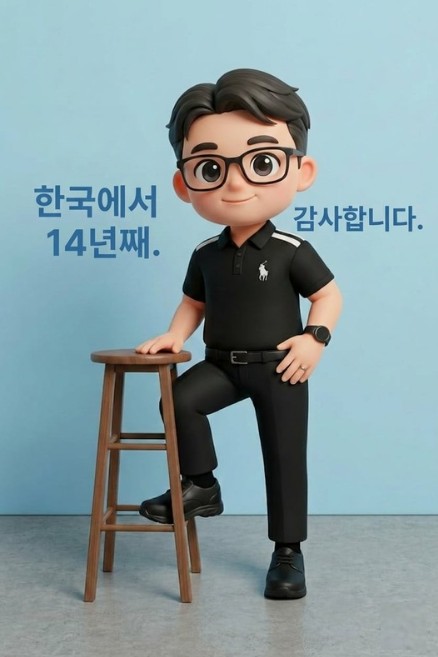
Today, I begin my 14th year here in South Korea.
Fourteen years ago, I boarded a plane carrying more than luggage. I carried questions. I carried fear. I carried unfinished conversations with the people I loved. And yet, above all, I carried conviction — the kind that whispers, Go. There is more waiting for you.
Time has a way of softening distances and turning foreign places into familiar ground. What was once unknown has become part of my story. What once felt like exile became expansion. And in all these years, I have come to understand that certain decisions do not merely change your address — they change your direction.
South Korea did not simply become my workplace; it became a refining ground. Here, I grew not only as an educator but as a thinker, a writer, and a man of faith. The classrooms sharpened my discipline. The solitude deepened my introspection. The unfamiliar culture stretched my perspective. This land became the platform on which I learned to rebuild, rediscover my purpose, and pursue excellence beyond the limits of my former comfort zone.
I thank the Lord for sustaining me through every season — through doubt, through growth, through silent battles no one else saw. And I thank this country for serving as the backdrop to one of the most defining chapters of my life.
But every long journey has a beginning. Every transformation has a first trembling step.
And mine began with a single day — a day marked by cold air, empty rooms, unanswered calls, unexpected kindness, and a faith that refused to collapse.
That first day in South Korea is something I will never forget.
It was in the early dawn of March 2, 2013 when I left the Philippines aboard Asiana Airlines. Around eight in the morning, the plane landed at Busan International Airport. At that time, Mr. Kenn Lachenal was with me. We were both headed to South Korea to teach English at Gyeongju University.
I admit that during that time, I was overwhelmed — not because of drugs, but because of the many thoughts about my loved ones and the anxiety over the new challenge I had chosen to face.
It was against my will to leave my loved ones behind, but it was necessary. I also did not want to step away from the school I had served as Principal for almost a year. Yet I have always refused to be ruled by my emotions. I did not want to avoid a decision simply because I surrendered to feelings. I carefully thought through my decision to go to South Korea to teach. It was not impulsive. It was part of my plans — a long-considered intention whose time had finally come. I would not allow my emotions to stop me.
It was not the desire for a higher salary that drove me abroad. I was already earning well as a principal. On top of that, I was working as an academic consultant at a technical school and as a part-time college instructor. Financially, I was stable. I had even built a house. The problem was this — I was no longer comfortable in my comfort zone.
I had grown weary of supervising teachers and employees. It felt stagnant — no longer challenging. Something was missing — something I longed to find. Personal issues that needed resolution did not help either. It became clear to me that I needed a radical change in my life if I wanted to preserve my sanity. I had to go somewhere new for a fresh beginning.
I felt as though I was at a dead end — yet I knew there was a world beyond dead ends. That was the world I wanted to reach… to explore.
As Jake Sully, the main character in Avatar, once said, “Sometimes your whole life boils down to one insane move.” Like Jake, though I felt fear, I was certain of my decision before I jumped to wrestle and tame my own “Toruk.”
I brought only two things with me to South Korea — self-confidence and faith in God. That combination has always been my shield against trials and my hook for reaching whatever I aspire to achieve.
I was not seeking luck in this country; I do not believe in luck. I believe that “God gives mercy, but man must act.” My purpose was to write a new chapter of my life here — a new phase in the destiny I believe I must draw for myself.
It was my first time traveling abroad, and I was fortunate to be with Mr. Lachenal. Aside from being helpful, he was experienced in overseas travel. Since we were both headed to Gyeongju University, I was confident I would not get lost.
When we arrived at Busan International Airport, I was shocked by the cold. It pierced through my jacket. I had assumed that since winter had ended and spring was beginning, the weather would be like Baguio. Thankfully, the bus we took to Gyeongju-si had its heater running. Though I was sleepy, I could not fall asleep during the ride. I kept looking at every place we passed. I said to myself, “Here I am in South Korea.”
After nearly two hours, we arrived in Gyeongju-si. Mr. Mark Celis welcomed us. He brought us to the apartments where we would stay — Mr. Lachenal to the “white house,” and me to the “blue house.” Not the White House of Washington D.C., nor any political residence in Seoul — those were simply the names given to the apartments provided by Gyeongju University for foreign professors. They were named after their paint colors. There was also a “yellow house” and a “green house.”
Before leaving, Mr. Celis ensured that my unit was in order and introduced me to another Filipino professor at Gyeongju University — Dr. Randy Tolentino, who also lived in the “blue house.”
When I entered my room, I felt for the first time what it truly meant to be alone — far from loved ones, in an unfamiliar place. I simply stood there, unsure of what to do first.
After regaining composure, I opened my suitcase and slowly arranged my belongings.
The surroundings were silent. I heard nothing but my own footsteps. I could even hear my heartbeat and the sound of my swallowing. After arranging my clothes and things, I suddenly felt the intense cold again — and hunger. The refrigerator was empty. There was a gas stove, but nothing to cook. I made do with the biscuits I had brought from the Philippines.
Then I remembered I needed to call my loved ones to inform them I had arrived safely. When I reached for my cellphone, I realized I had not activated roaming on my SIM card. I felt foolish. I cursed under my breath. I could not call anyone; my phone was nothing more than a music player.
I admit that at that moment, deep sadness overwhelmed me. I was still hungry despite finishing almost all my biscuits. I was shivering from the cold. The silence felt deafening. I was alone, with no one to talk to. I also worried that my loved ones were already anxious, waiting for news from me.
In that moment, I understood the true meaning of HOMESICKNESS — just hours after landing in South Korea.
But amid that sadness, I looked up to heaven and remembered that I had prayed many times for the chance to come to this country. I do not know why, but as far as I know, He has never ignored my prayers. I even wrote a poem about it in English — seven syllables only:
He answers.
Just wait.
Have faith!
I was about to lie down to drown my hunger and sadness in sleep when I heard knocks at my door. It was Randy.
He came in and talked with me. He was from Iloilo. At least I had someone to speak with now. While we talked, he looked at my stove and showed me how to operate it. He must have noticed I was cold, because he also taught me how to use the floor heater. I felt somewhat relieved by his help. He opened the kitchen drawers and found a few cans of food left behind by the previous tenant. He left briefly and returned with packs of noodles and some 3-in-1 coffee.
I was surprised by the generosity Randy showed, whom I would later call Sir Randy. It was as though he had known me for years. He stepped out again and returned, saying, “Come on, bro, my girlfriend has cooked. Let’s eat.”
I followed him to his unit. I was surprised, but I did not hesitate — not because I was desperately hungry, but because I felt the sincerity of his invitation. It would have been embarrassing to refuse.
The food was warm, but warmer still was the care shown to me by Sir Randy and his girlfriend, Nikki, who was from China. I was about to take my first bite when Sir Randy offered a prayer of thanksgiving. My respect for him deepened at that moment. At my first bite, tears welled up in my eyes — moved by their kindness and by how God answers prayers. When the couple looked at me, I casually said I must be catching a cold — that was why my eyes were watery. I do not know if they believed me.
After dinner, Sir Randy walked me back to my unit, carrying some cooked food. I said, “This is more than enough, bro!” He smiled and explained they were leaving for Daejeon and just wanted to make sure I had food until the next day. He then returned to his unit and brought me a pot, a pan, a kettle, and some coffee sticks. I did not know what to say. I wanted to hug him for all the help he was giving.
His kindness did not end there. When he learned I could not use my SIM card, he lent me one of his smartphones and his iPod before they left, and he kept his Wi-Fi open so I could use the internet. Our units were only meters apart, so I could access his connection from my room.
I had no words left. “Thank you” felt worn out from repetition. I wanted to hug him, but he was in a hurry to leave. After he stepped out of my unit, I simply closed my eyes and silently thanked Him. I am not a good person. I am weak and sinful. It is simply that the Lord is gracious and loving to those who call on Him.
I am truly fortunate that on my very first day in South Korea, I met friends like Randy and Nikki. They are more than friends — they are siblings from different wombs. They are the reason my first day in South Korea is so special.
Randy and Nikki are living testimonies of God’s goodness.
 M.A.D. LIGAYA



 M.A.D. L I G A Y A