To better appreciate who and what the Filipino is, one has to decipher the Filipino psyche and identify the factors that contributed to its formation. An in-depth analysis of the character of these people would require a thorough examination of their history and racial origins. The Filipinos cannot be figured out by establishing assumptions based on stereotyping and magnifying them using a supremacist lens.
Those who claim they know the Filipinos simply by stitching together information culled from the Internet are gravely mistaken. Those who formed assumptions about them after reading a news item or two without even checking the credibility of the ones who made the reports should hold their horses.
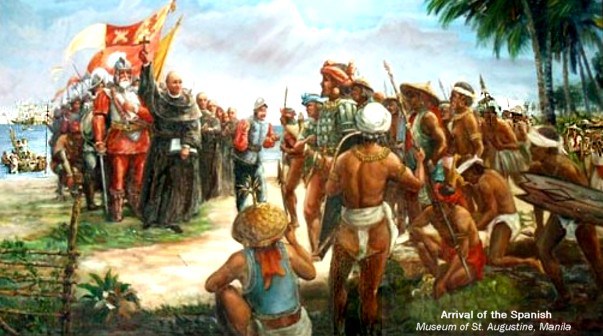
The pre-colonial Filipino was a race whose culture and genetic pool was a mix of Negrito, Indones, Malay, Arab, Hindu, and Chinese and whose spirit was either strengthened or weakened by the geographics of the island nation and its corresponding climate. There was a genetic and cultural identity flourishing in this part of Southeast Asia before the Portuguese explorer Magellan and his Spanish expedition landed in Mactan in 1521. There was a national identity evolving when the Spaniards, led by Miguel Lopez De Legazpi, came back in 1565 to establish a stronghold in what the Europeans would later call “Las Islas Filipinas.”
What the discovery of the Laguna copperplate in 1989 accomplished was to prove (or affirm previous findings of historians) that “a well-organized form of government based on customary law” [1] existed in the Philippines long before the Spaniards came. The pre-colonial Filipino was not a lost soul rescued by the Europeans from the Dark Ages. It could be the other way around. The coming of the Europeans could have disrupted the original trajectory of the development of that culture and only God knows if they made it better or worse. There was an emerging racial entity when they came and it veered away from its natural course of becoming when the colonizers from the West succeeded in subduing the natives.
For 333 years the Filipinos were under the mercy of the Spanish conquistadors. There were pocket revolts the Filipinos staged in different parts of the country to overthrow the invaders from the Iberian Peninsula, but they were quelled. The most significant of those uprisings was the one led by Francisco Dagohoy in Bohol that lasted for more than 80 years (1744-1829). Those attempts to vanquish the conquerors from Spain did not succeed because of the following: they lacked national character, they were based on limited geographical scales, and they were caused by non-encompassing issues[2]. It was only the 1896 revolution that succeeded which eventually led to the declaration of Philippine independence in 1898.
But it was short-lived.
The Americans, who the Filipinos thought came to help them establish a republic, had other agendas. They duped Emilio Aguinaldo, the leader of the revolt against Spain, into believing that they didn’t need any colony and that they came to free the natives from the yoke of Spain. Then, the Filipinos watched helplessly as the Spaniards, too proud to accept defeat in the hands of the Indios they enslaved for centuries, surrendered to the Americans instead and were paid $20,000,000 for all the improvements they made in the Philippine islands during their colonial rule. That’s one of the conditions set in the Treaty of Paris in 1898 which the two countries concluded without concurring with the Filipino people.
Would the Americans pay the Spaniards that huge amount (which is worth more than half a billion dollars today) and get nothing in return? Hell no! That’s what geopolitical experts would say. America, then an emerging world power, needed to flex its muscles in the Pacific. The Philippines was the ideal place for that. So, the Americans, contrary to their promise, which Aguinaldo admitted later that he naively believed, declared the Philippines a territory ceded to them by Spain.
The United States, initially perceived by Filipinos as allies in their quest for independence, had other motives. Emilio Aguinaldo, leader of the revolution, was deceived into believing that the Americans sought to liberate the Philippines from Spanish rule without ulterior motives. In reality, the Treaty of Paris in 1898 saw Spain cede the Philippines to the United States for $20 million, equivalent to over half a billion dollars today. The treaty, negotiated without Filipino input, transferred control of the islands from one colonial power to another.
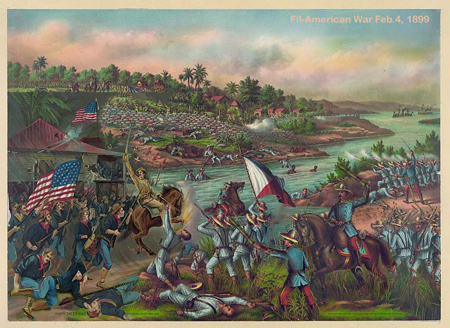
This betrayal was a bitter blow to the Filipinos. After centuries of resisting Spanish domination, they had hoped to chart their own future. Instead, they faced a new colonial master. Filipinos resisted, but despite their bravery, the Philippine-American War (1899–1902) ended in defeat after three years of intense fighting. The struggle for independence continued, but the dream of genuine self-determination was postponed again.
When the Spaniards left, the natives fought the more superior American forces. It was a case of a “David” having to contend with a “Goliath.” But in this version, Goliath subdued David. It wasn’t that way that it ended for the Filipinos. They gallantly stood their ground and fought as fiercely as they could but eventually lost the Fil-American war after three long years of struggle.
So, the Philippines changed hands – from one colonial master to another, from the Spanish yoke to that of the American.
As the Philippines transitioned from Spanish to American rule, elements of both cultures became integrated into Filipino society. The Spanish and American periods deeply imprinted Filipino values, traditions, and gene pool. The policies and practices implemented during these colonial periods undoubtedly influenced the evolution of the Filipino character.
The 20th century witnessed the rise of a distinct post-colonial Filipino identity—a fusion of Asian and European influences shaped by a history of colonization and resilience in the face of frequent natural disasters. This unique character continues to evolve, blending the past with contemporary influences.
How did these centuries of colonization influence the formation of the Filipino character? How did the cruelty of the Spanish and the betrayal of the Americans shape the values and traits of the Filipino people? These questions remain central to understanding what it means to be Filipino today.
 M.A.D. LIGAYA



 M.A.D. L I G A Y A