THE NATION WE CREATED (Part 3)
WHERE ARE WE? PARADISE, PURGATORY, OR HELL?
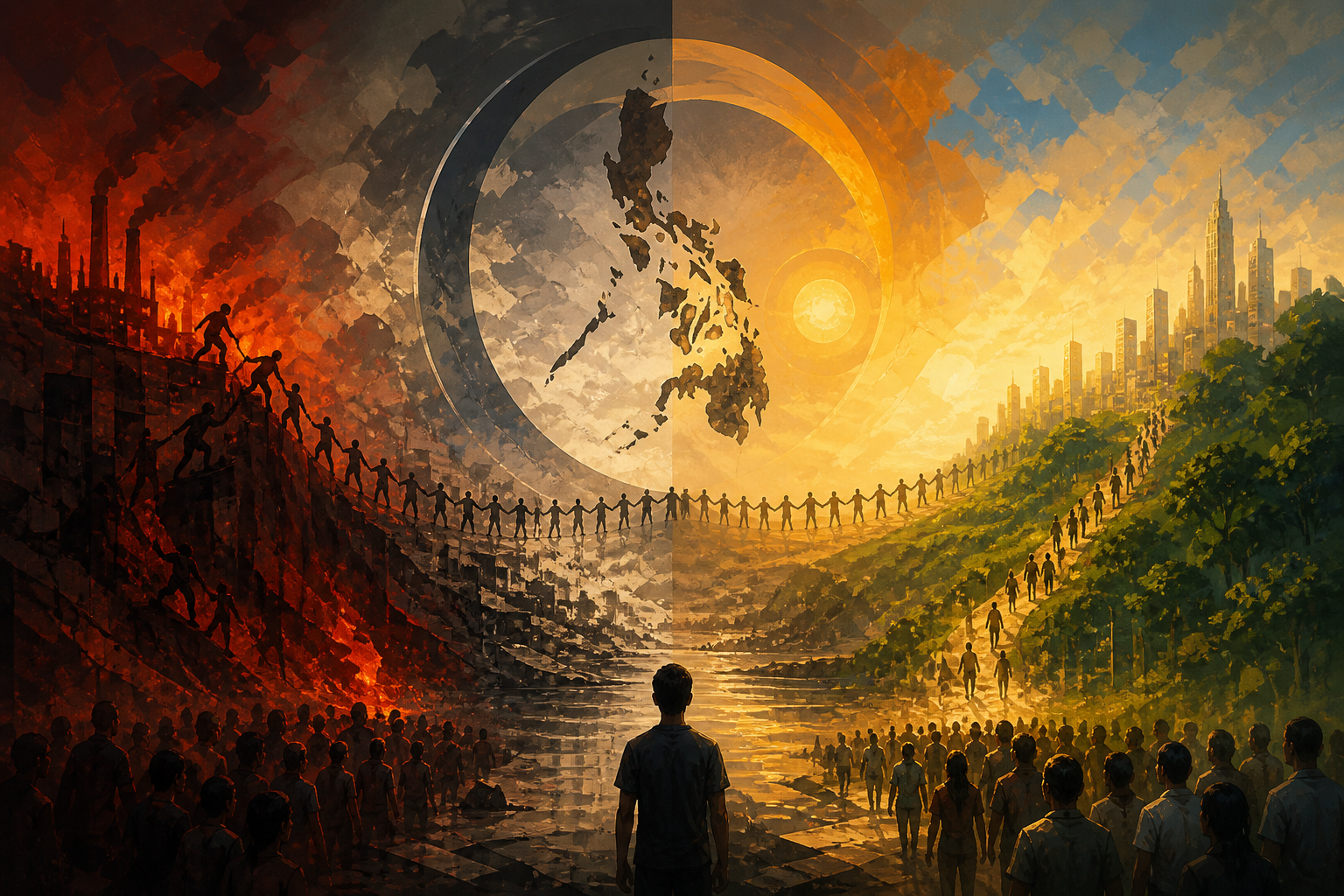
This brings me to the third question:
Where do we stand as a nation—paradise, purgatory, or hell?
Just as Dante was guided through the abyss by Virgil, I believe that if we are to find our way out of the “dark woods” of our national dysfunction, our Virgil must be a vigorous Faith in God. For me, this is not a passive faith that watches from the sidelines, but a demanding moral compass. It is the light that reveals the “ordered circles” of our descent and gives me the strength to finally begin the ascent.
I have long believed that a nation’s health is a simple equation: when both the government and the citizenry are strong, we find ourselves in a paradise; when one falters, we drift into purgatory; and when both fail, we descend into hell. As I look at the current state of our institutions and reflect on the character of our collective civic behavior, the conclusion is one I can no longer avoid.
We are not in paradise, and I fear we are not even in purgatory. We are in hell.
Yet, my studies of the Divine Comedy have taught me that purgatory represents something fundamentally different from either extreme—it is not a place of final condemnation, but a state of transition. In Dante’s vision, purgatory is where the work of purification begins, and for me, that starts with the difficult step of recognizing our own faults. It is a place where vices aren’t just punished; they are purified as every spirit confronts the very weakness that led it astray. I’ve realized that any path toward our national renewal demands that we not only recognize our failures but also deliberately set out to correct them.
If hell is the result of both a failing government and an irresponsible citizenry, then I see purgatory as the pivotal moment when one side begins to change even as the other lags behind. To me, a nation in purgatory is not yet healed, but it has finally moved past denial; it is a society that has begun to acknowledge its shortcomings and is actively striving for something better.
In our own context, I believe purgatory would require a profound shift in our consciousness—a personal willingness to move beyond the easy comfort of blame and toward the harder path of accountability. It would mean a readiness within our institutions to rebuild trust through genuine reform. For me, this is the stage where we stop avoiding difficult truths and start confronting them; it is where our excuses finally give way to effort, and our passive observation transforms into active participation.
Though we have concluded that we are not yet in this state, the concept of purgatory is fundamental—not as a description of where we are, but as a vision of what lies between our current condition and the possibility of renewal. It reminds us that transformation is neither immediate nor effortless, but attainable through deliberate, sustained change.
To understand how we arrived here, we must recognize that this condition is not merely the result of present failures—it is also rooted in a past that still shapes our present. As a nation, we have long been fragmented—geographically, culturally, and politically—an archipelago not only in land, but in identity. Our colonial history reinforced this fragmentation. Through the divide-and-rule strategy, our colonizers kept us subdued, preventing unity and making sure that resistance remained scattered and ineffective.
Though political independence has long been achieved, the imprint of this division remains. We continue to see ourselves not as a united whole, but as competing factions. This fragmentation deepens further when political actors exploit these divisions, prompting citizens to defend them against one another rather than hold them accountable. In doing so, we become participants in our own disunity.
Over time, our prolonged inability to free ourselves swiftly from colonial rule cultivated a quiet resignation. A decisive moment came when the struggle against our conquistadores from the Iberian Peninsula was nearing victory, and a sense of national identity was beginning to take shape. Yet at that critical juncture, the Filipino people were denied the opportunity to complete their own struggle for liberation, as another power, emerging at the close of Spanish rule, intervened—marking a transition from one colonial master to the next.
What followed was not merely a political transition, but a period in which the natural development of nationalism was constrained, delaying the full emergence of a unified national consciousness and leaving a lasting imprint on how we perceive our collective identity and capacity for self-determination.
I often reflect on how a defining victory for our people—one that might have truly forged a sense of national pride and unity—was interrupted by forces beyond our control. To me, this left behind more than just a political scar; it created a psychological one. In place of a fully realized sense of self-determination, I feel a lingering uncertainty about our capacity to shape our own destiny.
I’ve come to think of this uncertainty as our national Limbo. Much like those in Dante’s First Circle who lived without the “baptism” of a completed purpose, I feel the Filipino spirit remains suspended in a state of “what could have been”. Because our revolution was interrupted and our liberation was eventually granted rather than fully seized, I believe we have inhabited a political twilight for over a century—not fully damned, but not yet free. We are haunted by the sighing of those who are hopeless in desire, longing for a national identity that we were never permitted to finish building for ourselves.
I’ve seen how people subjected to long periods of domination can begin to internalize limitation—a quiet belief that significant change is simply unattainable. This inherited mindset, which I find so damaging, weakens our collective will to act. Yet, I’ve realized this condition isn’t a chaotic fall; it is a structured descent, much like the ordered circles of Hell I read about in the Divine Comedy. Each layer reveals a deeper moral failure: from our negligence and apathy to corruption, and ultimately to the betrayal of public trust. What we experience today is not random misfortune, but the cumulative result of choices I see being made—and responsibilities I see being ignored—time and time again.
Even our natural environment has played a role in shaping our collective mindset. Living in a country frequently visited by destructive typhoons, I believe our repeated exposure to disruption has fostered both a beautiful resilience and a tragic resignation. While these conditions have certainly strengthened our capacity to endure, I worry they have also normalized crisis, reinforcing a tendency in us to merely respond rather than anticipate, and to recover rather than prevent.
I have come to realize that whatever factors or historical circumstances may have shaped our current condition, they do not absolve us of our personal responsibility for it. In my own reflections on self-improvement, I see that our national state is not a sudden collapse, but rather the cumulative result of choices we have made over time—each one contributing to a gradual descent.
**********
WHAT SHALL WE DO THEN?
As I’ve learned from my studies of Dante, recognition of the journey through Hell is only the beginning. What, then, should we do? In the Divine Comedy, the journey does not end in the abyss; there is a path upward to paradise, though I know it is a difficult one to walk.
In Dante’s journey, Hell is governed by a moral logic where every consequence reflects a prior choice. Similarly, I believe the dysfunction we endure as a nation is not without cause; it mirrors the decisions we make, the leaders we choose, and the responsibilities we so often neglect.
Although I do not believe we are yet in Purgatory, I believe we must understand its profound significance.
For me, Purgatory is not a place of perfection, but of transformation—it is the space where acknowledgment finally leads to change and responsibility replaces denial. It is the necessary passage between failure and renewal. I’ve realized this slow ascent requires the effort, discipline, and readiness to confront my own shortcomings that I strive to bring to my writing and my life.
Reaching such a state requires a profound shift in my own consciousness—a willingness to move beyond the habit of blame and toward true accountability. It is the point where effort begins, discipline is cultivated, and active participation finally replaces passivity. However, I’ve come to understand that this path requires a fundamental change in how I think about our development as a nation.
For too long, we have relied on a flawed model that assumes progress begins externally. It is time, therefore, to look inward. Just as Virgil guided Dante through darkness—not by force, but through the light of Reason and the mandates of the Divine—we too must rely on a Faith sharpened by clarity of thought and self-awareness to navigate our way out of this abyss.
The alternative path begins with the individual and extends outward—to the family, the community, and the nation.
If paradise is to be realized, it must be understood not merely as prosperity, but as the restoration of unity and the overcoming of fragmentation that has long defined us. A nation cannot reach its highest potential while divided. True progress demands cohesion and a shared sense of purpose that transcends regional, political, and ideological boundaries.
To arrive at such a state, we must consciously unlearn the divisions that history has imposed upon us. The legacy of divide et impera must no longer define how we relate to one another. Instead of allowing ourselves to be separated by difference, we must recognize that our strength as a nation lies precisely in our diversity—when it is bound together by a common commitment to the greater good.
A nation in paradise is not free from disagreement, but disagreement does not lead to division. It is a nation where citizens hold leaders accountable without becoming instruments of partisan conflict, and where public discourse is guided by a shared desire for national progress rather than hostility.
Ultimately, paradise is not granted; it is built. It emerges when individuals rise above narrow loyalties, families instill values of discipline and responsibility, and citizens view themselves as integral parts of a greater whole. Only through unity, grounded in shared values and mutual accountability, can a nation truly ascend to its highest form.
I have realized that the ascent from Hell in Dante’s journey is neither sudden nor effortless; it demands a kind of movement, struggle, and persistence that I try to channel into my own creative projects. One does not simply wake up outside of the darkness; you must climb out of it. At the end of that grueling climb, Dante shares a powerful image that stays with me: the moment he emerges “to see the stars again”. It serves as a personal reminder that no descent is final, and even from the deepest darkness I may feel, a path toward renewal remains.
Only then can we truly begin our ascent: from hell, through purgatory, and ultimately toward paradise. I’ve come to understand that the path to national transformation doesn’t begin in the halls of power, but in the quiet, daily decisions of individuals like me who choose to change.
In the end, I see that a nation is nothing more and nothing less than a reflection of its people. If I desire a better nation, I must first strive to become a better individual.
The journey out of the abyss is long, but I find comfort in the fact that Dante’s final word in every canticle remained the same: stelle, the stars. For me, those stars are not just distant celestial bodies; they are the three stars of our national emblem, which have felt obscured for so long by the smoke of partisan conflict. Like Dante emerging from the dark to behold them once more, I believe we, too, may rise if we choose not merely to hope for change, but to become its source. Only when we fix our gaze upward, guided by our Faith and our shared history, do we leave the darkness behind. In that rising, we do not merely find paradise; we build it.

Posted on May 5, 2026, in Accountability, Expat Teachers in South Korea, Good Governance, My Personal Experiences, National Character, National Development, Nationalism, Personal Accountability, Responsible Citizenship and tagged Civic Responsibilities, Expat Teacher in South Korea, Good Governance, National Character, National Development, Responsible Citizenship. Bookmark the permalink. Leave a comment.
 M.A.D. LIGAYA



 M.A.D. L I G A Y A
Leave a comment
Comments 0