The Color Game
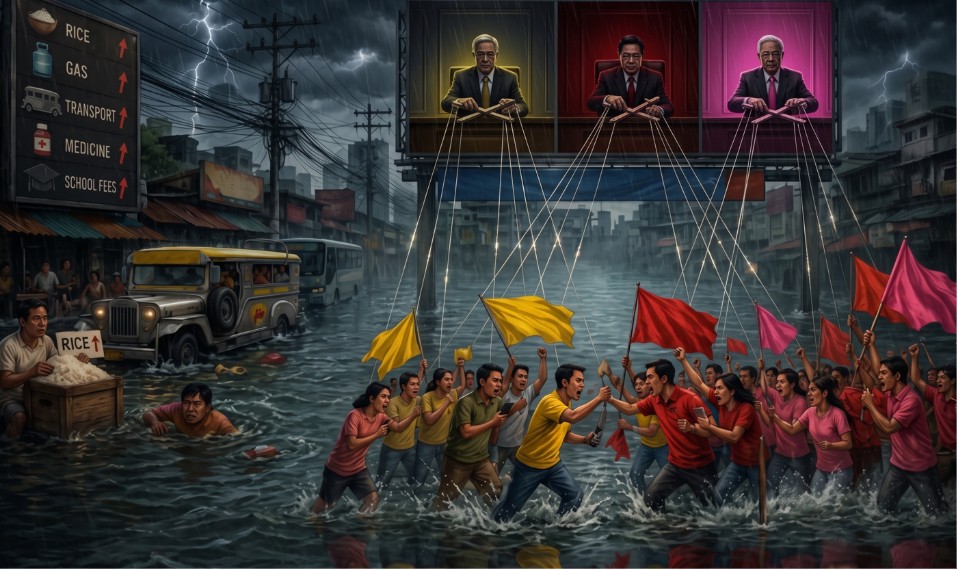
There is a game the Filipino people have been playing – and they are both the player and the prize.
It’s a color game, but not the kind played in peryahan.
It’s the dangerous variety of color game where they bet not a barya or buong isang daan or isang libo.
What they bet is their future and that of their children.
What they bet is the destiny of their nation.
They have chosen their color…
Red.
Orange.
Pink.
Yellow.
Are there other colors?
Which color is winning?
The color game they have been playing has continued for years. Like in peryahan, it’s loud, theatrical, and utterly consuming. The rules are simple: pick a color, wear it like a religion, and defend it with the ferocity you should have reserved for your children’s future. And just like in peryahan, there is always a crowd — excitable, passionate, absolutely certain that this time their color will land. There is always a string being pulled. And there is always an operator — calm, invisible, and smiling — who designed the game, controls the string, and goes home with the money regardless of which color it lands on.
The players change. The colors shift. But the game never ends. And while it rages — while you rage for it — the rice gets more expensive, the streets stay flooded, the hospitals stay broken, and the men and women you are fighting for, the ones called “honorable,” are already thinking about 2028.
They are always thinking about 2028.
You are thinking about winning an argument on social media.
Against those who denigrate the color you chose.
This is the color game. And it is eating the country alive — not from the top, where the operators sit in their comfortable certainty — but from the bottom, where you are. Where we are.
You know the colors by heart.
Yellow — the color of a promise, worn by those who believed that restoring democracy was the same as perfecting it, and discovered too late that it was not.
Red — the color of a fist, embraced by those who mistook loudness for leadership and force for order.
Orange — the color of a strongman’s campaign sunrise, bright and defiant, darkening as the years passed.
Pink — the color of a brief, beautiful hope, lit by millions of ordinary hands in 2022, then methodically extinguished by a machinery that had been perfecting itself for decades. And now the colors multiply, fragment, recombine — new shades for new seasons, new banners for old ambitions.
In a painter’s world, colors mixed together produce something new — something richer, something worth beholding. Yellow and red make orange, warm and alive. Red and pink deepen into something passionate and bold.
But in Philippine politics, when these colors bleed into each other, they do not produce beauty. They produce noise. They produce confusion. They produce a muddy, indistinguishable darkness that serves no one — except the ones holding the brush and palette.
The operators.
So tell me. What color have you painted your face with — Yellow, Orange, Red, or Pink?
The shade changes with every election cycle.
Poverty does not.
But perhaps the color game has endured this long because it taps into something deeper in the Filipino spirit — a tendency, born of centuries of uncertainty, to treat life itself like a peryahan. To believe that fate, not effort, determines outcomes. To bet rather than build. To cheer rather than question. The peryahan is loud and alive and for one electric moment, it makes you feel like you matter — like your barya could change everything.
It never does.
Because the color game in the peryahan was never designed for you to win. It was designed to keep you coming back. Hopeful. Distracted. Spending. Round after round, election after election, color after color — the string is pulled, the crowd roars, and the operator quietly counts his earnings. He does not care which color you choose. He owns all the colors. And win or lose, at the end of the night, he goes home with everything.
You go home with a color.
And an empty pocket.
And somehow, inexplicably, the hope that next time will be different.
In a spinning wheel, you can at least pretend the outcome is random. But in this color game, the operator’s hand is right there — pulling the string, controlling where it lands, deciding your fate — and you are watching him do it and calling it democracy.
Let us be honest about what this game costs.
It costs friendships.
It costs family dinners that turn into battlegrounds over people who will never sit at your table or attend your funeral if the color game you are playing suddenly turned fatal.
It costs the working hours of millions — hours spent sharing posts, crafting insults, fact-checking the other side while ignoring the failures of your own.
It costs the nation’s attention — that finite, precious resource — which should be trained on inflation, unemployment, crumbling infrastructure, and a generation of children being educated into irrelevance.
Instead, it is trained on who said what in a Senate hearing.
On who wore which color to which rally.
On who clapped, who sneered, and who walked out for the cameras.
The Senate — once the nation’s highest chamber of deliberation, where the most consequential questions of national life were supposed to be wrestled with — has become a peryahan of its own. The barkers are louder and better dressed, but they are barkers nonetheless — performing for the crowd, stirring the noise, keeping your eyes on the spectacle and away from your emptying pockets. The scripts are obvious. The performances are calculated. The actors know their audience and play to them perfectly — because their audience has been perfectly trained to applaud on cue, to hiss on cue, and to ask nothing in return.
Nothing. In. Return.
That is the arrangement. And you agreed to it.
And then there is the other half of Congress — the House of Representatives — quieter than the Senate, less theatrical, but no less complicit. If the Senate is the peryahan’s barker, loud and visible and working the crowd, then the House is its backroom — the place where the real transactions happen, away from the lights, away from the cameras, away from you. While senators perform for your attention, congressmen perform for each other — carving up budgets, protecting turfs, delivering pork to districts that will deliver votes in return. They are the ticket sellers of this peryahan: unremarkable, efficient, and absolutely essential to keeping the game running. They rarely trend. They rarely go viral. They do not need to. They have already been paid.
Ask yourself: when did your congressman last fight for something that mattered to your life? When did he author a law that changed your child’s classroom, your family’s hospital, your neighbor’s livelihood? Or has he been too busy — too busy attending the right political gatherings, wearing the right color, aligning himself with the powerful, and eliminating those who might stand in the way of their allies come 2028?
And above them all — setting the tone, managing the machinery, directing the entire peryahan from the main tent — sits the Executive. The President and his cabinet: the operators in chief. In a functioning democracy, the cabinet secretaries are the nation’s problem-solvers — the ones tasked with the grinding, unglamorous, essential work of making government actually work. Healthcare. Agriculture. Education. Infrastructure. Trade. These are not political abstractions. These are the departments whose decisions determine whether you eat well or poorly, whether your children learn or fall behind, and whether your country grows or stagnates.
But look at them now. Cabinet secretaries torn between serving the people and singing the political tune their appointer wants them to sing. Most of them are presidential allies — appointed not because they are believed to be capable of doing the job, but as payment for political favors — positioning themselves for the next election while the departments entrusted to them drift on autopilot.
The Executive branch — the most powerful instrument of governance in the land — being used not to solve the nation’s problems but to secure the political survival of those who sit atop it. The operators are not running the peryahan for your benefit. They are running it for their own. And the cabinet? They are the kargadors — setting up the stalls, rigging the lights, making sure the string is properly weighted — while the real work of the nation waits.
Then there is the Judiciary — the branch that was supposed to stand apart from the noise. The referee. The one institution whose entire legitimacy rests on its independence from the color game. And yet. When the flood control funds disappeared — when the corruption was not a rumor but a documented, reported, undeniable reality — where were the courts? Where were the swift, decisive interventions that could have stopped the bleeding before it became a hemorrhage? The wheels of justice turned — slowly, carefully, with great deliberation — while the evidence aged, the witnesses scattered, and the money finished finding its way into the pockets where it was always headed.
Justice delayed is justice denied. But in the Philippine peryahan, delayed justice is also convenient justice — convenient for the operators, who need only enough time for the crowd’s attention to move to the next spectacle. The Judiciary did not need to be corrupt to be complicit. It needed only to be slow. And slow it was, and still is.
And finally — standing at the edge of the peryahan, armed and watching — is the military. Trained. Disciplined. Bound by the Constitution to remain neutral in political affairs, to serve the state and not the politician, to protect the people and not the power. We respect that tradition. We understand its necessity. In a democracy, a military that takes political sides has chosen to become a weapon rather than a shield.
But neutrality, too, has its limits.
When the house is not merely in political dispute but structurally on fire — when the institutions meant to check power have been captured, when the people’s resources are being systematically plundered, when the color game has so thoroughly consumed the machinery of governance that the nation itself is being dismantled in plain sight — at what point does silence become complicity? At what point does standing down become standing aside while the people you swore to protect are robbed of their future? These are not questions with easy answers. But they are questions the military — and more importantly, the Filipino people — must eventually be willing to ask. A sword in its scabbard still has an obligation to the hand that forged it.
And then there is the clown. Every peryahan has one — not a fool, but a professional. His job is not to govern but to entertain. Not to solve but to distract. Not to lead but to make you laugh, make you gasp, make you watch — long enough that you forget to ask where the money went. In Philippine politics, the clown wears many faces. Sometimes he is bombastic. Sometimes he is outrageous. Sometimes he says the things that make you feel like finally, finally, someone is speaking your language. But while you are laughing, while you are cheering, while you are sharing his latest performance on your timeline — the operator is counting the night’s earnings. The clown does not get a cut. He gets your attention. And your attention is all the operator needs.
So here is the peryahan in its full form.
The Senate — its barkers.
The House — its ticket sellers.
The Executive — its operators.
The Judiciary — its security guard, looking away at precisely the wrong moment.
The Military — its silent giant at the gate, watching the crowd thin out, doing nothing.
Every booth is staffed. Every role filled. Every position occupied by someone who has, in some way, chosen a color — and the game that comes with it — over the country. And in the center of it all — the string, pulled endlessly, landing nowhere new — are you.
And who keeps the crowd gathered around the peryahan? The media — much of it owned by the very people who painted the colors, or by those who have chosen theirs. They broadcast the color game as though it were news. They amplify the noise and call it public discourse. They give the barkers a microphone, the ticket sellers a platform, and the operators a megaphone — and then wonder why the crowd never goes home. A free and fearless press could have been the peryahan’s greatest threat. Instead, for too many outlets, it became its most effective promoter.
There is a particular kind of pain in watching a Filipino fight for a politician.
Not the polite disagreement of people who see things differently. The savage, unrelenting, identity-staked warfare of someone who has confused a political patron with a personal savior. The kind of fighting where the goal is no longer truth — it is victory. Where the opponent is no longer a fellow Filipino with a different view — they are an enemy to be destroyed.
You have seen it. You may have done it.
And while you were doing it — while you were serving as the unpaid, unthanked attack dog of someone whose driver earns more than you — what was happening? You were playing the color game in the peryahan on their behalf, spending your energy, your time, your relationships — betting everything on their color — while they watched from a safe distance and calculated their odds for 2028.
The price of galunggong went up.
The peso weakened.
Your child’s classroom still had a leaking roof.
Your sick mother waited in a public hospital corridor for a bed that was not coming.
The politician you were fighting for didn’t notice any of it. Or rather, he noticed and calculated that it did not affect his numbers. He will notice everything once 2028 approaches. He will notice your barangay, your face, your vote. He will attend birthdays and wakes. Probably not the funerals — that might be too risky. He will arrive with a smile and a t-shirt in his color, reminding you of everything he stands for.
He will not mention what he failed to do.
And the cruelest part? You will probably forgive him. Because by then, those wearing different colors will have done something unforgivable — something real or manufactured, it no longer matters — and your loyalty will have been re-ignited, your attack dog instincts re-awakened, and the cycle will begin again. The string will be pulled. The crowd will roar. And the operator will smile.
This is not politics. This is a leash. And you are on it.
While the color game consumes us, the real emergencies accumulate quietly, patiently, like water rising in a room whose occupants are too busy arguing to notice the flood.
And what a flood it is. Not just the kind that swallows streets and living rooms every rainy season — the kind that has been swallowing them for decades while the flood control funds disappeared into pockets we were too distracted to check. Not just the kind that displaces families and destroys livelihoods — but the kind made of promises, millions of them, rising and rising, waterlogging every barangay, every household, every Filipino heart that dared to believe that this time would be different. Three kinds of flood. One country drowning. And the operators — dry and comfortable inside their tents — are on television arguing about colors.
Our economy is not where it needs to be for a nation of our potential. Our young people are leaving — not as temporary workers sending remittances home, but as emigrants, cutting the cord, choosing a country that will treat their talent as an asset rather than an export. Our agricultural sector struggles. Our fishermen are being pushed out of waters that are ours by law and ours by history. Our children rank among the lowest in the world in reading comprehension — a fact so devastating in its implications that it should have ended political careers and launched national emergencies.
It did not. Because we were busy with the color game.
These are not abstract problems. These are the slow, structural dismantling of a nation’s future — happening in plain sight, reported in the papers, discussed briefly, and then drowned out by the next political spectacle, the next hearing, the next viral moment from a senator, or a congressman, or the press secretary performing for a crowd that deserves so much better than a performance. The peryahan keeps running. The operator keeps winning. And the players keep losing — in ways that don’t show up in the night’s tally, but in the quiet devastation of lives that never quite got better.
The politicians pretending to be leaders know this. And they have made a calculation: as long as you are fighting each other, you are not fighting them. As long as you are watching the string being pulled, you are not watching the ledger. As long as the color game continues, the real questions — where is the money going, why are the poor still poor, what is the plan — never have to be answered.
The color game is not a distraction from politics.
The color game is the politics.
I know you.
You wake up before the sun. You stretch your money across the week like a tightrope walker, one wrong step away from falling. You want better for your children than you had. You are not stupid. You are not weak. You are, in fact, one of the most resilient and resourceful human beings on the planet — forged by centuries of hardship into something that should, by every measure, be unstoppable.
And yet here you are. Betting your future on someone else’s color. Playing in a peryahan where the string was never yours to pull.
I am not asking you to stop caring about your country. Caring about your country is an act of love, and love is never wasted. I am asking you to redirect that love — away from the operators of the peryahan who have weaponized it, and back toward yourself, your family, your immediate community.
Stop being an attack dog. Start being a builder.
The hours you spend in political warfare online — spend them on a skill that earns. The energy you pour into defending a congressman, a senator, a vice-president, a president who will never defend you back — pour it into your child’s homework, your small business, your neighbor who needs help. The loyalty you give so freely to people in air-conditioned offices — give it to your family, who are sitting right in front of you, needing you present and whole.
This is not surrender. This is not apathy. This is the most radical act available to an ordinary Filipino right now:
Refuse to be used.
Walk away from the peryahan.
Stop playing the color game.
The color game is not sustained by politicians. They are merely its operators. It is sustained by us — by every shared post, every tribal insult, every moment we chose the theater over our own lives.
And it will end the same way it is sustained — one person at a time, one quiet refusal at a time.
Not with a revolution. Not with a hero. Not with a new color to replace the old ones.
But with a father who turns off the political noise and helps his son with his homework.
With a mother who puts her energy into her livelihood instead of her timeline.
With a citizen who looks at a politician and thinks — not “he is my champion” — but “what, exactly, have you done for me lately? And what will you do tomorrow?”
And who, if the answer is nothing, simply turns away — and gets back to work.
The Philippines will not be saved by the right color.
It will be saved, if it is saved at all, by Filipinos who finally decided that their lives were worth more than someone else’s political survival.
That their children were worth more.
That their future was worth more.
The operator only wins as long as you keep pulling his string.
So pick up your tools, kapatid.
Put down the flag.
Walk away from the peryahan.

Posted on May 28, 2026, in Accountability, Good Governance, National Character and tagged Accountability, National Character. Bookmark the permalink. 4 Comments.
 M.A.D. LIGAYA



 M.A.D. L I G A Y A
They argue about the content without fixing the structural issues….
LikeLiked by 1 person
They argue thinking that our country will be better by simply winning an argument and do nothing about what they argue about.
LikeLiked by 1 person
Again it’s arguing over the content never fixing the underlying structural problems hence walang nagbabago
LikeLiked by 1 person
Tama ka… and the saddest part of all the things happening in our country is we not realizing that we created the problems besetting us.
LikeLike