If love… then what? (2)
(A Movie Review – 2nd of 3 parts)
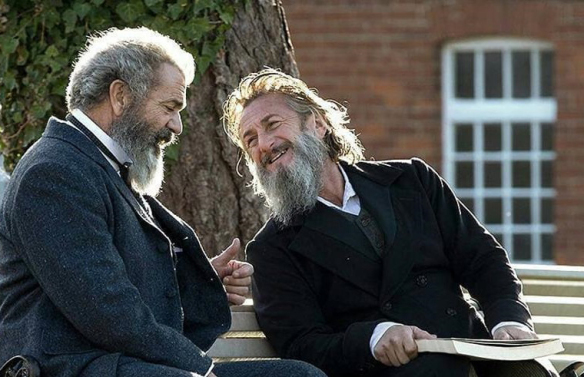
It might be surprising to some that a review of a movie about how a dictionary was created would be subtitled, “If love… then what?”
No… It’s not an attempt to romanticize the love for words of the lexicographers who dedicated their lives to creating a comprehensive compilation of all known English words. I chose that title because of the biopic’s interesting twist involving Eliza and William.
The Professor and the Madman is based on a book with the same title featuring the true story of Sir James Murray, a Scottish lexicographer and first editor of what is now known as The Oxford English Dictionary (OED), and Dr. William Chester Minor, an American surgeon and lexicographer researcher who contributed significantly to the creation of the said dictionary. The latter suffered from paranoid delusions and he killed a man (Eliza’s husband in the story) whom he accused of breaking into his room. He was committed to a psychiatric hospital, and while undergoing treatment, he (reportedly) made contributions to the OED.
Given all the aforementioned, you wouldn’t think this would be an interesting movie. How in the world would a movie about creating a dictionary generate excitement?
Well… I trust in the imagination and creativity of the scriptwriters.
While obviously, the main plot revolves around the events that led to the creation of the OED, as I expected, the creative minds behind the movie injected subplots to make the flick more literary and cinematic.
Those subplots were stitched together using the literary themes of friendship, redemption, forgiveness, and love as threads.
The main plot is centered upon diligence as the source of its theme. Ada, James’ wife, defined diligence to the members of the Oxford University Press. She said the following to the gentlemen deliberating her husband’s ouster from the OED project – “Diligence. I looked it up in your dictionary. A constant and earnest effort to accomplish what is undertaken. Persistence. Application. But also, toil… and pain.”
Those words encapsulate James and William’s efforts to create the OED. The persistence they have shown in the pursuit of such a daunting endeavor is worthy of emulation, and it is perhaps the most important value viewers could learn from the movie.
But as expected, James and Williams should meet an opposition to satisfy one very important requirement in story writing – conflict. Without it, the movie would turn into just a plain documentary. That opposition came from Ben and Phillip, the one whom Ada addressed as Mr. Gell when she gatecrashed into that meeting of the OED project’s oversight committee to speak on behalf (and in defense) of William and her husband.
Ben and Phillip, along with Dr. Richard Brayne (supervisor of the psychiatric hospital where William was undergoing treatment… or is it where he was incarcerated), are the story’s villains.
The maneuverings Ben and Phillip do to make things hard for James and William represent what I think is the story’s main conflict – Will Ben and Phillip succeed in diminishing the role of James in the creation of the OED and in striking out William as a contributor?
The main plot revolves around the aforementioned conflict. But the story has another conflict that, in my opinion, overshadows the main conflict. It is the one that involves William and Eliza.
As previously mentioned, Eliza is the wife of the man whom William killed while having a fit of delusion. This represents the other conflict in the story – Will Eliza forgive William?


Posted on July 4, 2021, in Creative Writing, Literary Criticism, Literature, Movie Review and tagged Creative writing, Literary Criticism, Literature, Movie Review, Movies. Bookmark the permalink. 2 Comments.
 M.A.D. LIGAYA



 M.A.D. L I G A Y A
Pingback: If love… then what? (1) | M. A. D. L I G A Y A
Pingback: If love… then what? (3) | M. A. D. L I G A Y A