Category Archives: Full potential
Longevity: The Race To 100
Longevity should be viewed as a product of the efforts of people to reach their full potential. To say that living as long as people can is the result of them giving their physical bodies the maximum care is tantamount to considering a person as a mere physical specimen. A person has not just a body but a mind and a spirit. In psychology, an individual is considered a physical, mental, emotional, social, and spiritual being. I believe that only when people can strike a perfect harmony among these different aspects of being can they hope to have a shot at longevity. How long do you want (or expect) to live?
What Makes You Happy?
A lot has already been written about happiness. Much has been said about how to achieve it and where to find it. It is my hope that the things I shared in this video would give you additional insights on the topic.
The Self-improvement Paradigm
According to Jim Rohn, “Success is not to be pursued, it is to be attracted by the person you become.” Imagine success as the fruit of a tree. A tree has to grow and mature. It will reach a certain stage of maturity that allows it to bear fruits. Imagine yourself as that tree. You have to grow and mature. The person you see at the end of the process of growing and maturing is what Jim Rohn refers to as the person you become. The fruits you bear or the success you achieve depends on the kind of tree you would turn into. And you have to become the best version of yourself. That’s the kind of tree you should be. You need to reach your full potential so you would bear the best fruits.
Self-improvement is the key to becoming the best version of yourself. If you succeed in getting to the end of the road to self-improvement, you reach your full potential.
But self-improvement is a complicated process. It is easier said than done. It requires the possession of certain beliefs, attitudes, and characteristics that will make up your value system. It requires also the acquisition of certain skills and abilities and the development of certain practices and habits.
The right beliefs, attitudes, characteristics, skills, abilities, practices, and habits, together, are the catalysts of self-improvement. However, having them is not enough. Something else is needed in order to make them work. Without it any attempt to reach one’s full potential is bound to fail. What is it? It’s self-discipline.
Self-improvement is not as simple as just being able to think positively. Positive thinking is but a tip of a huge iceberg called personal growth and development.
Self-improvement is a tedious process. Its ultimate goal is becoming the “best self” or achieving one’s full potential. As previously mentioned, certain beliefs, attitudes, characteristics, skills, abilities, practices, and habits are required. But possessing the said requirements is not enough. Consistency is needed in their pursuit. Thus, self-discipline is also needed.
In thes book that I am currently working on (A Paradigm for Self-Imrovement), I will encapsulate the interrelationships among these categories and self-discipline into a paradigm, illustrating how their synergy yields an effective process of self-improvement that leads to the attainment of one’s full potential.
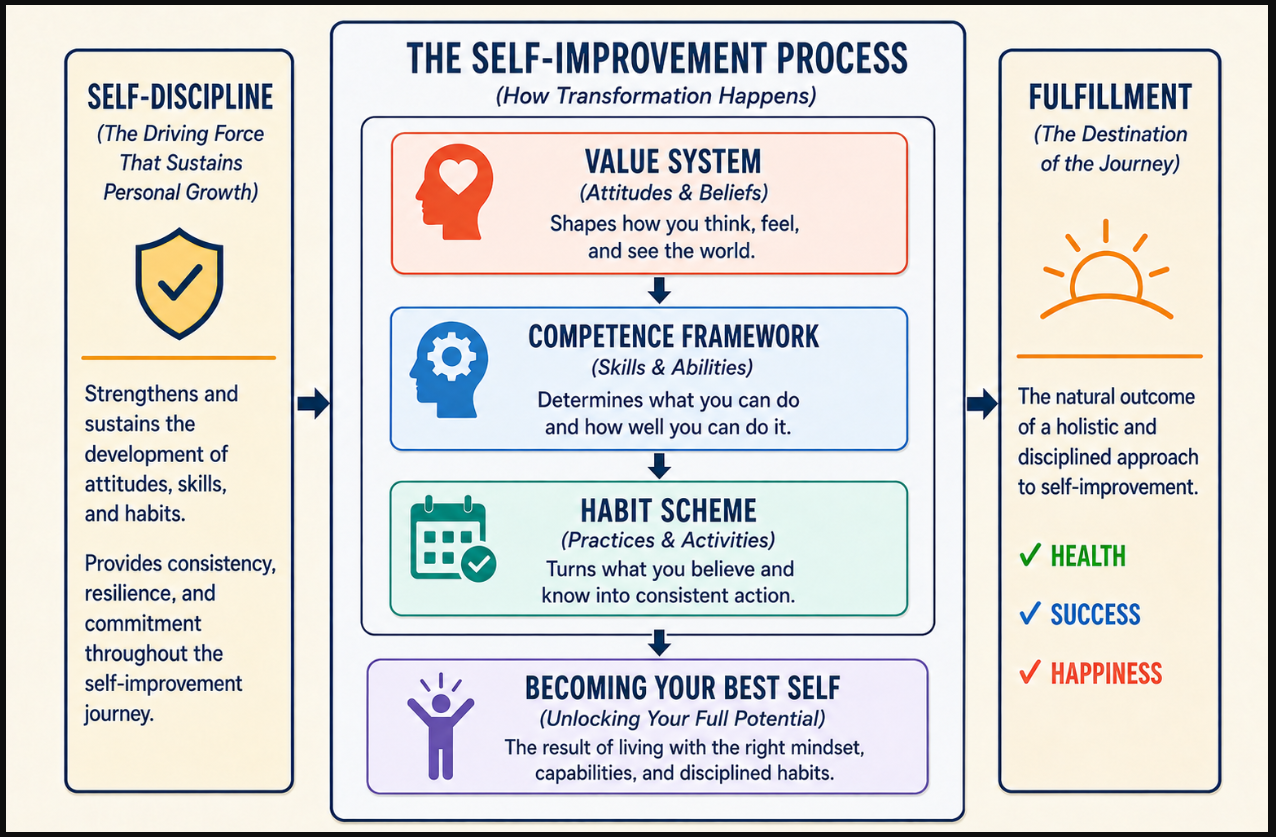
The paradigm is divided into three sections: left, middle, and right. The middle section comprises three parts: the dimensions of self-improvement, the self-improvement process, and the concept of full potential, also known as the best self. The dimensions of self-improvement in this book are generally categorized as the attitudes & beliefs (value system), skills & abilities (competence framework), and practices & activities (habit scheme) that a person pursuing personal growth and development should acquire, possess, or develop. These elements come together through the self-improvement process, forming the second part of this section. This process aims to help one become one’s best self—not as attaining perfection but as unlocking one’s full potential.
The left section of the paradigm highlights a crucial requirement for self-improvement: self-discipline. The paradigm illustrates how self-discipline continuously influences the process; even after one has achieved one’s full potential and become one’s best self, self-discipline remains essential. Self-discipline bolsters personal growth and development, forming the foundation for consistent progress and sustained fulfillment.
The right section of the paradigm illustrates the outcome of the self-improvement journey—fulfillment, marked by health, success, and happiness. This fulfillment represents not only the achievement of personal goals but also a deep sense of completeness and satisfaction that comes from living in alignment with one’s true potential. It is the reward for the dedication and discipline invested in becoming the best version of oneself.
Through self-improvement, individuals develop attitudes and beliefs, acquire skills and abilities, and engage in practices and activities to navigate life’s complexities with confidence and purpose. This transformation empowers them to achieve personal success, sustain a healthy state of being, and experience genuine happiness.
Those who achieve their full potential and become their best selves succeed in personal and professional endeavors. They become healthy, successful, and happy. Throughout this book, I refer to them interchangeably as winners, achievers, champions, high performers, and successful people.
I will divide the book into three major parts. In Part 1, I will explore the nature of dreams, ambitions, and potential; in Part 2, I will examine the foundations of holistic self-improvement; and in Part 3, I will delve into the connection between self-discipline and self-improvement and how their synergy leads to fulfillment.
Part 1 lays the groundwork by helping readers understand the importance of having dreams and ambitions, the deeper reasons that drive them, and the role of self-improvement in unlocking one’s full potential. This section encourages reflection on personal goals and provides the motivational foundation needed to begin the journey toward growth and fulfillment.
Among the three major parts of the book, Part 2 is the core of the holistic framework, presenting the key components that support lasting personal growth and development. Part 2 is subdivided into three sections—Value System, Competence Framework, and Habit Scheme.
The Value System section presents the attitudes and beliefs essential for personal growth. Topics such as the power of strong self-belief, the importance of seizing control over one’s life, and the role of personal accountability in staying grounded are discussed. You will also discover how maintaining the proper perspective, cultivating an adaptive mindset, thinking positively, and living with purpose can propel you forward.
The Competence Framework section focuses on the skills and abilities needed to succeed in one’s pursuits. From mastering time management and sharpening focus to practicing sound thinking, making purposeful decisions, and communicating effectively, this section equips readers with the tools to translate dreams into reality. It also addresses achieving work-life balance and overcoming self-doubt.
The Habit Scheme section emphasizes the practices and activities that transform self-improvement from a concept into a daily way of living. This part explores goal setting and planning, visualization, continuous learning, the pursuit of well-being and longevity, and the development of a consistent daily routine—elements that form the foundation of a fulfilling and productive life.
Part 3 brings the framework together by highlighting the vital role of self-discipline in sustaining self-improvement efforts and achieving fulfillment. It emphasizes that while knowledge and skills are essential, consistent action and commitment are what ultimately turn growth into lasting success.
For clarity, let me emphasize that being healthy, as articulated throughout this book, is a holistic state of well-being, encompassing not only physical, mental, and emotional well-being but also all dimensions of well-being.
If your current personal growth and development model is not helping you attain your desired self-improvement goals, you might need to make a paradigm shift. Try this one.
In this book, I will collectively refer to attitudes and beliefs, skills and abilities, practices and activities, and self-discipline as dimensions of self-improvement.
At the beginning of each chapter, I will include essential questions about the construct being discussed. These questions are designed to prompt reflection and prepare you for the discussion. Your answers will help you gauge your familiarity with the aspect of self-improvement being presented. May I suggest you keep a journal to record your answers and any other insights you gain from reading this book.
I will create and adopt action exercises (from related literature and studies) and put them at the end of each chapter. They are designed to encourage active participation in incorporating the discussed concepts into one’s daily routine.
The exercises are valuable for helping you turn ideas into behaviors that support your personal development. Spend time with each task, consider your answers, and incorporate the steps into your daily schedule. Remember, these activities are meant to help you feel comfortable going through them at your own speed and let them lead you on your path. There is no rush. Take as much time as you need.
There are empty areas at the end of the chapters that you can use for your notes.
I will also create and adapt questionnaires for each self-improvement construct comprising 10 items. Suppose the readers want to assess their understanding of the concepts discussed in personal growth and development. In that case, I will encourage readers to take a few moments to complete the relevant assessment before reading each chapter. It is also okay if they decide to answer them when you are finished reading the whole book. Either way works.
These questionnaires are intended as informal self-assessment tools rather than formal research instruments. Their purpose is to provide personal insight, encourage reflection, and guide you in identifying areas for improvement as you progress through the book.
This book will be more than just a guide—it is an invitation for the readers to take control of theirfuture, be their best and strongest selves by unlocking their full potential, pursue their dreams and ambitions, and live the life you they always envisioned.
This book will cover many concepts, not to mention the related essential questions, the action exercises, and the questionnaires. I hope none of these will overwhelm the readers. I needed to include all the constructs presented as the self-improvement paradigm, which I propose is inherently inclusive, seeking to provide a comprehensive framework that addresses the many dimensions of personal growth and development.
The Road To Self-improvement: The Road Not Taken
The road to self-improvement is either not taken or the one less traveled because it is easier, if not intuitive for people, to be complacent. Well, according to scientists, we should blame our brains for this. (And this is where we’re good at – putting the blame on someone or something else.) They (the scientists) say that we are naturally wired to prefer either lying on the couch or sleeping. We are naturally lazy. We hate getting out of our comfort zones. We want things to be given to us on a silver platter…
Broadening Your Perspective
My latest YouTube video…
A discussion of what perspective is and why having an enlightened perspective is important.