On Filipinos Teaching English In South Korea
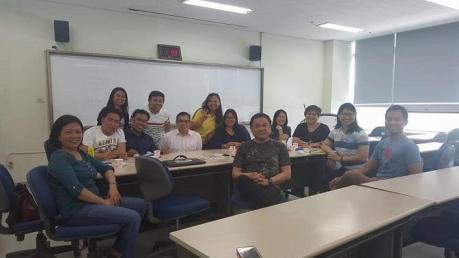
Filipino professors attending a meeting of the AFEK
Most universities here in South Korea (and other Asian countries) prefer to recruit English teachers from countries where English is the native language. That is a matter of policy but it does not follow that the best English teachers are the ones coming from those countries… they could be somewhere else, just waiting to be given an opportunity to prove their mettle in ESL teaching. Whether that policy reaped dividends and made the students in those countries better at English or ripped those countries of their precious dollars is an interesting topic for discourse.
A few tertiary institutions in this country employ teachers from the Philippines to teach English. These are the universities that believe that teaching English is not a monopoly of the teachers labeled as “native speakers” coming from the following countries: USA, UK, Canada, Australia, New Zealand, South Africa, and Ireland. I have also written an article about the Filipinos and their romance with the English language. I also discussed in the same article a little bit about the thesis that ACCENT is getting in the way of INTELLIGIBILITY and COMPREHENSIBILITY. I am planning to explore the topic further in future articles.
If the statistics gathered in 2013 by the Association of Filipino Professors in Korea (AFEK) are accurate. There are more or less 100 teachers from the Philippines in this part of the Korean peninsula. That could still be the same number as of 2023. Reportedly, there are more in elementary and secondary schools and academies (hagwon). This AFEK came to know when they launched in May 2017 the program “Skills Enhancement for Filipino Teachers Teaching English in Korea.” Several attendees were Filipino women married to South Koreans and employed as English teachers. However, the Philippine Embassy in Seoul doesn’t have any official record that could give the exact number of Filipinos teaching in the basic education schools and academies here.
Filipino professors are not limited to teaching English subjects only. They are E-1 visa holders and are allowed to teach content subjects depending on their fields of specialization.
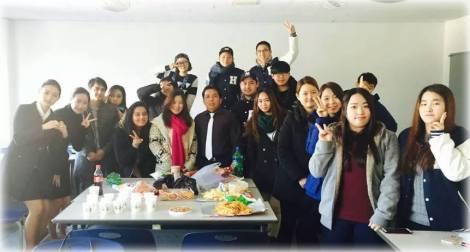
The writer and his TOEIC students
E-2 visa holders are allowed by the Ministry of Education here to teach strictly English subjects only. One advantage of hiring Filipino professors, because theirs is an E-1 visa, is that they can be asked to teach content subjects related to their fields, especially if the curriculum requires that the content subjects be taught in English. Currently, in the university where this writer is teaching, three teachers from the Philippines, aside from teaching English subjects, would once in a while be invited to teach content subjects in the university’s Graduate School or serve as advisers to foreign students writing their dissertation.
I wouldn’t say that Filipino professors in universities in South Korea are lucky to have been hired. Why? They have to go through the proverbial eye of the needle to have a chance of getting hired. They applied alongside teachers who are native speakers of English and have the upper hand, not because of their qualifications and pedagogical skills but because of their geographical roots.
Most of the Filipino professors here are PhD degree holders. The minimum requirement FOR THEM is a Master’s. Surprisingly, some native speakers of English are allowed to teach in universities here even if they don’t have a Master’s.
To the universities that opened the opportunity for Filipino professors and hired them, the applicants needed to prove they were as capable as their counterparts from the native English-speaking regions of the world. When they got hired, it was because they were qualified and had proven that they have what it takes to be English teachers. It wasn’t luck.
Filipino teachers are trained in the Philippines to know what to teach and how to teach what they know.

The writer with a fellow-Filipino professor and some students
Modesty aside, the Philippines has a very good education curriculum implemented through the Commission on Higher Education, which closely monitors TEIs (Teacher Education Institutions) to ensure strict compliance. Thus, Education graduates from the Philippines can be relied upon in terms of the knowledge, skills, attitude, and values in their field of specialization, pedagogy, and research. Filipino teachers are good in both instruction and research.
One of the best features of “teacher training” in the Philippines is teachers are made to understand that the most important stakeholder in a school is the STUDENT, not the TEACHER. Filipino teachers adhere to the philosophy that teaching-learning should be student-centered.
One reason, if not the main and only reason, most universities in Asian countries (like South Korea, Japan, and China) prefer to hire teachers from those seven countries is ACCENT.
The Filipinos are good at English, with the language being the official medium of instruction in the Philippines from kindergarten to college – even in graduate school. Filipinos, at an early age, write and speak English. They hear and read it everywhere. It is also the official language of communication in the Philippines. All business and government transactions are done in English. The country also has the world’s 3rd largest group of English speakers. Their accent is not bad. It’s neutral, to say the least. This is the reason why the Philippines is one of the leading countries for BPO. But notwithstanding all the aforementioned, the said universities prefer native English speakers and do not include Filipino teachers in their lists of preference.
But two things would make hiring a Filipino teacher a wise investment – two things far more important than ACCENT… their PASSION for teaching and COMPASSION for the learners.
It is easier to acquire an accent than to develop a passion for teaching and compassion for the learners. It is hard, if not impossible, for a person to be passionate about teaching and compassionate with the students if they are not trained to be a teacher and were only forced to accept the teaching job for lack of better options or “lots of dough” are too hard to pass up. They will end up as “mercenaries” in the teaching profession. I have seen some of them.
 M.A.D. LIGAYA



 M.A.D. L I G A Y A